
Mask
1900-1940 (made)
| Artist/Maker | |
| Place of origin |
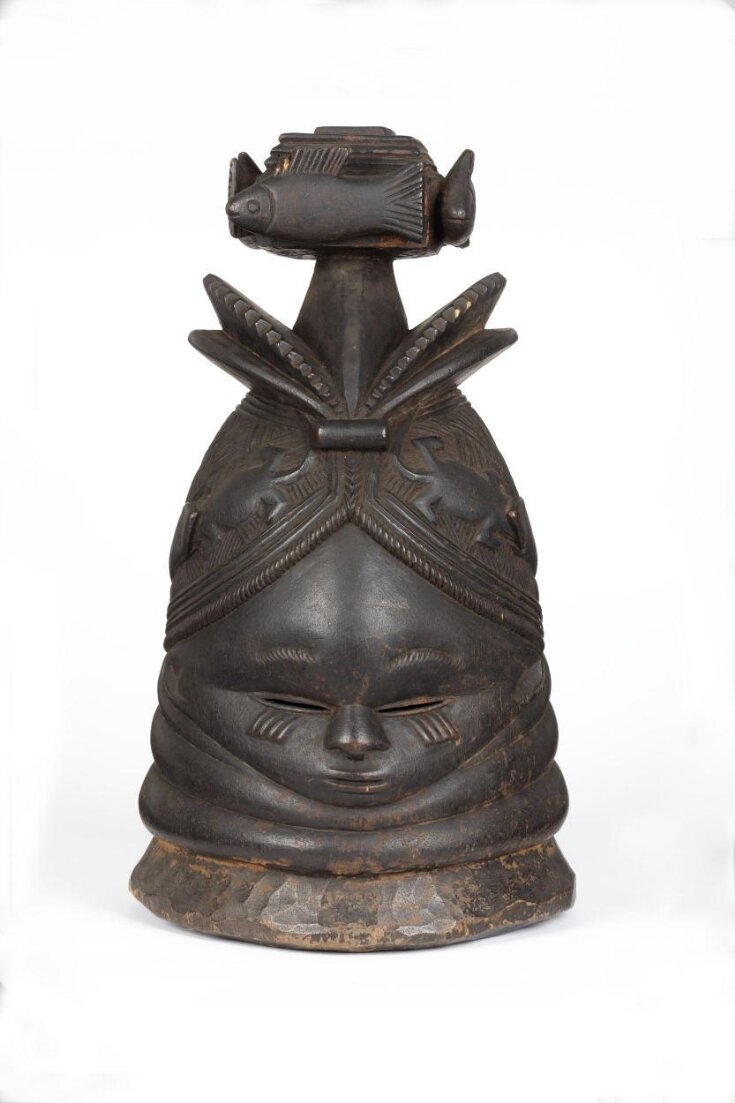
This wooden mask is associated with the Sande, a secret women's society found in Liberia, Sierra Leone and Guinea. It would have been worn, with a black raffia costume, at important civic events such as the visit of an important dignitary or the coronation or funeral of an important chief. It is particularly associated with girls' initiation ceremonies and is unique in Africa in being owned and worn, if not made, by women.
Sande masks are usually made of lightweight bombax wood, smoothed down with the rough leaves of the ficus tree before being dyed black. A rich glossy surface is achieved by rubbing the mask with palm oil or shoe polish. Although masks such as this are not often used today, the Sande society continues to play an important role in championing women's social and political interests.
Sande masks are usually made of lightweight bombax wood, smoothed down with the rough leaves of the ficus tree before being dyed black. A rich glossy surface is achieved by rubbing the mask with palm oil or shoe polish. Although masks such as this are not often used today, the Sande society continues to play an important role in championing women's social and political interests.
Object details
| Categories | |
| Object type | |
| Materials and techniques | Carved, dyed and polished (bombax?-)wood |
| Brief description | Mask, of bombax wood, Sande society, of the Mende people, Sierra Leone (probably), early 20th century |
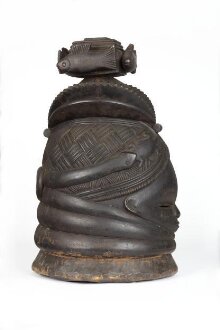
| Physical description | Carved wooden helmet mask in form of woman's head. Elaborate coiffure split into five crests on top of head. These surmounted by square shape with carved fish on each outer face, pointing in same direction. Neck rolls become the bodies of two snakes which each, on either side of the mask's 'forehead', grasps a lizard in its jaw. Eyes are slits for the masker to see through, with scarification marks below. |
| Dimensions |
|
| Object history | Accessions register entry: 'MASK:- Black painted wood in the form of a head and headdress. / AFRICAN (Mende tribe): 19th or 20th century. / Dimensions:- H.14 ¼" W. 9 1/8" (at base) / Gift / Good, the top of the headdress slightly chipped. / Mrs Leonard, 15 Oakwood Court, Off Melbury Road, W. 14 / 28th October 1953 / [Authority] 53/3086A' Given by Mrs Leonard. |
| Production | Sande masks were also made and used in Liberia and Gambia. |
| Subjects depicted | |
| Summary | This wooden mask is associated with the Sande, a secret women's society found in Liberia, Sierra Leone and Guinea. It would have been worn, with a black raffia costume, at important civic events such as the visit of an important dignitary or the coronation or funeral of an important chief. It is particularly associated with girls' initiation ceremonies and is unique in Africa in being owned and worn, if not made, by women. Sande masks are usually made of lightweight bombax wood, smoothed down with the rough leaves of the ficus tree before being dyed black. A rich glossy surface is achieved by rubbing the mask with palm oil or shoe polish. Although masks such as this are not often used today, the Sande society continues to play an important role in championing women's social and political interests. |
| Bibliographic reference | Mask subject of a V&A web object story, 'Beauty Secrets - A sowo mask',
http://web.archive.org/web/20221215152409/https://collections.vam.ac.uk/item/O152708 |
| Collection | |
| Accession number | CIRC.508-1953 |
About this object record
Explore the Collections contains over a million catalogue records, and over half a million images. It is a working database that includes information compiled over the life of the museum. Some of our records may contain offensive and discriminatory language, or reflect outdated ideas, practice and analysis. We are committed to addressing these issues, and to review and update our records accordingly.
You can write to us to suggest improvements to the record.
Suggest feedback
You can write to us to suggest improvements to the record.
Suggest feedback
| Record created | April 15, 2008 |
| Record URL |
Download as: JSONIIIF Manifest
