Glass Goblet by Franz Paul Zach
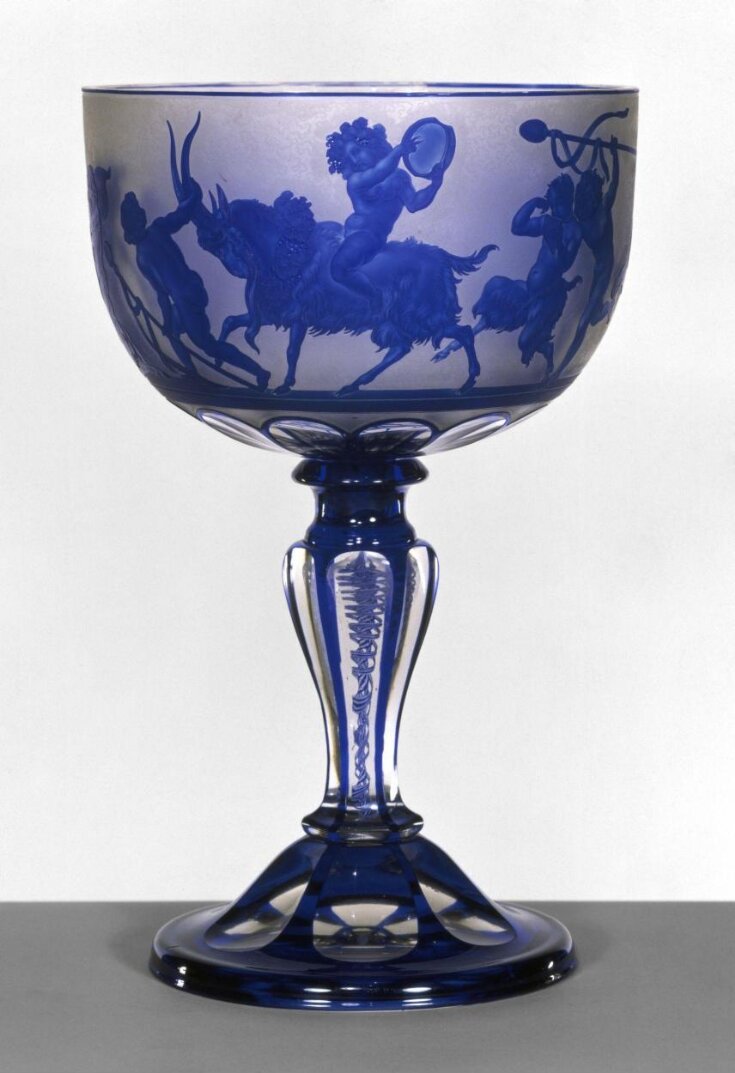
Glass goblet by Franz Paul Zach, Germany, 1855, Museum no. 2672-1856
Christopher Cook and Reino Liefkes talk about a blue glass goblet, originally from the Paris International Exhibition of 1855.
Part of the 2004 Proms Performing Art season of talks.
CHRISTOPHER COOK: Welcome to the first of this year's Performing Art talks at the Victoria and Albert Museum.
Each week through out the Proms we'll be discussing one of the treasures from the collections here in South Kensington, and matching our art to the principal themes of eight weeks of concerts down the road at the Royal Albert Hall.
Bohemia is one thread that runs through this year's programme. The Bohemia of Janá cek and Dvorá k, who died exactly 100 years ago this year, so, here's a magnificent example of the art of Bohemian glass.
A ceremonial goblet engraved in the middle of the 19th century by Franz Paul Zach, continuing a tradition of glassmaking in what is now the Czech Republic that stretches back to the Renaissance and on into the Baroque period and then into the 19th century.
Indeed, in 1853, 120,000 people were employed in Bohemia in the manufacture and the decoration of glass and three-fifths of the entire glass production of the Austrian Empire was produced in Bohemia.
Well, I'm joined by the senior curator from the ceramics and glass collection here at the Victoria and Albert Museum, Reino Leifkes.
CHRISTOPHER COOK: Reino, the size of this goblet, first of all, is something of a surprise - it's no modest table goblet, is it?
REINO LIEFKES: No, absolutely, it's about 40 cm high and 20 in diameter and really it's a monumental exhibition piece as it were. It's not a simple object you nip wine off.
There is actually a central European tradition of making these wonderfully decorated large standing goblets and I think, in the 17th and 18th century, these were still used for ceremonial drinking - to pass around along the table and drink certain healths and this is very much inspired by that but it's an exhibition piece that people would have put in a wonderful cupboard after they had purchased it.
CHRISTOPHER COOK: And it's made in two quite separate pieces, isn't it?
REINO LIEFKES: Yes, it is, and later on we'll discuss more about the technique of how it's made but I think partly because of that and its size, the glassmakers have decided to make it in a bowl that simply lifts off with little protrusion and fits into a hollow in the foot.
CHRISTOPHER COOK: The most striking thing when you first see this here now, luckily so close to us, is the colour - that extraordinary kind of cobalt blue that almost is luminous, isn't it? Now, of course, this is not called a colour, I believe in glassmaking, but a stain.
REINO LIEFKES: Well, now, actually, the glass is made out of two colours of glass. It's first blown… When you gather glass, you take your blowpipe and dip it into colourless glass and for this particular type of glass, they then dip the blowpipe immediately into a pot of molten blue glass, so it is actually glass, but if you then blow in the pipe, it expands and the layers become thinner and thinner and then of course it lays on top like a one or two millimetre thick layer of blue glass.
CHRISTOPHER COOK: That sounds an extraordinarily complicated technique. I presume it requires immense skill just to get the thickness of that blue layer which you're going to lay round the clear layer of glass?
REINO LIEFKES: Absolutely. There was only one or two factories in the early days in the 1840s that specialised in these techniques and this is probably made in one of them in Bohemia in Nový Bor or Nový Svet, which was called Neuwelt in those days.
Indeed, to control, to get the blue layer so even all the way around is extremely difficult and requires a lot of skill and that's why also I think it's been made in two parts because it would have been too complicated to make the whole thing in one, using this difficult technique.
CHRISTOPHER COOK: Engraved around the bowl in a kind of continuing procession, there appears to be some kind of celebrating party going on. Are these Bacchae, are these devotees of the god, Bacchus? Is this about wine and drinking? What's actually going on in the decoration?
REINO LIEFKES: It's a continuing frieze, as it were, of a bacchanalian procession - one could call it 'The Triumph of Bacchus', because on one side one sees the young Bacchus sitting on his chariot, very much a Roman chariot. This is a kind of depiction that goes back to the Greek 5th century BC - you see it on drinking bowls.
Bacchus, of course, popularly known as the god of wine, but originally in ancient times, also was the god of fertility and it also had to do with goat worship and one sees a wonderfully-attired goat with a wreath round its neck at this side and actually, the bacchanalian rite was a frenzied orgy really, in which huge quantities of drink were consumed but it also culminated with this poor goat being torn apart and its flesh was consumed raw. It was almost a symbolic eating of the god as it were, so it was a huge… Hence all the movement and the force and very appropriate in the composition.
CHRISTOPHER COOK: It looks indeed a very giddy goat - blissfully unaware of the awful fate that awaits it but the figure that really catches my eye is this man, sitting on the back of what I assume is the goat itself, with his tambourine held out, beating it. Already his body twisted away from his own shoulders in that kind of almost frenzy. The party's begun, hasn't it?
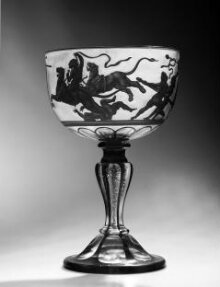
REINO LIEFKES: Oh, absolutely, yes. The person there, it could be Bacchus actually. There are two people in the composition that could classify as Bacchus because of the wreath of wine and grapes they have on their hats. It's the one on the goat and the one on the chariot. But what happens very much in this running frieze, is there's an enormous feel of moving forwards but also of pulling behind and the goat is pulled along quite reluctantly here - maybe it did know its destination. But also we see the chariot on which Bacchus sits is sort of just stopped and the two panthers pulling that carriage have just spun off and run off in the wild - one mounted with another bacchanalian figure.
CHRISTOPHER COOK: And the panthers are of course, again associated with the god, Bacchus.
REINO LIEFKES: Absolutely, I think it's got to do with the spread of this whole cult into the East, into Asia, where panthers or sometimes lions are used as well.
CHRISTOPHER COOK: I have to say that Bacchus seems to be already anticipating the party as he sits in his chariot because there he is tugging at the hair of one of the assistants. Luckily we can't tell what gender the assistant is, tugging at the hair in a very determined way as he sits in his chariot, obviously hoping for something more that a little goat meat at the end of this festival.
REINO LIEFKES: Oh, absolutely. It's an orgy not only involving lots of drink but also other things. One sees here the goat's also a satyr here with a shallow drinking bowl which is filled from a goatskin container, doubtless with wine again. And then back to the fertility aspect of it, these special wands they're carrying they were called thyrsus. They were wands topped with a pine cone which was an ancient fertility symbol.
CHRISTOPHER COOK: All of these things puzzle me. This was made in the 1850s, long after the great European love affair with the classical world had resurfaced - neoclassicism at the end of the 18th century into the early 19th century, yet here is a wonderful example of a classical subject - what's going on? Is it simply an old-fashioned piece of work?
REINO LIEFKES: I don't really think so. This is a wonderful thing. It lays in between the earlier neoclassicism and the early decade of historicism when people went back to all sorts of styles be it classic or gothic or rococo, so this is a sort of in-between thing and it has quite a severe classicism in it but I think what's special about this one is that pure classicism can often be quite static and heavy but here because of the genius of the composition and how that fits around the goblet, it has a fantastic movement, so it's not just neoclassic, it has something special.
CHRISTOPHER COOK: Is it an original composition or has the maker adapted an existing canvas, an existing frieze, an existing vase of some kind?
REINO LIEFKES: We don't know. I've looked around a bit in the environment of the academy in Munich, where this piece was actually purchased, the manufacturer had a big outlet there. There you see the kind of decoration we see on this goblet, but I haven't found the exact match and it fits so well around the goblet that I well imagine that maybe some parts have been taken off engravings or drawings of that time, but I think the whole composition was specially designed for this goblet but we don't know exactly.
CHRISTOPHER COOK: As we've talked about the decoration, we've rather taken for granted the astonishing skill of the maker of this. Can you explain to me two things - how do you create these blue figures who are almost in relief on the clear glass, but how also do you create the astonishing sense of perspective because as the procession goes round the goblet, you get a sense of depth of the people - Bacchus on his chariot, the attendants, the men carrying the wands - a sense of depth - how is it done, what's the technique?
REINO LIEFKES: I should quickly say that classicism also goes back in that kind of working because it very much is inspired by cameo glass from the Roman period but this does actually more, because normally the figures on those kinds of engravings stand out in white but here., the whole glass was actually covered with this blue overlay, then the engraver first mapped out all the figures and he cut away all the background.
CHRISTOPHER COOK: How does he cut it away? What is he using?
REINO LIEFKES: That is just done with little copper wheels with a sort of abrasive paste and water. Later on it could be done by etching but this was just before the time they could do that. So, he's engraved it all away and he's actually put little squiggles in the background which you could see if you come to the fore. But what is really special about this kind of technique, is that then he continued to engrave into the blue layer, and actually by taking a tiny little bit away, you make it more transparent and because of the shape of the goblet, the light falls in very beautifully and these become the highlights - the deepest engraved parts become the highlights of the composition. So, within a very shallow relief he has a wonderfully illusory effect of light and shade.
CHRISTOPHER COOK: What do we know about the maker of this? His name was Franz Paul Zach, what do we know about him?
REINO LIEFKES: We don't, we know relatively little. Indeed, until the '60s, we only knew one piece by him - this was forgotten at that time and we thought it was a 17th century engraver but he was actually born in 1820 in Prague. He trained there, as people did, from 14 to 17 onwards at a local glass and chandelier manufacturer and trader and he trained to be a glass cutter and engraver and then he moved onto a specialist area in Bohemia called Nový Svet or Neuwelt, where he trained with a very famous engraver but he was then snatched away by a man called Franz Steigerwald and he was really the greatest glass trader in the whole area and he had outlets in many, many places - mostly in Germany, in Wü rzburg, Frankfurt and later also in Munich. So, he snatched him away and Zach came to work in Munich with Steigerwald and he worked there on and off for 40 years as a sort of house engraver.
CHRISTOPHER COOK: So, first of all there is a kind of tradition of master and apprentice. Zach will have learned his craft from those who had learned it from someone else. We're looking at that wonderful European tradition of one man teaching others. At that moment when, for example, art students when they're graduating, put their hands on each others shoulders to signify moving forward.
REINO LIEFKES: Absolutely, yes.
CHRISTOPHER COOK: And then, would he have been amongst the aristocrats of the glass producers as an engraver in Bohemia?
REINO LIEFKES: I'm not quite sure. I think they had a very special… they had high standing, of course. I don't think they got very rich by doing their craft but they were very much the prima donnas of the glassmaker's world. The fact that he was poached away or headhunted by Steigerwald proves that. Also, I think Steigerwald had one or two very good and famous engravers and those were the only ones who were occasionally allowed to sign and this piece is actually signed F. P. Zach very discreetly because he also worked with engravers that he just did a little commission with and he didn't want to know who these engravers were because you could go directly to them and probably get it much cheaper, so, it was very clever, big commercial enterprise.
CHRISTOPHER COOK: Who was Steigerwald commissioning work for and who was he selling to? He sounds as if he was a very big operator.
REINO LIEFKES: He was very big and a lot of the material went abroad. As I say, he had various German outlets and the German people bought there but it was very much the time that people went for health spas and there were lots of tourists who actually wanted to take away a piece. Some of them quite simple little beakers with local scenes on it and the names of the town but it went up to the best kind of material and this of course being an exhibition piece, it's really a piece for the whole world to see what they could do. Zach, quite a few of his surviving signed pieces have come up in Britain through British collections, so we think there was a particular taste for his work here and there was I think, also a London outlet where these kind of pieces could be acquired.
CHRISTOPHER COOK: How did Zach's goblet here arrive at the Victoria and Albert Museum?
REINO LIEFKES: That's a special story. It was bought by us at the International Exhibition of 1855, which was the second international exhibition after London '51, in Paris, where it was displayed and almost five million people came to see it and the V& A of the South Kensington Museum as it was called then came and purchased this piece for about £ 12, which was quite an amount in those days, for the museum and it then of course had a place of pride here,
But in the early 20th century it was quite forgotten actually and it was sent off to one of our outstations, the Bethnal Green museum which is now the Museum of Childhood of course, but it was really forgotten there completely until about 1970 when it was rediscovered and now it's one of our great treasures again.
CHRISTOPHER COOK: Reino Leifkes, thank you very much indeed.
REINO LIEFKES: Thank You.
[Applause]
Related content
- Christ between St Peter & St Paul
- Dr Franz Johann Joseph Bock
- Stained glass from Mariawald Abbey: design & symbolism
- Stained glass from Mariawald Abbey
- The Adoration of the Magi
- From Cloister to Museum
- The art of drinking
- Gothic architecture
- Video: Art Nouveau Glass
- Treasures of Fairford
- Installing the Leistler bookcase
- German and Swiss stained glass 1470–1510
- Stained glass reading list
- Close Encounters of the Art Kind: GMS Frieden, by Richard Wilson
- More
Become a V&A Member
V&A Members enjoy a wealth of benefits, including free entry to exhibitions, previews, exciting events and the V&A Members’ Room. In addition, you will be supporting the vital work of the V&A.
Buy or Renew Membership OnlineShop online
Looking at Glass: A Guide to Terms

An essential guide to glass and its production. This compact handbook offers definitions and descriptions of a wide range of glass terminology such as…
Buy nowEvent - Glass Galleries Tour
Tue 21 May 2013 11:00

Reino Liefkes, Senior Curator of the Ceramics & Glass Collection, will lead a tour of the Glass Gallery, illustrating the development of glass from a rare and precious material to a commodity available to all, and from an ideal material for utilitarian objects to an exciting medium for contemporary artists.
Book online


