The Ardabil Carpet is the world's oldest dated carpet and one of the largest, most beautiful and historically important.
It was made in the town of Ardabil in north-west Iran, the burial place of Shaykh Safi al-Din Ardabili, who died in 1334. The Shaykh was a Sufi leader, ancestor of Shah Ismail, founder of the Safavid dynasty (1501-1722). While the exact origins of the carpet are unclear, it's believed to have been commissioned by the court for the shrine of the Shaykh, which, by the 16th century, had became a place of pilgrimage.
.jpg)
We can date the carpet exactly thanks to an inscription on one edge, which contains a poetic inscription, a signature - 'The work of the slave of the portal, Maqsud Kashani’, and the date, 946 in the Muslim calendar, equivalent to AD 1539 - 1540. Maqsud was probably the court official charged with producing the carpet and not a slave in the literal sense.
.jpg)
.jpg)
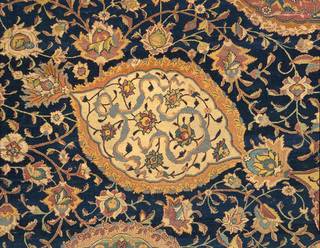
The entire surface of the Ardabil carpet is covered by a single integrated design - an impressive feat considering the carpet's great size. The border is composed of four parallel bands. It surrounds a huge rectangular field, which has a large yellow medallion in its centre. The medallion is surrounded by a ring of pointed oval shapes, and a lamp is shown hanging from either end. This centrepiece is matched by four corner-pieces, which are quarters of a similar but simpler composition, without the lamps.
The lamps shown hanging from the centrepiece are of different sizes. Some people think this was done to create a perspective effect - if you sat near the small lamp, both would appear to be the same size. Yet there is no other evidence that this type of perspective was used in Iran in the 1530s, and the lamps themselves are shown as flat shapes rather than as three-dimensional objects. Another view is that the difference is a deliberate flaw in the design, reflecting the belief that perfection belongs to God alone.
The stunning filler pattern incorporates ten colours. The dyes were made from natural materials like pomegranate rind and indigo, so the shades vary slightly, producing a ‘ripple’ effect where darker and lighter batches of wool were used.
Each part of the design is filled with one or more types of scrollwork set with fantastic swirling flowers or leaves, characteristic of early Safavid dynasty design. In some there are also symmetrical snaking forms that represent clouds. The weavers would have worked from drawings provided by a specialist designer.
The wool pile, which holds dye much better than silk, is very dense - there are about 5,300 knots per ten centimetres square. This density allowed the designer to incorporate a great deal of detail. Making such a large carpet with so many knots would have taken a team of skilled weavers several years - up to 10 weavers may have worked on the carpet at any one time. Carpet weaving was usually performed by women at home, but a court commission like this one may have been woven by men.
The carpet was still in the shrine of Shaykh Safi al-Din in 1843, where it was seen by British visitors. Around 30 years later, the shrine suffered an earthquake, and the carpet was sold to a Manchester carpet firm, who in turn put it up for sale in 1892. On inspecting the carpet on behalf of the V&A, designer William Morris reported it of “singular perfection … logically and consistently beautiful”. The Museum acquired the carpet for £2,000 in March 1893.

In 2006, the Museum created the vast display case in the centre of the Jameel Gallery, so that the carpet can be seen as intended, on the floor. It is lit for ten minutes on the hour and half hour, in order to preserve its rich colours.


