Teachers' resource: Exploring Image & Identity in the galleries

The V&A objects featured in this resource support learning about concepts of identity and status and demonstrate how image can be created through scale, style and symbolism. The objects chosen are on long-term display within the main galleries and span a diverse range of cultures from 18th- century Japan to contemporary Britain.

This resource includes teachers' notes and five museum activity sheets for students. The teachers' notes are designed as background information on all the objects that are included in five museum trails for students. The objects have been chosen for their links with image, identity, style and symbolism.

The museum activity sheets for students provide opportunities for discussion, drawings and writing during your museum visit.

You can see images of some of the objects explored in this resource and find out more about them in Search the Collections.

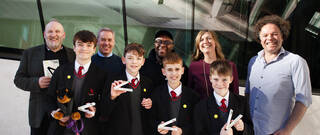
Students in the V&A's Sackler Centre for arts education

Students in the V&A's Sackler Centre for arts education. © Victoria and Albert Museum, London

Museum activities for students

The museum activity sheets for students include opportunities for discussion, drawings and writing. You may want to provide your group with extra paper for writing and drawing. You will need to bring your own pencils and something to lean on such as clipboards or sketchbooks. The museum activities could be combined with a visit to the Prints and Drawing Study Room where you can explore the Cultural Identity photographic resource box.

As group numbers in the Prints and Drawing Study Room are limited to 15 people, we suggest that you split your class into two groups. One group can do the museum activities whilst the other group look at the resource box. Both groups will need to be accompanied by teaching staff.

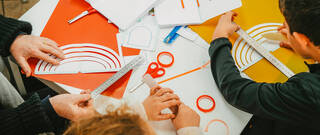
Students in the Dorothy and Michael Hintze Sculpture Galleries

Students in the Dorothy and Michael Hintze Sculpture Galleries. © Victoria and Albert Museum, London

Curriculum Links

Art & Design Key Stage 3
Unit 7A: Self-image

In this unit students learn about the ideas, methods and approaches used by artists who have made images of themselves and/or portrayed others.
Exploring and developing ideas:

  • How would they like to be seen by others?
  • What powerful messages would they wish to communicate?
  • How they might represent themselves, e.g. in words, in images, a combination of both? Other ways?

Unit 9A: Change your style
Within this unit students investigate the influence of art from different cultures and traditions on fashion and design.

Students look at work in different styles, including textile artifacts from different times and cultures, e.g. printed, woven, embroidered. Ask them to discuss work in a particular style, and to identify and record:

  • shapes, colours and patterns that are used
  • motifs, emphasis of particular shapes, colours, etc
  • the style of the piece of work

Unit 10: Visiting a museum, gallery or site
This unit supports visits to museums and galleries, the importance of seeing the real thing and what that might mean.

Citizenship Key Stage 3
Unit 04: Britain - a diverse society?

Within this unit students:

  • explore and celebrate diversity
  • recognise the importance of images and how these can be seen differently.
 
'Tippoo's Tiger', emblematic organ, 1790. Museum no. 2545 (IS). © Victoria and Albert Museum, London

'Tippoo's Tiger', emblematic organ, 1790. Museum no. 2545 (IS). © Victoria and Albert Museum, London

Background information on objects for teachers

South Asia: Tippoo's Tiger

South Asia, Room 41

Tippoo's Tiger
Mysore, India
About.1790
painted wood
177.8 cm long
Museum no. 2545 (IS).

Tippoo's Tiger is a unique mechanical toy, a model of a life-size Indian tiger devouring a European soldier. It
belonged to Tipu (Tippoo Sahib to his European contemporaries) who was the courageous Muslim Sultan of Mysore in Southern India from 1782-99. Tipu governed Mysore as a prosperous state, but it was under regular attack from the British East India Company who wanted to take control of Southern India.  Tipu hated British control of India and fought the British army for 20 years. In 1799 he died fighting in the struggle with the British for the city of Seringapatam.

Tipu understood the power of propaganda:  the tiger was his emblem and he stamped it like a logo onto his possessions. He also kept live tigers in his palace courtyard in Seringapatam. A tiger's head supported his magnificent throne and tiger stripes covered the walls of his palace and decorated his soldiers' uniforms and weapons.

Built by craftsmen from wood Tippoo's Tiger was kept in the music room in his palace because it was a musical toy. When the handle is turned the European's arm moves up and down as a wailing sound is produced from his mouth. Growls are produced by a mechanism inside the tiger's head and hidden inside the tiger's flank is a keyboard. 

The flowers decorating the soldier's red jacket were a feature of Indian court dress and here they are transferred to the European soldier's uniform. Tipu encouraged the textile industries. Flowering plant designs had been a dominant theme in Indian art since the reign of the 17th-century Mughal emperor, Shah Jahan. These motifs were a popular source of inspiration for British textile designers and wallpaper manufacturers in the 19th century. The Indian display at the Great Exhibition of 1851 greatly increased the public's understanding of India's rich culture.

Back at school
You can watch a video about Tippoo's Tiger on the V&A's website: www.vam.ac.uk/collections/asia/object_stories/Tippoo's_tiger/index.html
Or watch an animation of Tippoo's Tiger and listen to the sounds it makes at: www.vam.ac.uk/vastatic/microsites/1196_encounters/exhibition/tippoo/tippoo.html

Islamic Middle East: Ardabil Carpet

Islamic Middle East, Room 42

The Ardabil Carpet (detail), Iran, 1539-40. Museum no. 272-1893. © Victoria and Albert Museum, London

The Ardabil Carpet (detail), Iran, 1539-40. Museum no. 272-1893. © Victoria and Albert Museum, London

The Ardabil Carpet
Ardabil, North-west Iran
1539-1540
Hand-knotted carpet in wool and silk
width approx. 535.5cm x length approx.1044cm
Museum no. IS.266-1800. © Victoria and Albert Museum, London

The Ardabil carpet was made in 1539 and was most likely commissioned as one of a pair by the ruler of Iran, Shah Tahmasp, for the shrine of his ancestor, Shaykh Safi al-Din, in the town of Ardabil in north-west Iran. Shah Tahmasp became ruler when he was 10 years old and it was another 10 years before he could assert his authority at court. He became a great patron of the arts and it was during his reign that carpet weaving became a national industry as well a highly-prized art form.  Shah Tamasp was a skilled painter and kept an entourage of painters at his court. His love of painting and books is visible in the overall composition of the carpet. The composition is derived from contemporary and earlier bookbinding and manuscript illumination.

The Ardabil carpet is the world's earliest dated carpet. Here's a translation of the inscription that can be found at one end of it:

'Other than thy threshold I have not refuge in this world
My head has no resting place other than this doorway
Work of a servant of the court, Maqsud of Kashan, [in] the year 946'
[1539-40]

The carpet is woven in wool on silk warp threads.   It is hand-knotted - there are 4,914 knots in every 10cm square (304 to every square inch) and it would have taken about four years to make. Its whole surface is covered by a single unified design, of a central medallion surrounded by 16 almond-shaped pendants with two lamps projecting from it. Quarter medallions are repeated in the corners and the background is a dense field of flowers that grow from scrolling leafy vines.

It has been copied many times and the copies range in size from small rugs to full scale carpets. There are hand-knotted Ardabils from Iran, England and also from Indian prisons. There are machine woven Ardabils too. There is an Ardabil at 10 Downing Street and even Hitler had an Ardabil in his office in Berlin. In 1893 the British designer William Morris persuaded the V&A to raise funds to buy the carpet. It cost £2,000, a vast sum of money at the time (about £200,000 in today's money). Morris described the carpet as 'a remarkable work of art' .

You'll see when you look at the carpet that the two lamps in the design are different sizes. The smaller lamp is in the lower half of the carpet, this is the end where weaving began. The larger lamp is 20 cm longer and 10 cm wider and the oval pendants by it are also larger. The difference in size between the two lamp motifs is a deliberate visual trick because the designer of the Ardabil Carpet knew exactly how it would be used.  The dignitaries would be seated on low cushions at the end where the weaving had begun, the end with the small lamp. From there they would be looking against the pile and so would more easily appreciate its colours. To them the larger lamps and oval pendants would appear to become shorter and narrower as they receded into the distance. In other words both lamps and pendants would seem to be the same size.

British Galleries: The Garricks

British Galleries, Room 118a

The Garricks

The Garricks were a fashionable and wealthy couple, considered 'leaders of taste' in 18th century London. David Garrick was a famous actor and playwright and his wife Eva Maria Veigel, a dancer. The Garricks had a country villa as well as a London home. They employed top designers, like Thomas Chippendale to work on their properties.

Thomas Chippendale made his name as a cabinet-maker and furniture designer but he also advised on interior design and furnishings.Chippendale hung several rooms in the Garrick house with Chinese wallpaper and supplied japanned (painted) furniture to match.

Portrait of David and Eva Garrick playing Piquet
Unknown artist
London
1755-1760
Oil on canvas
Painting on loan from the Royal Shakespeare Company (RSC.6-2001)

The Garricks show themselves as a fashionable, wealthy couple. They sit opposite each other at a small table but both faces are turned towards us. They appear deliberately relaxed, confident and pleased with themselves. Mrs Garrick wears a fashionable silk dress patterned with leaves and flowers. Her triple-ruffle sleeves are the height of fashion. The fullness of the dress can be seen behind her as she leans forward in the chair. She holds a run of cards and she shows us her hand as she selects the Queen of Hearts. David Garrick's jacket is open allowing us to see his silk waistcoat.

The Garrick bed, Thomas Chippendale Snr, around 1775. Museum no. W.70-1916. © Victoria and Albert Museum, London

The Garrick bed, Thomas Chippendale Snr, around 1775. Museum no. W.70-1916. © Victoria and Albert Museum, London

The Garricks' Bed and Valance
Thomas Chippendale Senior
London
About 1775
Jappaned (painted), beech and pine
Chintz hangings, dyed and painted cotton

The luxurious four-poster bed was made in Chippendale's workshop. David Garrick had to plead with customs to let the material, Indian chintz, through because there was a restriction on importing Indian textiles. Chintz is cotton that has been dyed and painted. The hangings are modern copies but the valance from the original hangings is displayed beside the bed. It was sent to the Garricks by friends in Calcutta, India. They were made in Masulipatam, Madras in an East India Company factory. The influence of Chinese wallpaper designs can be seen in the foliage.

Clothes Press, 1775-78, Museum no. W.22-1917. © Victoria and Albert Museum, London

Clothes Press, 1775-78, Museum no. W.22-1917. © Victoria and Albert Museum, London

Gown, 1760-65. Museum no. T.593-1999. © Victoria and Albert Museum, London

Gown, 1760-65. Museum no. T.593-1999. © Victoria and Albert Museum, London


Clothes press
Thomas Chippendale Senior
London
1777-78
Jappaned (painted) pine
Museum no. W.22-1917

This is from the Garricks' dressing room, inside it is fitted with shelves and pegs to hang clothes from. It is decorated with a design similar to that in the Chinese wallpaper. This style, known as Chinoiserie, was extremely fashionable in the mid18th century. It was inspired by art and design from China, Japan and other Asian countries. Many British designers and craftsmen imitated Asian designs to create their own fanciful versions of the East. Mrs Garrick complained that the decoration cost twice as much as the furniture itself.

Robe and petticoat made for Mrs Garrick
Mrs Garrick's dress was the height of fashion, made in hand-painted silk. The robe was made in England but the silk was woven and painted in China. Between 1700 and 1800 Britain was importing silk from China and dyes from the West Indies.

 
Potrait of Lu Ming, China, 18th century. Museum no. E.360-1956. © Victoria and Albert Museum, London

Potrait of Lu Ming, China, 18th century. Museum no. E.360-1956. © Victoria and Albert Museum, London

China: Ancestor portraits

China, Room 44

Pair of Ancestor Portraits
China
1700-1800
Watercolour on silk
Width 112cm x height 183.5cm
Museum No. E.360-1956, E.361-1956

These ancestor portraits show a high ranking civil official and his wife from between 1740-80, they are painted in watercolour on silk. The layers of colour are usually thick in the costume area and thin in the face and hands. The details of the embroidered costumes and jewellery are meticulously depicted. A great deal of care was taken with the costume because it revealed the rank of the deceased. The silk borders are in the tradition of Chinese hanging scrolls.

The ancestors in the portraits are almost life-size, their pose is frontal and they are seated on elaborately carved chairs. The woman's feet, considered the most erotic part of her body, are hidden. Her hands are hidden too. Both are wearing long jade bead necklaces and elaborate headdresses with gold and pearl ornaments.  The only background detail is a richly patterned carpet behind each throne.

The symbols on the costumes indicate the wearer's court status and social position. Status or rank determined all aspects of life and it was denoted in the colours and symbols that people were allowed to wear, for example bright yellow was reserved for the emperor.  However, the most important part of the portrait is the face.  Although ancestors were painted with the same sombre and detached expression, great care was taken to capture a true likeness of the deceased's face. It was said that if even one hair in the depiction was wrong, all future prayers would go to someone else's ancestor, resulting in family tragedy. Today photographs are used instead of expensive scroll paintings.

A Captive Audience? Cast glass, wood and metal, David Reekie, (b.1947), made Norwich, UK, 2001 Gift of Paul Bedford (Museum no.C.112–2000)

A Captive Audience? Cast glass, wood and metal, David Reekie, (b.1947), made Norwich, UK, 2001 Gift of Paul Bedford (Museum no.C.112–2000). © Victoria and Albert Museum, London

Contemporary glass: A Captive Audience?

Contemporary Glass, room 129

A Captive Audience?
David Reekie, (b.1947)
Norwich, UK
2001
Lost-wax cast glass with wood, metal and cotton
Museum no. C.112.1-2000

This group of eight naked figures stands rooted to the spot on a small platform hemmed in by a barrier. They are identical apart from one figure at the back. Unseen by his companions, he has turned his head, perhaps hoping to escape. The work refers to cloning and is both tragic and comic. The artist, David Reekie, is interested in the way that individuals express their frustrations with tiny but heroic actions. Seven men have been made from the same model; the eighth is the unique one.

David Reekie was born in 1947.  He is a figurative artist and his work is inspired by the way people react and adapt to society. He is interested in politics and was an opponent of Margaret Thatcher's form of Conservatism during which he witnessed what he saw as the disintegration of the individual.  Both this sculpture and the following one make you look at glass in a different way.

View of the Glass Gallery showing Eisch's 'Helmut Kohl' in the foreground. © Victoria and Albert Museum, London

View of the Glass Gallery showing Eisch's 'Helmut Kohl' in the foreground. © Victoria and Albert Museum, London

Helmut Kohl: Break Through the Wall
Erwin Eisch, (b.1927)
Model 1997, blown 2002, painted 2003-04
Mould-blown, painted, gilded and sand-blasted
Museum no. C.5-2004

Eisch was born in 1927 and is both a painter and a sculptor. His interest in glass comes from the local glass works that his family owns in Frauenau, Germany. He is interested in politics as well as relationships and identity.

Erwin Eisch started making glass heads in the 1970s. He believes they show both individuality and fantasy because the head is the most important part of the body. The head is where ideas come from and in this work Eisch paints the ideas as images that have broken through to the outside. The head of Helmut Kohl was started just before Kohl stepped down from office as Chancellor of Germany in 1998 but it wasn't painted until 2004. Kohl oversaw the unification of Germany in 1989 after the Berlin Wall came down. The eagle (Germany's national symbol and usually black) is painted on the top of Kohl's head in white.  The head is painted red, black and gold, the colours of the German flag. It communicates Kohl's passion for German unification.

A gift in your will

You may not have thought of including a gift to a museum in your will, but the V&A is a charity and legacies form an important source of funding for our work. It is not just the great collectors and the wealthy who leave legacies to the V&A. Legacies of all sizes, large and small, make a real difference to what we can do and your support can help ensure that future generations enjoy the V&A as much as you have.

More

Shop online

Medieval and Renaissance Galleries Postcard Book

Medieval and Renaissance Galleries Postcard Book

This book of 16 postcards features highlights from The Medieval and Renaissance Galleries at the V&A.The galleries are home to one of the world's …

Buy now

Event - V&A Sanctuary

Fri 19 October 2012–Fri 19 July 2013

TEACHERS' EVENT: Recharge your creative batteries and work with artists, designers and makers. Enjoy meeting other creative teachers, try out new techniques, develop your own creative talents and get inspiration to take back to the classroom.

Book online