The Tenterden Aesop
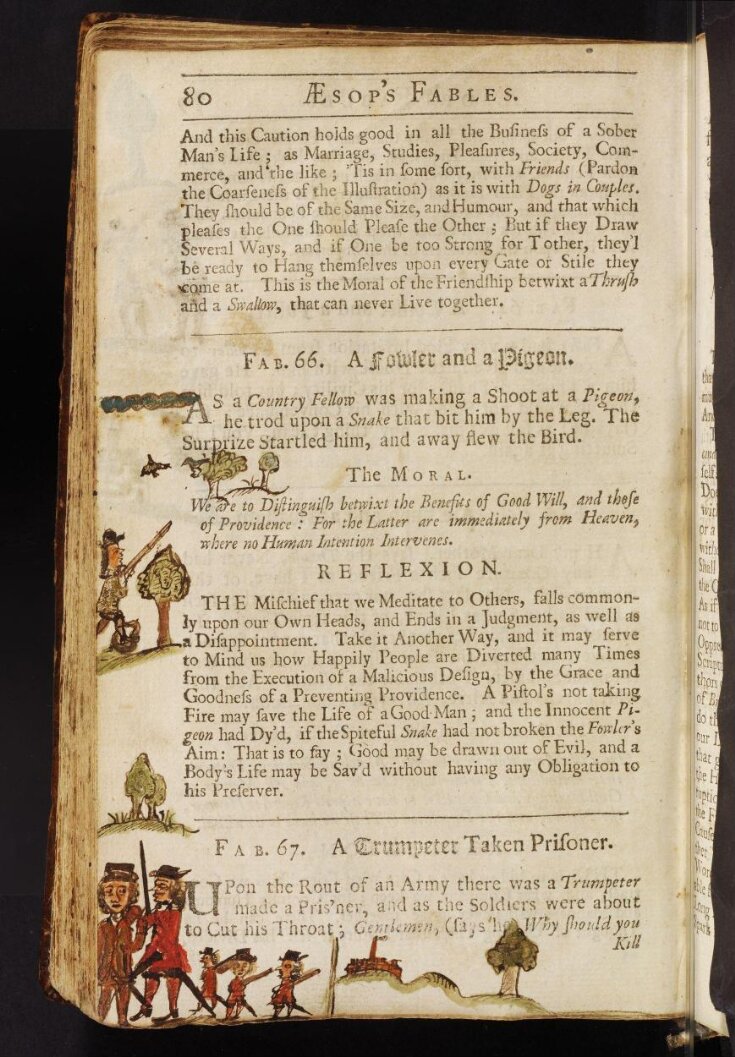
‘The Frogs Chuse a King’ (The Frogs Desiring a King), hand-drawn illustrations by Jeremiah Cliff, in 'Fables of Aesop and other eminent mythologists' by Roger L’Estrange, 1708. Printed for R. Sare, London. Pressmark NAL Safe 6.A.10
This is an early 18th-century English edition of Aesop's Fables, a collection of stories that has been a 'best-seller', among both adults and children, for more than two thousand years. What makes this particular copy special is the complete series of illustrations painted on the margins throughout by its first owner, Jeremiah Cliff, within a few years of the publication date.
Jeremiah Cliff's drawings
Jeremiah Cliff has been identified as an apothecary living in the town of Tenterden, in Kent. Apothecaries performed the functions of modern-day pharmacists, but also traded in other goods including artists' pigments, which might suggest why Cliff took up painting as a hobby. Though amateur in style, his images are full of detail and humour, as well as observations of daily life. He has a feel for page design, and the placement of his figures within the tiny spaces available is careful and often witty. He also uses compositional motifs found in published fable illustrations, and his marginal notes cross-refer to another edition of the Fables: clearly he was a cultivated person, perhaps with a large library of his own.
But there is more to it. On several pages, Cliff has depicted a priest figure, labelled with the name of 'Dr Sacheverell'. Henry Sacheverell was a Tory cleric put on trial in London in 1710 for publishing inflammatory sermons preached against the Whig government and especially its toleration of Dissenters (religious Nonconformists). The trial was a widely-reported sensation. Jeremiah Cliff's locality was strongly associated with Dissent, and his scathingly satirical depictions and captions suggest his own viewpoint. From this we can also reconstruct the fact that Jeremiah Cliff owned and illustrated this book within a year or two of its publication.
This book invites comparison not only with other fable books and images, but with the long traditions of manuscript illumination and watercolour painting, as well as printed street literature such as illustrated broadside ballads, and - as these pages clearly show - with the later development of comics and the graphic narrative arts. In addition, it offers an unusual example of an early-modern reader's intense engagement with one of his books.

‘A City Mouse and a Country Mouse’ alongside ‘A Lion and an Ass’, hand-drawn illustrations by Jeremiah Cliff
Jeremiah Cliff, owner of the book in about 1711
‘A City Mouse and a Country Mouse’ alongside ‘A Lion and an Ass’
Hand-drawn illustrations in a copy of Fables of Aesop and other eminent mythologists by Roger L’Estrange, 1708
Printed for R. Sare in London
National Art Library Pressmark: Safe 6.A.10What makes this early 18th century English edition of Aesop’s Fables special is the complete series of illustrations painted on the margins throughout by its first owner, Jeremiah Cliff, within a few years of the publication date.
Jeremiah Cliff has recently been identified as an apothecary living in the town of Tenterden, in Kent. Apothecaries performed the functions of modern-day pharmacists, but also traded in other goods including artists’ pigments, which might suggest why Cliff took up painting as a hobby.
Though amateur in style, his images are full of detail and humour, as well as observations of daily life. He has a feel for page design, and the placement of his figures within the tiny spaces available is careful and often witty. He also uses compositional motifs found in published fable illustrations, and his marginal notes cross-refer to another edition of the Fables: clearly he was a cultivated person, perhaps with a large library of his own.

‘An Ass and a Whelp’ and ‘A Lion and a Mouse’, hand-drawn illustrations by Jeremiah Cliff
Jeremiah Cliff, owner of the book in about 1711
‘An Ass and a Whelp’ and ‘A Lion and a Mouse’
Hand-drawn illustrations
In a copy of Fables of Aesop and other eminent mythologists by Roger L’Estrange, 1708
Printed for R. Sare in London
National Art Library Pressmark: Safe 6.A.10What makes this early 18th century English edition of Aesop’s Fables special is the complete series of illustrations painted on the margins throughout by its first owner, Jeremiah Cliff, within a few years of the publication date.
Jeremiah Cliff has recently been identified as an apothecary living in the town of Tenterden, in Kent. Apothecaries performed the functions of modern-day pharmacists, but also traded in other goods including artists’ pigments, which might suggest why Cliff took up painting as a hobby.
Though amateur in style, his images are full of detail and humour, as well as observations of daily life. He has a feel for page design, and the placement of his figures within the tiny spaces available is careful and often witty. He also uses compositional motifs found in published fable illustrations, and his marginal notes cross-refer to another edition of the Fables: clearly he was a cultivated person, perhaps with a large library of his own.

‘Cocks and a Partridge’ and ‘A Bragging Traveller’, hand-drawn illustrations by Jeremiah Cliff
Jeremiah Cliff, owner of the book in about 1711
‘Cocks and a Partridge’ and ‘A Bragging Traveller’
Hand-drawn illustrations
In a copy of Fables of Aesop and other eminent mythologists by Roger L’Estrange, 1708
Printed for R. Sare in London
National Art Library Pressmark: Safe 6.A.10What makes this early 18th century English edition of Aesop’s Fables special is the complete series of illustrations painted on the margins throughout by its first owner, Jeremiah Cliff, within a few years of the publication date.
Jeremiah Cliff has recently been identified as an apothecary living in the town of Tenterden, in Kent. Apothecaries performed the functions of modern-day pharmacists, but also traded in other goods including artists’ pigments, which might suggest why Cliff took up painting as a hobby.
Though amateur in style, his images are full of detail and humour, as well as observations of daily life. He has a feel for page design, and the placement of his figures within the tiny spaces available is careful and often witty. He also uses compositional motifs found in published fable illustrations, and his marginal notes cross-refer to another edition of the Fables: clearly he was a cultivated person, perhaps with a large library of his own.

‘A Fortune Teller’, and ‘A Cunning Woman’
Jeremiah Cliff, owner of the book in about 1711
‘A Fortune Teller’, and ‘A Cunning Woman’, and ‘An Astrologer and a Traveler’
Hand-drawn illustrations
In a copy of Fables of Aesop and other eminent mythologists by Roger L’Estrange, 1708
Printed for R. Sare in London
National Art Library Pressmark: Safe 6.A.10What makes this early 18th century English edition of Aesop’s Fables special is the complete series of illustrations painted on the margins throughout by its first owner, Jeremiah Cliff, within a few years of the publication date.
Jeremiah Cliff has recently been identified as an apothecary living in the town of Tenterden, in Kent. Apothecaries performed the functions of modern-day pharmacists, but also traded in other goods including artists’ pigments, which might suggest why Cliff took up painting as a hobby.
Though amateur in style, his images are full of detail and humour, as well as observations of daily life. He has a feel for page design, and the placement of his figures within the tiny spaces available is careful and often witty. He also uses compositional motifs found in published fable illustrations, and his marginal notes cross-refer to another edition of the Fables: clearly he was a cultivated person, perhaps with a large library of his own.

‘A Dog and a Wolf’, and ‘A Lyon and a Bull’
Jeremiah Cliff, owner of the book in about 1711
'A Dog and a Wolf', and 'A Lyon and a Bull', and 'A Lyon in Love'
Hand-drawn illustrations
In a copy of Fables of Aesop and other eminent mythologists by Roger L'Estrange, 1708
Printed for R. Sare in London
National Art Library Pressmark: Safe 6.A.10What makes this early 18th century English edition of Aesop’s Fables special is the complete series of illustrations painted on the margins throughout by its first owner, Jeremiah Cliff, within a few years of the publication date.
Jeremiah Cliff has recently been identified as an apothecary living in the town of Tenterden, in Kent. Apothecaries performed the functions of modern-day pharmacists, but also traded in other goods including artists’ pigments, which might suggest why Cliff took up painting as a hobby.
Though amateur in style, his images are full of detail and humour, as well as observations of daily life. He has a feel for page design, and the placement of his figures within the tiny spaces available is careful and often witty. He also uses compositional motifs found in published fable illustrations, and his marginal notes cross-refer to another edition of the Fables: clearly he was a cultivated person, perhaps with a large library of his own.

‘A Council of Birds for Chusing more Kings’, and ‘A Woman That Would Needs Die for Her Husband’
Jeremiah Cliff, owner of the book in about 1711
‘A Council of Birds for Chusing more Kings’, and ‘A Woman That Would Needs Die for Her Husband’
Hand-drawn illustrations
In a copy of Fables of Aesop and other eminent mythologists by Roger L’Estrange, 1708
Printed for R. Sare in London
National Art Library Pressmark: Safe 6.A.10What makes this early 18th century English edition of Aesop’s Fables special is the complete series of illustrations painted on the margins throughout by its first owner, Jeremiah Cliff, within a few years of the publication date.
Jeremiah Cliff has recently been identified as an apothecary living in the town of Tenterden, in Kent. Apothecaries performed the functions of modern-day pharmacists, but also traded in other goods including artists’ pigments, which might suggest why Cliff took up painting as a hobby.
Though amateur in style, his images are full of detail and humour, as well as observations of daily life. He has a feel for page design, and the placement of his figures within the tiny spaces available is careful and often witty. He also uses compositional motifs found in published fable illustrations, and his marginal notes cross-refer to another edition of the Fables: clearly he was a cultivated person, perhaps with a large library of his own.

‘A Bull and a Ram’, and ‘A Widow and a Green Ass’
Jeremiah Cliff, owner of the book in about 1711
‘A Bull and a Ram’, and ‘A Widow and a Green Ass’
Hand-drawn illustrations
In a copy of Fables of Aesop and other eminent mythologists by Roger L’Estrange, 1708
Printed for R. Sare in London
National Art Library Pressmark: Safe 6.A.10What makes this early 18th century English edition of Aesop’s Fables special is the complete series of illustrations painted on the margins throughout by its first owner, Jeremiah Cliff, within a few years of the publication date.
Jeremiah Cliff has recently been identified as an apothecary living in the town of Tenterden, in Kent. Apothecaries performed the functions of modern-day pharmacists, but also traded in other goods including artists’ pigments, which might suggest why Cliff took up painting as a hobby.
Though amateur in style, his images are full of detail and humour, as well as observations of daily life. He has a feel for page design, and the placement of his figures within the tiny spaces available is careful and often witty. He also uses compositional motifs found in published fable illustrations, and his marginal notes cross-refer to another edition of the Fables: clearly he was a cultivated person, perhaps with a large library of his own.

‘Women and Churches’, hand-drawn illustrations by Jeremiah Cliff
Jeremiah Cliff, owner of the book in about 1711
‘Women and Churches’
Hand-drawn illustrations
In a copy of Fables of Aesop and other eminent mythologists by Roger L’Estrange, 1708
Printed for R. Sare in London
National Art Library Pressmark: Safe 6.A.10What makes this early 18th century English edition of Aesop’s Fables special is the complete series of illustrations painted on the margins throughout by its first owner, Jeremiah Cliff, within a few years of the publication date.
Jeremiah Cliff has recently been identified as an apothecary living in the town of Tenterden, in Kent. Apothecaries performed the functions of modern-day pharmacists, but also traded in other goods including artists’ pigments, which might suggest why Cliff took up painting as a hobby.
Though amateur in style, his images are full of detail and humour, as well as observations of daily life. He has a feel for page design, and the placement of his figures within the tiny spaces available is careful and often witty. He also uses compositional motifs found in published fable illustrations, and his marginal notes cross-refer to another edition of the Fables: clearly he was a cultivated person, perhaps with a large library of his own.

‘A Spider and Gout’, hand-drawn illustrations by Jeremiah Cliff
Jeremiah Cliff, owner of the book in about 1711
‘A Spider and Gout’
Hand-drawn illustrations
In a copy of Fables of Aesop and other eminent mythologists by Roger L’Estrange, 1708
Printed for R. Sare in London
National Art Library Pressmark: Safe 6.A.10What makes this early 18th century English edition of Aesop’s Fables special is the complete series of illustrations painted on the margins throughout by its first owner, Jeremiah Cliff, within a few years of the publication date.
Jeremiah Cliff has recently been identified as an apothecary living in the town of Tenterden, in Kent. Apothecaries performed the functions of modern-day pharmacists, but also traded in other goods including artists’ pigments, which might suggest why Cliff took up painting as a hobby.
Though amateur in style, his images are full of detail and humour, as well as observations of daily life. He has a feel for page design, and the placement of his figures within the tiny spaces available is careful and often witty. He also uses compositional motifs found in published fable illustrations, and his marginal notes cross-refer to another edition of the Fables: clearly he was a cultivated person, perhaps with a large library of his own.

Signature of Sarah Cliff, owner in about 1736
Signature of Sarah Cliff (owner in about 1736)
In a copy of Fables of Aesop and other eminent mythologists by Roger L’Estrange, 1708
Printed for R. Sare in London
National Art Library Pressmark: Safe 6.A.10What makes this early 18th century English edition of Aesop’s Fables special is the complete series of illustrations painted on the margins throughout by its first owner, Jeremiah Cliff, within a few years of the publication date.
Jeremiah Cliff has recently been identified as an apothecary living in the town of Tenterden, in Kent. Apothecaries performed the functions of modern-day pharmacists, but also traded in other goods including artists’ pigments, which might suggest why Cliff took up painting as a hobby.
Though amateur in style, his images are full of detail and humour, as well as observations of daily life. He has a feel for page design, and the placement of his figures within the tiny spaces available is careful and often witty. He also uses compositional motifs found in published fable illustrations, and his marginal notes cross-refer to another edition of the Fables: clearly he was a cultivated person, perhaps with a large library of his own.

Signature of Jeremiah Cliff, owner in about 1711
In a copy of Fables of Aesop and other eminent mythologists by Roger L’Estrange, 1708
Printed for R. Sare in London
National Art Library Pressmark: Safe 6.A.10What makes this early 18th century English edition of Aesop’s Fables special is the complete series of illustrations painted on the margins throughout by its first owner, Jeremiah Cliff, within a few years of the publication date.
Jeremiah Cliff has recently been identified as an apothecary living in the town of Tenterden, in Kent. Apothecaries performed the functions of modern-day pharmacists, but also traded in other goods including artists’ pigments, which might suggest why Cliff took up painting as a hobby.
Though amateur in style, his images are full of detail and humour, as well as observations of daily life. He has a feel for page design, and the placement of his figures within the tiny spaces available is careful and often witty. He also uses compositional motifs found in published fable illustrations, and his marginal notes cross-refer to another edition of the Fables: clearly he was a cultivated person, perhaps with a large library of his own.
A gift in your will
You may not have thought of including a gift to a museum in your will, but the V&A is a charity and legacies form an important source of funding for our work. It is not just the great collectors and the wealthy who leave legacies to the V&A. Legacies of all sizes, large and small, make a real difference to what we can do and your support can help ensure that future generations enjoy the V&A as much as you have.
More


