Post-war design
Features

-

Althea McNish – an introduction
Discover how Althea McNish's tropical textile designs changed the character of British Modernism
-

The Festival of Britain
A riot of colour in austerity Britain, the Festival of Britain helped transform British manufacturing and design
-

The Garden Egg Chair
Behind the story of the Garden Egg Chair's mass production lies a fascinating tale of Germany's East/West relations
-

Post-war textiles
Chart the progression of post-war textile design, from wartime utility to atomic-era patterns, abstract art, psychedelia and nostalgic florals
-

Ashley Havinden and the 'Britain Can Make It' poster
Explore the development of Ashley Havinden's patriotic poster for the landmark 1946 exhibition, 'Britain Can Make It'.
-
 Dieter Rams – a brave new world of product design
Dieter Rams' revolutionary 'SK4' record player kick-started a brave new world of product design
-

British design stories
How the post-war legacy of 'good design' continues to influence contemporary British designers
-
 Examining Christian Dior's 'Bar' suit: a post-war fashion icon
Watch dressmaking expert and V&A volunteer, Sue Clark, as she examines Christian Dior's 'Bar' suit
-

Robin Hood Gardens
Discover the history of Robin Hood Gardens – a defining example of Brutalist architecture and social housing, as a three-storey section is acquired by the V&A
-

Space-Age chairs
Bold, futuristic, out-of-this-world – discover five iconic space-age chair designs
-

Introducing Mary Quant
The most iconic fashion designer of the 1960s, Mary Quant's witty, irreverent clothing was critical to the 'Swinging Sixties' scene
-

Vivienne Westwood: punk, new romantic and beyond
Track the development of Westwood's truly unique career in fashion – from the edgy printed T-shirts of the punk years, to sumptuous ballgowns
-

Lucienne Day – an introduction
Of all the talented women textile designers of post-war Britain, Lucienne Day's influence is the most far-reaching
-

An introduction to 1960s fashion
Discover how a new kind of fashion helped mark the arrival of the modern age
-
 Historical and British Wallpapers – a landmark 1945 exhibition
A landmark moment in post-war industrial design
-
 The Rolling Stones tongue and lips logo
Discover the fascinating story about how a young RCA student was commissioned to produce one of the world's most iconic logos
-
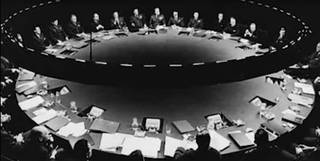 Designing Dr Strangelove: set design by Ken Adam
Discover one of the most significant production designers of the 20th century – Sir Ken Adam
Collection highlights
-
 EKCO A22, radio, designed by Wells Coates, manufactured by E. K. Cole Ltd, 1946, Southend-on-Sea, EnglandV&A East Storehouse
 -
 Festival of Britain, poster, designed by Abram Games, 1951, UKV&A South Kensington
 -
 (Detail) Olympic torch, designed by Ralph Lavers, manufactured by High Duty Alloys Ltd, 1947, London, EnglandV&A East Storehouse
 -
 Boric Acid 8.34, wallpaper, designed by William J. Odell, produced by John Line & Sons Ltd., 1951, EnglandV&A South Kensington
 -
 Britain Can Make It, poster, designed by Ashley Havinden, printed by Haycock Press Ltd., 1946, UKV&A South Kensington
 -
 Garden Egg Chair, designed by Peter Ghyczy, manufactured by Elastogran GmbH, 1968, Lemförde, GermanyV&A South Kensington
 -
 Ornament, designed by Wendy Ramshaw and David Watkins, 1966 – 7, London, EnglandV&A South Kensington
 -
 Frequency, furnishing fabric, designed by Barbara Brown, made for Heal Fabrics Ltd.,1969, UKV&A East Storehouse
 -
 (Detail) Robin Hood Gardens, Poplar, London, building, by Alison and Peter Smithson, 1970 – 72, UKV&A East Storehouse
 -
 Jamie Reid archive, t-shirt, by Jamie Reid, Malcolm McLaren, Vivienne Westwood and Johnny Rotten, 1976, London, EnglandV&A South Kensington
 -
 Pye model CS17, television, designed by Robin Day, made by Pye Ltd, 1956 – 7, Cambridge, EnglandV&A East Storehouse
 -
 Homemaker, plate, designed by Enid Seeney and Tom Arnold, made by Ridgway Potteries Ltd., 1950s, Staffordshire, EnglandV&A South Kensington
 -
 Queen Elizabeth II, photograph, C-type print, by Cecil Beaton, 1953, London, EnglandV&A South Kensington
 -
 Marilyn Monroe, screenprint, by Andy Warhol, printed by Aetna Silkscreen Products Inc./ Du-Art Displays, published by Factory Additions, 1967, New York, USV&A South Kensington
 -
 Christine Keeler beside chair, 1963, photograph, gelatin silver print, by Lewis Morley, 1963, London, EnglandV&A South Kensington