In this guest blog, Ananth Ramaswamy and Devi Seetharam share their first in-person encounter with the Cochin ceiling.
When Devi arrived in London, it marked the first opportunity for us to work together in person on the V&A Cochin Ceiling commission. Until then, much of our research had necessarily happened at a distance, through photographs, drawings, digital archives and conversations.
We began by studying articulations of the lotus within the arts and architecture of Kerala. Considering the journey and recontextualization of the ceiling as a whole led us to look further afield, exploring how the lotus has been approached across the V&A’s collection, spanning different periods, geographies and cultures. Devi’s visit allowed us to move from this remote understanding into something far more expansive, nuanced and sensitive.

Seeing the ceiling in person
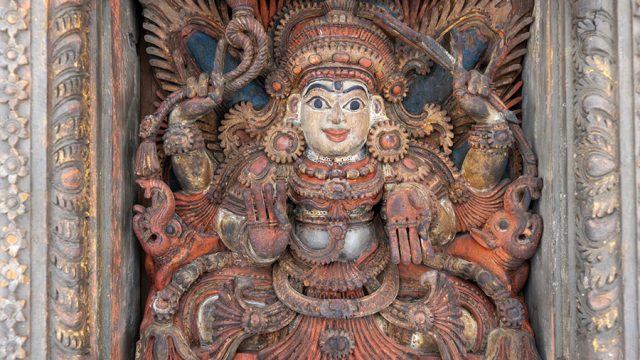
Our first meeting with the wider project team took us behind the scenes to see the historic Cochin Ceiling during conservation. Encountering it in person fundamentally changed our understanding of the object. Its sheer scale was immediately apparent, but so too were the smaller things: the depth and intricacy of the carving, the transverse structure holding the panels together, variations between individual pieces and, importantly, the colour beginning to emerge through the cleaning process.

Working alongside the conservation team also gave us an opportunity to consider how the materiality of our intervention might sit alongside the original. We came prepared with samples of woods commonly used for carving in India today, together with different oils and stains, and were able to place these directly against the historic material. While the ceiling itself is predominantly teak, seeing its polychromy in person made us question whether matching the timber was necessarily the most sympathetic response. Darker samples receded more quietly, while warmer timbers subtly complemented the colour being revealed through conservation.
Exploring the collection
The visit extended far beyond the ceiling itself. We met people from different departments and areas of expertise, all contributing to how we might approach the project with as much sensitivity and depth as possible. We spent time in the V&A’s galleries, archives and stores, looking at more than a hundred objects. Some had been selected for a particular relationship to our research; others only became significant once we encountered them in person.

There was a pleasure in allowing the research to remain this open. A glazed bowl might reveal an indentation we had never noticed online. A small metal object could suggest a way of reducing a petal to a few essential lines. Translucency, distortion, surface texture, line weight and changes in scale all began to enter the conversation.
Devi spent time drawing as we looked, while objects were taken out from storage for us to study at close quarters. Things that had appeared monumental online were sometimes unexpectedly tiny; apparently simple objects revealed considerable nuance when handled and observed.
A way of looking
What was particularly valuable was the seriousness with which this research process was supported. Rather than looking for a motif and immediately translating it into a design, we were given time to observe, question and follow unexpected threads. Our first encounter with the ceiling became less about finding an immediate answer and more about developing a way of looking that could inform the work to come.


The contemporary commission will be part of the transformation of the V&A’s South Asia Gallery, opening in 2028. The South Asia Gallery refurbishment is supported by The National Lottery Heritage Fund, Dunard Fund, Mandakini Puri and many other generous donors.