
Within hundreds of boxes on various pallets inside our V&A Wedgwood Collection store are thousands of objects waiting to be unpacked and shared. These objects are a unique record of over 250 years of Wedgwood’s ceramic production. Once part of the Wedgwood Museum’s Trust (WMT) collection, these objects were saved in 2014 following a major fundraising campaign led by Art Fund and gifted to the V&A. These objects are now being catalogued as part of a major unpacking, cataloguing, and digitisation project called ‘Unpacking the V&A Wedgwood Collection’.
When the collection was moved to a new store, over 60,000 objects were packed away, and following a storage transformation project in 2022, the process of unpacking could begin. Since 2023, we have been systematically cataloguing objects held on site and have so far recorded 25,820 objects. These range from teapots to sculptures, dinner services to potter’s tools. When the boxes were originally packed, they were stored in chronological order. We have worked our way through 18th and 19th century objects and are now focusing on the 20th and 21st centuries.
But what does cataloguing at this scale involve? How does an object go from box to permanent home? Below you can follow the process of cataloguing one of these boxes from start to finish.
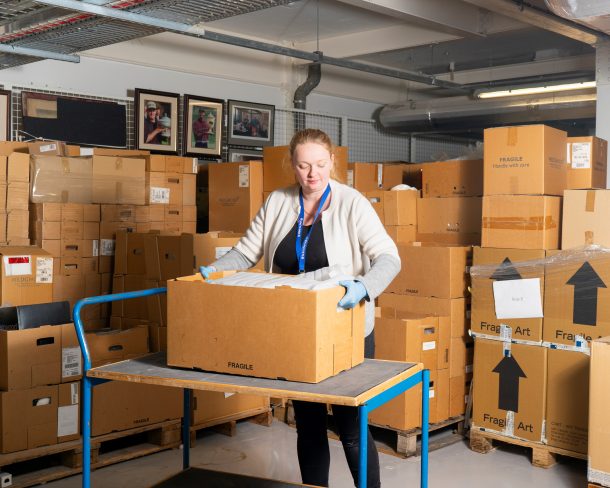
Phase 1: Unpacking & Initial Condition Checking
Each box begins its journey tightly packed with other boxes on a pallet, before being brought into the cataloguing workspace, where its contents are carefully unpacked. Objects are removed one by one and given a close visual check for any signs of damage, such as the object having loose fragments or cracks that might make them especially fragile and unstable to handle.
We are fortunate that when these boxes were originally packed, objects were often grouped together, by pattern, type of form, or a designer. All the objects in this box have been designed by Nick Munro (b. 1963) in the late 20th to early 21st century, and fortunately none of the objects are in an unstable condition.
Munro is a British designer, established in 1987, celebrated for blending traditional craftmanship with modern, functional design. Wedgwood and Munro’s collaboration saw Munro reinterpret jasperware making modern functional items such as wine coolers and pet bowls.

Phase 2: Cataloguing
Within this one box were eight objects: a flared bowl, a spiral vase, a spiral cup and larger mug, and two metal versions of salt & pepper shakers and grinder.

Now begins the investigative part of the work, where each piece of information recorded gradually builds into a full record. The information gathered follows the V&A’s accessibility standard, ensuring that across the collection, an object is described in a consistent and clear way. We start by looking for a Wedgwood Museum Trust (WMT) accession number. These function as a vital link back to the WMT accession registers, often unlocking additional background information that can enrich the object’s story, such as being “Found on Works” meaning the Etruria factory, or gifted by the family of a former employee.
Unfortunately, there were no WMT accession numbers found on these objects. While many objects acquired by the WMT had accession numbers, most Wedgwood material from the late 20th century onwards did not yet have WMT numbers assigned. WMT’s aim was to acquire a representative selection of Wedgwood wares directly from the factory floor, which created a backlog which we are now cataloguing.
Next, the object is given its unique object number within the collection in the format WE.XXXX-2014. This ties it to the Wedgwood Collection (WE.), and the year it formally became part of the V&A’s collection (2014). If the object has multiple parts (for example a sugar bowl with a cover and a spoon) part numbers are included, showing that there are multiple items which make up the whole object. From this point, the WE. number becomes the object’s primary reference across all systems. In our store we use labels for object identification, preferably attached to each object or part, or placed inside or ontop if it is not possible to attach safely.

The object is then classified with an object name (such as cup, bowl, shaker etc.), and any known title is added. For example, if a pattern name or number is present, this is added as the Object Title and designated as either a manufacturer’s title, an artist-assigned title, or a generic title for if it became commonly used to identify the object.
We then work through the core information needed to identify the object which is:
1. Materials and techniques: For the bowl, vase, cup and mug the material is Jasperware made using several techniques: moulding, glazing and engine turning. The shakers and grinder are metal, the spheres are Stainless Steel with a chrome finish, and the wedges are Pewter with hammering.
2. Manufacturer: Much of our collection is Wedgwood, but we also have objects made by subsidiary companies acquired by Wedgwood such as Coalport. We also have a range of objects designed by world renowned designers including Jasper Conran, Sheila Bridges and Nick Munro who have designed for Wedgwood. For instance, whilst the flared bowl and spiralling objects were designed by Nick Munro for Wedgwood, both styles of salt and pepper shakers and grinder are Munro’s own products.
3. Inscriptions and labels: Any inscriptions and labels are then recorded in detail, including how they are presented (impressed, printed, inscribed). Interestingly, on the spiral mug is a small unfired transfer printing label of the Nick Munro backstamp which appears printed on the spiral vase. All four Jasperware objects also have the impressed ‘WEDGWOOD’ stamp.

4. Production dates: For these objects the unique Nick Munro backstamp gives some objects the copyright year of 1999 or 2001. This allows us to identify those objects as being ‘ca. 1999’ or ‘ca. 2001’, while the others without such specific marks can be confidently dated to ‘late 20th to early 21st century’.
5. Production place: Production place is closely tied to production date. For the Jasperware items we know that it will be at ‘Barlaston’ as Wedgwood’s jasperware has been made at this site since the 1940s. However, as the salt and pepper shakers and grinder are made of metal, the manufacturing location is unlikely to be Barlaston, so England is used to broaden the production area.

At this point, we also assess condition and safety. Any hazards are recorded; these are rare but occasionally occur as chemicals such as mercury in 18th century objects. Each item is also given a condition rating on a scale of 1 to 4, from excellent condition to heavily damaged, providing a useful snapshot of stability and handling needs. Fortunately, all these objects received a rating of 1.
We then add any associations, for example if Queen Elizabeth II was depicted on the object her record would be added. Associations may also include notable buildings (such as Etruria Hall, the Wedgwood family home), or any known involvement of artists, engravers, or designers, in this case Nick Munro.
Once this information has been gathered, we can write a brief description. This acts as a consolidated summary of everything established, bringing together object type, title (if applicable), materials and techniques, designer and/or manufacture, production place, and production date. For example, the bowl’s brief description is:
‘Bowl, Jasperware with engine turning and glaze, designed by Nick Munro for Josiah Wedgwood & Sons, Barlaston, late 20th to early 21st century’.
The object is then moved to a designated holding area, ready for photography and the next stage of the cataloguing process.
Phase 3: Photography & Location
High-resolution images are taken by our project photographer who captures every object. In addition to overall shots, close-up images are taken of notable details such as signatures or distinctive backstamps.

After photography, objects are placed in a temporary holding cabinet while awaiting allocation within the store to a cabinet and shelf/tray level. To give a sense of the scale of our store, we have over 200 cabinets that can be arranged to have either a maximum of 11 shelves or 44 trays.

The store itself is organised chronologically, with 18th and 19th century objects grouped together, and 20th and 21st century material separated due to the vast quantity we have for 20th century. Careful use of space is essential, so storage methods vary depending on the object type and size. Smaller items are grouped together in trays, while plates are in cabinets with multiple shelves, stacked no more than four high and separated by acid free foam discs for protection.
This stage ensures that each object in not only photographed, but also securely and logically stored for future access and care.
Phase 4: Becoming Accessible
The final stage of cataloguing takes place at the computer, where each object record is checked and prepared for upload for public access via the V&A’s ‘Explore the Collection’ online database. If an object carried a WMT Accession Number, this is used to locate its entry in the older accession registers, allowing any additional historical information to be incorporated into the record.
Once complete, the record is reviewed to ensure accuracy and consistency, with checks for spelling, punction and grammar but also any additional research is conducted. For these objects, a look on Nick Munro’s website revealed the names of ‘Rockers’ and ‘Spheres’ given to the two styles of salt and pepper shakers and grinder, so this information was added to the records as an Object Title assigned by artist. It also shows Munro has favoured producing his products in Sheffield since the early 1990s, and so this location is more accurate and appropriate than England, so the production location is updated to this.
Due to the scale of cataloguing occurring, we work on spreadsheets which are then uploaded to our Collections Management System (CMS). This is done in batches by the V&A’s Collections Care and Access (CCA) team and is also when the photographs taken during the previous phase are linked together. From here, the object becomes part of the museum’s ‘Explore the Collection’ website, making it accessible to anyone wishing to browse or research the collection.

The V&A aims to mark every object in the collection, however due to the quantity of objects being catalogued in this project it would significantly slow down the process, as object marking using a reversible conservation grade method takes skill and time. Therefore, during this phase of the project we have taken the decision to prioritize object marking for the items currently in the galleries and objects from the store which are selected for a gallery redisplay or a loan. Once a store object is selected for display or loan, the CMS record is updated to reflect its new location, and a Public Access Description is added, offering a richer account of the object’s history, significance, and notable features.
This phased cataloguing project brings together research, documentation, and public access, ensuring each object is not only recorded, but also accessible to everyone, everywhere. The process of cataloguing involves many steps, but ensuring every item in the collection is documented and accessible is part of our remit as a national museum. We estimate there are around 65,000 objects in the store. Thanks to the support of various funders and organisations, as well as our fantastic team of volunteers, student placements, and project cataloguers, every object both in the store and in the galleries will be catalogued and available online by 2030. Until then you can follow our cataloguing project on our socials @vawedgwood and see new objects appearing on the V&A’s ‘Explore the Collection’ website regularly.
Woah! Never knew any of this before, great blog. How long did it take to go through this process from start to finish?
This article shares the main information in a simple and friendly style. I tried Tunnel Rush 2 and liked how quickly the action starts. The narrow tunnel and unexpected barriers require players to stay focused and make quick choices to continue farther.