
We’re delighted to announce that Karenjeet Kaur Bains will be a judge for our V&A Innovate National Schools Challenge 2026 – 27.
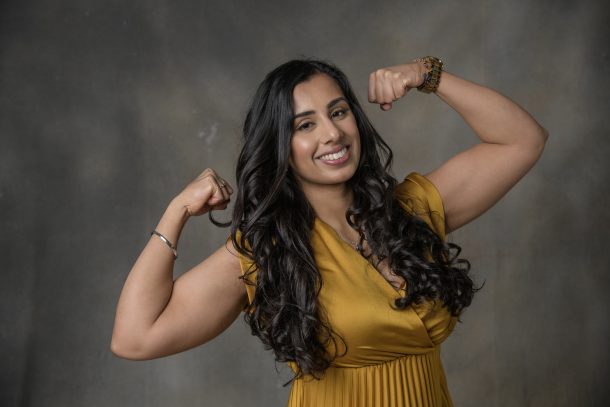
Known for appearing on the television show Gladiators as “Athena”. Karenjeet aims to empower South Asian Women Through Fitness, helping her audience to achieve fitness goals and break barriers through online coaching. She has won the Commonwealth Powerlifting Championships junior title and became the first British Sikh woman to represent her country at both the European and World championships.
We spoke to Karenjeet about being on the panel and why design is important to her.

1. What are you most looking forward to as a V&A Innovate judge, and why?
I’m really looking forward to seeing the creativity and imagination of the students and how they approach real world problems. As an athlete, I’m always looking for ways to improve performance, overcome challenges and find solutions to problems, so I’m excited to see how the students apply that same mindset through design. I hope I can encourage them to believe in their ideas, think outside the box and recognise that their ideas have the potential to make a real difference.
2. What do this year’s themes of ‘Simplify, Empower, Nurture’ mean to you?
To me, these three themes are all about making a positive difference. Simplify means finding ways to make things easier, more efficient or more accessible. Empower is about giving people the confidence, tools and opportunities to reach their potential. Nurture means creating an environment where people can learn, grow and develop. Throughout my sporting career, I’ve experienced how important it is to have the right support, believe in yourself and keep finding ways to improve. I think these themes are a great reminder that even small changes can have a big impact on someone’s life.
3. Why is design important to you?
Design is important because it helps turn ideas into practical solutions that can improve people’s lives. In sport, the design of equipment, training spaces and technology can make a real difference to performance, safety and accessibility. As someone who is always looking for ways to improve, I appreciate how thoughtful design can solve problems we might not even realise we have. I also think good design is about understanding people and their needs, rather than simply making something look good.
4. What invention or innovation could you not live without?
My smartphone would probably be the one! It allows me to manage my coaching business, communicate with clients, track my training, create content and stay connected with people wherever I am. As someone who balances several different roles, having so many tools in one device makes my life much easier. It’s a great example of how innovation can simplify everyday tasks and give us more opportunities to focus on the things that matter most.
5. Can you share any top tips for the students taking part in the V&A Innovate this year?
My biggest advice is to be curious, think creatively and don’t be afraid to make mistakes. Some of the best ideas come from asking questions, challenging the way things have always been done and looking at problems from a different perspective. Listen to one another, because everyone brings different strengths and ideas to a team. Most importantly, don’t worry about having the perfect idea straight away. Test your ideas, learn from what doesn’t work and keep improving. In sport, I’ve learned that progress comes from being willing to learn and try again, and the same applies to innovation. Believe in your ideas and remember that you don’t have to be an adult or an expert to make a difference.

REGISTER TO TAKE PART
The 2026-27 Innovate National Schools Challenge is now open for registration and entry submissions from student groups in years 7, 8 and 9 from state schools in England. This year’s themes are Simplify, Empower and Nurture, and a theme inspiration pack as well as Teacher and Student Toolkits to help with the design journey and submitting entries are now on the V&A website.
#InnovateVAM

Love this interview — especially the point that good design is about understanding people and their needs, not just making something look good. Karenjeet’s advice to “test your ideas, learn from what doesn’t work and keep improving” is spot on, and it’s such a healthy mindset to pass on to Year 7–9 students. The athlete’s perspective on problem-solving is a refreshing angle for a design judge. Really excited to see what the kids come up with around Simplify, Empower and Nurture!