Adobe Creative Residency programme
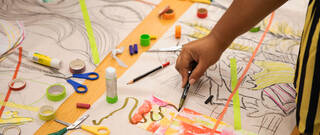
This programme brings making into the museum, giving artists, designers, performers and creators unprecedented access to world-class arts resources, mentorship, studio space, creative programming and the opportunity to publicly display their work.
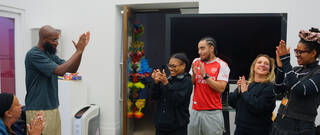
Each year, three creatives work for 12 months, full-time, based in a studio space at the V&A South Kensington. Each Adobe Creative Resident is paired with a curatorial mentor who acts as a guide to the collection throughout their time. Residents also work with a designated audience (schools, families or young people) and collaborate with the learning team to expand access to creativity, design and making. The programme ends with a display of their work at V&A South Kensington. Work from the previous year’s Adobe Creative Residents is now part of a free display at the V&A South Kensington until November 2026. More information can be found here.
The Adobe Creative Residency is supported by the Adobe Foundation.
Open Calls
We currently have no Open Calls.
Artists in residence 2026
Shanti Bell
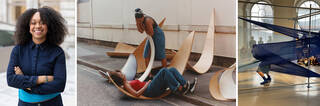
Rethinking Spaces - Furniture and Placemaking Residency
Focus audience: Young People
Shanti Bell is a London-based multidisciplinary artist whose practice centres on creating experiential sculpture that is interactive, immersive, and often wearable. Her work explores the relationship between sculpture and the human form, conceptually navigating emotions and the complexities of human connection, family, and personal relationships.
Read more about Shanti's practice
For her residency, Shanti is interested in breaking down traditional barriers to art engagement by reimagining furniture as a medium for interaction. Globally recognised as an object of physical engagement, furniture offers a pathway to foster connection and challenge the conventions of gallery spaces. Through research into furniture design and collaborative exploration, she aims to create works that encourage touch, participation, and dialogue, while engaging young people in the creative process. In addition to spatial design and consideration of the spatial context of furniture, which are aspects she aims to build upon within her practice.
Shanti’s experience spans exhibitions, education, and community engagement. Her recent solo show The Room that Shared (2024) featured immersive sculptures activated by audience interaction, blurring boundaries between body and object. She has delivered workshops at Somerset House, Makerversity, and The King’s Foundation, focusing on design, research, and conceptual development.
Committed to accessibility, Shanti's focus for the residency is to create workshops for underrepresented groups that encourage creative empowerment and practical skills, in turn providing confidence in seeking continued pathways into the creative industry. Working with underrepresented groups, she aims to dismantle financial and confidence barriers to art participation, drawing on her own experience of navigating the realities of social and economic barriers.
Her practice combines material innovation with social engagement, aiming to unlock creativity and foster inclusive spaces for dialogue and expression.
"I am beyond excited to begin a residency at the V&A. The space that this residency will create will allow me to push my own creative boundaries as I navigate how to design and make works that not only encourage community and connection but are considerate of the historical landscape they will be placed within. I am particularly excited to be working with young people and developing experiences that encourage them to expand their own art practices and creative thinking.”

Emily Stapleton-Jefferis
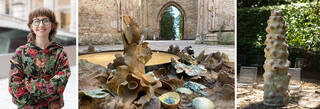
Making and Meaning – Mixed Media Residency
Focus audience: Families
Emily Stapleton-Jefferis is a London-based visual artist working with a particular focus on ceramics. Her practice is rooted in clay’s tactile qualities as well as the transformative processes involved in its making. Emily’s work draws inspiration from human, botanical, and geological forms, often zooming in on overlooked details to reveal beauty and strangeness hidden in the natural world.
Read more about Emily's practice
For her residency, Emily is interested in exploring repair as both a metaphor and an embodied act of care—connecting material processes with ideas of sustainability and community. She plans to experiment with transforming broken ceramics into mosaics and new objects, creating clays from crushed fragments, and reintroducing metalwork through casting waste metals into ceramic moulds. This research will bring together her personal practice and her community arts practice under a shared lens of care: for objects, people, and the environment.
Alongside her studio practice, Emily’s community arts practice includes delivering creative projects in galleries, museums, hospitals, and community settings. She has held residencies at Camden Arts Centre, St George’s Hospital, The Leonora Carrington Museum and worked on inclusive programmes such as MK Gallery’s Art and Us. Her workshops encourage playful material exploration, making art accessible to all ages and abilities. Through these engagements, Emily champions creativity as a powerful tool for connection and well-being.
“I’m so excited for this residency at the V&A. I’m interested in how repair can pull an object out of its tragic linear path towards landfill, allowing for new stories and richer relationships to develop. I find the tactility of things so affecting, I can’t wait to be immersed in the collections and conduct material research, whilst engaging with families”

Maria Than
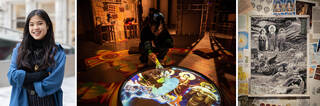
Artificial Intelligence and the Digital World Residency
Focus Audience: Schools
Maria Than is a Vietnamese-British-French creative technologist, artist, and co-founder of the award-winning practice Ricebox Studio. Her multidisciplinary work spans augmented reality (AR), illustration, moving image, and creative AI, exploring themes of fragmented identities, Viet and Tibetan Buddhism, intergenerational trauma, and escapism.
Read more about Maria's practice
For her residency, Maria seeks to integrate her expertise in creative technology with socially engaged practice, using digital tools to foster dialogue and accessibility. She is particularly interested in how emerging technologies can be demystified and used as vehicles for storytelling, cultural preservation, and community empowerment. Building on her recent solo exhibition Homage to Quan Âm (arebyte Gallery, 2024), which combined AI, AR, and handcrafted objects to explore Vietnamese Buddhist heritage, Maria plans to research new ways of blending immersive media with participatory design - creating spaces where lived experience and technology intersect.
Alongside her artistic practice, Maria lectures in digital and social design, creative AI ethics, and emerging technologies at institutions including Central Saint Martins, Camberwell College of Arts, and the University of Greenwich. She has led workshops and hackathons for universities, charities, and community groups worldwide, introducing AR and AI as tools for storytelling and activism.
Through Ricebox Studio, she has co-created installations with children and delivered projects addressing sustainability, identity, and digital inclusion. Committed to working with underrepresented communities, Maria advocates for equitable access to technology and creative education, drawing on her own experience of navigating socio-economic and cultural barriers. Her work combines technical innovation with a strong social mission, aiming to make creative tech a space for empowerment and collective imagination.
“I am extremely excited to be working with the Schools programme and my community partners to tackle the important challenge of teaching AI critically to young people and harness their unbridled sense of imagination to bring new perspectives on how AI can be designed, implemented and used by others.”

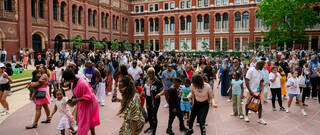
Open Studios, events and workshops
Meet and learn about our residents with drop-in creative workshops, open studio sessions, and resident-led activities. Aimed at families, young people and schools.
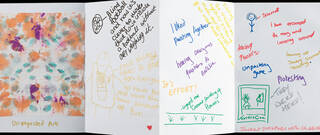
Alumni
Our Residency programme has hosted a wide range of practitioners since it was established. Watch our films to get a first-hand account of the research and projects that our residents have carried out.