
Watercolour
Features
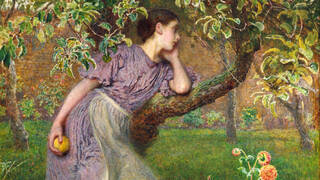
What is watercolour?
Our extensive collection of watercolours tell a fascinating story of the medium
-
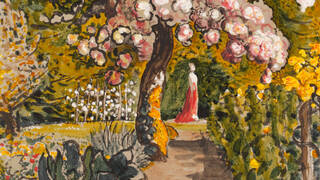 Samuel Palmer and his visionary landscapes
Rediscovering the spiritual and joyous depiction of nature
-

The botanical album of Jacques Le Moyne de Morgues
Explore the 16th century album of exquisite watercolours in high definition
-
 A watercolour painting of a pomegranate by Lucy T Smith
Possibly the most soothing 40 minutes experience you'll have this week
-
 Eric Ravilious – British wood engraver and watercolour artist
Discover more about the life and works of British wood engraver and watercolour artist Eric Ravilious.
-

Constable's watercolour sketches
Take a closer look at the techniques used by Constable in his later works
-

Renaissance watercolours: materials and techniques
Discover the qualities that made watercolour the medium of choice for artists during the Renaissance
-

Handling and care of precious books: ASMR
Experience the National Art Library – a calm and tranquil yet deeply sensory space
Collection highlights
-
 A Fashionable Marriage, drawing, by Lubaina Himid, 1986, LondonV&A South Kensington
 -
 Double-sided leaf from a calendar, by Simon Bening, 1510 – 60, Flanders, BelgiumV&A South Kensington
 -
 Citron, watercolour, by Vincenzo Leonardi, about 1640, Rome, ItalyV&A South Kensington
 -
 Holy Island, Northumberland, by Joseph Mallord William Turner, about 1829, EnglandV&A South Kensington
 -
 Dorigen of Bretagne longing for the safe return of her husband, by Edward Coley Burne-Jones, 1871, EnglandV&A South Kensington
 -
 Stonehenge, watercolour, by John Constable, 1835, Salisbury, EnglandV&A South Kensington
 -
 The Source of the Arveiron, with Mont Blanc in the Background, watercolour, by Francis Towne, 1781, FranceV&A South Kensington
 -
 Gilded Amanita (Amanita franchetii), by Beatrix Potter, 1890s, watercolour over pencil on paper.V&A South Kensington
 -
 The Eclipse of the Sunflower, watercolour, by Paul Nash, 1945, BritainV&A South Kensington
 -
 Christ, St Paul, Charity and the Theological Virtues, drawing, by Jacob Jordaens, about 1660, BelgiumV&A South Kensington
 -
 Ornaments with Flowers, watercolour, by Frances Hodgkins, 1942, BritainV&A South Kensington
 -
 Friesland Farm under red clouds, watercolour, painted by Emil Nolde, about 1930, Friesland, GermanyV&A South Kensington
 -
 The Resurrection: The angel rolling away the stone from the sepulchre, watercolour, by William Blake, about 1808, EnglandV&A South Kensington
 -
 Girl in a Hat Shop, watercolour, by David Remfry, 1982V&A South Kensington
 -
 Study of a tulip, watercolour sketch, by Mary Moser, about 1764 – 1800, BritainV&A South Kensington
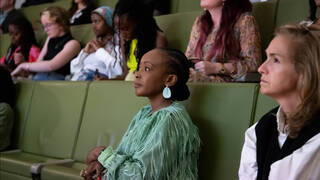

Join a V&A Academy experience
Explore our curated range of expert-led courses, workshops, and talks, all with the V&A collections at their core.
- Expert led courses
- Practical workshops
- Lectures & talks
- Professional development
