Champlevé enamelling 1100–1250
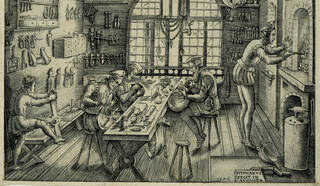
Engraving tools in the workshop of Phil Barnes, 2009
Between 1100–1250 specialist metalworkers flourished in the areas around Cologne (the Rhineland), Liège (the Meuse Valley) and Limoges (France). They supplied monasteries and churches with vessels essential for the rituals of the church, objects such as chalices, crosses, candlesticks, altarpieces and shrines. The large shrines and altarpieces were complex structures. They had a wooden core overlaid with metal, engraved and embellished with brilliantly coloured gems or enamel plaques.
The technique of enamelling used intense heat to fuse glass onto a prepared metal surface. It allowed the metalworker to create brightly coloured images. Medieval enamellers used several different techniques but champlevé enamelling was one of the most common. The word champlevé means literally 'raised fields' and refers to the way that beds were dug out of a copper plate to receive the powdered enamel.
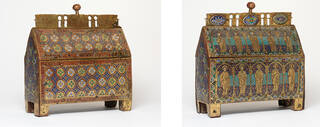
This short film focuses on the champlevé technique. Enameller Phil Barnes was commissioned to produce a small plaque based on a detail from a reliquary chest made around 1180 in Limoges. The film highlights the key stages that were involved in producing champlevé enamel plaques. The basic process remains the same but medieval enamellers used kilns fuelled with charcoal and relied on their judgement when firing the enamel plaques.
This film was supported by William and Valerie Brake.
Champlevé enamelled objects from the V&A's collection
The religious wars and revolutions of successive centuries have destroyed many medieval enamelled objects, but outstanding examples of complete objects, and impressive fragments, do survive in museums world-wide. These are a selection of objects decorated with champlevé enamel from the V&A's collections.

Becket Casket, Museum no. M.66-1977
Becket Casket
Gilded coper and champlevé enamel on a wooden core
Limoges, France
About 1180
Museum no. M.66-1977
Purchased with the assistance of the National Heritage Memorial Fund, with contributions from the Po Shing Woo Foundation, the Art Fund, the Friends of the V&A, the estate of T S Eliot, the Headley Trust and many private donations.The murder of Archbishop Thomas Becket in 1170 stunned the Christian world. Canterbury Cathedral immediately became a major pilgrimage site and a shrine was built over his grave. This box commemorates Becket's martyrdom and may have contained relics. The front depicts the murder. The lid shows his burial and his soul ascending to Heaven. Limoges enamellers produced many boxes depicting Becket's death of which this is probably the earliest to survive.

Two plaques with angels, Museum nos. 6816 & 6817-1860
Two plaques with angels
Gilded copper with champlevé enamel and cloisonné details
Inscribed in Latin, 'Blessed are the meek, for they shall inherit the earth' and 'Blessed are the pure in heart, for they shall see God'
Rhineland (Germany), probably Cologne
About 1160-70
Museum nos. 6816 & 6817-1860These concave plaques are both carefully shaped to fit into the space between two arches along the side of a saint's shrine. They would have formed part of a series of angels, each holding a text from the Beatitudes, the sermon given by Jesus at the start of his ministry.

The Rolls Plaques, Museum nos. M.53
The Rolls Plaques
Gilded copper with champlevé enamel and cloisonné details
Meuse Valley (Belgium, France or Germany)
About 1160
Museum nos. M.53, 53A & 53B-1988
Previously owned by the Harding-Rolls family
Purchased with the assistance of the National Heritage Memorial Fund and the Art Fund (Eugene Cremetti Fund)The most skilled enamellers in Europe at this time worked around the valley of the River Meuse. These plaques are outstanding examples of the virtuosity of their craft. They once decorated an altarpiece or shrine. The programme of imagery must have been complex, combining Old and New testament stories with allegorical and classical scenes.

Tabernacle, Museum no. 7650-1861
Tabernacle, probably from the church of St Pantaleon
Gilded bronze and copper on a wooden core with champlevé enamel and walrus ivory
Cologne, Lower Rhine, Germany
About 1180
Museum no. 7650-1861This tour de force of Romanesque goldsmiths' work and carving combines widely varied foliage patterns with ivory figures that are classically inspired. Its function has been much debated. The iconography or subject matter centres on Christ's redemption of mankind, fulfilling Old Testament prophecy. This indicates that the tabernacle proabably housed the consecrated bread for the Mass.

Plaque, Museum no. 223-1874
Plaque with St Paul Disputing with the Jews
Gilded copper with champlevé enamel
England
About 1170-80
Museum no. 223-1874This is part of a group of seven surviving plaques telling the story of St Peter and St Paul. The group originally decorated a larger object, possibly an altarpiece or reliquary.
Close links to the English manuscript style identify the group as rare surviving English enamels. The choice of scenes is unusual. This episode appears in Byzantine fresco cycles in Sicily, but was available to English enamellers through contemporary manuscripts.

Plaque with the Resurrection of the Dead, Museum no. M.104-1945
Plaque with the Resurrection of the Dead
Gilded copper with champlevé enamel
Inscribed in Latin with part of a rhyming poem about the Crucifixion
Limoges, France
About 1250
Museum no. M.104-1945With another plaque (now in the Walters Art Gallery, Baltimore), this may once have adorned the base of an exceptionally large crucifix. Both have the same pseudo-Kufic (Arabic) script on the border. This plaque shows the dead rising up after the Crucifixion, as recounted in St Matthew's Gospel.

Plaque with Two Prophets, Museum no. M.207-1938
Plaque with Two Prophets
Copper gilt with champlevé enamel
Limoges, France
1160-1180
Museum no. M.207-1938Rectangular copper plaque with chamfered copper gilt engraved frame. In the central panel two standing male figures face each other, each holding long scrolls inscribed with Biblical verses. The figure on the left is thought to be St Matthew.

Plaque with martyrdom of St Thomas Becket, Museum no. 4041-1856
Plaque with martyrdom of St Thomas Becket
Gilded copper with champlevé enamel
Limoges, France
1190-1210
Museum no. 4041-1856The shape and subject suggest that this came from the side of a casket containing relics of Thomas Becket. Some of the enamel has disappeared, showing how the surface was engraved to receive the powdered glass. The heads, typical of Limoges work of this period, are made of separate pieces of copper.

Masters Plaque, Museum no. M.209-1925
Masters Plaque
Gilded copper with champlevé enamel
England, probably Winchester
1150-60
Museum no. M.209-1925
Given by Dr Robert masters to the Rev Thomas Kerrich in 1796The early history of enamelling in England is uncertain. This plaque, showing the last Judgement, is extremely unusual in both style - with Christ's clinging draperies - and the choice of imagery. Its closest links appear in English manuscripts rather than in other enamels.

Reliquary casket, Museum no. 7945-1862
Reliquary casket
Gilded copper with champlevé enamel plaques on oak
Limoges, France
1185-95
Museum no. 7945-1862Several saints surround the central figure of Christ in the lower row, suggesting that the casket may have contained relics of more than one saint. Like many of the reliquaries enamelled in Limoges, it is shaped like a tomb or shrine.

Plaque from a reliquary casket, Museum no. CIRC.406-1921
Plaque from a reliquary casket
Gilded copper with champlevé enamel
Limoges, France
About 1200-50
Museum no. CIRC.406-1921It was common for the end of a reliquary casket to show apostles or saints. Here the figure is gilded and set against a coloured ground. This indicates a slightly later date than the earlier technique of showing an enamelled figure against a gold background.

Plaque with Moses and the Brazen Serpent, Museum no. M.59-1952
Plaque with Moses and the Brazen Serpent
Inscribed in Latin, 'Aaron', 'Moses', 'Serpent', 'Law', 'the Wounded'
Copper with traces of champlevé enamel and gilding
Meuse Valley (Belgium, France or Germany)
About 1160
Museum no. M.59-1952
Given by Dr W L Hildburgh FSAUnlike the other three plaques in the group known as the Rolls plaques, this has lost virtually all its enamel, revealing the spaces engraved into the copper plaque. The powdered enamel was placed into these beds, then fired. The gilding was added after the firing was complete.
Ballgowns: British Glamour Since 1950
From 19 May 2012 the V&A celebrates the opening of the newly renovated Fashion Galleries with an exhibition of beautiful ballgowns, red carpet evening dresses and catwalk showstoppers.
Book nowEvent - BSL Tour: Japanese Enamels - The Seven Treasures
Fri 22 June 2012 18:30

BSL TOUR: Enjoy this talk which looks at the art of cloisonné enamelling, one Japan’s most successful forms of manufacture and export.
Book online