Circulating South Asian textiles

While recent histories have emphasised the role of imperial authority in shaping the V&A's South Asian collections, the Museum's original objective was the general improvement of taste, part of what Henry Cole saw as the task of civilising the modern age, a 'great and sacred mission'. The intention was to educate students, manufacturers, artisans and the consuming public through a first-hand experience of art, and the impact of the South Asian textiles shown at the Great Exhibition contributed to the radical rethinking of design principles that underlay this mission.

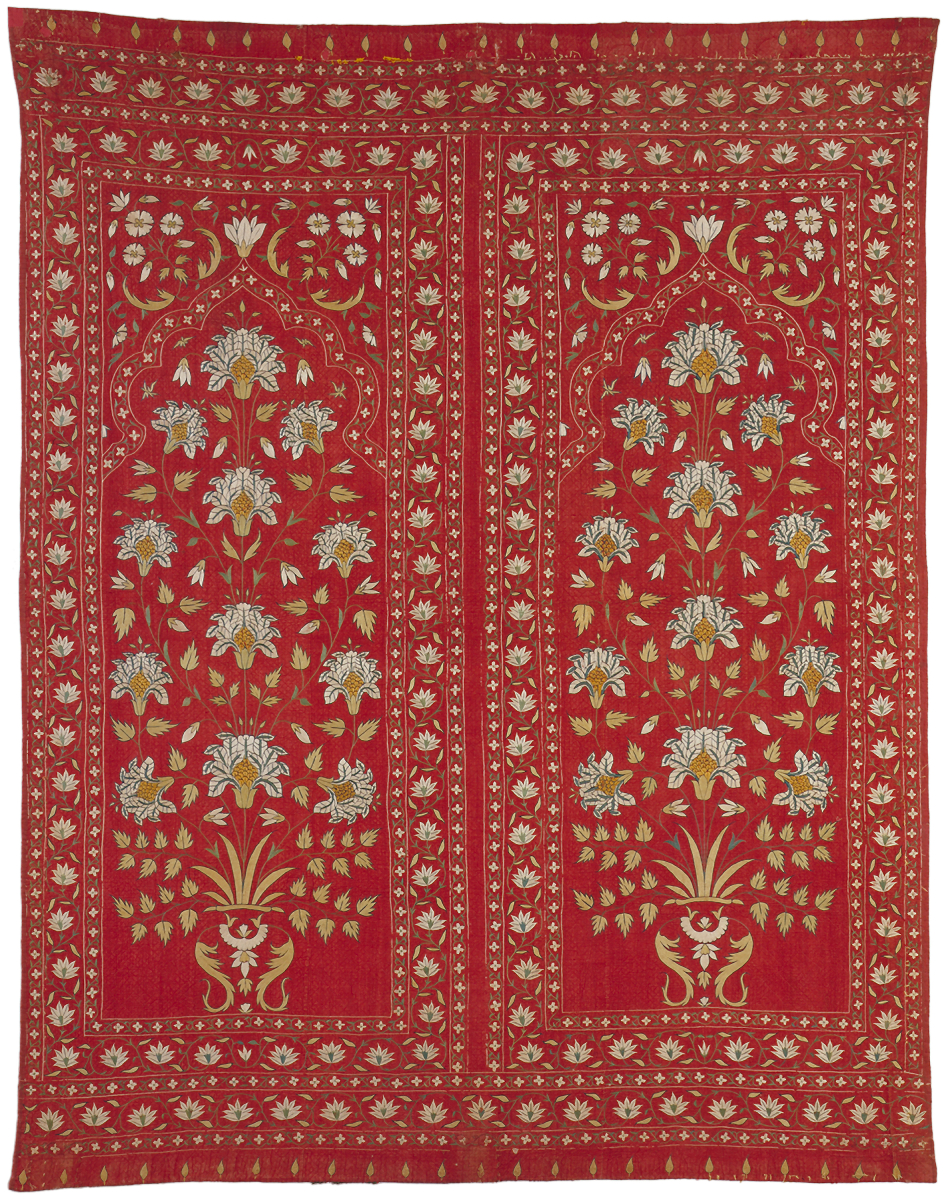
Henry Cole's colleague, the architect and designer Owen Jones, saw Indian designs as among the most perfect of all the things displayed in the exhibition and helped to select examples of Indian objects including textiles for the museum. Jones particularly admired their 'unity of design ... equal distribution of the surface ornament over the ground' and the use of 'the most brilliant colours perfectly harmonised'.

Advertisement for Circulating Exhibition at Plumptre House, Nottingham, 1855. V&A Archives

Advertisement for Circulating Exhibition at Plumptre House, Nottingham, 1855. V&A Archives

‘Portable Museum’, designed by John Forbes Watson, from Watson’s, 'The Imperial Museum & the Colonies', 1876.

‘Portable Museum’, designed by John Forbes Watson, from Watson’s, 'The Imperial Museum & the Colonies', 1876.

From 1855, although collected and to some extent perceived in an imperial context, South Asian textiles formed a small but consistent part of the South Kensington Museum's circulating exhibitions that travelled round the country, displayed as paragons of design and workmanship. This 'portable museum' was the precursor of what later became the Circulation Department of the museum, which survived until 1978.

In four and a half years, the first circulating exhibition toured twenty-six towns, was open for 907 days and was visited by 306,977 people. Besides objects, the Museum also sent out art reproductions and books, including fifty copies of the Grammar of Ornament, to the regional art and design schools.

Thus Indian and other non-European objects became an important element in the attempt to revitalise a 'British' design culture, at the same time as Britain was establishing schools of art and design in India based on the South Kensington model.

Museum collecting also developed in an increasingly imperialistic cultural climate and a background of fierce trade competition. Despite the growing admiration for Indian textiles, by the second half of the 19th century many of the textiles made in India were woven from English thread and British manufactures had become a real threat to the traditional Indian producers so highly estimated at South Kensington.

With its own textile industry in difficulties, Britain wanted to increase its penetration of Indian markets, generally regardless of the impact on both traditional hand production and an emergent, largely Indian-run mechanised textile industry in the subcontinent.

While the idea of a 'portable museum' also lay behind the publication of John Forbes Watson's Collections of the Textile Manufactures of India (1866), it was for specific motives; he saw the volumes as 'industrial museums ... promoting trade operations between the east and the west.' Watson was less interested in the textiles as artistic objects than as a systematic collection of specimens of commercial value to manufacturers and importers and to the administrators of empire. He saw India's potential as 'a magnificent customer ... to clothe but a more percentage of such a vast population would double the looms of Lancashire.' Seeing the exploitation of the vast Indian market as an economic duty, Watson's meticulously annotated samples, taken from the Indian Museum collections, were undoubtedly intended as a template for manufacturers wishing to enter that market as well as a general model for the improvement of British textiles.

Prince of Wales’ Pavilion, Paris International Exposition, 1878. 
From Illustrated London News, 1878.

Prince of Wales’ Pavilion, Paris International Exposition, 1878. From Illustrated London News, 1878.

Durbar Hall, Colonial and Indian Exhibition, South Kensington, 
1886. From Illustrated London News, 8 May 1886

Durbar Hall, Colonial and Indian Exhibition, South Kensington, 1886. From Illustrated London News, 8 May 1886

From 1851 South Asian textiles had also attracted attention and admiration at the international exhibitions staged with the co-operation of South Kensington Museum authorities in an increasingly imperial context. They formed part of the sumptuous Indian display shown in the Prince of Wales Pavilion at the 1878 Paris Exposition, the first major display of Indian objects put on by the British government rather than by the East India Company.

In 1886 Indian textiles were used with theatrical effect at the Colonial and Indian Exhibition in London where India had pride of place as an imperial possession. The dazzling display of Indian art wares, in an 'Indian Palace' designed by Caspar Purdon Clarke, was set against a background of 'the richest textile fabrics, carpets, curtains, silks, shawls, muslins, chintzes, and cotton goods of all descriptions', according to a typical review.

Clarke had hung the main 'Durbar Hall' with light-reflecting, silk-embroidered phulkari from the Punjab, the vestibule with Kashmiri printed cottons, and an Indian Silk Court organised by the dyer and printer Thomas Wardle contained another sumptuous display. Indian craft workers, including weavers, demonstrated their skills in the outer courtyards. The critical reception, although regretting some loss of quality in Indian manufactures, was enthusiastic, especially about the textiles. The Art Journal noted that the exhibition 'appeals alike to the artist and to the Art-lover, as well as to the economist and the statesman.'

Thus the South Kensington Museum, for a variety of motives, played an important part in drawing the attention of the British public to a great range of traditional textiles, hand-made in the Indian subcontinent during the second half of the 19th century.

Palampore, block-printed cotton, India, 19th century. Museum no. 5471 (IS)

Palampore, block-printed cotton, India, 19th century. Museum no. 5471 (IS)

Owen Jones, Grammar of Ornament, Indian no. 4, Plate LII, 1865. National Art Library, Ref No. ND.91-0040 (Vol II)

Owen Jones, Grammar of Ornament, Indian no. 4, Plate LII, 1865. National Art Library, Ref No. ND.91-0040 (Vol II)

Owen Jones, Grammar of Ornament, Indian No.2, Plate L, 1865. National Art Library, Ref No. ND.91-0040 (Vol II)

Owen Jones, Grammar of Ornament, Indian No.2, Plate L, 1865. National Art Library, Ref No. ND.91-0040 (Vol II)

Further Reading

  • Burton, Anthony. The uses of the South Kensington Art Collections Journal of the History of Collections 14:2002, pp. 79-95
  • Dutta, Arindam. The Bureaucracy of Beauty: Design in the Age of its Global Reproducibility London: Taylor and Francis, 2007
  • Driver, Felix and Sonia Ashmore. The Mobile Museum: Collecting and Circulating Indian Textiles in Victorian Britain (Unpublished article, 2009)
  • Farnie, D.A. The English Cotton Industry and the World Market Oxford: Clarendon Press, 1979
  • Jones, Owen. The Grammar of Ornament London, 1856
  • Watson, John Forbes. The Textile Manufactures and Costumes of the People of India London, Eyre & Spottiswoode, 1866

A gift in your will

You may not have thought of including a gift to a museum in your will, but the V&A is a charity and legacies form an important source of funding for our work. It is not just the great collectors and the wealthy who leave legacies to the V&A. Legacies of all sizes, large and small, make a real difference to what we can do and your support can help ensure that future generations enjoy the V&A as much as you have.

More

Shop online

British Asian Style: Fashion and Textiles

British Asian Style: Fashion and Textiles

South Asian textiles have shaped British fashion and dress for centuries, from the fashionable chintzes of the seventeenth and eighteenth centuries, t…

Buy now

Event - William Morris Textiles and Wallpapers

Sat 15 June 2013 14:00

STUDY DAY: Artist, writer, socialist and conservationist, William Morris is best-known today as a designer of flat patterns.

Book online