Cut and structure in stage costume

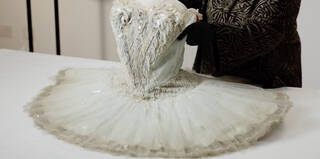
Good cutters are highly prized. Designs are an evocation of a costume and not a detailed pattern of cut and seaming, so working out the structure is the job for an expert. Some costumiers make patterns and construct toiles (a prototype costume made up in cheap fabric which, after fitting, is used as a pattern). Others cut directly into the cloth. It is not enough to follow measurements without taking into account the movements the performer has to make and ensuring that he is comfortable. It is possible to perfectly replicate an 18th-century man's coat, but the smaller, set back armholes would seriously constrict a modern actor.

Striped, plaid or patterned material have to be accurately matched and fabrics like velvet cut with the pile lying in only one direction. Fabrics are often expensive, and a good cutter works with minimum waste.

The characteristic silhouette of a period comes not from the dress itself but from the construction beneath - bones, corseting, petticoats, padding, bum rolls, drum farthingales all create an artificial 'fashionable silhouette', which emphasises different parts of the body at different periods and allows the display of costly, sumptuous fabrics.

16th-century farthingales created skirts which were drum- and cone-shaped while 18th-century hoops and panniers emphasised the horizontal; in the 19th century hoops created characteristic domed crinolines until the crinoline skirt slipped backwards creating the bustle which itself eventually disappeared. Not until the First World War did skirts begin to rise.

For theatre costumes, the underpinnings can either be created separately, or the shapes can be built into the costume.

Modern men's tailoring developed in the early 19th century to meet demands of the Dandies, whose figures were compressed by corsets to give the fashionable tight-waisted look. The Dandy's coat, waistcoat and trousers developed into the three-piece suit. Men's suits fit less closely than women's clothes, so can be cut from block patterns.

Lucrezia Borgia

Costume for Alfonso d’Este in Gaetano Donizetti’s 'Lucrezia Borgia', London, 1980. Museum no. S.80:1-2003

Costume for Alfonso d’Este in Gaetano Donizetti’s 'Lucrezia Borgia', designed by Michael Stennett, worn by Stafford Dean, costume made by Bonn & Mackenzie Ltd, Royal Opera House, London, 1980. Museum no. S.80:1-2003

Stage costumes can be very heavy; the weight helps the performers stand and move with gravitas and dignity. Ellen Terry was once asked to wear a magnificent cloak that looked superb, but was too heavy to act in; it took two assistants to carry away the removed stones. After Ellen objected to her heavy Lady Macbeth headdress ('you've borne me to the ground already with those jewels on my cloak. How do you think I'm going to act?'), her designer, Alice Comyns-Carr, used to weigh the materials before starting work on a new costume.

The extraordinary weight and scale of this costume helps the singer establish the power and authority of the character Alfonso d'Este, Duke of Ferrara, in Donizetti's opera Lucrezia Borgia. It was designed by Michael Stennett for a production at Covent Garden in 1980 and made by Carl Bonn and Colin MacKenzie, acknowledged as the finest theatrical costumiers of their generation. The rich red velvet symbolises power, but, given the Borgia history, could also be blood.

The costume is in two parts, an under tunic and the elaborate overcoat. The only concession to the weight is that the back of the tunic is of a heavy cotton instead of velvet. The complex construction of the sleeves contrasts with the starker simplicity of the body. Each sleeve is attached to vertical tapes which are pulled up and fixed inside to give the exaggerated puffs. To achieve a similar effect in the 1930s, the stage designers the Motleys used gas tubing, looped into a circle and fastened with sticking plaster, which was then inserted into the sleeves, to give the same sculptured look.

Carl Bonn cut the costume to Stennett's design, and Colin MacKenzie executed the embellishment, mostly carried out in bold gold cord. The detailed workmanship is evident in small touches, like the chain of office, whose central medallion sits exactly over the oval on the front decoration, giving it extra emphasis.

Mame

Costume for Mame in Jerry Herman’s 'Mame,' London, 1969. Museum no. S.103-2000

Costume for Mame in Jerry Herman’s 'Mame', designed by Robert Mackintosh, worn by Ginger Rogers, costume made by Barbara Matera, Theatre Royal, Drury Lane, London, 1969. Museum no. S.103-2000

Star performers demand star costumes. For her appearance in Mame in London in 1969, Ginger Rogers's star wardrobe was designed by Robert Mackintosh and made by Barbara Matera, English by birth, who had established herself as a legend in America among theatrical costume makers. The costumes ranged from several extravagant concoctions to everyday suits and dresses, each with carefully co-ordinated accessories.

Keeping the audience's eyes on the star performer can be achieved in several ways. In this case, both fabric and colour are major factors. The fabric is a lurex cloqué fabric, typical of the late 1960s and early 1970s. The strong apricot, itself a characteristic colour of the period, is tempered by the 'bubbled' texture of the fabric and the glint of the metal thread. The costume is a jump-suit (with flares) worn with an open-fronted skirt with a huge bow accent, which throws attention onto Ginger's fabled legs and away from her, by then, broad shoulders - the result of her passion for tennis and swimming.

Ginger's star status did not just depend on her costumes or performance. Producer Harold Fielding laid on one of the last great ballyhoo receptions for her arrival at both Southampton and London, complete with brass bands and open carriage. At Drury Lane, her dressing room was extravagantly redecorated in pink, to provide the proper setting for the no-longer young star described by The Times as 'a gallant old war-horse'.

The Ring Cycle

Rita Hunter as Brunnhilde in Wagner’s 'Siegfried', London, 1973. Museum no. TM CT 2274. Photograph by Anthony Crickmay

Rita Hunter as Brunnhilde in Wagner’s 'Siegfried', London, 1973. Museum no. TM CT 2274. Photograph by Anthony Crickmay

For English National Opera's ground-breaking staging of Richard Wagner's Ring cycle, produced between 1969 and 1973, Ralph Koltai designed a timeless yet contemporary setting of gleaming metal rods and fractured globes. As Brunnhilde, Rita Hunter was acclaimed by audiences and critics alike. She was in the popular image of Wagnerian sopranos - substantial and heroic, although not tall - but Koldai eschewed the horned helmets and armour of clichéd Nordic epic and the used new fabrics characteristic of the 1960s. The basic dress, simple and uncluttered, was made of textured grey PVC; two front panels from waist to hem helped break up the width of Hunter's body.

Equally effective in making her appear slimmer was an overcoat made of strips of 'leather' interspersed with narrow braids and occasional overlays in a shiny fabric; under the stage lights, the costume took on a silvery sheen, suggesting a heroic warrior maiden. Her breastplate was made of plates and moulded cups of perspex, linked by leather straps.

There was no indication on Koltai's design how the strips of the overcoat should be interpreted. The costume-maker Ralph Dyer originally experimented with all kinds of wavy and curling fringing, before Koltai pointed out that simplicity was best and the strips stayed straight.

Duel of Angels

Costume worn by Vivien Leigh as Paola in 'Duel of Angels', by Jean Giraudoux (1882-1944), designed by Christian Dior, Apollo Theatre London, 24 April 1958. Museum no.1905-57

Costume worn by Vivien Leigh as Paola in 'Duel of Angels', by Jean Giraudoux (1882-1944), designed by Christian Dior, Apollo Theatre London, 24 April 1958. Museum no.1905-57

This stunning costume was designed by Christian Dior and worn by Vivien Leigh as Paola in Jean Giraudoux's play Duel of Angels. It was a complex play, wittily and elegantly examining how little difference there can be between evil and purity, vice and virtue.

The costume is red because, almost too obviously, Leigh portrayed the 'vice' character, the 'scarlet woman' - 'looking luridly wicked in gorgeous red' according to critic Milton Shulman. The costume was made by costumiers Bermans for the 1958 London production following the designs devised by Dior for the original production in Paris.

The play is set in 1868 and while the costume looks 19th century in silhouette, like all theatre costume, it recreates the past in terms of the present, i.e. the period in which it was designed. It has all the hallmarks of Dior's New Look, which was launched in 1947: the tightly fitted and heavily structured jacket, emphasising the waist, and the huge bell skirts with box pleats (which no 19th-century dressmaker would ever have used).

Beneath the costume is a vast structured underskirt made of hoops, frills and stiffened nets, an extreme version of the bouffant petticoats of the 1950s. The jacket is tightly fitted but the 'corset' structure is achieved by seaming and stiff interlining, not heavy boning, although a few light bones are used to give the unyielding effect.

The colours are especially notable. The wool and silk fabric, which seems dull in daylight, takes fire under the intense stage lights, which pick up the silk in the material. From the lower sides of the front jacket are the beginnings of a pleated silk sash in shades of caramel and coffee, which increases in width to flow from the back over the skirt to the floor - a stupendous theatrical touch.

The underskirt is a complex construction composed of 5 layers - a nylon top layer and a stiffening layer plus three layers using about 78 metres of net; to minimise volume around the waist, and make the skirt fall correctly, the layers begin below the waist and are placed at intervals down the hip basque. However, the skirt must have been very difficult to wear, walking 'through' such quantities of prickly net (even though the bulk at the front is less) and Leigh must have worn an underskirt to protect her legs from the unhemmed net.

Costume for Paola in Duel of Angels

Costume for Paola in Jean Giraudoux's 'Duel of Angels', designed by Christian Dior, worn by Vivien Leigh, Apollo Theatre, London 1958. Museum no. S.1443-1984

The Visit

This costume was designed by Rae Smith for Kathryn Hunter as Clara in Friedrich Dürrenmatt's play The Visit in 1991. Clara, the world's richest woman, returns to the village of her birth to wreak vengeance on the man who seduced her and had her driven from the village.

Kathryn Hunter, as Clara, hobbled through the play on diamond-encrusted crutches, walking in jerks, like some evil stick insect, crippled in body, mind and soul. The crutches (which unfortunately did not come with the costume) were a necessity after Hunter suffered an accident, but they became woven into the character and the final touch in the picture of malevolent evil. The costumes are a sign of her excessive wealth but also suggest the decay induced by hate and the corruption of money.

The basic cream satin of the suit jacket is overlaid with a patchwork of appliqué, trimmed with fur, braids, feathers and nets. It was worn with a vast 30' train, to which were attached all kinds of underwear - panties, bras, corsets. It is amusing and attractive, but when looked at in close-up and with all its accessories, it becomes clear that everything is fractured, over the top, an expression of limitless extravagance, tastelessness and a twisted mind.

Costume for Clara in Friedrich Dürrenmatt's 'The Visit', designed by Rae Smith, worn by Kathryn Hunter, Théâtre de Complicité at the Royal National Theatre, London, 1991. Museum no. S.1095-1997

Phedra

Costume for Phedra in Racine’s 'Phedra', costume designed by Philip Prowse, London, 1984. Museum no. S.930-1985

Costume for Phedra in Racine’s 'Phedra', designed by Philip Prowse, London, 1984. Museum no. S.930-1985

Philip Prowse is a flamboyantly theatrical designer, whether working within the limited budgets of the Glasgow Citizens theatre or for large-scale opera and ballets in major opera houses. His sense of line is exceptional, both in the cut of the costumes and in their decoration, and he uses colour sparingly, usually working within a narrow range of tones.

Phedra's costume is devoid of almost all decoration, whereas the costumes for the secondary characters are elaborately constructed and decorated. Thus she stands out by her relative simplicity and, at first, by an uncharacteristic use of colour - the dress was originally scarlet, but the colour was changed during the run.

Although the costume seems relatively simple, the draping of the fabric is masterly. On a hanger, the costume means nothing at all, but on a figure, it falls perfectly into shape. The basic outline of a French 17th-century dress is achieved by a separate padded underskirt and an integrated very heavily boned v-shaped stomacher to the front. Over this, the draped fabric to shoulder and hip is enough to create a costume that marries 17th-century French theatrical costume to Greek draperies. It perfectly matches both the classicism of the play and the Baroque vision of Prowse's production.

Orpheus in the Underworld

Gerald Scarfe is best-known as a savagely brilliant cartoonist but he has designed several theatrical productions in his career as well as creating design and animation for Pink Floyd's concert tour and film 'The Wall.' His first theatre designs were for English National Opera's 1985 production of Orpheus in the Underworld, and the blending of his talents with Offenbach's witty satire of the French Second Empire was an imaginative idea.

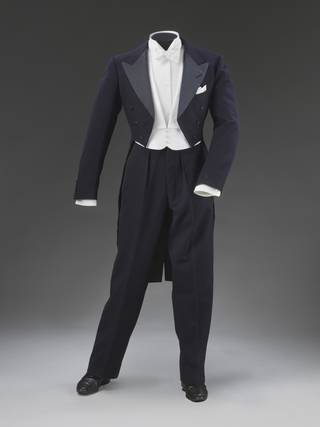
The costume resembles a traditional devil rather than the classical Pluto, king of the Underworld. It conveys the idea of the devil as a fashionable mid-19th century gentleman, which fits the period when the operetta was first performed.

To achieve the effect, the tailcoat (the coat tails being literally forked tails) and hat are covered with alternating horizontal lines of red and green scales, the hat having devil's 'horns'. The green 'waistcoat', fixed inside the coat edges, mirrors the green scales, while the red trousers pick up the red scales. The dickey and cuffs are serrated to suggest flames and are made in red lurex fabric, which is also used to line the coat tails and cover the forked end of the tails.

The scales on the tailcoat could have been drawn onto the fabric and coloured in, but the designer and maker chose the more labour-intensive way of cutting and stitching each row of scales before attaching each row individually, which makes for a more lively effect. The coat tails are stiffened and shaped, reinforcing the idea of someone not quite human. The forked tails can be fastened onto the front of the coat, unfastened to trail behind or become a useful actor's accessory. The problem is getting the tails to fold and fasten without destroying the correct shape of the tails at the back.

Costume for Pluto in Offenbach's operetta 'Orpheus in the Underworld', designed by Gerald Scarfe, made by Kandis Cook, English National Opera, Coliseum, London, 1985. Museum no. S.788:1/4-1991

Costume for Pluto in Offenbach’s operetta 'Orpheus in the Underworld,' London, 1985. Museum no. S.788-1991
Costume for Pluto in Offenbach’s operetta 'Orpheus in the Underworld', London, 1985. Museum no. S.788-1991
Costume for Pluto in Offenbach’s operetta 'Orpheus in the Underworld,' London, 1985. Museum no. S.788-1991
Costume for Pluto in Offenbach’s operetta 'Orpheus in the Underworld', London, 1985. Museum no. S.788-1991
Costume for Pluto in Offenbach’s operetta 'Orpheus in the Underworld,' London, 1985. Museum no. S.788-1991
Costume for Pluto in Offenbach’s operetta 'Orpheus in the Underworld', London, 1985. Museum no. S.788-1991

A gift in your will

You may not have thought of including a gift to a museum in your will, but the V&A is a charity and legacies form an important source of funding for our work. It is not just the great collectors and the wealthy who leave legacies to the V&A. Legacies of all sizes, large and small, make a real difference to what we can do and your support can help ensure that future generations enjoy the V&A as much as you have.

More

Shop online

Costume design for Anna Pavlova (Custom print)

Costume design for Anna Pavlova (Custom print)

Costume design for Anna Pavlova in Oriental Fantasy by Leon Bakst (A4 Satin print)

Buy now

Event - Create! Costume Design

Sat 18 February 2012–Sat 25 February 2012

YOUNG PEOPLE'S EVENT: Create a range of costume designs for a live music concert, dance show or stage performance. Using the Theatre and Performance collections as inspiration, find out how to capture ideas on paper for a collection of outfits needed for a show and learn how to create and communicate a concept for a performance.

Book online