Diaghilev and the Ballets Russes
Serge Diaghilev (1872-1929) and Igor Stravinsky (1882-1971), black and white photograph, Spain, 1921
Serge Pavlovich Diaghilev (1872-1929), Серге́й Па́влович Дя́гилев, Serge de Diaghileff, Sergey Dyaguileff, dictator, devil, charlatan, sorcerer, charmer - all names of a single man whose unique character and driving ambition caused a ferment in European culture.
Diaghilev's greatest achievement was his dance company - the Ballets Russes. Created a century ago, the productions of the Ballets Russes revolutionised early 20th-century arts and continue to influence cultural activity today.
As an individual, Diaghilev remains elusive. He lived through the cataclysms of the First World War and the Russian Revolutions, yet seemed strangely unaffected by them. He embraced the modern and exploited the avant-garde, but was in many ways deeply conservative. He lived mostly in hotel rooms, but turned his company into an extended family.
He left few personal possessions, but offers all of us an astonishing legacy of music, dance and art.

Serge Diaghilev, about 1924
Serge Diaghilev, about 1924, V&A Theatre & Performance Collections

Ballet Russes on tour
Roger Désormière, Serge Diaghilev, Serge Lifar, Boris Kochno, Alexandra Danilova, Felia Doubrovska and Lubov Tchernicheva on tour, Liverpool, 1928, V&A Theatre & Performance Collections

Poster for the Ballets Russes featuring illustration by Valentin Serov
Poster for the Ballets Russes featuring illustration by Valentin Serov of Anna Pavlova in Chopiniana, Théatre du Châtelet, Paris, 1909. Museum no. S.561-1980

Costume worn by Feodor Chaliapin as Boris Godunov
Costume worn by Feodor Chaliapin as Boris Godunov, designed by Alexandre Golovine, made by the Maryinsky wardrobe, about 1908. Museum no. S.459&A,D,E-1979

Detail of costume for Mariuccia in The Good-Humoured Ladies
Detail of costume for Mariuccia in The Good-Humoured Ladies, designed by Léon Bakst, 1920s. Museum no. S.148-1985
The first seasons 1909-14
Léon Bakst (designer), costumes for brigands in Fokine's ballet Daphnis and Chloé, 1912. Museum no. S.508&A, B-1979; S.639&A, B, 635&A, C-1980
On 19 May 1909, after weeks of publicity, Diaghilev launched his first season of Russian ballet in Paris. Audiences were dazzled by the dancing and striking designs. Over the next few seasons a self-consciously Russian element dominated the productions. Innovative music magnified their impact, in particular that of Igor Stravinsky. The company's principal choreographer was the Russian dancer Mikhail Fokine.
Visually, the first Ballets Russes seasons were marked by the exotic designs of the Russian-born artist Léon Bakst. His bejewelled colours, swirling Art Nouveau elements and sense of the erotic re-envisioned dance productions as total works of art.
Following his critical triumph in 1909, and despite a financial loss of 76,000 francs (over £350,000 today), Diaghilev was in demand across Europe. So in 1911 he established the Ballets Russes as a year-round touring operation rather than a seasonal enterprise.

Costume worn by Adolph Bolm as the Polovtsian Chief in Prince Igor
Costume worn by Adolph Bolm as the Polovtsian Chief in Prince Igor, designed by Nicholas Roerich, 1909. Museum no. S.590-1980&A,B-1980

Costumes for Polovtsian Warriors in Prince Igor
Costumes for Polovtsian Warriors in Prince Igor, designed by Nicholas Roerich. 1909. Museum no. S.577&A,B-1980 and S.576C-1980; S.588&B-1980 and S.587A-1980

Detail of a costume for a Polovtsian Girl in Prince Igor
Detail of a costume for a Polovtsian Girl in Prince Igor, designed by Nicholas Roerich, 1909. Museum no. S.589-1980

Boots worn by Alicia Markova in Prince Igor
Boots worn by Alicia Markova in Prince Igor, about 1926. Museum no. S.655&A-1983

Sculpture of Adolph Bolm as the Polovtsian Chief in Prince Igor
Sculpture of Adolph Bolm as the Polovtsian Chief in Prince Igor, M. Frödman Cluzel, 1909. Museum no. S.874-1981
Nijinsky: a force of nature
Nikolai Roerich (designer), costumes for female dancers in The Rite of Spring, 1913. Museum no. S.669&A-1980, S.659&A, B-1980, S.681-1980 and S.667A-1980
The virtuosity and charisma of Vaslav Nijinsky (1889-1950) were such that no one who saw him perform, it was claimed, ever forgot him. He transformed himself for each role he danced.
Trained in the Russian Imperial Ballet, he was an instant success on the Parisian stage from the Ballets Russes' first season in 1909. Audiences had not seen an equivalent male dancer for more than two decades.
As a choreographer, he created unusually varied productions, whose style of movement differed radically from one another and from the academic ballet audiences were used to seeing.
Nijinsky became Diaghilev's lover in late 1908. It was an intense relationship in which Diaghilev was often seen to dominate, and abruptly halted when Nijinsky married and Diaghilev dismissed him from the company in 1913.
He returned briefly for two seasons during the First World War, but later suffered from schizophrenia, which eventually ended his career.

Signed photograph of Vaslav Nijinsky
Signed photograph of Vaslav Nijinsky in Le Spectre de la Rose, photograph by Bert, 1912, V&A Theatre & Performance Collections, Valentine Gross Archive

Ida Rubinstein and Vaslav Nijinsky print
Ida Rubinstein as Zobeide and Vaslav Nijinsky as the Golden Slave in Schéhérazade, published by Georges Barbier, dedicated to the bookseller and balletomane Cyril Beaumont, 1913. Museum no. S.15-2001

Woman’s jacket and hat from The Rite of Spring
Woman’s jacket and hat from The Rite of Spring, designed by Nicolas Roerich, made by Caffi, 1911. Museum no. S.653&A-1980

Costume worn by Vaslav Nijinsky as Albrecht in Act II of Giselle
Costume worn by Vaslav Nijinsky as Albrecht in Act II of Giselle, designed by Alexandre Benois, 1910. Museum no. S.836&A-1981

Earrings worn by Vaslav Nijinsky as the Golden Slave
Earrings worn by Vaslav Nijinsky as the Golden Slave in Schéhérazade, designed by Léon Bakst, 1910. Museum no. S.405&A-1984
Creating ballet
Ballet uses the human body to express story and emotion. Given this basic character, ballet tends to explore strong simple stories which may also provide opportunities for dancers to display their virtuosity.
While the dances performed by the Ballets Russes appeared revolutionary, they drew on existing traditions of ballet production. As the driving force of the company, Diaghilev gathered a wide range of composers, choreographers, designers and performers, but maintained ultimate control over every aspect of the productions. His greatest achievement was to ensure the close integration of story, music, choreography and design, creating spectacles where the overall impact surpassed the parts.
From the start, Diaghilev's ambition was to generate entirely new ballets rather than repeat others' successes. Typically, each Ballets Russes season might include two or three new productions and their creation, often protracted, took up a large proportion of his time and energy.

Detail of a costume for a Knight in The Firebird
Detail of a costume for a Knight in The Firebird, designed by Alexandre Golovine, 1910. Museum no. S.5321:1,2-2009

Lubov Tchernicheva as the Tsarina from The Firebird
Lubov Tchernicheva as the Tsarina from The Firebird, Vera Willoughby, about 1921. Museum no. S.437-2000

Tamara Karsavina and Adolph Bolm in The Firebird
Tamara Karsavina and Adolph Bolm in The Firebird, photograph by Bassano, 1910, V&A Theatre & Performance Collections

Illustration of Adolph Bolm as Ivan Tsarevitch
Illustration of Adolph Bolm as Ivan Tsarevitch outside the Enchanted Castle in The Firebird, Fortunino Matania, Covent Garden Theatre, London, 1912. Museum no. S.473-1989

Cover of Le Théatre showing Tamara Karsavina
Cover of Le Théatre showing Tamara Karsavina in costume as the Firebird, May 1911, V&A Theatre & Performance Collections
Pablo Picasso (designer), costume for the Chinese Conjuror from Parade, 1917. Museum no. S.84&A-1985
The war years
The First World War (1914-18) nearly destroyed the Ballets Russes. During the years of devastating warfare, Diaghilev was isolated from his main European venues. In 1914 Diaghilev and Stravinsky were successful citizens of imperial Russia. By 1918 they were stateless exiles from a Bolshevik Russia wracked by civil war.
When war broke out, the Ballets Russes had completed five successful years and were just dispersing for their summer vacation. The company did not reform until May 1915, when Diaghilev rebuilt it for the first North American tour.
The productions of 1915-19 were both the most conservative and most experimental. The Ballets Russes toured popular works to new audiences in North and South America. Yet there were long periods in Europe without performing, in which the company could workshop original ideas.
Léonide Massine emerged as a talented new choreographer, drawing on influences from the countries of his travels, notably Italy and Spain.

Nicholas Zverev as an Acrobat from Parade
Nicholas Zverev as an Acrobat from Parade, photograph by Lachmann, 1917, V&A Theatre & Performance Collections

Léonide Massine as the Chinese Conjuror from Parade
Léonide Massine as the Chinese Conjuror from Parade, photograph by Lachmann, 1917, V&A Theatre & Performance Collections

Marie Chabelska as the Little American Girl from Parade
Marie Chabelska as the Little American Girl from Parade, photograph by Lachmann, 1917, V&A Theatre & Performance Collections

The American Manager from Parade
The American Manager from Parade, photograph by Lachmann, 1917, V&A Theatre & Performance Collections

The French Manager from Parade
The French Manager from Parade, photograph by Lachmann, 1917, V&A Theatre & Performance Collections
Ballets Russes in the 1920s
The First World War saw the collapse of the Russian, German, Austro-Hungarian and Ottoman empires. After a brutal civil war, Russia came under Communist control and Diaghilev never returned. The belle époque that had seen the birth of the Ballets Russes had been shattered forever.
Diaghilev's great themes - Russia, the classical world and the Orient - were now treated in the context of modernity. Other ballets reflected topical interests such as beach culture, films and sport.
By 1920 the Ballets Russes had a considerable repertoire to which new ballets were added each year. French avant-garde artists such as Matisse, Derain and Braque designed productions, while the choreographers Massine, Nijinska and Balanchine approached movement in innovative ways.
Diaghilev and his company had to adjust to very different economic circumstances. Monte Carlo now provided a winter base in which to create new works, while long seasons in London provided some financial stability.

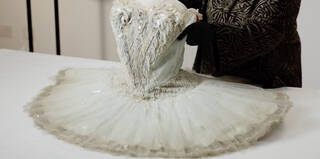
Detail of costume for a Huntsman in The Sleeping Princess
Detail of costume for a Huntsman in The Sleeping Princess, designed by Léon Bakst, 1921. Museum no. S.119-1981

Back view of costume for a Marquis in The Sleeping Princess
Back view of costume for a Marquis in The Sleeping Princess, designed by Léon Bakst, 1921. Museum no. S.817&A,B-1980

Costume for a Negro Lackey
Costume for a Negro Lackey (as programmes of the time referred to the character) from The Sleeping Princess, designed by Léon Bakst, 1921. Museum no. S.767&A-1980

Costume for Prince Charming from The Sleeping Princess
Costume for Prince Charming from The Sleeping Princess, designed by Léon Bakst, 1921. Museum no. S.829&B,D,F-1980

A group of costumes for The Sleeping Princess
A group of costumes for The Sleeping Princess, designed by Léon Bakst, 1921. Museum no. S.817&A,B-1980, S.821&A,B,C-1980, S.119-1981
Legacy
The designs and colours used in Ballets Russes productions forged a new aesthetic in the 20th century. Knowledge of the company's revolutionary ballets filtered through to theatre, fashion and daily life, including interior design. Diaghilev's presentation of his homeland in particular created a notable strand of Russian style.
Perhaps the most evident legacy is the music Diaghilev commissioned. Ballet scores by Stravinsky, de Falla and others continue to be performed in concert halls around the world.
The repertoire of the Ballets Russes remains an invaluable resource for choreographers today. Over 200 different versions of The Rite of Spring have been choreographed since Diaghilev commissioned it. Diaghilev's achievements continue to inspire the worlds of art, theatre, music and dance.

The Royal Ballet production of The Firebird
The Royal Ballet production of The Firebird, photograph by Graham Brandon, Royal Opera House, Covent Garden, 2006, V&A Theatre & Performance Collections

Costume worn by Alice Nikitina as Flore in Zéphyre et Flore
Costume worn by Alice Nikitina as Flore in Zéphyre et Flore, designed by Georges Braque, 1925. Museum no. S.838&A-1980

Sotheby’s auction of Ballets Russes material
Sotheby’s auction of Ballets Russes material, a dancer models the costume for Flore from Zéphyre et Flore against the frontcloth for Le Train bleu, photograph by Nesta MacDonald, 1968, V&A Theatre & Performance Collections

Article in The Sunday Times describing an auction of Ballets Russes material
Article in The Sunday Times describing an auction of Ballets Russes material, with illustrations of models in costumes from The Sleeping Princess and Thamar, V&A Theatre & Performance Collections

Adolph Bolm and Tamara Karsavina in costume for the ballet Thamar
Adolph Bolm and Tamara Karsavina in costume for the ballet Thamar, photograph by Waléry, 1912, V&A Theatre & Performance Collections

Alicia Markova teaching the title role of George Balanchine's Le Chant du Rossignol to Iohna Loots
Alicia Markova teaching the title role of George Balanchine's Le Chant du Rossignol to Iohna Loots, Graham Brandon (photographer), English National Ballet, 1995, V&A Theatre & Performance Archive
A gift in your will
You may not have thought of including a gift to a museum in your will, but the V&A is a charity and legacies form an important source of funding for our work. It is not just the great collectors and the wealthy who leave legacies to the V&A. Legacies of all sizes, large and small, make a real difference to what we can do and your support can help ensure that future generations enjoy the V&A as much as you have.
MoreShop online
Diaghilev 3 CD Boxed Set
The compilation accompanies the V&A exhibition Diaghilev and the Golden Age of the Ballets Russes 1909-1929.
Buy now