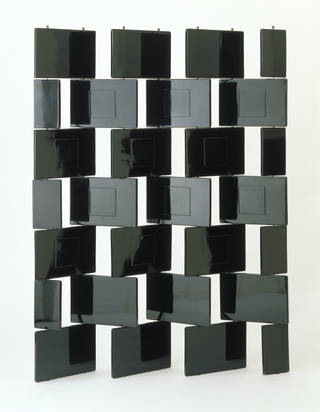
Lacquer screen, Eileen Gray, about 1928. Museum no. W.40-1977
Eileen Gray was born Enniscorthy, Ireland in 1878 and died in Paris in 1976.
Eileen Gray was born into an aristocratic Irish family. Independent and adventurous, she enrolled at the Slade School of Art in London aged 20. She then moved to Paris in 1902, where she was to spend most of her life.
In Paris she studied to become the first western practitioner of Japanese lacquer. Initially, she was known for her work in the Art Deco style but by the mid 1920s, under the influence of Le Corbusier especially, she became a proponent of Modernism.
Gray worked relatively little after 1930 and her work was largely forgotten until the 1970s. Today she is considered a pioneer of both Art Deco and Modernism.
Learning lacquer
In 1906 Gray met Seizo Sugawara, a Japanese lacquer master living in Paris. Although lacquer was a laborious and potentially toxic art, she became a devoted student and publicly exhibited examples of her work in 1913.
By the early 1920s Gray was creating not only lacquered screens but also architectural panelling and extravagant furniture in the Art Deco style. She had fashionable clients and set up a special workshop for furniture and lacquer.
Gray’s approach to lacquer, including her use of glossy surfaces, was original and did not always follow Japanese traditions.
Business model
As a designer and practitioner Gray was extremely unusual, not least because she was a woman operating on her own. In 1910 she created a workshop for the weaving of her carpets, which became her most successful products. As well as making lacquer work herself, Gray also hired craftsmen, eventually creating a separate studio for lacquer and furniture. In 1922 she opened a shop, Jean Désert on the fashionable Rue du Faubourg Saint-Honoré, to sell the full range of her designs.
By the late 1920s, however, tastes changed and the shop closed. Gray then turned her attention mainly to architecture.
Folding hammock chair, designed by Eileen Gray, 1938. Museum no. CIRC.579-1971
Defying categories
Gray was a designer who defied easy categorisation. In her early, Art Deco work she explored decorative surfaces and luxurious materials within a design vocabulary that could be either extravagant or restrained.
By the mid 1920s her architectural sensibility became more evident, in increasingly geometric, even abstract, furniture, carpets and lighting. Yet she maintained her interest in the feel and effect of materials. When Gray created her own Modernist house she put into practice her belief that ‘human needs’ should guide the designer. ‘The art of the engineer’ was not enough.
Armchair, designed and made by Eileen Gray, before 1929. Museum no. Circ.578-1971
Amanda Levete, architect and furniture designer, discusses an Eileen Gray armchair
I'm Amanda Levete, I'm an architect and I design furniture.
It's very personal for me, this chair, because Eileen Gray was firstly a designer and then practised architecture - for me it's the reverse. But the chair is very expressive of a direct relationship between architecture and design. In a sense it's like architecture in miniature, because every piece of it is doing exactly what it should be doing and is very expressive of that. So the sycamore frame, which supports this very slung piece of leather, and then the chrome joints which hold it all together.
She designed this chair for the house that she designed for her lover Jean Badovici. And the house was very much about its site and its aspect and looking on to the Mediterranean. But inside it was a very clean, simple space, straight lines and lots of light. And every piece of furniture was designed by Eileen Gray, including the rugs on the floor and the bed and the bedside table. So it was an ensemble, if you like, of her pieces, and an opportunity for her to create a total environment, which is a great privilege and what we all aspire to doing.
The form of the chair makes you think of a languid afternoon in the Mediterranean looking out at the sea, because this house she designed was like a beached liner that was slung across the rocks. And the name, the ‘Transat’ chair - it’s the deck chair that you'd find on a transatlantic liner. And a deck chair is pure reductive functionalism. So it was, the very form of the chair is, suggestive of a kind of sensualism and a relaxation and a kind of lying back and observing or reading, but it's a very sensual piece for me.
Armchair (back view), designed and made by Eileen Gray, before 1929. Museum no. Circ.578-1971
Christopher Wilk, Head of the Furniture, Textiles and Fashion Department at the V&A, discusses an Eileen Gray armchair
I'm Christopher Wilk and I'm head of the Furniture, Textiles and Fashion Department at the V&A.
This is one of the most remarkable and beautiful chairs by the architect and designer Eileen Gray. Eileen Gray was born in Ireland but she spent her entire professional life in Paris, where she died at a ripe old age.
She came to furniture because she wanted to learn how to make lacquer, which is an extremely difficult thing to do. And her screens and her other lacquer work were highly decorative and they fit very much into that deluxe Parisian style of Art Deco. However, at the same time she was interested in the architecture of Le Corbusier, in German Modernism, and I think in this chair you can see bits of both. You can see that sense of elegant form, which characterises Art Deco, and attention to surface. And on the other hand the geometrical rigour of Modernism.
In some ways, it's a traditionally jointed chair, but it's obviously not a chair designed by a traditional furniture maker. She's decided to use these chrome metal plates that she wraps around some of the joints as if to highlight them, as if to draw your attention to the actual physical structure of the chair and the way that it's put together.
One of the most interesting things about this chair in terms of its history is that it was ignored, along with all of her work, for so many decades. The first exhibition of Eileen Gray's work wasn't until 1972, and she really was a figure who was lost to history and to the design community until relatively recently. Now, that's clearly because she was a woman. She said that she was a no one as far as the French architectural world was concerned. And the story of Eileen Gray is really the story of retrieval. You look at her work, you look at this chair, you look at the lacquered screen just to the right of this chair, and you think, how could a woman of this talent ever have been forgotten? How come decades went by when essentially nobody knew about her?
Audio description of the Furniture Gallery's Eileen Gray display
In this display is an armchair designed by Eileen Gray. It's a long lounger positioned sideways in front of reproductions of various sketches from Eileen Gray's notebooks enlarged on the wall behind.
This elegant chair, designed in the late 1920s, combines luxury with functionality in a way that’s reminiscent of the deckchairs on transatlantic liners – so it’s come to be known as the ‘Transat‘ chair – one to lie back in and relax. Its overall shape is a long, low rectangle, the frame constructed from slim, square-cut lengths of sycamore, whose shiny surface has mellowed to a golden honey colour. Slender front and rear legs are joined at the top by a long horizontal arm. The corners where legs and arm meet are rounded off.
Slung from front to back, like the canvas on a deckchair, is a yellowy-brown seat divided into ten thick padded slat-like sections. At the front, the padding is wrapped over the edge, cushioning under the knees. The curvaceous form of the seat contrasts strongly with the straight lines of the wooden frame. A separate headrest is held in position by gently arched chrome joints, allowing it to swivel. The chrome detailing on the joints is a feature elsewhere on the chair, emphasising its construction.
With its clean straight lines, pale wood, chrome joints and curvaceous upholstery, the chair has a sense of poise and balance – formally constructed without being brutal, functional without compromising on comfort.
You may not have thought of including a gift to a museum in your will, but the V&A is a charity and legacies form an important source of funding for our work. It is not just the great collectors and the wealthy who leave legacies to the V&A. Legacies of all sizes, large and small, make a real difference to what we can do and your support can help ensure that future generations enjoy the V&A as much as you have.