The religion of Islam was revealed to the Prophet Muhammad in the early 7th century. Muhammad was a political leader as well as a religious guide, and after his death in 632, his successors established a vast empire. By conquest and conversion, the new religion spread quickly westwards through the territories of the Byzantine empire. By the 640s, Muslim forces were advancing across North Africa, conquering Sicily in 652 and the Iberian Peninsula in 711. By the early 8th century, Islamic territories had almost encircled the Mediterranean.
The Mediterranean has always been a linking sea, and as Islam became established as a power to be reckoned with, contacts developed with the Christian-ruled states of Europe. These were sometimes the product of conflict, but more often occurred through diplomacy and trade. The Islamic side of the Mediterranean was the terminus of ancient trading networks between East and West Asia, and the Muslim states controlled other routes along which precious commodities were carried back and forth. In Europe, the main destination for these luxury imports was Italy. The city republics of Venice, Florence and Genoa controlled maritime trade in the Mediterranean, and their merchants were principally responsible for the movement of Islamic goods around its coasts.
These objects were prized, because at least initially the materials and techniques used to make them were far more sophisticated than anything being made in Europe at the time. Medieval Islamic objects made from rock crystal, for example, were thought to have magical properties because they were so clear and transparent, compared with the glass then made in Europe. These objects were given as precious gifts to church treasuries where they sometimes stored holy relics. One reason why some types of medieval Islamic objects survive at all is precisely through their reuse in Christian contexts.
Rock crystal
Naturally-occurring rock crystals were used by craftsmen from Iraq and Egypt to make objects of supreme beauty and elegance. Objects like the Egyptian ewer were made to be royal possessions of the Fatimid rulers of Egypt (969–1171). They were prized for their clarity, which was thought to combine the qualities of air and water, and for the great skill required to hollow the crystal to a thickness of only 2mm in places, and then polish its surface, without breaking or blemishing it. Most of the surviving Fatimid rock crystal ewers were preserved in important church treasuries, such as the basilicas of Saint Mark in Venice and Saint Denis in Paris.
The tiny rock crystal flask in the shape of a fish may originally have held a precious perfume. It is believed to have been made in Egypt, where rock crystal was used to make precious possessions for the ruling dynasty, the Fatimids (969–1171). It found its way to Europe where it was made into a pendant with silver-gilt and niello mounts. These bear the Latin inscription, Ave Maria Gracia Plena ('Hail Mary Full of Grace'), suggesting that it was worn as a personal talisman. The cavity inside the flask may also have been used to hold a tiny relic.
Until the 14th century, objects in rock crystal were imported into Europe ready-made from the Islamic world. European admiration for these objects, and for the clarity of the crystal they were made from, was so great that, around 1300, the French began to import the raw material from the Islamic world, and to carve their own versions. These copied the pear-shaped form of the Egyptian ewers, but their surface decoration was never as elaborate as the Islamic objects. Instead, decoration was concentrated in the silver-gilt mounts, which here feature Gothic ornaments in the most fashionable style.
Import & imitation
European admiration for sophisticated Islamic wares led to their imitation. Exotic raw materials such as rock crystal and ivory were imported from the Islamic world, and local craftsmen were commissioned to re-work copies of them in a more familiar style or for a specific local function. Other imported items made of less precious materials were also imitated locally, sometimes inspiring the creation of new industries.
Muslim-ruled countries like southern Spain, Turkey and Egypt, produced fine carpets which were exported to Europe from the 14th century. They were sought after as luxurious furnishings in palaces and churches, and their high status is shown by the many European paintings in which they are prominently depicted. In fact some types of Turkish carpet are sometimes known after the 16th-century European painters who included them in their paintings, such as Hans Holbein (about 1497–1543) and Lorenzo Lotto (about 1480–1556).
European craftsmen imitated the patterns they so admired in Islamic imports, especially complex floral scrolls which they called arabesques, geometric interlacing, and even the Arabic inscriptions which decorated many items of Islamic art. Certain imported shapes were so closely copied that their eastern origins were quickly forgotten. Gradually the Europeans learned the techniques themselves, and started to apply their own styles of decoration to them. These began to challenge the supremacy of the exotic imports, and Islamic production started to lose ground to European wares. In some instances, however, Islamic craftsmen seized back the initiative from their European competitors, as with the Ottoman imitations of Italian velvets.
Islamic Spain
Spain, and to a lesser extent Portugal, was the most important meeting place between the Christian and Muslim worlds of the Mediterranean. In 711 the armies of Islam conquered the Iberian Peninsula, which now became the westernmost outpost of the Islamic empire. Most of the Peninsula remained under Islamic rule until the early 13th century.
The great golden age of Islamic Spain was the 10th century, during the heyday of the Umayyad caliphate (756–1031). At this time the capital, Córdoba, was the largest and most sophisticated city in Europe; an international centre of learning, an entrepôt for trade, and a production centre for luxury arts. The caliph al-Hakam II (reigned 961–76) was a great cultural patron, and went to enormous lengths to collect books and objects from all over the known world, even asking the Byzantine emperor for a copy of Dioscorides' treatise on the medicinal properties of plants, and for glass mosaic tesserae to adorn the mihrab (prayer niche) of Córdoba's Great Mosque.
Between 1160 and 1238 the North African Almohad dynasty unified Spain with Morocco, but by 1258 they had been defeated by the Christian crusaders of the Reconquista (reconquest). Islamic territory was picked off by land-hungry Christian kingdoms, leaving only the small state of the Nasrid sultanate in the south-eastern corner of the peninsula, with its capital at Granada. This last outpost of Islamic rule on the peninsula flourished until its conquest in 1492 by the Catholic monarchs Ferdinand and Isabella.
Islamic culture was present in Europe for nearly 800 years. Muslims continued to live in Spain until they were expelled in the early 17th century, but their cultural influence lived on far longer, since after so many centuries of interaction and assimilation, the Islamic origins of, for example, architectural tilework or the use of carpets had been forgotten.

Marble column capital
950-75
Córdoba, Spain
Museum no. A.10-1922A characteristic of Islamic art in Spain was the influence of Roman ornament. When the Muslims arrived in the early 8th century, the landscape was littered with Roman ruins, and the Umayyads reused many marble columns and capitals in the monuments they erected, especially in the Great Mosque of Córdoba. In the 10th century, marble was carved afresh, due to the huge number of construction projects undertaken by the caliphs. Gradually new styles emerged, but some examples like this one continued to copy Roman forms. This composite capital looks entirely Roman, but the Arabic inscription in kufic script along its top edge indicates its Islamic origins.

Ivory casket
Ivory casket
About 962
Spain, probably Madinat al-Zahra'
Museum no. A.580-1910This ivory casket was made for a daughter of the caliph Abd al-Rahman III (reigned 912-61). This great ruler wished to create an imperial power centred in Córdoba, and to demonstrate this aspiration, he constructed an enormous palace city outside Córdoba, which he called al-Madinat al-Zahra, 'the shining city'. He was also a great patron of the luxury arts, and created an ivory-carving industry which was based at the palace. The scrolling decoration of leaves and flowers on this casket resembles that on the walls of his throne room. Caskets like this, carved from solid blocks of ivory, were probably used to store precious possessions, like jewellery or perfumes.

Ivory casket
Ivory casket
975–1000
Byzantine Empire
Museum no. 5471-1859The Byzantine empire also had an important ivory-carving tradition, and knowledge of this may have inspired Abd al-Rahman III (reigned 912-61) to create his own industry. The Córdoban ivories were sent out as diplomatic gifts, and it is likely that ivories similar to the previous example were sent as gifts to the Byzantine emperor. They must have been appreciated in Constantinople: while most Byzantine ivories feature religious or mythological subjects, a few examples like this one are carved all over with curling leaves, which suggests the influence of Islamic caskets from Córdoba.

Ivory plaque from the front of a casket
About 1020–30; lock-plate re-carved about the 13th century
Cuenca, Spain
Museum no. 4075-1857In the early 11th century a period of civil war led to the disintegration of central authority from Córdoba, and a number of independent city states established themselves, whose rulers vied with each other to recreate the splendour of Umayyad Córdoba at their courts. One of these new kingdoms was based at Toledo, whose rulers continued to patronise luxurious creations from ivory. This plaque became separated at some point from its original casket, and was later reused in a Christian context, probably as a book cover; a bust of the evangelist St Matthew has been carved into the small rectangle that was originally left plain for the lock-plate.

Fragment of silk textile
1100–50
Almería, Spain
Museum no. 828-1894The Muslims introduced sericulture (silk production) and silk-weaving to Spain. By the 12th century Almería, on the Peninsula's south-eastern coast, had grown into one of the greatest ports in the Mediterranean, and was well-known as a production centre for 'costly silks of the brightest colours'. Silks were woven here for the highest levels of society, and exported in large numbers, especially to the Christian kingdoms of northern Iberia. Their designs usually featured paired animals inside roundels, inspired by silks from Byzantium and pre-Islamic Iran. The raised eye-tails of the paired peacocks on this silk would have appeared like roundels when repeated across the surface of a large textile. Above and below the birds is a mirror-image inscription in Kufic script which repeats the phrase 'perfect blessing'.

Fragment of silk textile with gold thread
1250–74
Spain, probably Almería
Museum no. 796-1893This fragment of a rich silk woven with gold thread comes from the large cope in which the body of Prince Felipe of Castile (1231-74) was wrapped. It was recovered from his tomb in the church of Santa María at Villalcázar de Sirga (near Burgos). Felipe was the brother of Alfonso X of Castile (reigned 1252-84), but rebelled against him and sought refuge in Granada, at the court of the Nasrid sultan Muhammad I (reigned 1237-73). It is likely that Felipe was given this brocaded textile as a gift during his stay. It was so prized by him that it was used to dress him in splendour for the afterlife. The inscription in the wide lower border repeats the word 'barakah' , 'blessing'.

Tin-glazed earthenware bowl
Tin-glazed earthenware bowl decorated in lustre and cobalt blue with a ship
1425–50
Málaga, Spain
Museum no. 486-1864From the 12th century, potters at the Islamic city of Málaga perfected the production of often large-scale ceramics covered with a white tin-glaze and decorated with golden lustre. In the 13th and 14th centuries, Málaga lustrewares were exported widely, from England to Egypt, and commissioned by royalty, nobility and the very wealthy. The ship depicted on this magnificent bowl is a caravel, in which Iberian merchants and explorers sailed the high seas in the 15th century. The sail bears the arms of Portugal and it may have been commissioned by a Portuguese maritime merchant, perhaps to celebrate his commercial success.
Islamic influence in Sicily and Southern Italy
The island of Sicily, at the heart of the Mediterranean, is a natural stopping place for sea travellers. Sicily is close to Tunisia on the North African coast, and this proximity has played an important role in the island's history. Conquered by armies from Tunisia in 652, it was ruled by Muslim dynasties until the Norman conquest in 1071. Like Spain, Sicily is a region that though now part of Europe, was, for several centuries, part of the Islamic world.
Under the Normans, Islamic cultural influences remained strong on the island. These were constantly reinforced by the goods which arrived in Sicily and southern Italy through trade and the close diplomatic contacts maintained between the Norman kings and the Fatimid caliphs in Cairo. Arabic was spoken by several of the Norman kings of Sicily, and remained one of the languages spoken at court in Palermo. Objects and buildings created in Sicily were adorned with Arabic inscriptions, and Arab scholars wrote poetic and historical works dedicated to the Norman kings.
These influences were particularly strong in the 12th century, during the reigns of Roger II (1130–54) and his grandson William II (1166–89). In 1143 Roger was crowned in the Palatine Chapel which he erected in Palermo, wearing a cope inscribed with a long Arabic inscription, beneath one of the best-preserved examples of a medieval Islamic decorated ceiling.
Coastal sites on the Italian mainland were also susceptible to Islamic influences. Ceramic dishes made in Fatimid Egypt (969–1171)were popular for decorating the façades of buildings, especially churches, in the manner of tiles, since sophisticated glazed ceramics were not yet made in Italy.

Casket with birds and roundels
1200–50
Sicily
Museum no. 4535-1859Some 200 ivory caskets decorated in the Islamic style were made in Sicily in the 12th and early 13th centuries. They were probably made for the court as marriage gifts or for storing precious objects. This casket shows the usual style of painting found on the Sicilian ivories. The most common motifs were floral scrolls within roundels, and various types of birds - those with the crest at the lower corners of the casket are probably peacocks. The same birds are also woven into contemporary Sicilian textiles. On this casket, the joins between the small panels of ivory are disguised by rudimentary plant motifs.

Casket with Christian figures
1100–1200
Sicily
Museum no. 603-1902The form and most of the decoration of this large casket are entirely characteristic of the ivory caskets made in Sicily, apart from the prominent figures of Christian saints painted at the front. This may indicate that it was commissioned for use in a church, and in fact this casket used to belong to the treasury of Bari Cathedral, on the south-eastern coast of Italy. The casket also has a long poetic inscription in Arabic, invoking blessings and happiness on the owner, in a manner that is very common on secular works of art made in the Islamic world.

Casket with a reused Fatimid base
Sicily, 1200–50; base probably Cairo about 1150
Museum no. 700-1884This casket illustrates the presence of Egyptian works of art in Sicily. Its base was formed from a cut-down panel. It is made from wood incrusted with small, shaped pieces of ivory, set into a dark resin, a technique which relates to a small group of objects made in Fatimid Egypt, probably in the early 12th century. Perhaps the original object from which this panel came was worn out or broken with use but, as an exotic import, was too highly valued to be thrown away, so it was trimmed down and reused.

Ceiling of the Cappella Palatina
Albumen print of the ceiling of the Cappella Palatina
Palermo, Sicily
Ceiling about 1143; print about 1890–1910
Museum no. 7903-1936This is one of the best surviving examples of an Islamic ceiling in the Mediterranean, though it crowns a Christian religious space – the royal chapel of the palace in Palermo. This building was created for the Norman king of Sicily, Roger II, and was probably completed in time for his coronation in 1143.
The three-dimensional decoration of the ceiling is formed from small cells of carved wood in a technique known in Arabic as muqarnas . The central structure of the ceiling is a pattern of stars and crosses, and every element is covered with paintings in the Islamic style. These include dancers, musicians, seated drinkers and mounted hunters, and every border carries Arabic inscriptions in Kufic script, containing blessings, in the manner of Islamic decorative arts.
A team of carpenters and painters may have been imported from Cairo to produce this most luxurious royal commission. Ironically, few buildings of this period survive in Egypt itself, so now the 'Arabo-Norman' architecture of Sicily provides important information about the lost Fatimid palace architecture on which it was modelled.

Oliphant
Oliphant
Southern Italy
1000–1100
Museum no. 7953-1862An oliphant is a horn formed from a whole elephant tusk. Oliphants may have been used in hunting, but are so heavy that they may equally have been symbols of status or land ownership. Oliphants are often elaborately carved, since the craftsman had the whole thickness of the ivory at his disposal. Many surviving oliphants show the influence of Islamic decoration. This example is covered with roundels containing animals with disproportionately large bodies, and tails which terminate in a palmette or tiny head. This way of depicting animals was used on Fatimid ceramics and other works of art, which were imported by sea into the coastal cities of Sicily and southern Italy
Arabic inscriptions
The Arabic language has an important place in Islam since this was the language in which the Qur'an was revealed to the Prophet Muhammad. Its importance led to the prominence of texts written in the Arabic script in Islamic culture, while the sophistication of this culture is reflected in the development of refined forms of script. A great tradition of Arabic calligraphy developed and a variety of styles of script evolved; equivalent to the different fonts used in printing. Earlier styles are more rectilinear; these are usually known as Kufic script. Some are relatively plain while others have decorative flourishes, which sometimes became very elaborate.
Pre-Islamic Middle Eastern societies used inscriptions on buildings and objects, a practice that continued in the Islamic period using the calligraphic forms of the Arabic script. On Muslim religious buildings or objects, inscriptions often consist of quotations from the Qur'an or other religious sources, but not all the texts used were pious in nature. Inscriptions on luxury objects most often contain good wishes for the owner, while others are moral sayings or quotations from well-known poems. These secular texts could be used on objects made for non-Muslims, including those exported to Christian-ruled Europe.
Arabic inscriptions were seen as the identifying feature of an Islamic object and were therefore frequently imitated in European art, as they immediately gave an object a rich and exotic air. Most European artists could not read Arabic, so when they copied the inscriptions, they misunderstood the shapes of the letters or how they should be joined together, so that the inscription became meaningless, although it still looked like Arabic. Sometimes European artists were not concerned about representing the original inscription accurately and just conveyed the sense of an inscription through shapes that looked vaguely like Arabic letters. These meaningless versions of Arabic inscriptions are known as pseudo-inscriptions.

Bowl with Kufic inscription
Eastern Iran or Uzbekistan
900–1000
Museum no. C.909-1935This small bowl is decorated with a simple inscription in the more rectilinear Kufic style. It reads 'Blessing and ease to its owner'. Good wishes for the health or good fortune of an object's owner were one of the most common types of inscription in Islamic art. Here the lettering has been elongated horizontally, so that the short inscription fills the whole space. This creates an elegant and decorative effect.

Silk textile with inscription
Granada, Spain
1330–1450
Museum no. 1105-1900This silk textile was made in the court workshops of the Nasrid dynasty, who were the last Islamic rulers in Spain. During the 14th century, silks woven with this kind of striped decoration became very popular in Granada. Here, wide bands of inscription in a cursive script alternate with narrower bands of lotus flowers and geometric interlace. The inscriptions stand out clearly in white silk against a blue ground. One phrase is repeated four times along each row of this fragment. It reads 'Glory to our Lord the Sultan'.

Tunic
Tunic
Egypt
700–900
Museum no. 291-1891After the Arab conquest of Egypt in 642, the long-standing traditions of Roman and Byzantine dress continued alongside Islamic fashion. This man's tunic is a good example of new features mixed with old. Most intriguing are the different scripts in the tapestry woven decorations. A pseudo-inscription on the shoulder bands, close to the neckline, may have had the Arabic phrase 'Dominion belongs to God' as inspiration. On the medallions of the same shoulder bands, there is another 'inscription', which resembles the script used for Coptic, the language of most Egyptians at the time of the Islamic conquest. Neither the Arabic or the Coptic lettering conveys meaning here, and are treated as any other pretty pattern.

Enamel plaque
Enamel plaque
Limoges, France
About 1250
Museum no. M.104-1945This enamel plaque shows three men being resurrected from the dead on the Day of Judgement. It probably came from a larger enamelled object showing Christ's crucifixion, which is referred to in the Latin inscription along the bottom of the plaque. Around the other edges, a border of pseudo-Kufic has been engraved into the copper. This pairing of a border decoration derived from Arabic with a strongly Christian scene may reflect an appreciation of Islamic luxury arts in French church or noble treasuries.

Silk fragment
Silk fragment
Italy
1370–1430
Museum no. 814-1899During the late 13th and early 14th century, luxury silks with lively scenes made in the vast Mongolian empire were in high demand among Europe's elite. To compete with these expensive silks, European textile industries had to adjust, and incorporated eastern motifs into their products to better appeal to the European luxury market. This Italian silk fragment shows a dramatic scene typical of the period, in which a large bird attacks a deer. It is combined with a scroll bearing pseudo-Kufic inscriptions. The eastern motifs and the exotic inscription create an illusion that this was an example of the more expensive imported silks, instead of Italian production.

Mazer bowl and cover
Probably France
About 1400
Museum no. 221-1866This lidded drinking bowl is carved out of a knot of maple wood, which is known as a 'mazer'. Mazer bowls were common in royal or noble households until the 17th century and were often adorned with gold or silver mounts. This example is unique for having carved decoration, which is also particularly elaborate. Amongst the floral motifs run two long bands of pseudo-inscriptions, one encircling the lid, the other the body. These inscriptions probably copied those on imported examples of inlaid brassware made in the Mamluk empire.

Pharmacy jar
Pharmacy jar (albarello)
Valencia (Manises), Spain
1375–1400
Museum no. C.123-1931An albarello was a form of storage jar that originated in the Middle East. It stored spices, herbs or medicines, which were exported to Europe, where the form of the container was copied. They became a popular shape for pharmacies, because they often had a pinched-in waist, which meant they could easily be grasped when they were lined up close together on a shelf.
This example was made in Spain, in the Christian-owned workshops of Manises, near Valencia. At first, these were staffed by potters from the Muslim lustre industry at Málaga, and the earliest products continued many motifs from their Islamic antecedents. This included the use of Arabic inscriptions. One particular word is common on pharmacy jars from Manises, the Arabic word al-'afiya , meaning 'well-being', which is appropriate for their medicinal contents. However, the word is written in a very stylised way, so that it becomes a pattern rather than a readable inscription.

Tapestry altar frontal with scenes of Christ's Passion
Probably Arras, Southern Netherlands
1400–25
Museum no. T.1-1921This magnificent tapestry shows the descent of Christ from the Cross, his entombment, and then his resurrection. This subject matter indicates that it was probably used as an altar frontal in a great church or cathedral. In the entombment scene, the figure at Christ's feet wears a robe whose borders are decorated with pseudo-inscriptions. Islamic silks would have been luxury imports in the 15th-century Netherlands, where this tapestry was made, and the figure's prominent position, almost at the centre of the tapestry, implies the high status environment in which this tapestry was woven and used.
Patterns & shapes
In Islamic art, the accurate representation of living beings was controversial, since it was believed that only God could create life. For some, any image that was too lifelike threatened to encourage idol worship. Consequently, in religious contexts, the depiction of living beings was usually avoided, and other forms of ornament became predominant. Inscriptions, geometric elements, and motifs based on plants and nature came to have a prominent role in Islamic design. Certain patterns or motifs which were mostly used as border decoration by pre-Islamic cultures – especially the Romans or Sasanians, from whose art much Islamic ornament was derived – might cover an entire surface on an Islamic building or object.
European craftsmen copied designs from Islamic imports, especially luxury silk textiles. These were the most easily transportable trade goods, and often travelled vast distances. Silks made in China and Central Asia were also brought to Europe via Mamluk trade routes, and with them travelled motifs, such as the lotus flower, or mythological beasts whose exotic forms captured the European imagination.
Styles and motifs were also adapted to local tastes. In the 16th century, two styles emerged in Italy at the time of the rediscovery of Classical culture, which were directly based on plant ornaments in Islamic designs. These were known as moreschi or moresques, after the word Moor (a Spanish Muslim), and rabeschi, for arabesques. Today it is difficult for us to tell the difference between these two styles, but we still use the word arabesque to describe the scrolling plant ornament which is so abundant in Islamic design.
The shapes of Islamic imports were also copied. The albarello, for example, was originally a Middle Eastern form of storage jar, which was so widely copied in Italy that this shape is now known by an Italian word.

Silk fragment with a senmurv
Iran or Central Asia
700–800
Museum no. 8579-1863This textile fragment shows a mythological creature called a senmurv. It has a dog's head, a lion's paws, a peacock's tail, and a palmette on its neck. The senmurv was a creation of Sasanian art, though it derived from more ancient Iranian cultures and may have symbolised royal luck. Senmurvs were a popular motif and appear for hundreds of years over a wide geographical area, not only on textiles but also in other media such as metalwork. It even appears in Venice in a 9th-century mosaic. However, in the West, the creature underwent a transformation from a fierce mythical beast, as seen here, to a tamer-looking creature.

Silk fragment with a griffin
Byzantine Empire
900–1100
Museum no. 764-1893The griffin has the body of a lion and the head and wings of an eagle and was seen as a protector from evil. The motif possibly originated in Achaemenid Iran, though it was also used in Byzantine art. As with the senmurv, this exotic creature travelled to Western Europe on silks. Here they captured the local imagination. The Western craftsmen sometimes mixed the creatures' characteristics, and as a result the beasts took on a more cartoonish appearance. On this textile fragment, only the griffin's head remains, though the trunk of an elephant is just visible below it, indicating it was part of an animal combat scene.

Ewer in the shape of a griffin
Germany or Mosan
About 1120
Museum no. 1471-1870This kind of vessel held water to wash hands in the home or at church. They were often made in the form of mythical animals, like this griffin, or exotic animals like lions or elephants that European artisans would never have seen in the flesh. The craftsmen probably copied patterns from luxury eastern imports, the most easily portable of which were Chinese, Iranian or Byzantine silks. The animals in these silks were already quite stylised and their transformation to three-dimensions sometimes had strange results. Instead of a fierce mythical creature that combines attributes of the lion and eagle, this griffin looks rather like a tame dog.

Tile panel
Tile panel
Iran, probably Kashan
1262
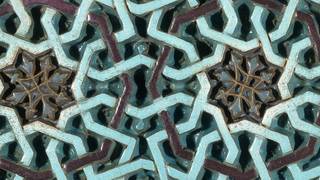
Museum nos. 1487, 1489, 1837&A, C, E, F, 1838&C, E-1876, 1077, 1099&A, 1100&A-1892These lustre tiles come from the tomb of a descendant of the Prophet Muhammad at Varamin near Tehran in Iran. This was a religious building and figural decoration was therefore inappropriate so the tiles are decorated with stylised plant motifs organised according to a geometric structure. Each tile is then bordered by quotations from the Qur'an. The shapes of the tiles – eight-pointed stars alternating with crosses – also form a geometric pattern, indeed one of the most characteristic geometric patterns used in the Islamic world. The star-and-cross framework spread to Europe, where it was used as the underlying structure of the Cappella Palatina ceiling in Palermo and the pavement of tiles from the Petrucci Palace in Siena, for example.

Pavement of tiles from the Petrucci Palace
Siena, Italy
1509–10
Museum nos. 4915 to 5386-1857This impressive pavement of tiles was commissioned by Pandolfo Petrucci to adorn the floor of the principal room of his palace in Siena. The colours and grotesque designs were inspired by the decoration of the recently-excavated Golden House of Nero in Rome. The pavement also shows aspects of Islamic influence. One is the tin-glazed technique in which the tiles were produced, which was introduced to Italy from Islamic Spain, as was the idea of having a tiled pavement at all. Lastly, the geometric framework of stars and crosses evokes Islamic patterns, which were well known in Italy by this date.

Ceiling from the Palacio de Altamira, Torrijos
Toledo, Spain
About 1490
Museum no. 407-1905Spain was part of the Islamic world for nearly 800 years and so Islamic ornament was prevalent there through the continuity of local traditions, rather than the import of exotic art from the East. After the conquest of Granada in 1492 Islamic styles and techniques remained popular with the ruling elite. Luxurious palaces were created in which the architecture and furnishings were covered with Islamic designs. Sometimes rooms were crowned by magnificent marquetry ceilings like this one. Their construction method as well as their decoration continued an Islamic architectural form which emerged under the Nasrids, who installed many such ceilings in the Alhambra palace.

Detail of the ceiling from the Palacio de Altamira, Torrijos
Ceiling from the Palacio de Altamira, Torrijos
Toledo, Spain
About 1490
Museum no. 407-1905Spain was part of the Islamic world for nearly 800 years, so Islamic ornament was prevalent there through the continuity of local traditions, rather than the import of exotic art from the East. After the conquest of Granada in 1492 Islamic styles and techniques remained popular with the ruling elite. Luxurious palaces were created in which the architecture and furnishings were covered with Islamic designs. Sometimes rooms were crowned by magnificent marquetry ceilings like this one. Their construction method as well as their decoration continued an Islamic architectural form which emerged under the Nasrids, who installed many such ceilings in the Alhambra palace.

Detail of the ceiling from the Palacio de Altamira, Torrijos
Ceiling from the Palacio de Altamira, Torrijos
(detail of Enriquez coat of arms)
Toledo, Spain
About 1490
Museum no. 407-1905Spain was part of the Islamic world for nearly 800 years, so Islamic ornament was prevalent there through the continuity of local traditions, rather than the import of exotic art from the East. After the conquest of Granada in 1492 Islamic styles and techniques remained popular with the ruling elite. Luxurious palaces were created in which the architecture and furnishings were covered with Islamic designs. Sometimes rooms were crowned by magnificent marquetry ceilings like this one. Their construction method as well as their decoration continued an Islamic architectural form which emerged under the Nasrids, who installed many such ceilings in the Alhambra palace.

Design for Moresque ornament, Thomas Geminus
Design for Moresque ornament
Thomas Geminus
London
1548
Museum no. 19009In 1548 Thomas Geminus, a French artist working in London, published the first pattern-book to appear in England, entitled Morysse and Damashin [Moresque and Damascene] renewed and encreased Very profitable for Goldsmythes and Embroiderars. The title reveals the particular popularity of these Renaissance versions of Islamic ornament on inlaid metalwork and embroidered textiles, though they were used on a wide range of objects made throughout Europe during the first half of the 16th century.
Moresque was popular at the English court of Henry VIII (reigned 1509–47) and is seen in many examples of clothing and hangings in royal portraits. The word 'damascening' is derived from the city of Damascus, from where Mamluk inlaid metalwork was probably exported to Europe.

Valance embroidered with moresques
Probably Italy
1500–50
Museum no. 4513-1858This long panel of embroidered velvet forms part of the luxurious set of furnishings from a bed. Its design, embroidered in gold-wrapped thread, is a type of Renaissance ornament known as moresque which was frequently used on embroidered textiles. Here the design is formed from scrolls which interlace into a geometric pattern which repeats symmetrically across the panel. The scrolls terminate in fleshy palmettes. Rather than closely copying an original Islamic design, this pattern is an unmistakably Renaissance creation, but succeeds in imparting a strongly Islamic feel.

Gamesboard painted with arabesques
Italy, probably Venice
1570–90
Museum no. W.9-1972This stunning gamesboard is made from lapis lazuli and ebony and is painted with arabesque decorations in gold. Lapis lazuli came from mines in Afghanistan and is another example of a luxury raw material imported to Europe from the Islamic world. For centuries Venice was the point of entry for eastern hardstones and as a result developed an industry for hardstone carving. The arabesque patterns that decorate the sides of this gamesboard seem to be copied from Islamic originals, such as lacquer bookbindings or the delicate designs of illuminated manuscripts that probably came to Venice from the Ottoman world.
Materials & techniques
Certain artistic techniques produced in the Islamic world were so admired in Europe that they were imported in huge numbers, especially to Italy. Local artisans began to experiment with their own versions of these techniques even, in the case of tin-glazed lustreware, enamelled glass and inlaid brass, eventually surpassing their Islamic models and dominating the market.
Tin-glazed lustreware
Tin-glazing was a ceramic technique invented in Iraq in the 8th century to imitate the appearance of fine white Chinese porcelains. Particles of tin added to the traditional lead glaze remained in suspension when the pot was fired, creating an opaque white effect. Painting in lustre was a further decorative development. Metallic pigments (copper or silver) were painted on to the fired ceramic surface and the object was then re-fired in an atmosphere starved of oxygen. The pigments reacted with the glaze and fixed the metals to the surface in a thin layer. It had the effect of transforming humble ceramic vessels into glamorous objects which 'shone like the sun'.
This technique was widely practised throughout the Islamic world and was being made at Málaga, Spain by the 12th century. A competitive industry was established at Manises, a suburb of Valencia, one of the main western Mediterranean ports where Italian merchants had trading posts. Surviving Italian documents, especially from Florence, detail the huge number of imports via this trade network. These were described as maiolica, a term which only later became applied to the locally-made Italian wares. Many were decorated with the coats of arms of their Italian patrons, which helps date them.
From the late 15th century, Italian potters at Gubbio and Deruta experimented with tin-glaze and lustre to make their own ceramics. They decorated them in the Renaissance style which was then coming into fashion. During the 16th century these home-grown wares overtook Valencian imports in popularity and the Spanish industry began to decline.
Enamelled glass & inlaid brass
Enamelled glass and inlaid brassware were produced in Mamluk Egypt and Syria from the 13th century and widely exported, probably from Damascus, one of the main trading centres in the eastern Mediterranean. The clarity of Mamluk glass exceeded anything that could be made in Europe at the time. Coupled with the complicated and colourful technique of enamelling, these objects were highly valued by their European owners.
Venetian glassmakers responded quickly to the commercial challenge of Islamic glass and by the late 13th century they were also producing glass decorated with enamels. Some of their early products follow exactly the shape and decoration of the Mamluk exports. Venetian glassmakers ground river pebbles to create a silica with almost no impurities, which resulted in a clear colourless glass. Their rise to technical supremacy by the 15th century caused the Islamic industry to decline, and glass mosque lamps were made in Venice for export to the Middle East.
Mamluk brasswares were intricately engraved with plant ornament and bold inscriptions, and inlaid with silver and sometimes coloured resins. These were extremely popular in Italy and so many first came to light in Venice in the 19th century that they were thought to have been made there. In fact many of these pieces were probably made in the Mamluk realm, since some are signed in Arabic. Local imitations were also made in Venice and it can be very difficult to tell these apart from the Islamic imports. Sometimes the shape of the object or the tiny motifs filling the background to the main design suggest a European rather than a Middle Eastern origin.

The Luck of Edenhall
Glass beaker: Syria, 1250–1300
Leather case: probably England, 1450–1530
Museum no. C.1-1959The shape and decoration of this enamelled glass beaker are typical of Mamluk glass production of the late 13th century. It probably found its way to England through trade, where its sophisticated materials made it a prized object. It has been perfectly preserved by the leather case that was made for it, probably after the mid 15th century. The lid of the case is moulded with Christ's monogram, IHS, probably as a protective talisman.
This beaker was a precious family heirloom for the Musgrave family of Cumbria. A legend grew up that it had been left to their ancestor by fairies who cursed him for disturbing their secret banquet, and that if it were damaged or broken, they would lose their family home of Eden Hall.

Footed goblet
Footed goblet
Venice, Italy
1475–1510
Museum no. 7536-1861This beautiful goblet demonstrates the technical supremacy of Venetian glass in the late 15th century, after the invention of a colourless glass, known as cristallo, that was as clear as rock crystal. The form, on a high, bell-shaped foot, and the decoration, of dots of coloured enamels forming simple floral motifs, is characteristic of the drinking vessels and other tableware produced in Venice at this time. These were such luxury products that they were even sent to the Mamluks as diplomatic gifts,and traded to Islamic lands on the luxury market. An almost identical goblet, now in the Corning Museum of Glass, was said to have been found in the Jewish cemetery in Damascus.

Circular tray with inscriptions
Egypt, probably Cairo
1341–63
Museum no. 420-1854This impressive tray shows the kind of inlaid metalwork made in the Mamluk empire from the late 13th century. Mamluk art of the 14th century did not usually show figures, and other forms of decoration became more prominent, especially plant ornament and monumental inscriptions such as those which encircle this tray. Most of the silver inlay has been lost, but originally the letters would have stood out boldly against the minutely decorated ground. These inscriptions contain blessings for the reigning sultan, and mention al-Malik al-Mansur, a title borne by two sultans who ruled in 1341 and from 1361 to 1363.
Dishes such as this came to Europe through trade or as diplomatic gifts, and their impressive inscriptions were copied on European-made objects. However, by the end of the 14th century, Mamluk tastes began to change in response to the import of Chinese blue-and-white porcelain, and the production of inlaid metalwork declined.

Brass ewer with 'Veneto-Saracenic' ornament
The Molino Ewer
The Netherlands or Germany, decorated in Venice
1450–1500
Museum no. M.32-1946This fascinating object, known as the Molino Ewer, demonstrates two different patterns of taste in 15th-century Venice: that for Netherlandish brassware, of which this shape with its handle and spout in the form of dragons is typical, and that for Islamic-style decoration, with which this ewer is covered. A brass ewer imported from Northern Europe may have been sent to Egypt for the decoration to be added. The motifs include elaborate pseudo-Kufic inscriptions, and lotus flowers, a Chinese motif which was introduced to Europe via Mamluk trade routes (it is shown here upside down). On the lid is the coat of arms of the Molino family of Venice, for whom this ewer was so luxuriously adapted.

Inlaid brass bowl with cover
Egypt or Syria
1450–1550
Signed by Master Mahmud al-Kurdi
Museum no. 2290-1855Mamluk production of brasswares decoration with silver resumed in the reign of Sultan Qa'itbay (1468–96), who has been credited with the revival of several traditional crafts and the introduction of others. One type of brassware produced in this period is decorated with larger arabesque and knot motifs, slightly raised above the surface and overlaid with silver. The spaces between are filled with a tiny pattern of arabesques.
During the late 15th and early 16th century large numbers of such items were exported to Italy and other European countries. Later these imports were copied by Venetian craftsmen, and it can be difficult to tell the difference between these and the Mamluk originals. This example, however, was signed by its maker, Mahmud al-Kurdi, in Arabic, and it was mostly likely made in Egypt. Mahmud signed several other pieces and seems to have played a leading role in this industry.
Links
Discover Islamic Art
An online project which brings together highlights of Islamic collections in countries around the Mediterranean, together with virtual exhibitions highlighting various themes and periods within Islamic art
Introduction to Islamic Art
Illustrated from the Islamic collections of the LA County Museum of Art website
The Heilbrunn Timeline of Art History
Illustrated from works of art in the collection of the Metropolitan Museum of Art, New York
This subject was written by Mariam Rosser-Owen with thanks to Moya Carey, Rosemary Crill, Glyn Davies, Stuart Frost, Ashley Givens, Elisa Sani, Tim Stanley, Helen Persson
International Training Course
The Victoria and Albert Museum welcomes applications for ‘Creating Innovative Learning Programmes’, its new one week intensive course. This is a unique training opportunity for museum professionals from overseas who are interested in attracting and programming for a range of museum audiences.
Find out more