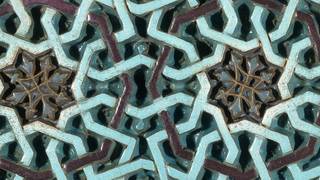
Islamic Middle East
Features

-
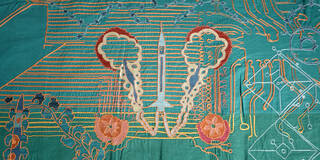
Blending modern technology with traditional Uzbek embroidery
Meet visual artist Aziza Kadyri, who is bringing together traditional Uzbek suzani embroidery and artificial intelligence.
-

5,000 years of Persian history in 15 objects
Take a journey through 5,000 years of Iranian art, design and culture
-

Iranian bath rasps: ASMR
Watch as we unbox and gently rattle a selection of late 17th and early 18th century ceramic bath rasps from Iran
-

Calligraphy in Islamic art
Discover the creativity and versatility of the written word in Islamic art
-

Owen Jones and the Grammar of Ornament
Owen Jones (1809 – 74) was a versatile architect and designer, and one of the most influential design theorists of the 19th century.
-

Researching the Alhambra Palace
Experts from the Alhambra Palace and the V&A delve into one of the finest collections of Islamic art and architecture
-
 The Luck of Edenhall: history and legend of a 14th-century glass beaker
Its unique, superstition-wrapped history makes this antique drinking glass one of the museum's most intriguing objects
-

Recreating Palmyra's Arch of Triumph using photogrammetry
-

Contemporary ceramic making from the Middle East
Discover the meanings, inspiration and processes of making
-

Design and make your own Islamic tile and printed pattern
Have a go at creating patterns inspired by Islamic art
Collection highlights
-
 Kaftan, about 1590, Bursa, TurkeyV&A East Storehouse
 -
 Mamluk minbar, 1468 – 96, Cairo, EgyptV&A South Kensington
 -
 (Detail) 22,500, composition, by Hadieh Shafie, 2011, Baltimore, US
 -
 The Luck of Edenhall, beaker and case, 14th century, Middle EastV&A South Kensington
 -
 (Detail) The Ardabil Carpet, 1539 – 40, IranV&A South Kensington
 -
 Ewer, 1000 – 50, EgyptV&A South Kensington
 -
 Pyxis, about 969 – 970, Madinat al-Zahra, SpainV&A South Kensington
 -
.jpg) (Detail) Tile panel, 17th century, Isfahan, IranV&A South Kensington
(Detail) Tile panel, 17th century, Isfahan, IranV&A South Kensington -
 Animals by the Watering Hole, tapestry, by 'Ali Salim, 1985, EgyptV&A East Storehouse

Experience more as a V&A Member today
Treat yourself or a lucky recipient to the gift of Membership
- Unlimited free entry to all exhibitions
- Exclusive access to two Member spaces
- 10% discount in all V&A Shops
- Members-only previews and events