
Enamels
Enamels are made by fusing finely-ground glass to metal. Vibrant as the day they emerged from the kiln, our rich and outstanding collections, created over many hundreds of years, showcase a wide range of highly skilful enamel techniques.
The art of enamelling on metal has been practised in most countries of mainland Europe, in Britain and Scandinavia, as well as in Russia, the Middle East, South and East Asia and the US. Highlights of our collections include medieval enamels, Renaissance painted enamels, enamelled portrait miniatures, gold boxes and jewellery from Europe, enamels from the Arts and Crafts revival and Art Nouveau periods, 19th-century Indian enamels, imperial and export Chinese enamels and a world-class collection of Japanese enamels.
Features

-

How was it made? Guilloché enamelling
Watch precise geometric patterns appear on metalwork in this centuries-old process
-

Huguenot enamellers
Discover the refugee craftsmen with extraordinary talent
-

How was it made? Enamelled copper box
Watch the process of making a beautiful enamelled copper snuff-box
-

Traditional Indian jewellery making
Craftsman in Mumbai and Jaipur demonstate how traditional kundan and enamelled jewellery is made
-

How was it made? Champlevé enamelling
See how this medieval technique was carried out
-
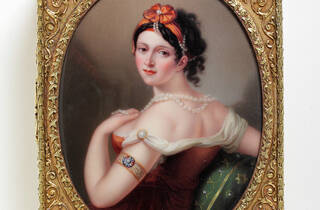 Portrait miniatures painted in enamel
The Gilbert Collection of enamel portrait miniatures represent some of the most important artists working in the medium
Collection highlights
-
 Triptych, by Master of the Louis XII Triptych, about 1498 – 1514, Limoges, FranceV&A South Kensington
 -
 Dish, by Muhammad Ja'far, 1817 – 1818, Tehran, IranV&A South Kensington
 -
 Turban Ornament, about 1800 – 50, Jaipur, IndiaV&A South Kensington
 -
 Box, by Jean Georges Rémond et Cie., 1783 – 1790, SwitzerlandV&A South Kensington
 -
 Beaker, by Pavel Ovchinikov, 1892, Moscow, RussiaV&A South Kensington
 -
 Handbag, by Haruta Yukihito, 2008, JapanV&A East Storehouse
 -
 The Mérode Cup, cup and cover, about 1400, FranceV&A South Kensington
 -
 The Habsburg-Rosenberg Cup, 1665, Augsburg, GermanyV&A South Kensington
 -
 Jug, designed by Gerald Benney, made by Alan Evans, 1978, EnglandV&A South Kensington
 -
 Portrait of Hortense Mancini, Duchesse de Mazarin, enamel miniature, by Jean Petitot Sr, about 1675, FranceV&A South Kensington
 -
 Snuff box, 1765 – 1775, Birmingham, EnglandV&A South Kensington
 -
 Vessel, 1736 – 1795, Beijing, ChinaV&A South Kensington
 -
 Success to the British Fisheries, plaque, designed and engraved by Louis Philippe Boitard, 1750 – 1751, Birmingham, EnglandV&A South Kensington
 -
 Fish slice, by Linda Darty, 2004, North Carolina, USYoung V&A
 -
 The Becket Casket, about 1180 – 1190, Limoges, FranceV&A South Kensington
 -
 Ring tray, by Eugène Feuillâtre, about 1901, FranceV&A South Kensington
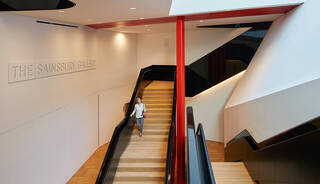
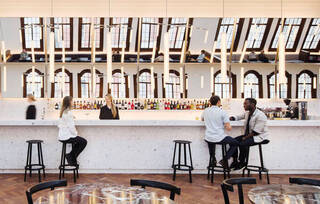
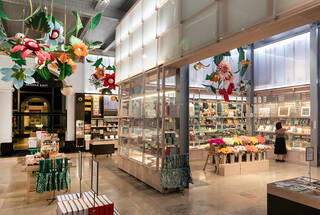
Experience more as a V&A Member today
Treat yourself or a lucky recipient to the gift of Membership
- Unlimited free entry to all exhibitions
- Exclusive access to two Member spaces
- 10% discount in all V&A Shops
- Members-only previews and events

Header image:
Ring tray, Eugene Feuillâtre, about 1901, France. Museum no. M.24-1972. © Victoria and Albert Museum, London