Interview with Lubaina Himid, artist
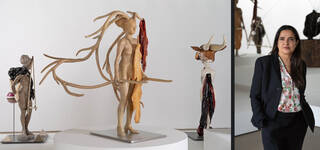
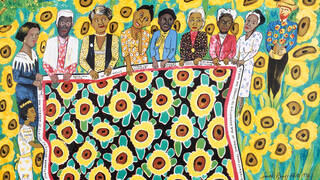
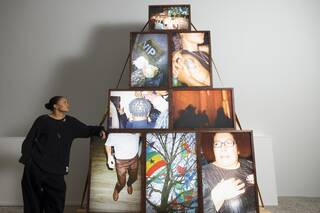
Naming the Money (part of a series of works), Lubaina Himid, UK, 2004
Lubaina Himid (b. 1954, Zanzibar, Tanzania) was one of 11 artists featured in the exhibition Uncomfortable Truths: The Shadow of Slave Trading on Contemporary Art which was held in 2007 to commemorate the bi-centenary of the pariamentary abolition of the British slave trade. She is a painter and is Professor of Contemporary Art at University of Central Lancashire. Her work focuses on issues of history and identity, in particular the creative strategy needed to achieve a sense of belonging. Her work, based on exchanges of ideas and memories, is in the permanent collections of Tate and the V&A. She is represented by Peg Alston New York.
Lubaina chose the particular groupings of each of the 'Naming the Money' figures on display in Uncomfortable Truths. Here she talks about her work and the exhinbition.
What for you is the appeal - or necessity - of addressing slavery in your work?
In my work I tend to address the hidden and neglected, cultural and economic contribution, made by real, but forgotten, people to the history and swagger of so-called great and established nations, rather than speak to the bitter cul-de-sac that is slavery itself.
How does the environment of the museum impact on the perception of your pieces?
The work 'Naming the Money' was an installation consisting of 100 cut-out, life-sized, painted, wooden slave servants first shown in 2004 in Newcastle. The work shown at the V&A was a tiny fraction of the original work and as such it was very different.
The piece was made to explore notions of what it is to belong and what it means to make the best of a life unpaid and abused that may have been thrust upon you. Each cut out had a name and this is very important, a real name and a real identity. It is more about naming than it is about money.
In the museum the cut out people were modest and demure, silent and nameless, in much the same way that you would see them in the paintings of the time, in the houses of the time. In reality as an artwork this gathering of creative and powerful determined Africans dominated the space and were each able to tell their stories and to put the record straight.
Can you talk visitors to our website through the creative process that led the work on display in the exhibition to take the shape it has done?
Usually I investigate, re-invent and then experiment with ideas, images and texts, colours and patterns in order to make work that invites an audience into a conversation.
In making 'Naming the Money' I worked with a team of seven people who helped with the sound track, the logistics of fabrication and the catalogue. I undertook all of the painting of all of the cut outs and the writing of the texts simply because this is the part of the project I enjoyed and reveled in.
The 100 cut outs were made up of 10 ceramicists, herbalists, dog trainers, toy makers, drummers, dancing masters, viola da gamba players, shoe makers, map makers and painters. The entire work took around 18 months to make. For the V&A all I had to do was choose 16 figures from the 100 to fit the locations allotted to me by the curatorial team. The person chosen and their life story each had to work with the tapestry, bed, statue or fireplace in front of which they stood.
Become a V&A Member
V&A Members enjoy a wealth of benefits, including free entry to exhibitions, previews, exciting events and the V&A Members’ Room. In addition, you will be supporting the vital work of the V&A.
Buy or Renew Membership OnlineShop online
Artistic Circles: Design and Decoration in the Aesthetic Movement

Artists' houses and their gardens formed a distinct and influential strand in Victorian architecture and decoration, eliciting public interest and cov…
Buy nowEvent - CreateInsights
Fri 25 January 2013–Fri 28 June 2013

YOUNG PEOPLE'S EVENT: Go behind the scenes with CreateVoice.
More details