Most early theatre in England evolved out of church services of the 10th and 11th centuries. It became a truly popular form around 1350 when religious leaders encouraged the staging of mystery cycles (stories from the Bible) and miracle plays (stories of the lives of saints). These were written and performed in the language of ordinary people rather than latin in order to teach the mainly illiterate masses about Christianity and the bible.

Each play was staged on pageant wagons that processed through the streets and stopped to perform at pre-arranged sites. By the end of medieval times, many towns had specific spaces dedicated to public theatre.
The rise of secular drama
Following the Reformation in the 16th century – a movement that opposed the authority of the Roman Catholic Church – all religious drama in England was suppressed. Licences were issued to theatre companies allowing them to rehearse and perform in public, providing they had the approval and patronage of a nobleman.
Britain's first playhouse 'The Theatre' was built in Finsbury Fields, London in 1576. It was constructed by Leicester's Men – an acting company formed in 1559 from members of the Earl of Leicester's household. Over the next 16 years, 17 new open-air, public theatres were constructed. Most of these theatres were circular, surrounding an open courtyard where members of the audience would stand around the three sides of the stage. New companies flourished and writers were expected to produce a number of new plays every year to satisfy demand. Companies became known by the title of the patron's household. The two most famous companies and fierce rivals were the Admiral's Men and the Lord Chamberlain's Men.

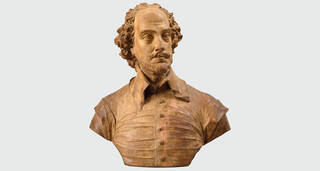
William Shakespeare (1564 – 1616)
William Shakespeare, born 1564 in Stratford-upon-Avon, Warwickshire, is England's most famous playwright. He wrote 38 plays and numerous sonnets. It is not just the breadth of his work that makes Shakespeare the greatest British dramatist but the beauty and inventiveness of his language and the universal nature of his writing.

In 1594 Shakespeare joined the Lord Chamberlain's Men as an actor and their principal playwright. He wrote on average two new plays a year for the company. His earliest plays included The Comedy of Errors (first performed in 1594) and his first published work was the poem Venus and Adonis (1593). Shakespeare wrote many of his most famous plays for the Globe Theatre, which was erected in 1599 by the Lord Chamberlain's Men. When the lease on the land at their playhouse, The Theatre, in Shoreditch ran out, the company decided to dismantle the timber frame building and rebuild it on the south bank of the River Thames, renaming it The Globe.
The court masque
The masque was a form of festive courtly entertainment that flourished in 16th- and early 17th-century Europe. The English architect and designer, Inigo Jones (1573 – 1652), collaborated with the playwright and poet Ben Jonson (1572 – 1637) to produce a series of elaborate masques for both James I (reigned 1603 – 25) and Charles I (reigned 1625 – 49). One production, The Masque of Oberon (1611) cost over £2,000 to stage, with costumes alone costing over £1,000.

Inigo Jones is credited with introducing into British theatre the proscenium arch – the space which framed the actors on stage – and moveable scenery arranged in perspective. Inspired by stage machinery he had seen whilst travelling in France and Italy, Jones' scenery used a series of shutters that slid in and out using grooves in the floor. He even flew in scenery from above and introduced coloured lighting by placing candles behind tinted glass.
The closure of the theatres
In 1642 civil war broke out in England between supporters of King Charles I and the Parliamentarians led by Oliver Cromwell. Theatres were closed to prevent public disorder and remained closed for 18 years, causing considerable hardship to professional theatre performers, managers and writers. Illegal performances were only sporadic and many public theatres were demolished.
In 1656, the poet and playwright William Davenant succeeded in producing an all-sung version of the play The Siege of Rhodes in his home. This is widely considered to be the first English opera. After Charles II was restored to the throne in 1660, Davenant and the dramatist Thomas Killigrew were granted royal patents, which gave them virtual monopoly over presenting drama in London. These monopolies were not revoked until the 19th century.
Restoration drama
The introduction of scenery and elaborate stage machinery to the English public stage in the 1660s gave rise to blockbuster semi-operas. Many of these were adaptations of other plays, often by Shakespeare. These had episodes of music, singing, dancing and special effects. The grandest theatre at this time, which included one of the first proscenium arches, was The Duke's Theatre in Dorset Gardens. Planned by William Davenant and designed by Christopher Wren (architect of St Paul's Cathedral), it cost £9,000 (about £600,000 today). It stood by the River Thames and steps led up from the river for those patrons arriving by boat.

For the first time women were recognised as professional actresses and playwrights. The most famous playwright was Aphra Behn (1640 – 89), who had previously been employed as a spy for Charles II and spent a brief stay in a debtors' prison. A group of women writers known as 'The Female Wits' produced many works for the stage. They included Mary Pix (1666 – 1709), Catherine Trotter (1679 – 1749) and the prolific Susannah Centlivre (about 1670 – 1723), who wrote 19 plays, including the satirical A Bold Stroke for a Wife, first performed in 1718.

The first woman to appear on the professional stage in England is generally considered to be Margaret Hughes (1645 – 1719), who performed in a production of Othello at the Vere Street Theatre, London in 1660. Other notable actresses at this time included Elizabeth Barry (1658 – 1713) , also known as the "queen of tragedy", and Nell Gwyn (1650 – 87), who was reputed to have been painted nude for Charles II and bore him two children.

18th-century theatre
The 18th century saw the flourishing of theatre as a popular pastime and many theatres were enlarged and new playhouses built in London and throughout the country. One of the most successful shows on the London stage in the early part of the 18th century was John Gay's ballad opera The Beggar's Opera. Gay recycled popular songs of the day and wrote new lyrics that were humorous and satirical.

Shakespeare's plays became increasingly popular during the 18th century but were reworked to suit the tastes of the day. His style was still felt to be too erratic and poets such as Alexander Pope carefully tidied up any uneven verse lines. Shakespeare's ending to King Lear was felt to be too distressing and Nahum Tate's revised version (where Cordelia and the King survive) was preferred to the original. David Garrick rewrote the end of Romeo and Juliet so that the lovers speak to each other before dying in the tomb and turned the Taming of the Shrew into a farce.

David Garrick
Garrick was one of Britain's greatest actors and the first to be called a star. From 1741 until his retirement in 1776, he was a highly successful actor, producer and theatre manager. He wrote more than 20 plays and adapted many more, including plays by Shakespeare. In 1742, the Theatre Royal, Drury Lane hired him and he began a triumphant career that would last for over 30 years. Within five years, he was also managing the theatre.

Garrick changed the whole style of acting. He rejected the fashion for declamation, where actors would strike a pose and speak their lines formally, and instead preferred a more easy, natural manner of speech and movement. The effect was a more subtle, less mannered style of acting and a move towards realism.
Stage censorship
The Licensing Act of 1737 had a huge impact on the development of theatre in Britain. It restricted the production of plays to the two patent theatres at Drury Lane and Covent Garden in London and tightened up the censorship of drama, stating that the Lord Chamberlain with his Examiners of Plays must vet any script before a performance was allowed.
The act was put in place by the then Prime Minister Robert Walpole (1676 – 1745), who was concerned that political satire on the stage was undermining him and the authority of the government. A production of The Golden Rump, a farcical play of unknown authorship, was the chief trigger for Walpole pushing the case for banning obscene drama from the public arena. The play scandalously suggested that the Queen administered enemas to the King. Henry Fielding, author of a number of successful satires, and others were suspicious that this play had in fact been engineered by Walpole himself.

Early Victorian drama
To get around the restrictions of the 1737 Licensing Act, non-patent theatres interspersed dramatic scenes with musical interludes. Melodrama and burlesque, with their short scenes and musical accompaniment, became extremely popular at this time. Eventually, the huge growth in demand for theatrical entertainment in the early 19th century made the patent theatres' system unworkable. Theatres had sprung up across London and the boundaries between what was allowed in the patent theatres (legitimate drama) and what was presented in other theatres (illegitimate theatre) had become blurred. In 1843 the Licensing Act was dropped, enabling other theatres to present drama, although Lord Chamberlain's censorship of plays remained in place until 1968.
The Old Price Riots
After the Covent Garden theatre burnt down in 1808, the management decided to raise prices to cover the cost of rebuilding. To increase revenue, the management reconfigured the upper gallery to squeeze in more of the one shilling seats, creating what angry patrons described as 'pigeon holes'. The price for a seat in the pit was raised from three shilling and six pence to four shillings, and the admission to the public boxes went up from six to seven shillings. A whole tier of boxes became 'private' and could only be hired for an entire season. Audiences were furious and turned their anger on the theatre's manager, the actor John Philip Kemble.
On 18 September 1809 Kemble stepped on stage in the costume of Macbeth to welcome the audience to the first production in the new theatre, and was met with a barrage of shouting, hissing and hooting which continued throughout the performance. Although magistrates were summoned, and some protesters arrested, the disturbance did not end until two in the morning. This was the start of what were known as the Old Price (or O.P.) Riots. For the next ten weeks every performance at Covent Garden was disrupted. The principal objective of the protesters was to force the management to restore the old system of pricing. By December 1809 the cost of legal fees, wages for bouncers, and free passes for allies who were paid to chant "N.P." ( 'New prices') meant that the theatre was losing £300 per night. Kemble accepted the demands of the rioters and made a public apology from the stage.

The Kemble family
At the turn of the 19th century the Kemble family dominated the London stage. Actor John Philip Kemble (1757 – 1823) was said to be the finest actor in England and his sister, Sarah Siddons (1755 – 1831), was regarded as one of the greatest ever tragedians. In her first season, she performed 80 times in seven different roles, inducing faintings and hysterics amongst her audiences. John Philip Kemble made his debut on the London stage in 1783 as Hamlet. His acting style was static and declamatory, with long sweeping lines and a detached grandeur.
Edmund Kean
The popular actor Edmund Kean (1787 – 1833) replaced Kemble as the darling of the London stage after making his Drury Lane debut as Shylock in The Merchant of Venice in 1814. Kean was one of the few actors who could fill the vast Drury Lane theatre to its capacity of 3,000. His natural passion and fiery spirit suited a melodramatic style of acting. He was said to be at his best in death scenes and those that required intensity of feeling or violent transitions from one mood to another.

Melodrama
Melodrama became popular from the 1780s and lasted until the early 20th century. The first drama in Britain to be labelled a melodrama was Thomas Holcroft's A Tale of Mystery (1802). Melodrama consisted of short scenes interspersed with musical accompaniment and was characterised by simple moral stories with stereotypical characters – there was always a villain, a wronged maiden and a hero acting in an overblown style.
Pictorial drama
From the middle of the 19th century theatre began to take on a new respectability and draw in more middle-class audiences. They were enthralled by the historical accuracy and attention to detail that was becoming increasingly influential in stage design. Pictorial drama placed great emphasis on costume and reflected a fashionable interest in archaeology and history. The inevitable long and complex scene changes meant that plays, especially those by Shakespeare had to be cut. One of the main exponents of pictorial drama was Charles Kean (1811 – 68), son of Edmund Kean. Charles Kean was known for his painstaking research into historic dress and settings for his productions at the Princess's Theatre in London's Oxford Street during the 1850s.

Actor-managers
19th century theatre was dominated by actor-managers who ran the theatres and played the lead roles in productions. Henry Irving (1838 – 1905), Charles Kean and Beerbohm Tree (1852 – 1917) all created productions in which they were the star. Henry Irving dominated the London stage for over 25 years and was hero-worshipped by his audiences. When he died King Edward VII and the President of the United States sent their condolences.
Shakespeare was the most popular writer for these actor-managers. It became fashionable to give Shakespeare's plays detailed and historically realistic sets and costumes. The stage spectacle was often more important than the play itself and texts were cut to allow time to change the massive sets and give maximum exposure to the leading role.

The first woman actor-manager in London was Eliza Vestris (1797 – 1856), a singer and dancer who also managed the Olympic Theatre from 1830. There she presented a programme of Burlesques, many starring herself. Other women managers in the 19th century included Madge Kendal (1848 – 1935) and Sarah Lane (about 1822 – 99) at the Brittania Theatre, Hoxton.
Ellen Terry
The greatest English actress of the late 19th and early 20th century was Ellen Terry (1847 – 1928). She joined the legendary actor-manager Henry Irving at the Lyceum Theatre from 1878 to 190 as his leading lady, and for more than the next two decades she was considered the leading Shakespearean and comic actress in Britain. Two of her most famous roles were Portia in The Merchant of Venice (1875) and Beatrice in Much Ado About Nothing (1882). In 1903 Terry took over management of London's Imperial Theatre where she focused on the plays of Bernard Shaw and Henrik Ibsen. However financial failure meant she returned to acting there years later.

The V&A holds The Ellen Terry Collection, which contains a vast quantity of correspondence, including letters written by Terry to her daughter, costume designer Edith Craig, and letters written from her stage co-star Henry Irving. The archive also contains a notebook of Terry’s thoughts on Irving.
19th century spectacle
The sophisticated technology and machinery of the late 19th century stage produced a succession of 'sensation' dramas in which special effects became the principal attraction. Scene painters, working with expert technicians, produced realistic reproductions of the natural world. Using ropes, flats, bridges, treadmills and revolves, they could produce anything from a chariot race in Ben Hur to a rail crash in The Whip.

One of the greatest designers of ‘sensation’ scenes was Bruce 'Sensation' Smith. He worked at Drury Lane Theatre, which became the acknowledged home of such drama following the introduction of hydraulic stage machinery at the theatre in 1894.
Cup and saucer drama
The playwright Tom William Robertson (1829 – 71) introduced a new kind of play onto the 19th century theatre scene. His pioneering 'problem plays' dealt with serious and sensitive issues of the day. Robertson's work was considered so revolutionary in style and subject that no established management would produce his plays. "Danger", said Effie Bancroft, "is better than dullness" and she went on to produce a string of successful and profitable hits by Robertson, such as Ours (1866), Caste (1867), Play (1868) and School (1869). Caste was about marriage across the class barrier and explored prejudices towards social mobility. People talked in normal language and dealt with 'ordinary' situations and the performers didn't 'act' but 'behaved' like their audience – they spoke, they didn't declaim.

New drama in the early 20th century
The turn of the 20th century saw the emergence of two dominate trends in theatre: the dramatisation of contemporary, moral and social issues, and an interest in a simpler and more abstract staging of plays. Innovative work from abroad, particularly playwrights such as Henrik Ibsen and Anton Chekhov, was also influential in the shaping of this new drama.
Political theatre
Harley Granville-Barker's management of the Royal Court between 1903 and 1907 saw the popularisation of the work of George Bernard Shaw. Bernard Shaw was one of the most successful writers of the early 20th century and an outspoken member of the Fabian Society, an organisation committed to social reform and considered by many at the time to be subversive. He challenged the morality of his bourgeois audiences with his satirical and often humorous writing that included uncomfortable topics such as religion and prostitution. Many of his plays were censored by the Lord Chamberlain, including Mrs Warren's Profession (1893, first public performance in England 1925), which centred on a former prostitute and her attempt to come to terms with her disapproving daughter.

At a more grass roots level, theatre groups aimed at promoting the socialist cause and the Labour Party sprang up across the country.
Between 1926 and 1935 the Workers' Theatre Movement (WTM), which was allied with the Communists, used theatre to agitate for social change. WTM developed an 'agit-prop' style that took songs and sketches onto the streets in an attempt to incite change.
Unity Theatre grew out of the WTM. It's aim was 'to foster and further the art of drama in accordance with the principle that true art, by effectively presenting and truthfully interpreting life as experienced by the majority of people, can move the people to work for the betterment of society'. Unity pioneered new forms of theatre, presenting factual information on current events to audiences, as well as satirical pantomimes that challenged the Lord Chamberlain's censorship.

Other influential political companies included the Salford-based Red Megaphones and the Hackney People's Players. Committed to removing the bourgeois trappings of theatre, they wanted to create a more physical theatre that reflected the machine age. Popular plays were Ernst Toller's Masses and Men (1923)and The Machine Wreckers (1922) and Karel Capek's futuristic nightmare RUR (1920) where machines and robots are used to replace the working class.
Founded in 1908, the Actresses' Franchise League supported the suffrage movement by staging events and readings. By 1914, membership numbered 900 and there were groups in all major UK cities. Plays included Cecily Hamilton and Christopher St John's How the Vote Was Won (1909), and Hamilton's most famous work Diana of Dobson's (1908).
The Pioneer Players was founded by Edith Craig, daughter of Ellen Terry, the renowned English actress of the late 19th and early 20th centuries. The company aimed to present plays of 'interest and ideas' and particularly those which dealt with current social, political and moral issues, including suffrage. The Pioneer Players performed at the Little Theatre which operated as a club theatre to avoid the censorship of the Lord Chamberlain. Productions included Margaret Wynn Nevinson's In the Workhouse (1911) and Christopher St John's The First Actress (1911).

The repertory movement
The repertory theatre movement was forged out of the passion and conviction of Barry Jackson and Annie Horniman, who believed that a wide variety of theatrical experience should be made available to people at a price they could afford. Horniman believed that by subsidising theatres you could both raise the standards of performance and broaden the programme a theatre could offer to its community.
Horniman was the daughter of a wealthy tea merchant with no family connections to the theatre but she recognised the cultural value of the state-subsidised repertory companies in Germany. In 1903, Horniman put up the money to open the Abbey Theatre in Dublin and the Gaiety Theatre in Manchester in 1907. In just ten years they produced over 200 plays at the Gaiety but were forced to close in 1917 because of financial difficulties.
Birmingham Repertory Theatre opened on 15 February 1913 with a production of Shakespeare's Twelfth Night. Its founder Barry Jackson, like Horniman, was passionate about the need to offer the people of Birmingham a wide variety of theatrical experience, and personally subsidised the building of the Rep Theatre as a base for his company.
Club Theatres in the early 20th century
In 1899 the Stage Society was founded with the aim of supporting a theatre of ideas. Frustrated with the conservative nature of more commercial theatres, it presented private Sunday performances of experimental plays that had not been granted licences by the Lord Chamberlain. After a police raid on their first production (Bernard Shaw's You Never Can Tell) it was argued that because these were private performances, the Lord Chamberlain's restrictions on Sunday performances and licensed plays were not applicable. The Stage Society won the case and other 'club' theatres opened with members paying a small subscription rather than an entrance fee. These theatres became the home of unlicensed, experimental and controversial plays – a situation that lasted until 1968 when censorship was finally overturned.

The Arts Theatre opened as a club theatre in 1927 and quickly developed a reputation for innovative and exciting work. Plays by French and German writers such as Racine and Goethe were staged there, as well as new writing from British playwrights. Actors such as John Gielgud and Sybil Thorndike worked at the Arts Theatre even when they were well known in the West End – such was their commitment to presenting more experimental work.
West End theatre between the wars
West End theatre between the wars was a strange mixture. For the most part theatres were impoverished by the Depression and remained conservative both in the content of their work and the staging.
The plays of George Bernard Shaw, Somerset Maugham, Terence Rattigan, Noël Coward and J B Priestley dominated the scene. Whilst Priestley and Shaw had a strong left-wing agenda, the plays were essentially conservative in form. Shakespeare's plays virtually vanished from the West End. His home now was the Old Vic Theatre and the regional repertory theatres which experimented with contemporary dress productions. It was John Gielgud who brought Shakespeare back to the West End in 1935 with his productions of Romeo and Juliet, Richard III and The Merchant of Venice.

Commercial theatre thrived and at Drury Lane large budget musicals by Ivor Novello and Noël Coward used huge sets, extravagant costumes and large casts to create spectacular productions. Coward's Cavalcade (first production in 1931) was an epic play which traced the history of the early years of the 20th century through the lives of one family. Coward remained one of the popular writers of this period with comedies such as The Vortex (1924), Fallen Angels (1925) and Present Laughter (1942).

The Second World War saw a surge of interest in the arts with many civilian and military audiences experiencing drama, opera and ballet for the first time. This interest led to the establishment of the Arts Council by the government in 1946 with an annual grant to distribute among the arts. This grant ensured the survival of companies like the Sadler's Wells Ballet and Opera and the eventual establishment of the Royal Opera, the Royal Shakespeare Company and the National Theatre, as well as supporting theatre in the regions and the work of individual artists and companies. By 1956 the Arts Council was subsidising 40 companies across the country and between 1958 and 1970 15 new theatres had been constructed with public money.
Post-war West End theatre
After the end of the Second World War, the West End was dominated by the commercial sector. Farces and 'who-dunnits' became popular, the most famous being The Mousetrap, an adaptation of an Agatha Christie novel that opened in 1952 and is still going today. The glamorous productions of the 1950s, produced by Binkie Beaumont and H M Tennent, soon became economically unviable. Actors moved into TV to make more money and West End productions shrank in size.
This period also saw an explosion of new writing with John Osborne's Look Back in Anger (1956) seen as the landmark for a new generation of young writers who included Arnold Wesker, Tom Stoppard, Edward Bond and Harold Pinter. Small venues continued to promote and support new writing as more experimental productions moved into the mainstream theatres, including George Devine's Royal Court. The phrase 'In yer face theatre' has been applied to many of the young writers who were produced by the Royal Court in the 1990s. This aggressive and confrontational style was designed to assault the audience's sensibilities. It explored the gut-wrenching extremes of the human condition and rammed the excesses of contemporary society down its throat. One of the most successful 'In yer face' productions was Mark Ravenhill's Shopping and Fucking, which opened at the Royal Court in 1996. "A shocker in every sense of the word", declared The Daily Mail.

The National Theatre Company was formed in 1963 at the Old Vic under Laurence Olivier and moved to its new home on London's South Bank in 1976, directed by Peter Hall. Peter Hall had also directed the first years of the Royal Shakespeare Company at Stratford-upon-Avon.
Political theatre also flourished at this time – notably the work of Joan Littlewood and the Portable Theatre Company, who produced young political writers such as John McGrath, David Edgar, Trevor Griffiths, David Hare and Howard Brenton. The company Joint Stock pioneered a process of collaborative working, with writers workshopping their ideas with the company to develop a script. Joint Stock was responsible for developing many of Caryl Churchill's early plays.
Alternative Theatre
The end of theatre censorship in 1968 saw a surge in the alternative theatre movement in Britain. No longer restricted by the Lord Chamberlain's censorious eye, companies were free to express any agenda they chose. Feminist theatre companies like Red Ladder and the Women's Theatre Group (now the Sphinx) began to put on plays that expressed the political agenda of the feminist movement and questioned the male dominance of writers and directors in British theatre. Women writers like Caryl Churchill and Pam Gems wrote for companies like Joint Stock before moving onto success in mainstream theatre.

Companies also explored new ways of creating theatre, devising work which aimed to be more democratic by involving the whole company in all aspects of the creative process from initial concept to final performances.
In the funding crisis of the 1980s many 'alternative' companies had their (meagre) subsidy cut and could no longer afford to continue. However, others successfully developed into the mainstream like Hull Truck and Mike Leigh who later moved successfully into film and television.
Physical and visual theatre
Throughout the 1980s and 90s companies began to experiment with a more physical type of theatre. They wanted to get away from the restraints of realistic and naturalistic drama and create an energetic visual theatre that combined strong design with choreography and physical imagery. Influenced by the work of Philippe Gaulier and Jacques Lecoq, companies such as Theatre de Complicite applied their style to the reworking of classic texts and created new work in collaboration with writers.

This departure was not completely new – in the 1960s Peter Brook had become interested in a more physical and visual theatre. He had been inspired by Japanese Noh theatre and influenced by the work of Adrienne Mnouchkine's Theatre du Soleil in Paris. Earlier innovators in this area included Bauhaus, Dadaist and surrealist performers, choreographer Rudolf Laban and directors Meyerhold and Jerzy Grotowski and Richard Schechozer.
Today, theatre companies and groups are producing ever-more experimental works that explore social and political questions and challenge conventions of what a performance is and how it should be presented.
Blast Theory describe their work as collaborative and interdisciplinary. Works such as Can You See Me Now? (2001) – a chase game played online and on the streets mixed video games and performance, whilst I'd Hide You (2012), My Neck Of The Woods (2013) and Too Much Information (2015) engaged diverse audiences through different media. Similarily, Punchdrunk, a British theatre company, produces work that eliminates the boundaries between stage and audience by creating immersive presentations in which the audience is free to choose what to watch and where to go.

The National Video Archive of Performance
The V&A holds the National Video Archive of Performance (NVAP), archive of over 300 high quality live theatre performance recordings made since 1992. This unique collection is available for free to all whether you are a researcher, an actor preparing for an audition, a stage designer reviewing past interpretations, or someone who missed the opportunity to attend a production during its run.