
As a technique, quilting has been used for a diverse range of objects, from clothing to intricate objects such as pincushions. Along with patchwork, quilting is most often associated with its use for bedding. But quilts are not only practical objects. The quilts in our collection have been preserved for many different reasons, whether sentimental or commemorative, as examples of needlework skills and techniques, or even because of the specific fabrics used in their designs.
What is quilting?
Quilting is a method of stitching layers of material together. Although there are some variations, a quilt usually means a bed cover made of two layers of fabric with a layer of padding (wadding) in between, held together by lines of stitching. The stitches are usually based on a pattern or design.
The history of quilting can be traced back at least to medieval times. The V&A has early examples in its collection from Europe, India and the Far East. The word 'quilt' – linked to the Latin word 'culcita', meaning a bolster or cushion – seems to have first been used in England in the 13th century.
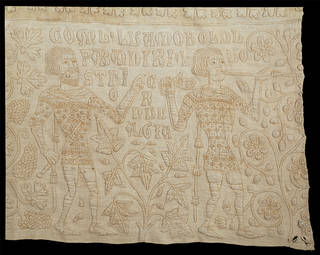
The earliest quilting was used to make bed covers: very fine quilts are often mentioned in medieval inventories and frequently became family heirlooms. Throughout their history, many superior examples of the technique have survived by being passed down through generations. Now in our collection, the Tristan Quilt survives from 13th-century Sicily. It depicts 14 scenes from the medieval legend of Tristan and Isolde – lively depictions of battles, ships and castles – and is one of the earliest surviving examples of 'trapunto', or stuffed quilting, (from the Italian 'trapuntare', to quilt).
During the medieval period, quilting was also used to produce clothing that was light as well as warm. Padded wear could be put on under armour to make it more comfortable, or even as a top layer for those who couldn't afford metal armour.
One fine example of quilted clothing in our collection is an Indian hunting coat, made in the 17th century, when the Mughal dynasty ruled South Asia. The exquisite 'tambour' chained stitch (worked from the top surface with a special needle called an 'ari', similar to a crochet hook) suggests that it was probably the work of a specialist craft workshop that would produce work for export to the West as well as for the Mughal court.

Quilting stitches
Although quilting can just use basic running stitch or backstitch, each stitch has to be made individually to ensure it catches all the layers within the quilt. Where the stitching is laid down in decorative patterns, it can be extremely fine work. Popular stitching patterns have been given names such as 'Broken Plaid', 'Hanging Diamond', 'Twisted Rope' or 'True Lovers' Knot'.
Because items such as bed covers typically involve large surface areas, quilt making is often associated with social occasions where many people share the sewing. Particularly in north America, where early settlers from England and Holland established quilting as a popular craft, there is a tradition of a quilt-making 'bee' for a girl about to get married, with the aim of stitching a whole quilt in one day. One American 'Bride's Quilt' in the collection was created for the marriage of John Haldeman and Anna Reigart in 1846. It uses a pattern known as 'sunburst' or 'rising sun', popular for its symbolic associations with the dawning of a new day.

Quilting in Britain
In Britain, quilting was most popular in the 17th century, when it was used for quilted silk doublets and breeches worn by the wealthy and later for petticoats, jackets and waistcoats. Quilts were produced professionally in major towns and cities – London, Canterbury and Exeter are all linked with sumptuous examples in our collection. Quilts were also imported. Quilted Indian bed covers made from chintz fabric (Indian painted and dyed cotton) were very popular export items for both the British and Dutch markets in the late 17th and 18th centuries.

Quilting also has a domestic history. Many of the English quilted items in the Museum's collection are the work of women sewing domestically for their own use. While some were made by necessity, others were made to mark specific life occasions, such as a birth or wedding, or, like the Chapman quilt, were perhaps made for a dowry.

What is patchwork?
Although closely linked to quilting, patchwork is a different needlework technique, with its own distinct history. Patchwork or 'pierced work' involves sewing together pieces of fabric to form a flat design. In Britain, the most enduring method is known as 'piecing over paper'. In this method, the pattern is first drawn onto paper and then accurately cut. Small pieces of fabric are folded around each of the paper shapes and tacked into place (also known as basting, this uses long, temporary stitches that will eventually be removed). The shapes are then joined together from the back using small stitches called whipstitches.

If quilting is often associated with warmth and protection, patchwork is more closely associated with domestic economy – a way of using up scraps of fabrics or of extending the working life of clothing. Unlike quilting, patchwork remained a predominantly domestic, rather than professional, undertaking. Not all patchwork was produced for reasons of economy, however. There's evidence that some of the patchwork quilts in our collection used significant amounts of specially bought fabrics and these quilts have been attributed to middle-class women making these objects for pleasure rather than necessity. There was also a tradition of military quilts, sewn by male soldiers while posted overseas in the second half of the 19th century.
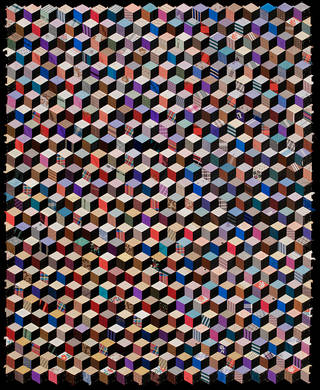
The V&A initially collected examples of patchwork because of the significance of the fragments of textiles, rather than the works as a whole. As a result, our collection charts the use of the fine silks and velvets of the 17th and 18th centuries through to the cheap cottons manufactured during the Industrial Revolution. The largest number of patchwork quilts in our collection date from the 19th century. During this period, intricate designs were used to portray a number of different motifs – from scripture and biblical scenes, as seen in Ann West's coverlet, to scenes of world events and even playing-card designs, as seen in a bed cover dated to 1875 – 85. This kind of patchwork was so popular that several examples were displayed at the Great Exhibition of 1851.

During the same period, patchwork was promoted by the likes of prison reformer Elizabeth Fry as a skill that should be taught to female inmates – a means of providing the prisoners both employment and allowing time for reflection. This tradition has recently been resurrected by social enterprise Fine Cell Work in a collaboration with the V&A and the inmates of the HMP Wandsworth Quilt.
Patchwork saw a broad decline over the 20th century, but was adopted by the fashion industry in the 1960s as a 'look' associated with hippie culture, not just a technique. By the end of the century, both patchwork and quilting – as crafts so closely associated with women – became techniques used by artists such as Tracey Emin and Michelle Walker to explore notions of 'women's art' and work. Memoriam by Michele Walker is one example in our collection. You can also watch interviews with contemporary artists and quilt makers Jo Budd and Natasha Kerr who draw on the long tradition of quilting and patchwork for their contemporary art practice.

Explore more of our vast Textile Collection.


