Kimono: decoration, symbols & motifs

Kimono, 1850-1900. Museum no. T. 389-1910

Kimono, Japan, 1850-1900. Museum no. T. 389-1910. The design of this kimono illustrates the close connection between painting and textile arts that exists in Japan. The surface of the garment has acted as a kind of hanging scroll for the creation of a hand-painted and dyed image of cranes among pines and plum blossoms. Touches of embroidery have been used to highlight the crests of the birds and parts of the pine boughs.

The patterns that adorn kimono are very significant, for it is through choice of colour and, most importantly, decorative motifs that the wearer's gender, age, status, wealth, and taste are articulated.

At the beginning of the Edo period there were no substantial differences between the kimono worn by men and women, but distinctions became more pronounced in the course of the 17th century. The patterns on women's kimono became larger and bolder. Younger women's kimono were particularly lavishly decorated and brightly coloured, while more subtle patterning and subdued colours were considered appropriate for an older woman. The length of the sleeve also varied.  Young women wore their sleeves long, a fashion that became particularly pronounced from the mid-Edo period onwards, but shortened them once they married. Men wore even shorter sleeves, while the patterns and colouring on their garments was generally quite restrained.

At the beginning of the 17th century the surface of the kimono was divided into irregular pattern areas. Over time such compartmentalisation gave way to an approach which considered the garment as a whole, and in which technique and motif, pattern and ground were fully integrated. The disposition of the pattern on the surface of the garment also changed over time. Nature, particularly seasonal references, provided a major source of designs, together with allusions to classical literature.  The increased market for luxury kimono led to a broadening of the visual repertoire to include aspects of popular culture and visual puns.  The range of patterns widened yet further during the late 19th century when western motifs were introduced. 

With the taste for dynamic, unified motifs, the clean, straight lines of the T-shaped garment served as a blank canvas, or scroll, for the kimono designer. It is important to remember, however, that kimono are 3-dimensional objects that move with the wearer. The simplicity of structure also belies the fact that donning a kimono, often in a number of layers, with an obi and other accessories, creates a rich and often visually complex effect.


Symbolism

Kimono, 1850-1880. Museum no. T. 72-1957

Kimono, 1850-1880. Museum no. T. 72-1957. This kimono has been embroidered with an extremely potent image of dragons, the most powerful of the mythical beasts, and Mt Fuji, the quintessential symbol of Japan. The striking red silk ground makes the image all the more dramatic.Yet this is an under-kimono (juban), so its design would not have been seen when worn. Instead it served to symbolically wrap the wearer with divine power and protection. The garment has quite long sleeves, usually indicative of female dress, but the dragon is traditionally a very masculine motif, so this under-kimono may have been worn by a man.

The images used on kimono often have complex levels of meaning, and many have specific auspicious significance which derives from religious or popular beliefs. The crane for example, is one of the most popular birds depicted on kimono. Believed to live for a thousand years and to inhabit the land of the immortals it is a symbol of longevity and good fortune.

The use of specific motifs can allude to the virtues or attributes of the wearer (or those they might aspire to), reflect particular emotions, or relate to the season or occasion. Such symbolism was used especially on kimono worn for celebratory events such as weddings and festivals, when it served to bestow good fortune on the wearer, wrapping them in divine benevolence and protection. This use of auspicious motifs in dress reveals the Japanese belief in the literal, as well as the figurative, power of images.

Colours too have strong metaphorical and cultural connotations. Dyes are seen to embody the spirit of the plants from which they are extracted. Any medicinal property is also believed to be transferred to the coloured cloth. Blue, for example, derives from indigo (ai), which is used to treat bites and stings, so wearing blue fabric serves as a repellent to snakes and insects. Colours were given a cosmological dimension with the introduction to Japan in the 6th century of the Chinese concept of the five elements. Fire, water, earth, wood and metal are associated with particular directions, seasons, virtues and colours. Thus black corresponds to water, north, winter and wisdom. Colours also have strong poetic significance. Purple, for example, is a metaphor for undying love, the imagery deriving from the fact that gromwell (murasaki), the plant used to create the dye, has very long roots. Perhaps the most popular colour for kimono is red, derived from safflower (benibana). Red connotes youthful glamour and allure, and is thus suitable for the garments of young women. It is also a symbol of passionate but, as beni-red easily fades, transient love.

Kimono, 1980-2000. Museum no. FE. 154-2002

Kimono, 1980-2000. Museum no. FE. 154-2002

The traditional Japanese wedding ceremony takes place in a Shinto shrine and is attended by only close family members. The bride wears a white under-kimono and heavy white outer-kimono known as a shiromuku, shiro meaning white and muku meaning pure. This outer-kimono has a design of a large noshi, an auspicious ornament traditionally tied to goodwill gifts, the ribbons of which cascade down the front and back of the garment.


Kimono, 1820-1860. Museum no. FE.28-1987

Kimono, 1820-1860. Museum no. FE.28-1987

The combination of delicate embroidery and dark satin fabric gives this kimono a striking, lustrous appearance. The design of paired ducks is a symbol of marital harmony, so this garment may have been part of a wedding trousseau. The kimono was brought back to Britain by John Bonham-Carter, who visited Japan in 1881-2.

Kimono, 1860-1880. Museum no. T.65-1915

Kimono, 1860-1880. Museum no. T.65-1915

The carp and swirling water that decorates this kimono is an auspicious one. It derives from a Chinese legend in which any fish able to leap the waterfall is transformed into a dragon (a metaphor for achievement and advancement in life). The design is executed with long supplementary wefts, a weaving technique that is unusual in kimono fabric. According to the donor, it once belonged to the famous kabuki theatre actor Ichikawa Danjuro IX and may have been worn for performance.

Natural motifs

Kimono, 1780-1800. Museum no. FE.106-1982

Kimono, 1780-1800. Museum no. FE.106-1982. This kimono has been decorated using ink, embroidery and a stencil-dyeing technique called kata kanoko. Across the shoulders of the kimono are various characters taken from the 'Poems of Congratulation' in the 10th-century Kokinshu anthology. Incorporating the written word into the design of the kimono would have demonstrated the literary discernment of the wearer.

The natural world provides the richest source for kimono motifs. Numerous flowers such as peonies, wisteria, bush clover and hollyhocks appear on garments. Many of them, for example cherry blossom, chrysanthemums and maple leaves, have a seasonal significance.
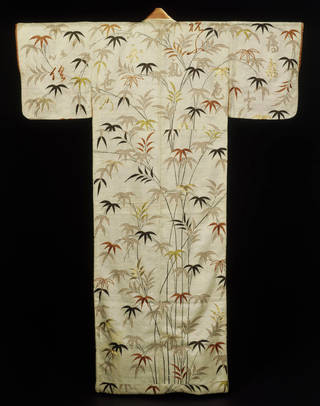
Pine, bamboo and plum are known collectively as the Three Friends of Winter (shōchikubai), and are symbols of longevity, perseverance and renewal. The pine tree is an evergreen and lives for many years, bamboo bends in the wind but never breaks, and the plum is the first tree to blossom each year. The plum is particularly favoured for winter kimono, for its use suggests that spring cannot be far away.

Birds, animals, butterflies and dragonflies also appear on kimono, along with other motifs drawn from the natural world such as water, snow and clouds. On some kimono whole landscapes of mountains and streams are depicted. The numerous different ways in which such popular natural motifs are used on garments is testament to the skill of kimono designers, and of dyers and embroiderers.

Kimono, 1820-1880. Museum no. T.17-1963

Kimono, 1820-1880. Museum no. T.17-1963

This is a summer kimono, or katabira, and is made of hemp, a linen-like fibre.

Kimono, 1910-1930. Museum no. FE.233-1974

Kimono, 1910-1930. Museum no. FE.233-1974

This kimono, which dates from the early 20th century, has long 'swinging sleeves' (furisode), which indicate that it would have been worn by a young, unmarried woman. The designer has composed an entire landscape across the surface of the garment, the image of cranes, rippling water, rocks and cherry blossoms being created with a technique called yuzen.

Kimono, 1860-1890. Museum no. 874-1891

Kimono, 1860-1890. Museum no. 874-1891

In 1891 the V&A purchased this kimono from Liberty's, the London shop founded by Arthur Lasenby Liberty in 1875. Liberty's specialised in selling goods imported from Asia and played an important part in fostering the late 19th-century craze for all things Japanese. The garment is decorated with a pattern of rippling water, bamboo and birds. Such stylised motifs provided a new source of inspiration to British designers.

Poems & stories

Kimono, 1850-1900. Museum no. T.155-1965

Kimono, 1850-1900. Museum no. T.155-1965. Silk crepe, resist-dyed with paste-resist dyeing (yuzen), stencilled imitation tie-dyeing (kata kanoko) and embroidery. The motifs on this kimono illustrate the tale of Urashima Taro.

Elements of the natural world that appear on kimono usually have strong poetic associations, while more complex landscape scenes often refer to particular stories drawn either from classical literature or popular myths.While carrying an auspicious meaning, they also serve to demonstrate the literary discernment and cultural sensitivities of the wearer.Although such stories invariably involved people, it is relatively unusual to find human figures depicted on kimono. Instead there are objects which suggest their presence or recent departure, a pair of dropped fans, for example, alluding to lovers disturbed.

From the early 20th century increasingly graphic imagery was used on kimono. On garments for young boys in particular, symbols of Japan's modern and progressive present - cars, trains, aeroplanes and skyscrapers - became as popular as stories of the past. In the 1930s such motifs became increasingly nationalistic and militaristic.

Kimono, 1820-1860. Museum no. FE. 36-1981

Kimono, 1820-1860. Museum no. FE. 36-1981

This kimono is an uchikake or outer kimono and would have been worn during the winter months. It is exquisitely embroidered, using a great variety of stitches, with different scenes derived from Japanese art, legends and literature.

Kimono, 1800-1850. Museum no. T.87-1968

Kimono, 1800-1850. Museum no. T.87-1968

This is a summer kimono, or katabira, the cool linen-like cloth being highly suitable for Japan's humid weather. The iris and bridge motif relates to a famous passage in the 10th century Tales of Ise, one of the most famous works of classical Japanese literature. In the ninth chapter the hero Ariwara no Narihira comes to a place in Mikawa province noted for its eightfold bridge and irises and composes a poem using the syllables of kakitsubata, the Japanese word for iris, as the first syllable of each of the lines. The crests, or mon, across the shoulders are those of the Tokugawa, the military family who ruled Japan in the Edo period (1615-1868).

Kimono, 1937. Museum no. FE.2-2005

Kimono, 1937. Museum no. FE.2-2005

In the 1930s kimono for young boys, such as this example, were often patterned with highly graphic propaganda images. Unusually, this kimono commemorates an actual event, the first aeroplane flight from Japan to Europe. The plane, called the 'kamikaze-go' flew from Tokyo to London, landing at Croydon airport on April 9th 1937 making its pilot, Masaaki Iinuma, a hero. The kimono is decorated with images of the plane and, in circles, Mount Fuji, Tower Bridge and the route of the flight, together with the British and French flags. The design also features block letters, in white on grey, which read '1937 Aorenraku 15000'. Aorenraku roughly translates to 'connections across the blue' and 15000 is the distance of the journey in kilometres.