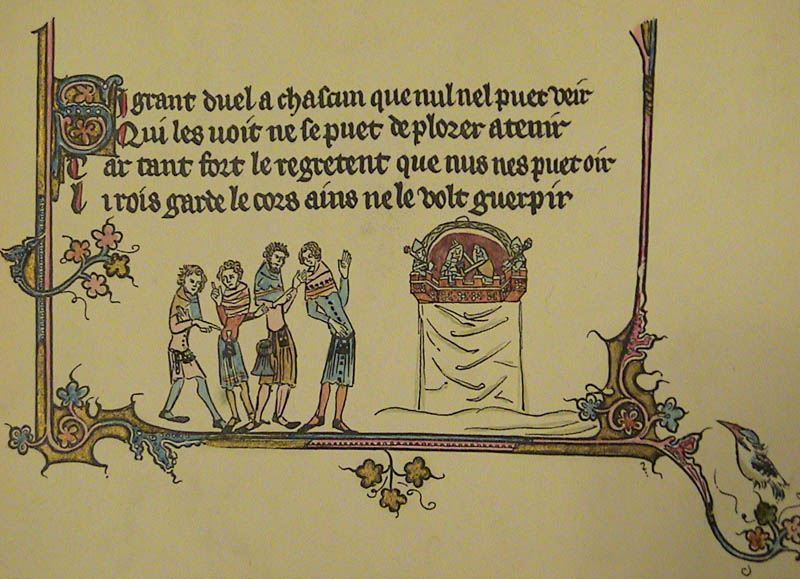
Nobody knows when the first puppet shows were performed in Britain, though there is evidence of puppetry dating back at least 600 years. Glove, or hand puppets, were very portable, making them popular with travelling minstrels and other medieval entertainers. The word 'puppet' was common in 14th-century England and appears in Chaucer's literature. The Romance of Alexander is a 14th-century manuscript, illustrated with pictures of glove puppet shows performed in booths much like those still used for Punch and Judy shows today. Although written in Flemish, the manuscript may have been made by English scribes and artists, and perhaps depicts English puppet shows. The early puppet shows were probably based on Bible stories and Greek and Roman legends.
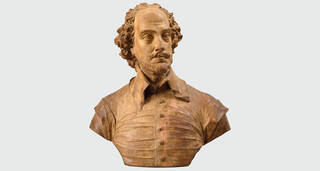
The earliest recorded puppet plays in London took place in about 1600 at Bartholomew Fair in Smithfield; Holborn Bridge; Fleet Bridge and Bankside, but puppeteers made their living by performing all over the country, including at wealthy households. In 1561 the Duchess of Suffolk recorded paying "two men who played upon the puppets". Shakespeare also referred to puppets, and in the 17th century, troupes of Italian puppeteers travelled around Britain playing at fairs and markets, probably using marionettes, which are operated from above by strings or rods.
Bible stories such as Jonah and the Whale still featured in 17th-century puppet shows and records show that one in Coventry in 1599 featured the devil. Medieval clergy used animated figures and puppets to help preach Christianity, and a devil puppet would have been a leading player in these, his evil-doings creating vivid and imaginative lessons. According to a 17th-century poem by Samuel Butler, fireworks were used with puppet plays involving the devil – a theatrical (if not downright dangerous) way to show the perils of hellfire: "Nor devil in the puppet-play be allowed / To roar and spit fire, but to fright the crowd".

Puppeteers also performed versions of popular stage plays, historical stories and contemporary events and figures such as Guy Fawkes and the Gunpowder Plot. Theatres were closed during the mid- 17th century during a period of religious and political upheaval In England, when stage plays were forbidden. Puppet plays, however, were still tolerated, so from 1642 until the restoration of the monarchy in 1660, puppet theatre flourished – mostly with glove puppets, though shadow puppets were also known. When Charles II returned to England following the end of the Second English Civil War, entertainers from Europe came too, including puppeteers. They brought a string puppet character based on the Italian Commedia dell'arte figure Pulchinella. In England he was called Punchinello and eventually shortened to 'Punch'.

Mr Punch was first recorded in England in 1662 by the famous diarist Samuel Pepys when he saw him as a marionette, operated in Covent Garden by the Italian puppet showman Signor Bologna. Pulchinella, as he was then called, was presented within a tent rather than in the type of booth we know today with the audience standing outside. Pepys brought his wife to see the show two weeks later and that October the same show was performed at Whitehall for the King. Pepys recorded seeing other Italian puppet showmen in England and in 1672 the King ordered that a puppet showman should be allowed to perform at Charing Cross.
Find out more about the history of Punch & Judy.
Puppet theatre became fashionable adult entertainment in 18th-century London and several marionette theatres were established, including Martin Powell's puppets, which opened in St Martin's Lane in 1710, Punch's Theatre in James Street and the Patagonian Theatre in Exeter Change. Powell's theatre, in a tavern in Covent Garden, used marionettes to lampoon famous people and satirise current theatrical fashions, such as Italian opera.

In 1770 a company of fantoccini, or Italian marionettes, introduced a new wave of European puppet theatre to London. Italian companies performed comic opera, plays in the style of the commedia dell’arte featuring Harlequin and Columbine, and 'magical' scenery transformations. By 1777 there were four puppet companies in the West End as well as an oriental-style shadow theatre show called 'Ombres Chinoises' (or 'Chinese Shadows'). By the end of the 18th century puppet shows at large fairs (many of which featured the marionette version of Mr Punch) almost died out because they were too expensive to operate. Instead, the glove puppet version of Punch & Judy began to be a familiar sight in portable booths on the streets of London.

By the 1850s, Punch & Judy shows were less popular, but their fortunes revived towards the end of the century because of the increasing leisure that people enjoyed once Bank Holidays were introduced. Punch & Judy found audiences at parties and social events as well as on the streets and at the seaside, either on the beach or the newly fashionable seaside piers.
In 1852 Signor Brigaldi's Italian marionettes were a great success when they appeared at an exhibition hall in London – which was renamed The Royal Marionette Theatre. They played in Manchester and Liverpool before returning to London and establishing themselves in a specially-built marionette theatre in Cremorne Gardens. By the 1860s, however, the days of the permanent marionette show were past and travelling marionette shows became popular instead, performed by family troupes including the Tiller-Clowes and Barnard family troupes. Our collection includes a set of 35 Tiller-Clowes marionettes – the largest set to survive from a 19th-century touring marionette theatre in Britain.
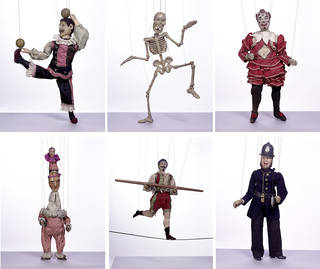
Like most marionette companies, the Tiller-Clowes troupe featured stock dramatic characters, like the policeman and villain, in this case a 'Drunken Wastrel', complete with a string-operated bottle of beer which could be raised to the puppet’s mouth. The collection also includes a number of 'speciality act' figures, including a juggler (with stringed juggling balls which can balance on his hands, feet or head), three Chinese bell-ringers, two stilt-walking drunken clowns, an expanding skeleton and a trick puppet with three heads. The tight-rope walking marionette was based on the real French tightrope-walker Chevalier Blondin, who became legendary for crossing Niagara Falls on a tight-rope in 1859.
Puppetry declined in the early 20th century, with audiences drawn to other forms of entertainment, including music hall, variety and cinema. Punch & Judy could still be found at the seaside, and marionettes on the music hall and variety stages, but the outbreak of the First World War meant that large travelling marionette shows disbanded. They could not operate without the men who went to fight.

In the 1920s and 30s, the art of glove puppetry, which had flourished in medieval times, was revived by puppeteer Walter Wilkinson, whose 'Peep Show' showed the dramatic possibilities of glove puppetry beyond Punch & Judy. He carved his puppets' heads and hands, dressed them, and pushed them around Britain and America in a cart setting up show wherever he could find an audience. Wilkinson was still performing in the 1950s when his repertoire included Thersytes, a 16th-century morality play, Cassius and Brutus, and the quarrel scene from Shakespeare's Julius Caesar which he described as 'Shakespeare specially disarranged'.

The wider fortunes of puppetry, however, did not begin to revive until 1923 with the publication of a book called Everybody's Theatre by H.W. Whanslaw, which led two years later to the foundation of The British Puppet and Model Theatre Guild. At first a society of keen amateurs, it soon generated expert professional puppeteers including Walter Wilkinson and his brother Gair Wilkinson, William Simmonds, Waldo and Muriel Lanchester, and John Bickerdike. They played a large part in the regeneration of puppetry after the war, founding the London Marionette Theatre in Stamford Brook and developing new ways of controlling and balancing marionettes. The London Marionette Theatre was also the first to broadcast puppets on television.

While puppeteers provided entertainment for Working Men's Clubs and night clubs in the late 1940s, (with performers operating for the first time in full view of the audience), it was TV that brought brought puppets to a much wider public. British children's television from the 1950s to the 70s made stars of several puppets, from the marionettes 'Muffin the Mule', 'Andy Pandy', 'Bill and Ben', 'Lady Penelope', 'Parker', 'Troy Tempest' and 'Captain Scarlet' to the glove puppets 'Sooty and Sweep' and 'Basil Brush' as well as the American sock puppet 'Lamb Chop' (who was still operated by hand). Jim Henson created many different types of puppets for the series Sesame Street and The Muppets which British audiences adored. Spitting Image puppets, created for television in the 1980s by Peter Fluck and Roger Law, renewed the 18th-century tradition of satirical puppetry at a time when many innovative British touring puppet companies were established, and theatre companies such as Forkbeard Fantasy began using large scale puppetry in their work.

Notable purpose-built puppet theatres from the late 20th century include The Harlequin Theatre, opened by Eric Bramall at Rhos-on-Sea, North Wales in 1958, John Wright’s Little Angel Theatre in Islington, opened 1961, Ray and Joan DaSilva's Norwich Puppet Theatre, 1980, Gren and Juliet Middleton's Puppet Theatre Barge on the Regent's Canal opened in 1982, and The Biggar Puppet Theatre, opened near Edinburgh by The Purves Puppets in 1986. Artist and Illustrator Mary Shillabeer created various full-scale marionette shows in the 1970s and 1980s, some of which appeared during the Edinburgh Festival, including 'Peter and the Wolf', 'Boite a Jou-Jou' (The Toy Box) and 'Babar the Elephant'.

A few dedicated puppet theatres survive in Britain today, often in the face of financial indifference from local authorities, but puppetry in 21st-century Britain is also finding new audiences with companies and productions incorporating puppetry into their work. The Lion King continues to delight audiences on the London stage, with shadow puppetry and large body puppets developed by Julie Taymor, exploring techniques thousands of years old, as does the acclaimed War Horse, with astonishing life-sized puppet horses – one of which is now in the V&A collection – by the Handspring Puppet Company. Mr Punch, meanwhile, is still celebrated annually in Covent Garden, and can be found flouting political correctness around the country, just as he has done for over 300 years.

Discover a selection of our favourite puppets, and their makers, in the slideshow below:
Find out more about the history of puppetry: