Masterpieces of ceramics through the ages
The ceramics collections at the V&A are one of its greatest glories. They are unrivalled in their range, diversity and global reach. A selection of over 100 masterpieces has been brought together to form the Masterpieces Timeline, tracing developments in world ceramics from ancient times to the present.
The timeline draws together potting traditions from across the globe, showing how they interrelate, and how trade and cultural interchange have shaped their histories. The array of stunning objects includes dramatic Chinese funerary sculpture, exquisitely painted Italian Renaissance pottery and boldly modernist wares.
Ancient

Ewer with three feet, China
Ewer with three feet
China, Shandong province
about 2500 BC
Unglazed earthenware
Museum no. FE.8-2000
Purchased with funds from Mr T.T. TsuiThis early ewer was made from the same kaolin-rich clay as porcelain. But at this date high-temperature porcelain kilns had not been invented. The clay was therefore fired below 1050ºC and has remained a porous earthenware.
Kaolin is more resistant to heat than other clays. This fact, together with the ewer's distinctive shape, suggests that it was placed over a fire for boiling water.

Jar with spirals, China
Jar with spirals
China, Gansu province
2000-1700 BC
Unglazed earthenware, painted and burnished after firing
Museum no. C.286-1938Large jars of this kind were used for storage and in burials. Examples have been found that contain food remains and children's bones.
The body was made from the fine, wind-blown soil called loess. The loess was formed into rolls of clay, which were coiled round and smoothed to build up the walls. This coiling technique was widespread before the invention of the potter's wheel.

Monumental sceptre, Egypt
Monumental sceptre
Egypt
1427-1400 BC
Composition with alkaline glaze (faience). Inscription naming pharaoh Amenhotep II (ruled 1427-1400 BC)
Museum no. 437-1895
Given by H.M. Kennard, Esq. through Prof. Flinders Petrie, University College, LondonThe huge sceptre is the largest known example of ancient Egyptian faience. Composed of powdered quartz rather than clay, faience was moulded or modelled by hand. It was the first material to have a glaze, here coloured turquoise by the addition of copper.
The sceptre, a symbol of divine power, was found in fragments in a temple. Its animal head probably represents the god Seth.

Jar with geometric designs, Cyprus
Jar with geometric designs
Cyprus, perhaps Kourion
about 750-600 BC
Unglazed earthenware, made in sections and assembled, covered with buff slip and painted
Museum no. 222-1883The jar, used for storing wine or water, was made in two halves. They were thrown on a potter's wheel and 'luted' together with slip (liquid clay).
Cyprus was colonised first from Greece, from 1500 BC, and then from Phoenicia (modern Lebanon). In 709 BC it came under Assyrian control. The refined decoration reflects this cultural mix and the high social status of the jar's owners.

Boar’s-head drinking cup, Greece
Boar's-head drinking cup
Greece, Athens
about 460 BC
Unglazed earthenware, painted in slip
Museum no. 669-1864Moulded from earthenware, the cup was painted with black slip apart from the silhouettes of the figures, which were left unpainted. This 'red figure' technique allowed the fired clay to show through. Skilful manipulation of kiln conditions was needed to achieve the bright red and glossy black.
The maker was probably the famous potter Sotades, who specialised in vessels with unusual shapes.

Green-glazed storage jar, China
Green-glazed storage jar
China, Zhejiang province
Western Han dynasty (206 BC-AD 8)
Glazed stoneware, with incised and combed decoration
Museum no. C.138-1913The clays of southern China need a relatively high temperature to mature. This led to advances in kiln technology, and by 1500 BC southern Chinese potters were using firing temperatures up to 1200ºC. The stonewares they made were the world's first high-fired ceramics.
The olive-green glaze was made using a mixture of clay and wood ash. The colour resulted from minor impurities in the clay.
1st–10th century

Tomb figure of a dog, Northern China
Tomb figure of a dog
Northern China
Eastern Han dynasty (AD 25-220)
Lead-glazed earthenware
Museum no. C.167-1914In China, animal figures were interred with the dead in their tombs. The figures, made from loess, were fired at relatively low temperatures. High levels of lead were added to the green glaze so that it would melt at these low temperatures. Similar high-lead glazes were used in the Roman empire at this time, but it is not known whether there is a link.

Vessel with two spouts, Peru
Vessel with two spouts
Peru, Nasca culture
AD 100-400
Unglazed earthenware, painted and burnished before firing
Museum no. C.15-1941
Given by Lady Steel-MaitlandThe Nasca potters of Peru produced some of the finest ceramics made in the Americas before 1500. This piece was formed by coiling and hand-modelling. The decoration in coloured slips depicts the killer whale of Nasca myth, which embodied the power of the ocean.
The two spouts may reflect the dualist aspect of Nasca beliefs. But a second opening was also needed to allow the passage of air in pouring.

Bowl with blue decoration, Iraq
Bowl with blue decoration
Iraq, probably Basra
800-900
Tin-glazed earthenware, with decoration painted into the glaze. Restored from excavated fragments.
Museum no. Circ.175-1926After 750, a direct sea route linked Iraq with China, and fine Chinese ceramics were imported for the first time. Wishing to imitate Chinese whitewares, Iraqi potters invented an opaque, white tin glaze to mask their darker earthenware. This technique later spread across the Middle East to Europe, remaining in use for centuries.
By adding decoration in cobalt blue, Iraqi potters created the world's first blue-and-white ceramics.

Pedestal stand, Korea
Pedestal stand
Korea
AD 400-600
Unglazed stoneware, with incised, raised and pierced decoration
Museum no. FE.58-1993The potter's wheel and high-firing kilns were introduced to Korea about AD 300. They enabled potters to produce thin-bodied, complex ceramics in an astonishing variety of shapes.
Tall pedestal stands were found in enormous numbers in royal tombs around Kyongju, the capital of the state of Silla in the south-east. They seem to have been used in funerals, probably to support round-bottomed containers.

Black-glazed ewer, China
Black-glazed ewer
China, Deqing kilns
Eastern Jin dynasty (AD 317-420)
Glazed stoneware
Museum no. FE.9-1972The potters in Deqing originally made fine green-glazed stoneware. After 300, they also began to use black and dark-brown glazes, probably inspired by black lacquer. These were the first in China's long tradition of dark-glazed ceramics.
The new colours were achieved by using an iron-rich clay for the glaze, or by adding iron to the glaze mixture already used for the green wares.

White stem cup, Northern China
White stem cup
Northern China
Tang dynasty, 600-700
Glazed stoneware
Museum no. C.138-1965
Mrs B.Z. Seligman BequestThe whiteness of fired kaolin was used to full effect in ceramics of this type, which are the first high-fired whitewares ever made.
The cup has the brightness, thin walls and overall shape of a silver vessel. It may have been made for drinking red wine. Wine made from grapes was brought to China from western Asia, and its introduction reflects the open, cosmopolitan nature of Tang culture.
Tomb figure of a horse, Northern China
Tomb figure of a horse
Northern China
Tang dynasty, 700-800
Earthenware, moulded in sections and assembled, details finished by hand, splashed with coloured (sancai) lead glazes.
Museum no. C.50-1964
Mrs Robert Solomon GiftLarge ceramic horses were placed in tombs from the time of the first emperor of united China, Qin Shihuangdi (died 210 BC). By the Tang period, the horses were shown with their saddle and trappings in place, ready for mounting.
The brown glaze running down the neck may relate to the 'blood-sweating' horses imported from the Ferghana valley, now in Uzbekistan.

Red bowl, Germany
Red bowl
Germany, Trier
AD 150-200
Unglazed earthenware, with moulded decoration and red slip
Museum no. 1921-1901In the first century AD, earthenware finished with a glossy red slip became the tableware of choice all over the Roman empire. It was easier to produce than earlier Greek 'black' and 'red figure' wares, and large quantities were made in many places with access to the right clays.
Relief decoration was standard. Here gladiators in combat alternate with a man presenting an emperor with a palm.

Lustre bowl with peacock, Iraq
Lustre bowl with peacock
Iraq, probably Basra
900-1000
Tin-glazed earthenware, with lustre painted over the glazes
Museum no. C.1309-1924
Given by Monsieur Georges TabbaghThe potters of Iraq invented the lustre technique. By using metallic pigments to decorate their whitewares, they were able to imitate precious metal vessels. The dotted background, for example, copies the ring-matted texturing on gold and silver.
Like the tin-glaze technique, lustre spread across the Middle East to Europe, where Spain became an important centre of production.
11th–14th century

Jar with incised designs, China
Jar with incised designs
China, Cizhou kilns
Northern Song dynasty, 1025-50
Glazed stoneware with incised slip decoration
Museum no. C.31-1935
Purchased from the Eumorphopoulos Collection with the assistance of The Art Fund, the Vallentin Bequest, Sir Percival David and the Universities' China CommitteeCizhou stonewares were produced across northern China over a long period. Covered with white or cream slip, they had decoration of many different types. Here the design was incised into the slip. It includes a scroll with camellia flowers against a 'ring-matted' background.
The shape is called a meiping, or 'prunus vase', in Chinese. Yet its sturdy body and thick base suggest it was a container for alcohol.

Ewer with blue-tinted glaze, China
Ewer with blue-tinted glaze
China, Jingdezhen
Northern Song dynasty, 1000-1100
Glazed porcelain
Museum no. C.112-1929
H.B. Harris BequestThe town of Jingdezhen has dominated porcelain production for much of the last millennium. Its potters combined the porcelain stone used for green-glazed stonewares with kaolin. The result, fired to very high temperatures, was of extremely good quality. The kiln conditions were manipulated to create a glassy, blueish-white (qingbai) glaze.
After 1100, qingbai porcelain was exported widely to Asian and Middle Eastern markets, and some eventually reached Europe.

Jar with ivory glaze, China
Jar with ivory glaze
China, Ding kilns
1000-1200
Glazed stoneware with incised decoration
Museum no. C.37-1935
Purchased from the Eumorphopoulos Collection with the assistance of The Art Fund, the Vallentin Bequest, Sir Percival David and the Universities' China Committee.The whitewares of northern China, called Ding ware, have an ivory glaze. The harmonious proportions and subtle lotus design of the jar are characteristic of the Song period (960-1279), which is widely considered a high point in world ceramic production. Ding ware is one of the Five Great Song Ceramics - the five types made in this period that were highly prized by later Chinese collectors.

Vase with olive-green glaze, China
Vase with olive-green glaze
China, Yaozhou kilns
Northern Song dynasty, 1000-1200
Glazed stoneware with carved decoration
Museum no. C.810-1936
Purchased from the Eumorphopoulos Collection with the assistance of The Art Fund, the Vallentin Bequest, Sir Percival David and the Universities' China CommitteeGreen-glazed stonewares, called celadons in Europe, were first made in southern China. Eventually the technology spread to northern China, and for a brief period after 1000 the products of the Yaozhou kilns in the north outshone their southern competitors.
The decoration was deeply carved. This allowed the glaze to pool in the recesses, intensifying the colour and making the design more legible.

Green-glazed water sprinkler, Korea
Green-glazed water sprinkler
Korea
Koryo period, 1150-1200
Glazed stoneware with inlaid decoration
Museum no. C.743-1909In Sanskrit, this type of water sprinkler is called a kundika. It was introduced to Korea for Buddhist purification ceremonies, but became more widely used.
The decorative willow trees and waterfowl were carved into the half-dry body and filled with two different compounds to create areas of white and black. The inlay technique was a Korean speciality, invented after 1100.

Vase with sky-blue glaze, China
Vase with sky-blue glaze
China, Jun kilns
Northern Song or Jin dynasty, 1100-1200
Glazed stoneware, splashed with copper
Museum no. FE.156-1975
Sir John Addis GiftJun wares are one of the Five Great Song Ceramics. Although coarsely potted, they are remarkable for their subtly coloured glazes, which are a great technical feat. Careful control of the cooling process allowed pinhole bubbles to form within the glaze. These refract the light, enhancing the glaze colour. Here the visual impact is heightened by a single splash of purple.

Dish with lustre pattern, Iran
Dish with lustre pattern
Iran, probably Kashan
About 1200
Glazed fritware, with lustre painted over the glaze
Museum no. C.158-1977
Ades Family CollectionThe potters of Kashan perfected fritware, which was the closest Middle Eastern potters came to imitating porcelain. Fritware is composed of ground quartz and a little clay and glass.
Some Kashan fritware was decorated with lustre. A Kashan potter, Abu'l-Qasim, wrote in 1301 that, when evenly fired, lustre 'shines like the light of the sun'. This example is unusual in its all-over pattern of stylised plant motifs.

Brown-glazed ewer, Cambodia or north-east Thailand (Khmer empire)
Brown-glazed ewer
Cambodia or north-east Thailand (Khmer empire)
1150-1250
Glazed stoneware, with incised decoration
Museum no. FE.130-1978Stoneware was first made in Cambodia after 800, when the Khmer empire was established. Production was concentrated in the Angkor region, the heart of the empire. Most stonewares with an iron-brown glaze have been excavated in north-east Thailand, then an outlying province.
The narrow neck and spout suggest that this pot was a domestic pouring vessel. The handle is in the shape of a small bird.

Tea bowl, China
Tea bowl
China, Jizhou kilns
Southern Song dynasty, 1200-1300
Glazed stoneware, with resist decoration
Museum no. C.30-1935
Purchased from the Eumorphopoulos Collection with the assistance of The Art Fund, the Vallentin Bequest, Sir Percival David and the Universities' China CommitteeIn China, powdered tea replaced leaf tea after 900. The leaf tea looked elegant in green bowls, but the green powdered tea looked more appealing against a dark glaze.
Potters manipulated the firing and cooling processes to create dramatic glaze effects, including this 'hare's fur' type. Here paper cut-outs of phoenixes were applied to the first, darker layer of glaze. They burned off in the firing, leaving their outlines.

Jar with crackled glaze, China
Jar with crackled glaze
China, Guan kilns
Southern Song dynasty, 1200-1300
Glazed stoneware
Museum no. C.25-1935
Purchased from the Eumorphopoulos Collection with the assistance of The Art Fund, the Vallentin Bequest, Sir Percival David and the Universities' China Committee.In 1126, the Song dynasty lost the northern part of its territories and retreated south to a new capital at Hangzhou. Two new imperial kilns were established nearby for the production of Guan ('official') wares.
Guan wares are distinguished by their crackled glazes, which occur when the glaze shrinks more than the clay body. These were created deliberately, probably by reducing the glaze's silica content.

Green-glazed funerary jar, China
Green-glazed funerary jar
China, Longquan kilns
Southern Song dynasty, 1200-1300
Glazed stoneware
Museum no. C.28-1935
Purchased from the Eumorphopoulos Collection with the assistance of The Art Fund, the Vallentin Bequest, Sir Percival David and the Universities' China CommitteeThe arrival of the Song court in southern China led to a rise in the quality of green-glazed ceramics produced at Longquan, 300 kilometres south-west of the new capital. The Longquan potters produced finely made wares with glazes of many shades and textures for export markets from Egypt to Japan, as well as for Song courtiers.
This jar was made to contain grain for burial in a tomb.

Wall tile with dragon, Iran
Wall tile with dragon
Iran, probably Takht-i Sulayman
1270-5
Moulded fritware, with decoration painted into and lustre over the glaze
Museum no. C.1970-1910
George Salting BequestThe Mongols took control of Iran in 1256-8 and established the Ilkhanid dynasty. They brought with them Chinese imperial symbols such as the phoenix and the dragon, which became popular motifs.
This example was made for the summer palace of Takht-i Sulayman in north-west Iran, which was constructed in the 1270s. The piece would have formed part of a tilework dado, combined with cross-shaped tiles.

Flask with dragon, China
Flask with dragon
China, Jingdezhen
Yuan dynasty, 1300-68
Porcelain, painted before glazing
Museum no. C.47-1935
Purchased from the Eumorphopoulos Collection with the assistance of The Art Fund, the Vallentin Bequest, Sir Percival David and the Universities' China CommitteeBlue-and-white decoration originated in the period of Mongol rule (1271-1368), when China was open to outside influences. It was created by applying designs in cobalt - probably a Middle Eastern idea - to a white porcelain body.
Blue-and-white was very successful, at first in export markets and later in China itself. Its introduction marks a revolution in the history of ceramics, as it became the most widely imitated of Chinese wares.

Wall tile, England or France (Normandy)
Wall tile
England or France (Normandy)
About 1330
Lead-glazed earthenware, with carved slip decoration
Museum no. C.470-1927Most decorative tiles in medieval England had stamped designs filled with clay of contrasting colour. Here, however, a more refined design was produced by covering red earthenware with a light-coloured slip, which was cut away and incised.
The tile, probably from a church at Tring, Hertfordshire, is based on manuscript illustrations. It shows Christ resurrecting three children who had died while playing with him and visiting a well, scenes from his childhood described in the apocryphal gospels.

Bowl with paired figures, Iran
Bowl with paired figures
Iran, probably Kashan
1180-1220
Glazed fritware, with enamels and gilding over the glaze
Museum no. C.85-1918
Given by Col. Stephenson Clarke, CBAfter about 1150, the potters of Kashan in western Iran experimented with a wide range of decorative techniques. In one, called mina'i, coloured enamels and gilding were applied over the glaze. The wide range of colours available allowed potters to reproduce elements of contemporary book illustration.
This bowl shows conversations between five pairs of young men, both seated and on horseback. The accompanying inscriptions contain good wishes.

Green-glazed jug, England
Green-glazed jug
England, Essex
1300-50
Lead-glazed earthenware, with incised slip decoration
Museum no. C.184-1926Mill Green, where this jug was made, supplied London and other areas with pottery from 1270 to 1350. The jug was made for use at table. It was thinly potted and has a speckled green glaze over a white slip. The base, made separately, was pinched into place. The pinch-marks are both decorative and functional: they reduced surface contact between pots during firing.

Dish with deer, Spain
Dish with deer
Spain, Paterna
1325-50
Tin-glazed earthenware, with decoration painted into the glaze
Museum no. C.21-1931From the 8th century to 1492, Spain had both Muslim and Christian rulers. Many cultural exchanges took place, as when Christians adopted the Muslim traditions of making, and eating from, luxury ceramics.
Paterna, near Valencia, specialised in tin-glazed wares painted in manganese and copper (brown and green). The deer design and leafy scrollwork were also Islamic in origin, but had become part of the Christian culture of the Mediterranean.
15th–16th century

Storage jar, Spain
Storage jar
Spain, Granada
1375-1425
Tin-glazed earthenware, with incised and stamped decoration
Museum no. 125-1897Although the wing-like handles and long neck of this huge jar have been lost, it was clearly once a prestigious object. The vertical bands of abstract flowers are similar to those used in the Alhambra, the palace in Granada of Spain's last Muslim rulers, the Nasrid dynasty (ruled 1238-1492).

Red-glazed wine cup, China
Red-glazed wine cup
China, Jingdezhen
Ming dynasty, 1403-24
Glazed porcelain
Museum no. 168A-1905Red-glazed porcelain of the Ming period is rare. The colour is difficult to achieve because it is made using copper, which is very unstable during firing.
Red wares were first made at the insistence of the Yongle emperor. He commissioned them with porcelain of other colours for use on altars in his new capital, Beijing. But knowledge of firing the red correctly was lost again by 1435.

Broken-mouthed jar, Japan
Broken-mouthed jar
Japan, Shigaraki kilns
1400-50
Stoneware, with natural ash glaze
Museum no. FE.20-1984This jar possesses a rugged beauty long prized in Japanese aesthetics. Three ridges reveal that it was made by the coiling method, not on a potter's wheel. The cracking and pitting were caused by the uneven melting of minerals in the clay and the burning off of organic matter. The streaky glaze was created naturally by wood ash in the kiln. The broken mouth signals its everyday use in the past.

Drug jar with leopards, Italy
Drug jar with leopards
Italy, probably Florence
1420-50
Tin-glazed earthenware, with decoration painted into the glaze
Museum no. 2562-1856About 1400, Tuscan potters began to make tin-glazed wares inspired by imports from Spain. They used a thicker, whiter glaze with designs crudely applied in cobalt blue, often with outlines in manganese purple. The expensive tin was only used on visible surfaces: the interior is lead-glazed.
A row of such boldly patterned drug jars would have been an impressive feature of a hospital pharmacy.

Lustre bowl and cover, Spain
Lustre bowl and cover
Spain, probably Manises
1440-60
Tin-glazed earthenware, with decoration painted into and lustre over the glaze
Museum no. 7659&A-1862By 1400, Manises, near Valencia, was the main centre for the production of lustre ceramics. Its export markets included the Middle East, where the lustre technique had originally begun.
Manises lustre wares were also popular in Italy. In 1407 an Italian merchant ordered 199 pieces, including 'three large bowls, their covers painted inside and out', a description that would fit this piece.

Dish with lion amid clouds, Vietnam
Dish with lion amid clouds
Vietnam, Hai Duong region
1480-1500
Stoneware, the blue painted before glazing, with enamelled and gilded decoration over the glaze
Museum no. FE.10-1987Vietnamese stonewares reached a high point in 1450-1500. Some were produced in an indigenous style for local use. Others, such as this dish, followed Chinese models and were made for export.
Many similar pieces have been excavated in Java and Thailand or recovered from shipwrecks in south-east Asian waters.

Floor tile with portrait, Italy
Floor tile with portrait
Italy, probably Pesaro
About 1480
Tin-glazed earthenware, with decoration painted into the glaze
Museum no. 12-1890The Spanish introduced tin-glazed floor tiles to Italy in the 1440s. Italian potters were soon producing their own, outstripping their Spanish models in the refinement of their designs. Such Italian wares were known as maiolica.
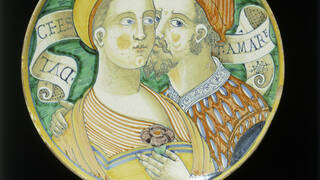
This tile is from a pavement in the convent of San Paolo in Parma. The floor includes portraits of smart young men and women and emblems of courtly love.

Footed bowl, Italy
Footed bowl
Italy, Ferrara
1480-1500
Earthenware, with moulded and incised slip decoration and coloured glazes
Museum no. 187-1866In the main design, a naked youth fights a dragon held on a leash by a young woman. The scene was incised through light-coloured slip (liquid clay) to reveal the dark earthenware beneath. This technique, first practised in China, reached Italy after 1200.
Incised slipware was most popular in northern Italy. This, the most ambitious example known, was made for the ducal court in Ferrara.

Boy playing the bagpipes, Italy
Boy playing the bagpipes
Italy, Florence
1490-1520
Tin-glazed earthenware, with decoration painted into the glaze
Museum no. 4677-1858
Given by HRH the Prince ConsortAndrea della Robbia, to whom this statue is attributed, belonged to a famous Florentine family of sculptors. He succeeded his uncle, Luca, who was an early exponent of the Renaissance style in Florence.
Luca was the first to make large-scale architectural sculpture in tin-glazed earthenware. Seated figures like this can be found surmounting altarpieces from the Della Robbia workshop.
Attributed to Andrea della Robbia (1435-1525)

Dish with maiolica painter, Italy
Dish with maiolica painter
Probably painted by Maestro Jacopo
Italy, Cafaggiolo
About 1510
Tin-glazed earthenware, painted in colours
Museum no. 1717-1855Maiolica is the name given to tin-glazed wares made in Italy. Potters exploited the white surface of maiolica as a blank canvas on which to apply the new ornamental and figurative designs of the Italian Renaissance.
This dish was made in a workshop established by the Medici rulers of Florence. Its painter exalted his own status by showing a finely dressed artist at work in the presence of his patrons.

Dish with Gothic beast, Spain
Dish with Gothic beast
Spain, Seville
1500-30
Tin-glazed earthenware, with cuerda seca decoration
Museum no. 300-1893The dish's design uses the cuerda seca (dry cord) technique. The potter first drew the outlines in a mixture of manganese and grease and then filled them with coloured glazes. The greasy lines kept the different colours separate during firing, but the grease itself burned away.
Cuerda seca was mainly a tilework technique, but from about 1480 it was also used for vessels decorated in a new Gothic style.

Blue-and-white basin, Turkey
Blue-and-white basin
Turkey, probably Iznik
About 1530
Fritware, painted before glazing
Museum no. C.257-1921In the 1470s, the Ottoman Sultan Mehmet II settled fritware potters in the small town of Iznik, near Istanbul. They were soon making some of the most accomplished Islamic ceramics.
The shapes were borrowed from metalwork, and the designs were in the Ottoman court style. But the colour scheme came from Chinese blue-and-white porcelain. After 1500, other colours came into use, including the touches of turquoise used here.

The Peixoto Ewer, China
The Peixoto Ewer
China, Jingdezhen
Ming dynasty, 1522-66
Porcelain, painted before glazing, with Iranian silver mounts. Mark: 'Made in the Jiajing reign period of Great Ming'
Museum no. C.222-1931
W.G. Gulland BequestThis is one of the earliest pieces of Chinese porcelain made for a European. The design includes the arms of the Portuguese merchant Antonio Peixoto, who first reached China in 1542.
This type of ewer was originally made for the Middle Eastern market, to which Portuguese traders sold porcelain. The contemporary Iranian mounts may have been added on Peixoto's return journey.

Jug with bearded face, Germany
Jug with bearded face
Germany, Cologne
About 1550
Salt-glazed stoneware, with relief-moulded decoration and iron wash
Museum no. 112-1908The earliest European stoneware was produced in the Rhineland in 1300-50, having developed separately from the East Asian tradition. After 1400, potters learned to throw salt into the kiln to create a tight-fitting glaze. Salt-glazed stonewares became very popular and were widely exported.
This type of jug is called a Bartmann ('beard man') in German, a reference to the bearded face on the neck.

Tile with celestial warrior, China
Tile with celestial warrior
China, Shanxi province
Ming dynasty, dated 1548
Stoneware, with coloured lead glazes
Museum no. C.71-1939
Given by Mrs E.L. Cockell, in memory of Edward Lawrence CockellThe armed warrior in high relief is probably the Buddhist deity, Wei Tuo. The tile is from an architectural frieze. An inscription on the back explains that it was made for a Buddhist temple in a village in northern China.
The body is high-fired stoneware, but it bears a low-firing lead glaze. The tile would therefore have been fired twice.
Inscription: 'Zhending prefecture, Jingjing county, Yi-an community, Mashan village, Fuchang temple. Rebuilt 27th year of Jiajing, 5th month, 18th day'

Footed bowl and cover, France
Footed bowl and cover
Possibly made in the workshop of Bernard Palissy (1509/10-90)
France, probably Paris
1550-75
Lead-glazed earthenware, with moulded and inlaid decoration
Museum no. 8715&A-1863Only 70 or so examples of this distinctive French ware survive. The decoration was made by stamping patterns into the surface and filling them with clays in contrasting colours.
Such wares were long associated with the village of Saint-Porchaire in western France. But they were more likely made in Paris, perhaps by Bernard Palissy. The presence of the royal arms suggests that they were made for the French court.

Blue-and-white flask, Italy
Blue-and-white flask
Italy, Florence
1575-87
Soft-paste porcelain, painted before glazing
Museum no. C.137-1914Francesco de' Medici, grand duke of Tuscany, financed an early attempt to manufacture porcelain in Europe. Starting in 1568, his workshop made a material very close to Islamic fritware. Production ceased at Francesco's death in 1587, and only about 70 pieces survive.
The shape of this flask is derived from metalwork. But the hazy decoration in blue was inspired by either Chinese porcelain or its Middle Eastern counterparts.

Dish with snake in relief, France
Dish with snake in relief
Probably made by Bernard Palissy (1509/10-90) or workshop
France
1570-90
Moulded earthenware, with coloured lead glazes
Museum no. C.2313-1910.Bernard Palissy was the most original French potter of his time. His most famous work is decorated with plants and animals cast from life and glazed in vivid colours.
Such pieces combine Palissy's experiments in ceramics with his love of natural history. He shared these interests with France's Catholic rulers, with whom he found favour despite his ardent Protestantism.

Stove tile with Tudor rose, England
Stove tile with Tudor rose
England, probably Surrey or Hampshire
1550-1600
Earthenware, moulded and lead-glazed
Museum no. C.383-1940Tile-clad stoves were widely used for heating in northern Europe after 1400. They were probably introduced to England by German potters, who settled south-east of London. In England, however, only the very rich installed such stoves.
The badge of the Tudor dynasty was the rose and crown. The initials ER refer either to Edward VI (1547-53) or Elizabeth I (1558-1603).

Jar for tea ceremony, Japan
Jar for tea ceremony
Japan, Bizen kilns
1590-1630
Stoneware, with natural ash glaze, firing marks and incised decoration
Museum no. 191-1877This jar contained the cold water used in the tea ceremony. The ceremony is associated with a taste for the simple and the restrained (wabi), which is matched by the jar's roughness and irregularity. The glaze deliberately uses a chance effect - the result of wood ash settling on the jar during firing.
The jar is an early example of purpose-made tea ware. Previously, ceramics made for other purposes had been used.
17th century

Dish with rocky landscape, Japan
Dish with rocky landscape
Japan, Arita kilns
1650-80
Porcelain, with enamels painted over the glaze
Museum no. 309-1877Japan began to manufacture porcelain after 1600. The main centre, Arita, created porcelain of exceptional quality, inspired by Chinese blue-and-white wares.
Around 1640, Arita also began to produce enamelled porcelain. Pieces such as this dish were once attributed to central Japan and called 'Kutani ware'. The maker of this dish sketched the fir tree, bamboo and rocks in black before adding the colours.

Dish with fabulous beasts, Iran
Dish with fabulous beasts
Iran
1666-74
Fritware, painted before glazing
Museum no. 2808-1876After 1600, Iran produced large quantities of blue-and-white dishes for domestic use and export. As the materials and techniques for making porcelain were not available, the Iranians instead made the dishes from fritware, which was composed of ground quartz and small quantities of white clay and ground glass.
The decoration freely interprets Chinese themes. Unusually, the rim and curve are united as a single band of decoration.

Bottle with enamel colours, Japan
Bottle with enamel colours
Japan, Arita
1680-1700
Porcelain, painted in enamels
Museum no. C.197-1956The first Asian porcelains with multi-coloured painting to be seen in the West were Japanese. The Dutch imported them when Chinese blue-and-white wares became unavailable.
They captivated the market, inspiring widespread imitation. By showing the range of enamel colours that could be added to already fired wares, they altered the course of Western ceramic decoration for ever. The simple asymmetric painting on this vase is typical of Japanese 'Kakiemon wares', so-called after a family of ceramic painters.

Blue-and-white vase, China
Blue-and-white vase
China, Jingdezhen
1685-1720
Porcelain, painted under the glaze
Museum no. C.859-1910
George Salting BequestThis vase shows Chinese blue-and-white at its most technically impressive. The decoration illustrates a popular love story.
The vase was made during the reign of Kangxi, China's longest-ruling emperor. Kangxi brought stability to China and encouraged the manufacture of ceramics for export. This vase was made not specifically for the West, but is of a type recorded in European princely collections.

Dish with lion, England
Dish with lion
Made by Thomas Toft (died 1689?)
England, Staffordshire
1670-89
Lead-glazed earthenware, with trailed slip decoration
Museum no. 2079-1901This thickly potted dish is decorated with trailed slips (liquid clays) and was probably made for a country tavern.
Most dishes of this type were made before Staffordshire's potteries industrialised and began concentrating on finely made tablewares. They were later championed as supreme examples of English vernacular art and were a formative influence on early 20th-century studio potters. This one became distorted when fired on its side.

Dish with panelled border, Japan
Dish with panelled border
Japan, Arita kilns
1660-80
Porcelain, painted before glazing
Museum no. 1724-1876Dishes with panelled borders were mass-produced in China for export to the Middle East and Europe from 1570 onwards. The trade was conducted at first by Portuguese and then by Dutch merchants, who called them 'Kraak porcelain'.
After the Ming dynasty fell in 1644, Chinese production collapsed and the Dutch turned to the Arita kilns of Japan for substitutes. The muted blue of the larger, heavier Arita wares is caused by impurities in the cobalt.

Flower pyramid, Netherlands
Flower pyramid
Made at the 'Metal Pot' factory
Formerly from North Mymms Park, Hertfordshire
Netherlands, Delft
About 1690
Tin-glazed earthenware, with decoration painted into the glaze
Museum no. C.19 to J-1982.Delft became a major centre of European ceramics after the Ming dynasty collapsed in 1644 and Chinese porcelain could no longer be obtained.
This tiered tulip vase is one of the most ambitious Delftware productions. The short-lived trend for such vases was set by the English court of William and Mary. Queen Mary had developed a passion for Delftware and blue-and-white during her years in the Netherlands.

Teapot with enamelled flowers, England
Teapot with enamelled flowers
Made by John Philip Elers (1664-1738) and David Elers (about 1656-1742) England, probably London
About 1693
Salt-glazed stoneware, painted in enamels, with a replacement silver spout
Museum no. C.133&A-1938The fashion for hot drinks such as tea, coffee and chocolate was a huge stimulus for the European ceramic industry around 1700.
This very early teapot was made by slip-casting, a revolutionary new technique invented by John and David Elers. Vessels were cast by pouring liquid clay (slip) into plaster moulds. The process made the manufacture of complicated forms in large quantities easier and less expensive.

Guanyin,China
Guanyin
China, Dehua
1600-1700
Porcelain, with ivory-coloured glaze
Museum no. C.548-1910
George Salting BequestDehua, in southern China, specialised in modelled and moulded figures, small tea wares and incense burners. They were made of glazed but unpainted porcelain stone, which fired to a beautiful creamy white. First produced for the domestic Chinese market, they were later exported to Europe, where they became known as blanc-de-chine.
The Buddhist figure, Guanyin, is the Bodhisattva ('enlightened being') of compassion.

Bowl with hunting scenes, Spain
Bowl with hunting scenes
Spain, Talavera
About 1700
Tin-glazed earthenware, with decoration painted into the glaze
Museum no. 329-1876The bright metallic lustres that had made Spanish pottery so desirable fell out of fashion by 1500. As potters from Italy, the Netherlands and France arrived in Spain, new styles emerged.
Talavera became famous for its colourful, painterly decoration. The market for such superbly painted pottery grew following a Spanish law of 1601 prohibiting gold and silver tablewares.
18th century

Teapot with actresses, Italy
Teapot with actresses
Italy, Venice
1720-7
Porcelain, painted in enamels
Museum no. C.130&A-1940
Arthur Hurst BequestThis tiny teapot is painted with female characters from Italian comedy. The Vezzi factory of Venice, where it was made, played a key role in the history of European porcelain. The Vezzi brothers were involved in a series of incidents of industrial espionage. It was these actions that led to the secret of manufacturing Meissen porcelain becoming widely known.

Vase with dragons, China
Vase with dragons
China, Jingdezhen
Yongzheng reign (1723-35)
Porcelain, painted before glazing and enamelled
Museum no. C.995-1910
George Salting BequestThis vase was probably made for the Chinese imperial court. Its most vivid feature is the yellow enamel. This was painted onto the fired pot and then refired at a low temperature to fuse it to the glaze.
Two-stage firing proved a crucial innovation. It greatly increased the colour range for decoration and made painting on porcelain in multiple colours possible.

Dish with peaches, China
Dish with peaches
China, Jingdezhen
Yongzheng reign (1723-35)
Porcelain, painted in enamels
Museum no. 719-1907
Dr Henry Couling BequestThe decoration recalls delicate Chinese court paintings of flowers on silk. The pink enamel common to Chinese porcelains in this period first appeared in China around 1720, but had long been known in Europe. The technology for this difficult colour may have been introduced by Jesuit missionaries at the imperial workshops.

Harlequin, Germany
Harlequin
Made at the Meissen porcelain factory; modelled by Johann Joachim Kändler (1706-75)
Germany, Meissen
About 1738
Porcelain, painted in enamels
Museum no. C.11-1984
Given by Mrs O.J. Finney in memory of Oswald James FinneyThe creator of this harlequin, J.J. Kändler, was the greatest porcelain modeller of his time. He established the sculptural conventions for all early European porcelain figures. Such pieces were initially made to replace wax and sugar sculptures used at grand dinners. This portrait of a celebrated harlequin, however, was not a table decoration. It was intended as a cabinet piece for connoisseurs.

Flambé vase, China
Flambé vase
China, Jingdezhen
Qianlong reign (1736-95)
Porcelain, with flambé glaze
Museum no. C.397-1910
George Salting BequestThe vase imitates imperial Jun wares of the Song dynasty (960-1279), which had become highly prized by this time. The deep red glaze with blue streaks was probably created on order of the Yongzheng Emperor (1723-35). Such glazes fascinated French and British art potters of the late 19th century. They are often described as flambé ('flamed').

Architectural ornament, China
Architectural ornament
China
1747-70
Stoneware, with turquoise glaze
Museum no. C382-1912This fragment once ornamented a palace in the Yuanming Yuan or 'Garden of Perfect Clarity' in Beijing. It is from the palace building that held the Qianlong Emperor's collection of European tapestries, paintings, clocks and furniture. This treasure store was designed in a mixture of European and Asian styles by Giuseppe Castiglione (1688-1766), an Italian Jesuit missionary at the imperial court.

Mythological sculpture, France
Mythological sculpture
Possibly Zephyrus and Flora
Made at the Vincennes porcelain factory.
France, Paris
1745-52
Soft-paste porcelain, mounted in gilt-bronze
Museum no. C.356-1909
Given by J.H. FitzhenryThe royal French porcelain factories of Vincennes and Sèvres were the most important in Europe between 1750 and 1800. They supplied an exclusively royal and aristocratic clientele, and set many of the wider fashions.
Their early figures and wares were hugely expensive to produce. Sensuously modelled, this piece is similar in spirit and style to the work of the French rococo artist François Boucher (1703-70).

European woman, China
European woman
China, Jingdezhen
1735-45
Porcelain, painted in enamels
Museum no. C.94-1963
Basil Ionides BequestThe woman wears a ruff that had gone out of fashion nearly a century before this figure was made. This suggests that it was based on earlier prints, and that the craftsman who modelled it had probably never seen a living Dutch or German woman.
The result is an image as striking and unrealistic as many European representations of Chinese people made around this time.

‘Purple sand’ teapot, China
'Purple sand' teapot
China, Yixing
1700-20
Unglazed brown stoneware
Museum no. 662&A-1903
W.H. Cope Bequest. Formerly in the collection of William Beckford (1760-1844)This teapot imitates a sheng, a Chinese reed instrument. It was made after the Chinese switched from drinking tea whipped in a bowl to steeped tea, prepared in a pot.
'Purple sand' teapots from Yixing were praised by Chinese scholars and tea connoisseurs. They were also exported to Europe, where potters tried to imitate them.

White teapot, China
White teapot
China, Dehua
1690-1720
Porcelain, with ivory-coloured glaze
Museum no. Circ.62&A-1931
W.G. Gulland BequestThe potter has incised a landscape on one side of this teapot. The other has a couplet from a poem by Su Shi describing the fragrance of orchids in the moonlight on a springtime night. The quotation may indicate that the pot was intended for a Chinese scholar, although scholars usually preferred the 'purple sand' teapots from Yixing.
The bold geometric design anticipates European modernism by more than two centuries.

Red stoneware tankard, Germany
Red stoneware tankard
Germany, Meissen
1710-13
Red stoneware (Böttger stoneware), lapidary polished, with silver-gilt mounts
Museum no. C.22-2006
From the Arthur and Hilde Weiner Collection. Accepted by HM Government in lieu of inheritance tax and allocated to the V&ABefore Meissen became the first European factory to make 'true' porcelain, it developed a red stoneware of which this tankard is an example.
An alchemist, Johann Friedrich Böttger, discovered the two formulas. He had been imprisoned by Augustus the Strong, Elector of Saxony, and ordered to find out the secret of making porcelain. The red stoneware was only made for a few years before commercial production of porcelain took over.
19th century

Camel teapot , England
Camel teapot
England, Staffordshire
About 1750
White salt-glazed stoneware
Museum no. 414/989&A-1885
Given by Lady Charlotte SchreiberThe years around 1750 were extraordinarily creative and prosperous for the Staffordshire potteries. Potters responded to widening markets and changes in dining and drinking habits both at home and abroad. They developed new designs, materials and techniques.
Salt-glazed stoneware, of which this teapot is made, was one of the major product lines. It was remarkably tough and could be cast into complex shapes.

Man and woman dining outdoors, Germany
Man and woman dining outdoors
Made at the Nymphenburg porcelain factory; modelled by Franz Anton Bustelli (died 1763)
Germany, Munich
1759-60
Porcelain
Museum no. C.21-1946
Bought with the Murray Bequest FundThe work of Franz Anton Bustelli is distinguished by the elegantly contorted poses of his figures. He combines this with naturalistic detailing, angular drapery and abstract rococo scrollwork. This group, designed to be seen from all angles, must have been made as a centrepiece for a dining table.

Punchbowl with ship, England
Punchbowl with ship
Possibly painted by William Jackson
England, Liverpool
1765-70
Tin-glazed earthenware, with decoration painted into the glaze and enamelled details
Museum no. 3615-1901Punchbowls painted with ships were a speciality of the Liverpool potteries. Punch had been introduced to Europe from south-east Asia.
English potters had produced tin-glazed earthenware since the 16th century. It was later painted in the style of Delft pottery, as here, and so became known as 'delftware.'

Tea and coffee service, England
Tea and coffee service
Made at Josiah Wedgwood's factory; transfer-printed in Liverpool by Guy Green (died 1799)
England, Staffordshire
About 1775
Creamware, transfer-printed in enamel
Museum no. 414/1155 to C-1885
Given by Lady Charlotte SchreiberThis selection from a Wedgwood tea and coffee service illustrates two of England's key contributions to ceramic history: creamware, a type of tough earthenware, and transfer-printing, an invention that revolutionised ceramic decoration worldwide.
Creamware was cheap, durable and well-suited to dinner and tea services. It was hugely popular between 1765 and 1820. Transfer-printing, perfected around 1750, enabled manufacturers to achieve high-quality decoration at a low cost.

Dessert plate of Catherine the Great, France
Dessert plate of Catherine the Great
Made at the Sèvres porcelain factory; painted by Vincent Taillandier (1736-90); gilded by Jean-Pierre Boulanger (1722-85)
France, Sèvres
1778
Soft-paste porcelain, painted in enamels and gilded
Museum no. 449-1921
Bequeathed by D.M. Currie. Formerly in the collection of Catherine the Great, St PetersburgThis plate is from one of the most expensive services ever made at the French royal factory of Sèvres. Comprising 800 pieces and serving 60 diners, it was commissioned by Catherine the Great of Russia. It was the first service made in the new Neo-classical style at Sèvres. Catherine herself closely supervised the pattern, and the plates alone were redesigned eight times before she was satisfied.

Louis XVI and Marie Antoinette, France
Louis XVI and Marie Antoinette
Made at the Sèvres porcelain factory; Louis XVI modelled by Louis-Simon Boizot (1743-1809).
France, Sèvres
About 1788
Biscuit porcelain
Museum no. C.367&A-1983The use of biscuit (unglazed) porcelain for ceramic sculpture was a major innovation of the Vincennes and Sèvres factories in the 1750s. Sèvres biscuit figures were originally intended as dessert table decorations, but were also displayed in room interiors from the 1760s. They were more expensive to make than glazed and enamelled figures, as flaws in the modelling or firing could not be concealed.
Presented to Tipu Sultan, ruler of Mysore, India, in 1788

The Portland Vase, England
The Portland Vase
'First edition' made at Josiah Wedgwood's factory; modelled by William Hackwood (1757?-1839) and Henry Webber (1754-1826)
England, Staffordshire
About 1790
Jasper with black 'dip' and white reliefs
Museum no. Circ.732-1956
J.A. Tulk BequestJasperware was the greatest technical innovation of the influential Staffordshire potter, Josiah Wedgwood (1730-95). It is a fine-grained stoneware, developed by Wedgwood following thousands of experiments in the 1770s, which could be stained a range of colours as a background for applied white reliefs.
Wedgwood's copy of the Portland Vase reproduces a Roman cameo-cut glass vase, which was then one of the most celebrated Classical antiquities.

Creamware jug and basin, England
Creamware jug and basin
Designed by George Bullock (died 1818); possibly made at Enoch Wood & James Caldwell's factory
England, Staffordshire
1808-15
Creamware, painted in enamels
Museum no. C.44:1,2-2005
Purchased with funds provided by the Contributing Members of the V&AGeorge Bullock designed pieces similar to this for Napoleon's use in exile. The bold classical style is unusual for English ceramics of the time and is closer in style to silver and furniture of this date. This is because Bullock was not a traditional ceramics maker, but a furniture designer, sculptor and upholsterer.

Polito’s Menagerie, England
Polito's Menagerie
England, Staffordshire
About 1830
Lead-glazed earthenware, painted in enamels
Museum no. C.128-2003
Purchased through the Julie and Robert Breckman Staffordshire FundThis mantelpiece ornament shows the entrance to a famous travelling menagerie. Although made of inexpensive earthenware, the elaborate moulded and painted decoration would have made it more costly than other pieces. It marks a high point in quality before Staffordshire potters began making cheaper, simpler moulded figures.

Thirty gallon jug, England
Thirty gallon jug
Made by Bourne, Baker & Bourne
England, Staffordshire
About 1830
Lead-glazed earthenware, transfer-printed before glazing
Museum no. 53-1870
Given by Mrs Illidge. Formerly in the London showrooms of Messrs Neale & BaileyAlthough not intended for use, this tour de force of Staffordshire pottery illustrates a typical product of 19th-century ceramics: blue-and-white, transfer-printed earthenware.
In transfer printing, a design was printed onto paper and then transferred to the surface of an unglazed pot. The technique transformed the Staffordshire industry and the market for cheap, earthenware pottery worldwide.

Plate, England
Plate
Designed by A.W.N. Pugin (1812-52); made by Minton & Co.
England, Staffordshire
About 1851
Bone china, transfer-printed in enamels
Museum no. 460-1851The pioneering Gothic revival architect, A.W.N. Pugin, designed this plate for the British ceramic firm, Minton & Co.
Their collaboration led to several innovations in ceramic manufacture and design. Here the plate is printed in solid areas of coloured enamels without lines. This printing process was developed by Mintons and was particularly suited to the flat patterns of Pugin's style.
Shown at the Great Exhibition, London, 1851

Alhambra vase, France
Alhambra vase
Made by Joseph-Théodore Deck (1823-91)
France, Paris
1862
Earthenware, inlaid with coloured clays and painted
Museum no. 18-1865This vase is a faithful replica of a celebrated lustreware jar recovered from the Alhambra, the palace fortress in Granada of the last Islamic dynasty to rule Spain. Tourists visited the Alhambra in the early 19th century, sparking a craze for 'Alhambra' design. Théodore Deck was a leading French potter and designer. He worked in a range of oriental and historic styles.
Shown at the International Exhibition, 1862

Elephant coffee pot, France
Elephant coffee pot
Made at the Sèvres porcelain factory; designed and decorated by Marc-Louis Solon (1835-1913)
France, Sèvres
About 1862
Porcelain, with pâte-sur-pâte decoration and gilded
Museum no. 8055-1862Between 1851 and 1915, nations from across the world competed in vast international exhibitions, where they displayed their country's products.
This coffee pot was made for the London 1862 exhibition. Like many such exhibits, it was designed to showcase its manufacturer's skills. The inventive design by Marc-Louis Solon features the pâte-sur-pâte technique, in which he achieved low relief by applying successive layers of liquid clay.

Renaissance-style ewer, England
Renaissance-style ewer
Made by Minton & Co.; designed by Pierre-Emile Jeannest (1813-57); painted by Thomas Allen (1831-1915)
England, Staffordshire
About 1862
Earthenware, painted before glazing and with majolica glazes
Museum no. 8107&A-1863Minton & Co. exhibited this Renaissance revival ewer and stand in 1862. Mintons pioneered the use of majolica glazes inspired by the Renaissance pottery of Bernard Palissy. The glazes are translucent and brightly coloured, and usually flow in broad areas of colour over moulded forms. Here, however, they are used alongside fine underglaze painting copying 16th- and 17th-century prints.

Hebe, Denmark
Hebe
Made by Bing & Grøndahl; modelled by C.O.A. Schjeltved after Bertel Thorvaldsen (1770-1844)
Denmark, Copenhagen
1871
Biscuit porcelain
Museum no. Misc.124-1921
Given by Her Majesty's Commissioners. Shown at the International Exhibition, London, 1871This life-size sculpture is probably the largest porcelain figure ever made in a single piece. Hebe was the Greek goddess of youth and a cup-bearer for the gods.
The figure was modelled after a sculpture of 1816 by the Danish Neo-classical artist Bertel Thorvaldsen. The Danish firm of Bing & Grøndahl specialised in making replicas of famous statues in biscuit (unglazed) porcelain.

Jar with streaked glaze, Japan
Jar with streaked glaze
Japan, Tsutsumi kilns
1800-1900
Glazed stoneware
Museum no. FE.15-1985This massive, dramatically streaked jar is typical of the rustic pottery made at Japanese regional kilns in the 19th century. The Tsutsumi kilns were located in the city of Sendai in north-eastern Japan. Their products have been much admired since the 1920s by followers of the Japanese folk craft movement.

Vase with goshawk, Japan
Vase with goshawk
Made by Miyagawa Kozan, Makuzu kiln
Japan, Ota, Yokohama
About 1875
Stoneware, with crackled cream glaze and high-relief moulding
Museum no. 308-1879Japan's Meiji period (1868-1912) was characterised by a programme of modernisation that included active economic and cultural engagement with Europe and the USA. Ceramic production thrived under a new drive to compete with industrial nations in the West.
This vase, with its unusual high-relief decoration, was made for export. It was intended to satisfy an extreme strand in Victorian taste.

Vase with copper glaze, France
Vase with copper glaze
Made by Auguste Delaherche (1857-1940)
France, Paris
1890-2
Stoneware, with a high-temperature flammée glaze
Museum no. 1613-1892The glaze effects on this vase exploit the unpredictable results of high-temperature firing. Derived from 18th-century Chinese court porcelains, such glazes were difficult to reproduce and their recreation acquired an almost mythic status.
Auguste Delaherche's choice of utilitarian stoneware as a material for artistic expression represented a radical departure, and was inspired by regional French and Japanese pottery.

Dancer, France
Dancer
Made at the Sèvres porcelain factory; modelled by Agathon Léonard (born 1841)
France, Sèvres
Designed 1898, dated 1904
Biscuit porcelain
Museum no. C.89A-1971With its flowing curves, this Sèvres porcelain figure captures the spirit of Art Nouveau. It was inspired by the sensational scarf dance that the American Loïe Fuller performed in Paris in the 1890s. Like many earlier figures of biscuit (unglazed) porcelain, it is from a set of table decorations intended to accompany dessert.

Jar with dragon, Korea
Jar with dragon
Korea
1600-1800
Porcelain, painted before glazing
Museum no. C.356-1912This jar, on which a scaly dragon chases a flaming pearl, shows Choson dynasty potting at its best. In 15th-century Korea, green-glazed wares had given way to white porcelain. Large porcelain pots were often painted with animal and plant designs in cobalt blue. However, when cobalt was scarce, brownish iron pigments were used, as here.

Hen and chick soup tureen, England
Hen and chick soup tureen
England, London
About 1755
Soft-paste porcelain, painted in enamels
Made at the Chelsea porcelain factory
Museum no. C.75 to B-1946
Given by Stephen, 6th Baron Lilford in accordance with the wishes of his brother John, 5th Baron LilfordPorcelain factories in continental Europe were often run under royal or aristocratic patronage. In England, however, factories were founded as commercial undertakings. They typically concentrated on cheaper wares.
The Chelsea porcelain factory was an exception. It frequently set out to rival continental productions with elaborate pieces such as this soup tureen, where the naturalistic design echoes Meissen's work.

Artist at his easel, France
Artist at his easel
France, Vallauris
1954
Painted by Pablo Picasso (1881-1973); made at the Madoura Pottery
Tin-glazed earthenware, wax resist and decoration painted into the glaze
Museum no. C.109-1994
Allocated to the Museum in lieu of tax by the Secretary of State for National HeritagePablo Picasso produced a large body of work in clay at the southern French pottery of Vallauris from 1946. Imaginative pieces such as this vase had a major impact on ceramics in the 1950s. They offered an alternative to the oriental sources favoured by many studio potters and encouraged the use of painted tin glazes and sculptural work.

Grotesque bird, England
Grotesque bird
England, Southall
About 1887
Made by the Martin Brothers; modelled by the Robert Wallace Martin (1843-1923)
Salt-glazed stoneware, with turned wood stand
Museum no. C.1151&A-1917
Given by Alfred R. Holland, Esq.The eccentric stoneware of the Martin Brothers epitomises the energy and experimentation of the 19th-century art pottery movement. This jar, possibly for tobacco, illustrates the principle that pottery should be a means of artistic expression, rather than the result of industrial production.
The brothers drew on an eclectic range of sources. This piece may have been inspired by traditional English owl-shaped jugs with removable heads.

Unglazed vase, Spain
Unglazed vase
Spain, probably Guadix
1872
Biscuit earthenware
Museum no. 981A to J-1872The potter probably made this complex vase to demonstrate his virtuosity. Essentially a container with nine cups attached, the design seems to follow a traditional form - a similar piece appears in a 17th-century Spanish still life.
Unglazed pottery was often used for water containers in Spain and the Mediterranean, as it permitted evaporation and so cooled the liquid inside.

The Music Lesson, England
The Music Lesson
Made at the Chelsea porcelain factory; modelled by Joseph Willems (1715-66)
England, London
About 1765
Soft-paste porcelain, painted in enamels and gilt
Museum no. 414/192-1885
Given by Lady Charlotte SchreiberLike the early French porcelain factories, those first established in England lacked the raw materials to make 'true' porcelains. Instead they made imitations, often of great beauty, known as 'soft-pastes'.
English soft-paste figures have a distinctive charm and character, though they often lack the crispness and glittering colours of German figures. The densely applied flower decoration here is characteristic of English taste.
20th century

Woman with a dog, Germany
Woman with a dog
Made at the Nymphenburg porcelain factory; designed and modelled by Paul Scheurich (1888-1945)
Germany, Munich
1916
Porcelain
Museum no. C.21-1955At the Nymphenburg factory in Munich, Paul Scheurich was inspired by the 18th-century figures of Franz Anton Bustelli. He created a series reviving the refined spirit of Bustelli, but in a contemporary style, which revitalised porcelain figure production in Germany.

Bubbles vase, England
Bubbles vase
Designed by Daisy Makeig-Jones (1881-1945); made by Josiah Wedgwood & Sons
England, Staffordshire
In production 1920-41
Bone china, printed and painted, with lustre glazes and additional gold print
Museum no. C.90-1988
Given by Suzanne and Frederic WeinsteinWedgwood's Fairyland lustreware was populated by elves and fairies. The design followed contemporary book illustration, but the shapes and density of decoration derive from Chinese porcelains of 1680-1720. The colours were inspired in part by the Russian Ballet.
The decoration was a technical tour de force, achieved by a complex layering of underglaze and overglaze painting and gilding.

Art Deco vase, France
Art Deco vase
Designed and decorated by René Buthaud (1886-1986)
France, Bordeaux
1928-30
Stoneware with crackled glaze, painted in enamels and lustre
Museum no. C.292-1987The Art Deco movement of the 1920s and 1930s used boldly geometric and modernist designs. But it also absorbed influences from across the world. René Buthaud was particularly fascinated by African art, which is reflected in the vase's patterning.

Stoneware bottle, Japan
Stoneware bottle
Made by Hamada Shoji (1894-1978)
Japan, Mashiko
About 1931
Stoneware, with off-white glaze
Museum no. Circ.348-1939
Given by the Contemporary Art SocietyHamada Shoji was a leading artist of the Japanese folk craft movement. He was closely associated with its founder, Yanagi Soetsu, and the pioneer English studio potter, Bernard Leach, with whom he worked in the 1920s. Like other members of the movement, he was an admirer of Korean ceramics. This is evident in the bottle's faceting and off-white glaze.

Argenta vase, Sweden
Argenta vase
Designed by Wilhelm Kåge (1889-1960); made at the Gustavsberg ceramic factory
Sweden, Stockholm
Designed about 1930, made 1954
Stoneware, with matt glaze, inlaid with silver
Museum no. C.129-1984
Given by A.B. GustavsbergThe Argenta range was launched at the 1930 Stockholm exhibition, where Sweden became recognised as a major force in international design.
Combining bold modern shapes with engraved silver inlay, often in Neo-classical style, the Argenta range represented the utmost in luxury. Yet its designer, Wilhelm Kåge, also pioneered low-cost, highly functional modernist kitchen and table wares.

Tea service, Austria
Tea service
Made by Lucie Rie (1902-95)
Austria, Vienna
About 1936
Red earthenware, burnished
Museum no. C.34 to E-1982
Given by Lucie RieLucie Rie is one of the 20th century's most celebrated potters. The flaring bowls and vases of her post-war period in Britain are greatly admired for their subtlety and delicacy.
This group of teawares exemplifies her earlier, Viennese period, which responds to modernism, but also draws on classical and archaic art. These pieces reflect Rie's interest in Roman burnished redwares.

Museum service, USA
Museum service
Designed by Eva Zeisel (born 1906); made by the Castleton China Company
USA, Pennsylvania
Designed 1942-3, produced from 1946
Porcelain
Museum no. Circ.161 to 163-1953
Given by Castleton China Inc.Eva Zeisel's Museum service was commissioned by New York's Museum of Modern Art. It was the first undecorated white porcelain service made in the USA.
The service responded to the functionalism and restraint of modernism, but also explored the expressive potential of forms. It exemplifies the sophisticated organic style that dominated post-war ceramic design.

Vase, England
Vase
Made by Bernard Leach (1887-1979)
England, St Ives
About 1957
Stoneware, with tenmoku glaze and incised decoration
Museum no. Circ.115-1958Bernard Leach's ideas shaped the development of studio pottery in the 20th century. After encountering ceramics in Japan, he established the Leach Pottery in St Ives, Cornwall in 1920.
This vase recalls the wares of Song dynasty China (960-1279) that Leach admired. By the time it was made in the late 1950s, making pottery by hand had moved from being a rarefied activity to a widespread movement, partly under Leach's influence.

Portrait of Zhou Enlai, China
Portrait of Zhou Enlai
Painted by Wu Kang (born 1914)
China, Jingdezhen
1965-75
Porcelain, painted in enamels
Museum no. FE.36-1990
Simon Kwan GiftZhou Enlai (1898-1976) was the first premier of the People's Republic of China. His portrait has the accuracy of a photograph, but has been painstakingly painted in enamels on porcelain. The artist Wu Kang was praised for his ability to bring out the inner life of his subjects.

Pot, England
Pot
Made by Hans Coper (1920-81)
England, Somerset
1968
White stoneware, with layers of white and manganese slip
Museum no. Circ.208-1969Hans Coper's sculptural use of clay made him one of the most significant potters of the post-war years. His exploration of a consistent vocabulary of forms radically extended the artistic scope of pottery. Coper was influenced by archaic pottery and work in other materials. Here the abraded surface recalls metal or stone.

Burnished pot, England
Burnished pot
Made by Magdalene Odundo (born 1950)
England, Hampshire
1983
Red earthenware, burnished and reduction-fired to black
Museum no. C.78-1984
Given by the Friends of the V&AMagdalene Odundo's sensuous ceramic vessels reflect the wider range of sources embraced by the studio pottery movement today. Her hand-built pots seem of our own time, but also remain rooted in African traditions. Abstract and sculptural, their forms make subtle allusions to the human figure.

Untitled Vessel, USA
Untitled Vessel
Made by Adrian Saxe (born 1943)
USA, Los Angeles
1985
Stoneware and porcelain
Museum no. C.53&A-1986
Given by Mark and Fredda HindenburgQuotation and subversion of historic styles are key elements of postmodern design and have been widely used by late 20th-century potters. Here Adrian Saxe parodies the opulence of early European porcelains by introducing exaggerated forms and surfaces. The proportions of his pot defy our expectations: its foot has the scale of a body, while the body is formed as a handle.

Geological Age V, Japan
Geological Age V
Made by Akiyama Yo (born 1953)
Japan, Kyoto
1992
Carbon-impregnated earthenware, partly polished
Museum no. FE.563-1992Akiyama Yo's sculpture exemplifies a major strand in ceramic practice today. He uses ceramic materials to produce contemporary works of art that make little reference to potters' traditional concerns.
Here he explores the primordial nature of clay, creating an arresting composition suggestive of the forms and forces of our geological past.

Siphoned Modernism, England
Siphoned Modernism
Made by Richard Slee (born 1946)
England, Brighton
2001
Earthenware, hand-built, with white glaze and polythene tube
Museum no. C.67-2005
Given by the artistRichard Slee often adopts elements of the uncanny and the surreal to provide a commentary on ceramic history.
In this piece, a simple, apparently modernist vessel is fitted with an outlet pipe that loops back to its interior, seemingly endlessly recycling the contents. As the wry humour of the title suggests, the work offers a critique of the revival of modernist design in contemporary craft.

The Bellringer, Russia
The Bellringer
Made at the State Porcelain Factory; designed and possibly decorated by Alexandra Shchekotikhina-Pototskaya (1892-1967) using a blank made in 1911
Porcelain, painted in enamels and gilded
Russia, St Petersburg
1920-1
Museum no. C.250-1991After the Russian Revolution, the former Imperial Porcelain Factory made ceramics as propaganda. They were painted with slogans and designs in a variety of styles, and some of Russia's most radical artists were involved in their production. Subjects included scenes from daily life and folklore.
The plate shows a figure ringing bells to celebrate the 8th Congress of Soviets.

Vase with clematis, Netherlands
Vase with clematis
Netherlands, The Hague
1904
Bone china, painted in enamels
Made at the Rozenburg porcelain factory; designed by J. Juriaan Kok (1861-1919); painted by J. Schellink (1876-1958) and J.M. van Rossum (1881-1963)
Museum no. C.41-1972The short-lived Rozenburg factory produced some of the world's best Art Nouveau ceramics. The style is typified by elongated organic shapes and sinuous curving lines. Rozenburg china is so thinly cast that the material is often described as 'eggshell porcelain'. The painted decoration here combines elements of French and Belgian Art Nouveau styles with the spareness and generous white space of Japanese design.
A gift in your will
You may not have thought of including a gift to a museum in your will, but the V&A is a charity and legacies form an important source of funding for our work. It is not just the great collectors and the wealthy who leave legacies to the V&A. Legacies of all sizes, large and small, make a real difference to what we can do and your support can help ensure that future generations enjoy the V&A as much as you have.
MoreShop online
Masterpieces of World Ceramics

The ceramics collections at the V&A are among its greatest glories. They are unrivalled in their range, diversity and global reach. Featuring 120 …
Buy nowEvent - Masterpieces of Chinese Painting 700-1900
Sat 26 October 2013 10:00

EXHIBITION: Presenting one of the world’s greatest artistic traditions, Masterpieces of Chinese Painting 700-1900 will be a once-in-a-lifetime chance to see rare surviving works of art drawn from collections around the world.
More details