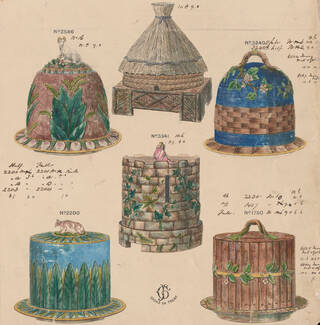
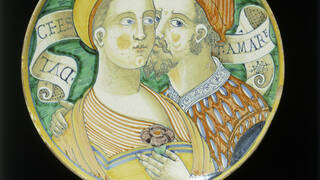
'Maiolica' is a type of tin-glazed earthenware which originated in Spain and spread to Italy. Often painted in bright colours on a white background, as illustrated below, Italian maiolica in its most elaborately decorated form was a luxury item, highly desirable and purchased by the higher ranks of society in Italy and across Europe. The V&A not only holds the greatest collection of maiolica in the world, but also this unique manuscript describing its manufacture.

The manuscript was written and illustrated around 1557 by Cipriano Piccolpasso (about 1523 – 79), probably at his birthplace Castel Durante (present-day Urbania), in the Duchy of Urbino, which was famous for its maiolica. Piccolpasso was not a potter, but there is no doubt that he did try his hand at this art, keen to learn its techniques through practice and observation. An engineer and architect, but also a writer and supporter of the arts, he compiled this treatise for an educated audience who appreciated and purchased maiolica, and wished to understand how it was made. Piccolpasso writes that he produced this manuscript at the request of Cardinal François de Tournon (1489 – 1562), who was ambassador to the French king Henry II in Italy. Tournon was a typical Renaissance humanist: learned in the classical cultures of ancient Greece and Rome, he combined high offices with enlightened patronage of the arts.

The careful execution of the manuscript indicates that it must have been a fair copy intended to be sent to the printer, but it was not actually printed until the mid-19th century. The treatise is divided into three books (the frontispiece to the first book is now missing). Ink drawings throughout illustrate the text with images of tools, kilns, processes, and craftsmen at work, while a final section shows different types of ornamental designs. Important sections in the text are marked with large initials that contain mythological or allegorical scenes and reflect the humanist education of the author. The manuscript begins with a view of Urbino, and ends with one of Castel Durante.

The treatise was known in 18th-century Italy, but it was in the 19th century, in the context of a wider revival of interest in medieval and Renaissance decorative arts, that its fame spread. Having remained in Italy all this time, the manuscript was finally published, not once but three times between 1857 and 1879. The 1857 publication brought the treatise to the attention of J.C. Robinson (1824 – 1913), who was then responsible for the art collections of the South Kensington Museum (as the V&A was then called). Maiolica pieces, as prime examples of the decorative arts, were among the first items to be acquired by the recently founded museum, notably from the 1855 sale of the politician and collector Ralph Bernal. Piccolpasso's treatise was exactly the kind of practical but also beautiful document relevant to the museum's educational mission and Robinson was able to acquire it in 1861 from its Italian owner Giuseppe Raffaelli (1785 – 1878).
Piccolpasso's treatise is a highlight of the V&A National Art Library's extensive collection of documentary manuscripts, how-to books and recipe books, that document artistic processes and techniques through the ages.