
Portrait miniatures
The V&A holds the UK's finest collection of portrait miniatures with 2000 examples spanning their development from the 16th to the 19th century. These small, portable portraits were often invested with great symbolism or significance, both politically and personally – painted to be held and viewed closely, and to be presented as tokens of loyalty, friendship or love.
The collection has outstanding examples from artists including Hans Holbein, Nicholas Hilliard, Samuel Cooper, Rosalba Carriera, Susanna Penelope Rosse, John Smart, Richard Cosway, Jean-Baptiste Isabey, Anne Mee and Sarah Biffin.
Features

-

How was it made? Portrait miniatures
See how these tiny intricate paintings were made
-

Portrait miniatures: other types of small portraiture
Find out how the success of portrait miniatures paved the way for other small, portable portrait types.
-

Renaissance watercolours: materials and techniques
Discover the qualities that made watercolour the medium of choice for artists during the Renaissance
-
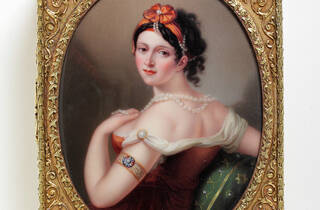 Portrait miniatures painted in enamel
The Gilbert Collection of enamel portrait miniatures represent some of the most important artists working in the medium
-
 Nicholas Hilliard – An introduction
Find out more about the most celebrated English miniaturist of the Elizabethan era
-
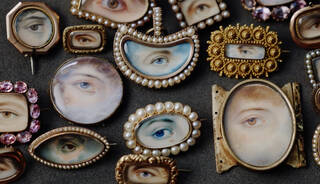 Keeping an eye on you – unboxing mysterious miniatures
Take a closer look at some of the V&A’s strangest and most intimate objects: eye miniatures.
Collection highlights
-
 Self-portrait of Simon Bening, aged 75, portrait miniature, by Simon Bening, 1558, Flanders, AustriaV&A South Kensington
 -
 Catherine de Medici, portrait miniature, by François Clouet, about 1555, France
 -
 Portrait of Marco Ricci, portrait miniature, by Rosalba Carriera, about 1724, Venice, ItalyV&A South Kensington
 -
 Self-portrait, portrait miniature, by John Smart, 1797, EnglandV&A South Kensington
 -
 Unknown boy, perhaps Sir Frederick Augustus D'Este, portrait miniature, by Richard Cosway (RA), 1799, EnglandV&A South Kensington
 -
 Self portrait, portrait miniature, by Anne Mee, about 1795, BritainV&A South Kensington
 -
 Self portrait, portrait miniature, by Christina Robertson, about 1822, ScotlandV&A South Kensington
 -
 Anne of Cleves, portrait miniature, by Hans Holbein, 1539, EnglandV&A South Kensington
 -
 Unknown woman, formerly called Frances Howard, Countess of Somerset, portrait miniature, by Isaac Oliver, 1596 – 1600, EnglandV&A South Kensington
 -
 An Unknown Man, called Sir Robert Henley, portrait miniature, by Samuel Cooper, 1659, EnglandV&A South Kensington
 -
 A Woman, presumed to be a self-portrait of Susannah-Penelope Rosse, portrait miniature, by Susannah Penelope Rosse, 1685 – 90, EnglandV&A South Kensington
 -
 Portrait of Katherine Whitmore, portrait miniature, by Bernard Lens (III, the younger), 1724, England
 -
 Portrait of an unknown woman holding a miniature, portrait miniature, by Heinrich Friedrich Füger, 1780 – 89, Vienna, Austria
 -
 Portrait miniature of the Duke of Reichstadt as a boy, watercolour on ivory, by Jean Baptiste Isabey, about 1818, France
 -
 Portrait miniature of William Pateshall, watercolour on ivory, by Sarah Biffin, 1811, England
 -
 Eye miniature, early 19th century, EnglandV&A South Kensington
Experience more as a V&A Member today
Treat yourself or a lucky recipient to the gift of Membership
- Unlimited free entry to all exhibitions
- Exclusive access to two Member spaces
- 10% discount in all V&A Shops
- Members-only previews and events

Header image:
Anne of Cleves, portrait miniature in ivory box, by Hans Holbein, 1539. Museum no. P.153-1910. © Victoria and Albert Museum, London