Medieval
Features

-
 The War of Troy tapestry
Explore one of the most magnificent examples of medieval tapestry in existence
-

The Christmas story in opus anglicanum
Christmas imagery appears throughout medieval art and particularly on richly-worked and intricate English medieval embroidered textiles, known as opus anglicanum
-

Medieval mythologies
Peering out from the stitched designs of English medieval embroideries are lifelike animals, alongside fantastical creatures drawn from mythology and the imagination.
-

Introducing Opus Anglicanum
Find out more about this stunning exhibition of English medieval embroidery – the first in over half a century
-

The Tree of Jesse Cope
Explore the richly-worked imagery and intricate design of the Tree of Jesse Cope
-

The Steeple Aston Cope
Discover how the fabric of this English medieval embroidery has been altered, ensuring its survival over centuries
-

The Butler-Bowdon Cope
Take a closer look at the elaborate iconography of the Butler-Bowdon Cope
-

The Syon Cope
Explore the beautiful imagery of the Syon Cope, embroidered in coloured silk and silver threads
-

Turning the pages of an illuminated manuscript
Watch as we open up a medieval choirbook
-

How was it made? Champlevé enamelling
See how this medieval technique was carried out
-
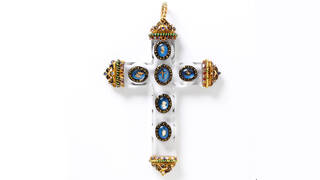 The hidden power of gemstones: meanings, myths, and magic
Revealing the hidden meanings and magical attributes of gemstones
-
 500 years of witches in art and design
Grab your broom and join us for a spellbinding journey through art and design history
Collection highlights
-
 Sallet, 1460 – 90, EnglandV&A South Kensington
 -
 October, roundel, about 1480, Norwich, EnglandV&A South Kensington
 -
 The Gloucester Candlestick, 1107 – 1113, EnglandV&A South Kensington
 -
 Griffin Ewer, about 1120, GermanyV&A South Kensington
 -
 The Symmachi Panel, diptych leaf, late 4th or early 5th century, Rome, ItalyV&A South Kensington
 -
.jpg) Altarpiece with 45 Scenes of the Apocalypse, made by Master Bertram, about 1400, Hamburg, GermanyV&A South Kensington
Altarpiece with 45 Scenes of the Apocalypse, made by Master Bertram, about 1400, Hamburg, GermanyV&A South Kensington -
.jpg) Virgin and Child, oil painting, by Carlo Crivelli, about 1480, ItalyV&A South Kensington
Virgin and Child, oil painting, by Carlo Crivelli, about 1480, ItalyV&A South Kensington -
.jpg) The Dead Christ (on the Cross), crucifix, about 1250, Tuscany, ItalyV&A South Kensington
The Dead Christ (on the Cross), crucifix, about 1250, Tuscany, ItalyV&A South Kensington -
.jpg) The Becket Casket, about 1180 – 1190, Limoges, FranceV&A South Kensington
The Becket Casket, about 1180 – 1190, Limoges, FranceV&A South Kensington

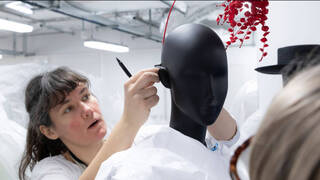
Join a V&A Academy experience
Explore our curated range of expert-led courses, workshops, and talks, all with the V&A collections at their core.
- Expert led courses
- Practical workshops
- Lectures & talks
- Professional development
