Of the ten original designs only seven have survived and these can be seen today in the Raphael Court in the V&A. Here we present the story of these monumental works on paper – their commission, production and incredible survival.
The Cartoons
All four Cartoons depicting the life of Saint Peter have survived: The Miraculous Draught of Fishes and Christ's Charge to Peter show key episodes from the calling of Peter as a disciple of Jesus. The Healing of the Lame Man and The Death of Ananias depict two miracles performed by the saint.
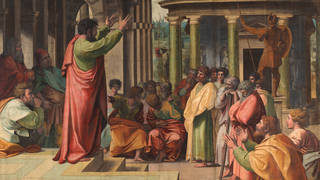
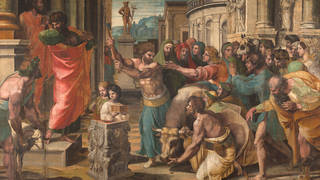
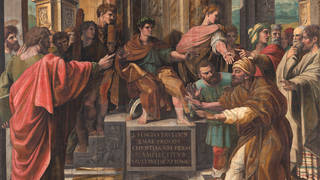
Of the six Cartoons depicting the life of Saint Paul, only three have survived: The Conversion of the Proconsul, The Sacrifice at Lystra and Paul Preaching at Athens. We can however appreciate what the three lost Cartoons may have looked like thanks to their surviving tapestries, which illustrate The Stoning of Stephen (Acts 9: 1–7) witnessed by Saul (the future Saint Paul) before his conversion, The Conversion of Saul (Acts 9:1–7), and Paul in Prison (Acts 16: 23–6).
View all seven of the Cartoons in ultra-high definition and find out more about the stories that they depict in the slideshow below
For each painting, you can also click on points of interest to discover more about its characters, symbolism and Raphael's masterly technique.
The commission
When Leo X was elected pope in 1513, he had the opportunity to make his own contribution to the ambitious programme of decoration of the Sistine Chapel in the Vatican Palace, in Rome. The site is highly important for the Roman Christian church as it is the official papal chapel where the pope is elected and official decisions are taken.

The papal chapel had previously been rebuilt between 1473 and 1481 under Pope Sixtus IV (Francesco delle Rovere, reigned 1471 – 84), who gave it his name ('Sistine' derives from 'Sixtus'). As soon as the chapel was completed, Sixtus IV, following tradition, commissioned frescoes depicting the life of Moses and Christ that would cover the entire surface of the chapel's walls. He commissioned the leading artists of the time including Raphael's future master Pietro Perugino (about 1446/52 – 1523), Domenico Ghirlandaio (1448 – 94), Luca Signorelli (about 1441/45 – 1523) and Sandro Botticelli (about 1445 – 1510) to devise this decorative scheme, which also comprised a series of papal portraits. This first phase of decoration was completed for the Feast of the Virgin (to whom the chapel in dedicated), celebrated on 15 August 1483.
A few years later, Pope Julius II (reigned 1503 – 13), commissioned Michelangelo (1475 – 1564) to depict the ceiling with scenes from the Bible's Book of Genesis and figures of the Sibyls and Prophets (1508 – 12). Michelangelo's revolutionary ceiling frescoes replaced the original starry blue sky attributed to the Florentine artist Piermatteo d'Amelia (1445 – 1508). This meant the only relatively free areas on which Leo X could make his mark were the lower walls, frescoed with a trompe l'oeil decoration representing plain hangings which he decided to cover with a tapestry cycle (a series of tapestries) depicting the lives of the apostles Peter and Paul, the founding fathers of the Christian Church.
Tapestries are not created directly onto a loom. The process of tapestry-making involves an artist-designer who draws the composition and a weaver who translates the design into a woven textile. The composition is supplied in the form of full-scale preparatory drawings, usually (but not exclusively) executed on paper. The word 'Cartoon' is translated from the Italian 'cartone', meaning 'large paper'. When Raphael was commissioned to produce the tapestry cartoons in about 1515, he had just completed the decoration of two large rooms at the Vatican Palace – the Stanza della Segnatura (1511) and Stanza d'Eliodoro (1514) – and was engaged in many other commissions. He was, at this point, at the peak of his career and the most celebrated artist in Rome.

Raphael's challenge
In designing the Cartoons, Raphael faced three challenges. Firstly, he had to comply with the existing decoration of the Sistine Chapel (completed in the early 1480s) and adapt his design to the style of the previous generation. Secondly, he had to create a design that would meaningfully translate from a work on paper to the less subtle medium of tapestry. And thirdly, he had to account for the fact that his designs would be reversed during the weaving process. The tapestries would be created Brussels (today in Belgium) using low-warp looms which produce a reversed image of the original design. Raphael would have to anticipate this in their compositions. Although Italy had at that time several centres of textile production, Brussels had made a speciality of tapestry weaving since the early 14th century.
Making the tapestries
The ability to work across different media was a speciality of the Renaissance workshop. The most successful workshops, or botteghe in Italian, relied on a vast range of artistic competencies and skills to produce a variety of artefacts, from easel paintings to frescoes, sculptures and architectural schemes, as well as designs for textiles, embroidery and inlaid wood or stone marquetry. This was the case with Raphael's large workshop in the Vatican, which included leading artists such as Giulio Romano (1499 – 1546), as well as lesser-known collaborators, including Giovan Francesco Penni (1490 – 1528), Perino del Vaga (1501 – 47), Giovanni da Udine (1470/75 – 1535) and Tommaso Vincidor (1493 – 1536).
The Cartoons were a result of a collaborative effort, as were most large-scale works produced during the Renaissance. Despite debates over how much of the Cartoons Raphael painted himself, it is evident that he was directly responsible for the overall composition and most of their execution, supervising and harmonising the occasional interventions of his assistants.
Ten tapestries were delivered to the Vatican Palace between 26 December 1519 and December 1521. Only seven tapestries arrived in time to be displayed in the Sistine chapel on the St. Stephen day (26 December) the remaining three (The Death of Ananias, Paul in prison and The Sacrifice at Lystra) were delivered by December 1521. We do not know the original arrangement of the tapestries which Raphael probably supervised in December 1519.
Etienne Dupérac's print shows a view of the Sistine Chapel in 1578, which depicts four of the tapestries hanging at the bottom of both side walls at that time, in the following order: on the extreme left is The Miraculous Draught of Fishes; next to it, nearer the altar, is Paul Preaching at Athens; on the extreme right is The Death of Ananias; next to it, nearer the altar, is The Blinding of Elymas. The Cartoons were presented in this way following modifications to the interior of the chapel, including the completion of the Last Judgement by Michelangelo (1536 – 41) on the altar wall.

The mystery
Following the deaths of Raphael in April 1520 and Pope Leo X in December 1521, it becomes unclear what the intended final destination was for the Cartoons. It is possible that they were meant to enter a prestigious collection, such as Cardinal Grimani's in Venice where one Cartoon, the Conversion of Saul, is recorded as early as 1521. It is also possible that they should have been returned to the pope to prevent the production of further sets or used as substitute hangings, as was the tradition in Northern European churches. What we do know is that following the delivery of the tapestries to the Vatican Palace, we lose trace of the Cartoons for nearly a century.
It is probable that the Cartoons remained in Brussels in the workshop of Pieter van Aelst for a number of years and were passed to fellow tapestry makers who produced further sets of the Acts up until the 1550s. A set of tapestries was woven around 1533 for François I, King of France. This set remained in the French Royal Collection until 1797 when it was burnt in the aftermath of the French Revolution (1789) in order to extract the silver and gold threads. Another set of tapestries were made for King Henry VIII and delivered to Westminster Palace in 1542. They remained in the British Royal Collection until 1649 when they were sold along with nearly 2,000 works of art to settle the late king's debts and raise money for the new regime. The tapestries were eventually acquired by the Kaiser Friedrich Museum in Berlin in the 19th century but were destroyed in 1945 during the Second World War. Two further sets were acquired in the late 1540s and early 1550s by the Emperor Charles V or his son Philip II (held in the collection of Patrimonio Nacional, Madrid, Spain), and by the Cardinal Ercole Gonzaga (held in the collection of Palazzo Ducale, Mantua, Italy). These sets retain the same iconography but their frieze borders (not included in the Cartoons) differ from the Vatican series.
The rediscovery
The Cartoons suddenly reappear in the Italian city of Genoa at the beginning of the 17th century. They were subsequently purchased by the Prince Charles, future King Charles I, and brought to England in 1623 to serve as tapestry designs for the recently founded Mortlake tapestry manufactory, then a village west of London, in 1619. When the Cartoons entered the collection of Charles I, they were already cut into long vertical strips. This had probably been done when they were sent to Brussels in December 1516 for easier handling and storage. Each strip was marked with the stamp of Charles I's monogram on the reverse (verso).
The set of tapestries woven for Henry VIII were still held in the Royal Collection in the 17th century and may have inspired Charles I to commission a set of his own from the original Raphael Cartoons. The German-born Francis Cleyn, who was the official designer at Mortlake, created full-scale copies of Raphael's originals and a new series of tapestries were made for Charles I between 1626 and 1642. Following the monarch's example, the British aristocracy commissioned sets for their own use, including the third Earl of Devonshire (1617 – 84), who commissioned a set for Chatsworth House, where they still hang today. Another example, made for the Earl of Pembroke can be seen on display in our Raphael Court, facing its corresponding Cartoon The Miraculous Draught of Fishes.

After the execution of Charles I in 1649, his collection was dispersed as part of the Commonwealth Sale (1649 – 54), with the exception of a few works retained by Oliver Cromwell, who was at the head of the new republican regime. Among these were Raphael's Cartoons and Mantegna's great cycle of the Triumphs of Caesar, which remained the property of the Nation. Charles I's set made by the Mortlake manufactory were later acquired by Louis XIV, King of France and are still in the French collection today (Mobilier national, Paris)
Following the Restoration of the English monarchy in 1660, the Cartoons returned to the possession of King Charles II but their history of public display only really began after William III became king in 1689.
Public display
The Cartoons were taken out of storage at Hampton Court Palace in 1697 so that copies could be made. It was at this time that the strips were reassembled in the first recorded restoration, which was carried out by Parry Walton (died 1699), the Surveyor of the Queen's Pictures, and the painter Henry Cooke (1642 – 1700). In 1698, William III commissioned the architect Sir Christopher Wren (1632 – 1723) to create a special gallery at Hampton Court to host the Cartoons, which were finally put on public display – though limited to the court and privileged visitors. As part of the display, the Cartoons were raised above head height, had green silk curtains attached to them to protect their colours from fading from the light, and a fire was kept lit throughout the winter months to reduce the humidity of the room.
This new presentation was recorded in an engraving by the Frenchman Simon Gribelin (1661 – 1733) in 1707 and prompted a series of copies and engraved reproductions, including the series made by the French engraver Nicholas Dorigny, presented to King George I (reigned 1714 – 27) in 1719. Dorigny became the first of only two individuals to be knighted for his work in making these prints. The Cartoons Gallery at Hampton Court is still visible today with full-scale copies of the Cartoons replacing Raphael's originals, which today are on loan to the V&A.


The Cartoons were later moved between Buckingham House (1763), Windsor (1787 – 88) and back to Hampton Court (1804). Between 1817 and 1819, they were exhibited at the British Institution, whilst the Cartoon The Charge to Peter went to Somerset House, on loan to the Royal Academy for copying, in 1823.
The survival of the Cartoons
The survival of the Cartoons is remarkable. Richard Redgrave (1804 – 88), who was appointed surveyor of the Queen's Pictures in 1857, informs us that they were often handled without appropriate care. He reported that "tracing was allowed [with] large sheets of paper pinned onto the cartoons, and a hard pencil used to trace the lines". Evidence of such treatment remains visible today. As a result, much criticism appeared in the press.
When the National Gallery was founded in 1824, it was felt that this would be their natural home, but this option was soon forgotten following several alternative proposals. The Great Exhibition of 1851 led to the foundation of the South Kensington Museum (later the V&A), which Richard Redgrave supervised together with Henry Cole (1808 – 82), the museum's first director. The Cartoons were finally deposited on loan at the South Kensington Museum in 1865 by Queen Victoria as a tribute to Prince Albert, Prince Consort to the Queen (1819 – 61), and his pioneering enterprise, known as the Raphael Collection. With over 5,400 photographs and engravings, the collection was intended to be a 'worthy representation of the greatest and noblest genius in the history of art'.


The Cartoons were first installed in the upper gallery (Gallery 94), and then moved to their current home, Gallery 48a, in 1950. This spacious gallery, now known as the Raphael Court, was not originally designed to house the Cartoons but was intended for the museum's Indian art and architectural collection. This new setting, however, restored the status of these Renaissance treasures as works of art in their own right as they were hung alone, and in conditions similar to those of the tapestries in the Sistine Chapel. The gallery itself is similar in size to the Sistine Chapel, only smaller by two square metres (546 as opposed to 548 square metres).

Over the course of the second half of the 20th century, the gallery has undergone different phases of interpretation and presentation. The most recent, in 2020, to mark the 500th anniversary of Raphael's death, includes a refreshed gallery and a new interpretive approach that transforms the way museum visitors experience the Cartoons. A high-resolution recording project that captured colour and infra-red image, as well as the three-dimensional data of the Cartoon's surface has given us unprecedented access to his creative process, while enabling the V&A to record and preserve these outstanding national treasures for future generations.