The tapestries were probably made in Arras, in modern day France – a centre famed for supplying the courts of France and Burgundy with magnificent wall hangings. They were acquired by the museum in 1957 from the estate of The Dukes of Devonshire, and probably belonged to the Countess of Shrewsbury, known as 'Bess of Hardwick', a celebrated, four-times married noblewoman who had the grand Derbyshire house Hardwick Hall built in the 1590s. The tapestries were hanging at Hardwick in the 19th century.

Tapestries were expensive and much-prized during the medieval and Renaissance periods. They were easy to transport and well-suited to the travelling lifestyle of the northern courts up to the 17th century, providing means for insulating and decorating the coldest and gloomiest castle. Tapestries would have hung from floor to ceiling and been placed edge to edge, like wallpaper in a modern room. Those with narratives also provided entertainment and interest for the household and guests at a time of low literacy, when images were extremely important.
The hunt was a particularly powerful theme and would have been a familiar pastime as well as an important source of food to many of the high-born individuals and families who owned tapestries. Henry VIII was known to have owned over 200 tapestries illustrating hawking and hunting scenes.
The Boar and Bear Hunt tapestry
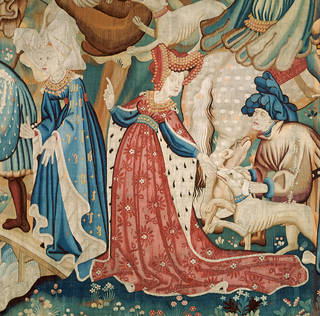
This tapestry features a number of elegant couples. In the centre of the tapestry a lady wears a sumptuous blue gown decorated with back-to-front letters that spell the motto 'much desire'. The man's sleeve is decorated with silver shapes that resemble teardrops and probably also relate to the pursuit of love.
The rich red gown of the lady further right is lined with miniver, an expensive fur obtained from the bellies of Baltic squirrels. A lining on this scale would have required hundreds of skins, taken from squirrels killed during the winter months.
The Swan and Otter Hunt tapestry
The otter hunt shown in this tapestry is rather gruesome. Otters were hunted not to eat but for their skins and because they ate the fish that were needed for the table. Swan meat was, however, highly desirable and here boys are seen robbing a swan’s nest. At one time, swans could be owned only by the royal family but as they gradually escaped into the wild they became fair game for other people, although theoretically they could only be hunted by licence. A ferocious bear hunt is seen on the right with oriental figures wearing turbans.

The Deer Hunt tapestry
By the 15th century all types of hunting had their own rules. Deer hunting was known as the sport of kings and confined to the courts and other favoured individuals. In this tapestry the main scenes show various parts of the deer hunt, including, at the centre bottom, a dead deer being cut up and the meat distributed. This was carried out as a set ritual with specific cuts of the meat being given to particular huntsmen and favoured dogs.

The tapestry has two horizontal ‘registers’, the upper part showing falconry on foot. This sport used falcons to catch ducks and other wild fowl and birds. It was also favoured by princes and the aristocracy and had its own rituals. Women participated using smaller falcons than the men and the activity is seen here as much as an opportunity for gossip and parading in fine clothes as a sport.
'Deer Hunt' has undergone more drastic repair than the other tapestries, but it is clearly of less fine quality. This may have been due to later weaving, using a cartoon (drawn design) which had lost some of its detail through wear.
The Falconry tapestry
'Falconry' is the tallest of the tapestries at 4.5 metres in height and over 10 metres in length. All four tapestries have undergone many restorations and lack a little in height or length.
The foreground is filled with tiny trees, bushes and flowers, rocky caves for bears and streams with water-fowl. In this setting the huntsmen and their prey crowd across the tapestry in two great tiers subtly linked by intermediate figures, which lead the eye from group to group. 'Falconry' is the only tapestry which focuses on a single hunt.

Dating the tapestries
It is the costume which helps to date the designs of the tapestries. The fashionable costume of the courtiers in the tapestries is shown in minute detail, down to the headdress skewered with long pins worn by the central lady in the 'Boar and Bear Hunt' and the laces on the hose of the boy in the 'Swan and Otter Hunt'.

'Boar and Bear Hunt' shows the fashions of the early 1430s: the women in high-waisted gowns with collars wider than their shoulders and wearing heart-shaped headdresses; the men in bulky garments with large drooping sleeves and low-slung belts. 'Falconry' and 'Swan and Otter Hunt' show slightly later developments; while 'Deer Hunt' displays fashion which emerged in the 1440s: a higher curved headdress for two of the women, the men having square shoulders, higher waistlines and more pointed shoes.
The difference of a decade or so in the dating of the costume is reflected by changes of style in the tapestries. The figures in 'Boar and Bear Hunt' are the smallest in proportion to their setting and the most decoratively posed. 'Falconry' and 'Swan and Otter Hunt' have figures on a larger scale, presented more naturalistically. Patterns on silks and velvets develop from small, spaced motifs in the 'Boar and Bear Hunt' into bold, flowing designs on the other tapestries.
In 'Deer Hunt' the trim flowers of the earlier tapestries are intermingled with more elaborately decorative plant forms often found in tapestries dating from the middle of the century; the figures have coarsened, and the costume, though up-dated in style, is plainer and the few silk patterns are confused.