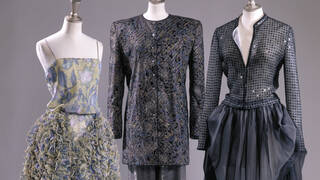
In Paris, couture houses such as Balenciaga, Balmain and Fath attracted worldwide attention for elegance and glamour. London was renowned for formal state gowns by court dressmakers and impeccable tailoring by designers like Hardy Amies.

The production of couture was important to the prestige and economy of both France and Britain. While traditionally catering for wealthy private clients, the couture houses also sought new markets. As the decade progressed, they created perfumes, opened boutiques and licensed their designs to foreign manufacturers. By the late 1950s, the leading couture houses had become global brands.
Dior's death in 1957 brought this golden age to an end. With the changing social and economic climate fashion moved from the fitting rooms and ateliers into the streets and boutiques. Yet its legacy of artistry and craftmanship survives in the remaining grand houses of Paris and the bespoke workshops of Savile Row.
Post-war and the Théâtre de la Mode
In 1939, there were seventy registered couture houses in Paris, including the grand establishments of Chanel, Schiaparelli and Balenciaga. This flourishing industry was disrupted by the wartime occupation of Paris. Private clients dispersed, international sales almost ceased and many couturiers closed. The Germans planned to move couture to Berlin but Lucien Lelong, president of the Chambre Syndicale de la Couture Parisienne, objected, saying, "It is in Paris or it is nowhere".

In 1945-6, the Paris couturiers created the Théâtre de la Mode, a touring exhibition of nearly two hundred dolls in sets, created by artists such as Christian Bérard and Jean Cocteau. The Théâtre brought together a community that even as late as 1946 was still suffering hardship: "Beautiful models huddled around little stoves. Skilful midinettes (seamstresses) bulged with sweaters...there was still not enough electric current to run all the machines or to burn the lights long". The Théâtre toured to Britain, Scandinavia and the USA, raising funds for war victims and promoting French fashion.
The ‘New Look’
Dior launched his couture house on 12 February 1947 and became an overnight sensation. His voluptuous collection was the antithesis of masculine wartime fashions. Instead, the designs featured sloping shoulders, a full bust and a cinched-in waist above full, long skirts. It was christened on the spot by Carmel Snow, editor of American Harper's Bazaar, as the 'New Look'. London couturier John Cavanagh described the style as 'a total glorification of the female form'.

The amount of fabric required to create a New Look garment caused outrage in London, as rationing was still in place. The collection was shown in secret to Queen Elizabeth II and other members of the royal family at the French Embassy in London. Although initially condemned by the British Board of Trade, the New Look gained widespread popularity, particularly after Princess Margaret adopted it, attracted by its femininity and youth.