
The Stein Collection
The V&A Stein Collection, on loan from the Government of India, includes nearly 600 textile fragments and over 70 ceramic and Buddhist objects. These rare objects, dating between 200 BC and 1200 AD, were recovered at the beginning of the 20th century by Hungarian-born, British archaeologist, Sir Marc Aurel Stein from The Silk Road – an ancient network of trade routes across Central Asia that connected the East and West.


Collection highlights
-
 Fragments of Artificial flowers, 300 - 400 AD, Miran, China, cotton and silk with wooden pegsV&A East Storehouse
 -
 Horse head-shaped fragment, 200 – 500 AD, Xinjiang, China, terracottaV&A South Kensington
 -
 Relief fragment, about 500 AD, Khadalik, China, moulded stuccoV&A South Kensington
 -
 Fragment of wooden panel, about 500 AD, Khadalik, China, painted woodV&A South Kensington
 -
 Shoe, 200 – 400 AD, The Limes Watchtowers, plant fibreV&A East Storehouse
 -
 Textile fragments, 600 – 900 AD, Dunhuang, China, silk damaskV&A East Storehouse
 -
 Head fragment, 200 – 500 AD, Xinjiang Uygur Zizhiqu, terracottaV&A South Kensington
 -
 Textile fragment, 700 AD, Dunhuang, China, embroidered silkV&A East Storehouse
 -
 Rope, 200 – 400 AD, Loulan, China, leather and grassV&A East Storehouse
 -
 Head of a Bodhisattva, 500 – 600 AD, Xinjiang, China, moulded stuccoV&A South Kensington
 -
 Ceramic fragment, 1000 – 1100 AD, Xinjiang, China, incised stonewareV&A South Kensington
 -
 Textile fragment, 600 – 800 AD, Dunhuang, China, pattern woven silkV&A East Storehouse
 -
 Porcelain fragment, 1368 – 1644, Jingdezhen, ChinaV&A South Kensington
 -
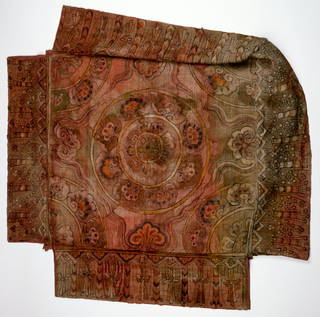 Canopy, 600 – 800 AD, Dunhuang, China, plain woven hempV&A East Storehouse
 -
 Banner, 600 – 900 AD, Dunhuang, China, pattern and plain woven silk, wood and paintV&A East Storehouse
Experience more as a V&A Member today
Treat yourself or a lucky recipient to the gift of Membership
- Unlimited free entry to all exhibitions
- Exclusive access to two Member spaces
- 10% discount in all V&A Shops
- Members-only previews and events

Header image:
Fragments of artificial flowers, 300 – 400 AD, Miran, China. Museum no. LOAN:STEIN.628. © Victoria and Albert Museum, London