Sir Aurel Stein & the Silk Road finds - Astana, Karakhoja, Loulan, Mingoi, Ushak-tal and Yar-khoto

Astana
Astana lies south of Turfan on the northern Silk Road. It once served as a burial site for Kharakhoja, an important trade centre during the Tang Dynasty (618-907 AD). Here Stein unearthed a stunning array of burial objects, including clay figurines, textiles, gold and silver coins, and thousand-year-old mortuary cakes, preserved in the dry heat of the desert. Ancient contracts for labour, land and grain purchases excavated at Astana and Kharakhoja show that carpets, rolls of silk, cotton and linen were often used as money.
The V&A holds several silk fragments, dating from the third to the sixth century. These include plain and pattern-woven pieces, some of which have been resist-dyed, painted and embroidered.
These figured silks incorporate decorative themes from Central Asia, Persia and China; reflecting the rich mingling of cultures which occurred along the Silk Road.

Boar design fragment, 600-700 AD. Museum no. LOAN:STEIN.679 (Ast.i.6.01)
Boar design fragment
Central Asia
600-700 AD
Weft-faced compound twill
Length 11.9 cm x Width 7.3 cm
Museum no. LOAN:STEIN.679 (Ast.i.6.01)
On loan from Government of India and the Archaeological Survey of IndiaThis textile fragment shows the remains of a boar design in orange and black. One of the boar’s ears is visible, part of a cheek with a tusk and part of the surrounding pearl border. Several textiles with a boar’s head have been discovered in Astana burial grounds. The designs of the head show, during the mid-7th century, typical Sassanian themes and are in weft-faced compound twill, or samite, a weaving technique which appears not to be used at this time in China. The execution of the patterns and the colour schemes seem to suggest a Sogdian type of manufacture. These textiles were intended for use as a burial face cover.

Silk fragments, 200-800 AD. Museum no. LOAN:STEIN.515 (Ast.vi.I.06)
Silk fragments
China
200-800 AD
Plain weave in silk, embroidery
Length 11.8 cm x Width 7.8 cm (largest fragment)
Museum no. LOAN:STEIN.515 (Ast.vi.I.06)
On loan from Government of India and the Archaeological Survey of IndiaThese are four fragments of monochrome plain woven silk, of which two are blue and one buff coloured. The fourth and largest fragment is dark red embroidered with floral design in pale blue, blue, green, cream and brown. Originally the embroidered red fabric was lined with a paler red silk, and there are fragments of this remaining. It is unclear what these textiles would have been used for, although they are likely to have been part of the burial furnishings or the shroud. The burials at Astana were richly attired, not only with textiles but food offerings, articles of personal use, vessels and sometimes miniature models substituting the real thing.

Silk fragments, 200-800 AD. Museum no. LOAN:STEIN.99 (Ast.vi.2.04)
Silk fragments
China
200-800 AD
Plain and patterned weave in silk, resist dye
Length 14.5 cm x Width 12 cm (largest fragment)
Museum no. LOAN:STEIN.99 (Ast.vi.2.04)
On loan from Government of India and the Archaeological Survey of IndiaThese textile fragments are of plain woven resist dyed silk with one piece of pattern woven silk showing an animal design attached. The structure of the latter textile is a weft-faced compound plain weave, also known as taquete, and was probably made in the Xinjiang area. The fragments original purpose is unclear although they were probably once part of a burial shroud.

Silk gauze fragments, 200-800 AD. Museum no. LOAN:STEIN.314 (Ast.vi.03)
Silk gauze fragments
China
200-800 AD
Gauze weave in silk
Length 8.5 cm x Width 8 cm (mounted)
Museum no. LOAN:STEIN.314 (Ast.vi.03)
On loan from Government of India and the Archaeological Survey of IndiaThis used to be a really fine and exquisite textile, of which the colours are still clear and strong. The colours of the silk gauze show a checked design but due the delicate nature of its weave only tiny fragments have survived. Stein discovered it in one of the tombs of Astana's burial grounds, where it originally may have been part of the burial furnishings.

Stylized animals, 200-800 AD. Museum no. LOAN:STEIN.595 (Ast.vi.I.03)
Stylized animals
Central Asia
200-800 AD
Weft-faced compound weave in silk
Length 18.7 cm x Width 10.7 cm
Museum no. LOAN:STEIN.595 (Ast.vi.I.03)
On loan from Government of India and the Archaeological Survey of IndiaThis textile fragment shows highly stylized animals in red and cream with blue or purple details, of which the top row might be camels. The overall pattern shows some similarity to the grid of Han dynasty textiles such as jin-silks with inscriptions, but the direction of the pattern is shifted 90 degrees. As a feature of Central Asian textiles for a long time, this pattern is a true repeat in the weft direction but not in the warp direction as seen in Chinese textiles of this period. The piece was found in one of the tombs at Astana and perhaps was once part of the burial face cover.

Silk damask, 200-800 AD. Museum no. LOAN:STEIN.321 (Ast.x.I.05)
Silk damask
China
200-800 AD
Damask weave in silk
Length 25.1 cm x Width 8.3 cm
Museum no. LOAN:STEIN.321 (Ast.x.I.05)
On loan from Government of India and the Archaeological Survey of IndiaThis modern-looking damask shows leaves within laurels and was discovered in the burial grounds of Astana. Stein states that the fragment came from a garment and it is possible that the yellow silk damask could have trimmed some sort of clothing. The fully clothed bodies buried at Astana were shrouded in textiles and also accompanied by model garments made of paper or silk, placed alongside them, with other funerary gifts.

Silk fragments, 650-725 AD. Museum no. LOAN:STEIN.594 (Ast.x.1.03)
Silk fragments
China
650-725 AD
Warp-faced compound weave in silk
Length 10.7 cm x Width 4.3 cm (largest fragment)
Museum no. LOAN:STEIN.594 (Ast.x.1.03)
On loan from Government of India and the Archaeological Survey of IndiaThis textile was woven in warp-faced compound twill, which was a popular weave structure during the early and late Tang periods. It has a floral roundel pattern with petals in a trilobite shape. A pair of shoes with rolled toe-caps found in another tomb at Astana burial ground are covered with a similar textile. Comparable patterns are also found on silks from the Mogao caves at Dunhuang.
Karakhoja
Karakhoja lies south of Turfan, towards the eastern end of the northern Silk Road. The Chinese established a military post at Karakhoja in the fourth century AD, but it fell to successive nomadic groups until the Chinese regained it during the Tang Dynasty (618-907 AD). Later, the Turkic Uygurs made Karakhoja their capital. Stein excavated its Buddhist shrines and cave-temples, finding for example Uygur text fragments, some textile fragments and fragments of stucco Buddha, some of them painted.
View of northern group of ruined tombs, Karakhoja, Sir Marc Aurel Stein, 1914. Photo 392/28(613),
© The British Library Board
Large ruined tombs, Karakhoja, Sir Marc Aurel Stein, 1914. Photo 392/29(158),
© The British Library Board
Chintaksa from the south-west with east wall at the back, Karakhoja, Sir Marc Aurel Stein, 1915. Photo 392/29(215),
© The British Library Board
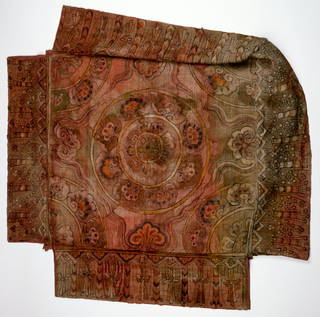
The V&A holds on loan a piece of clamp-resist dyed silk from Karakhoja. This rectangular piece consists of six separate parts of textile stitched together. All parts are of plain woven red silk but with two different resist dyed patterns. Two pieces show a repeating design of five petalled flowers in cream while four pieces have a cream coloured design of repeating four petalled floral lozenges. Stein discovered this textile in the ruins of a sepulchral structure in the Uygur city of Karakhoja (Gaochang). It is possible that the textile piece had been used as some sort of cover.
Resist dyed silk fragment, Karakhoja, 800-1000 AD. Plain weave in silk, resist dye. Length 64 cm x Width 21 cm. Museum no. LOAN:STEIN.542 (Kao.III.E.i.01.a). On loan from Government of India and the Archaeological Survey of India.
Loulan
Loulan was once an important garrison town which lay between the Peishan and Taklamakan deserts on the Silk Road. The city was also a centre of Buddhist worship. When Sven Hedin explored the site in 1900, he discovered remains of a stupa, reliefs depicting Buddhas among lotuses, and statues of deities. This strategically important city is mentioned in Chinese records for the first time in 176 BC with the conquest by the Xiongnu, but the area fell under Chinese control around 100 BC. Located in the middle of the Silk Road, Loulan had contacts with many cultures, represented by hundreds of documents in Chinese, Indian Kharosthi, and Sogdian scripts which were unearthed by Hedin and Stein. A woollen cloth, which Stein found in a tomb, depicted the head of Hermes and his caduceus, or staff, in the classical style of western Asia. He also unearthed a number of mummies with feathered felt caps and arrow shafts by their sides, which indicated that a community of herdsmen and hunters had inhabited the region long before various conquests. Loulan flourished until the early fourth century AD, when it was abandoned, due to the desiccation of a nearby lake, Lop Nor.
Stupa ruins and remains of dwelling, Loulan, Sir Marc Aurel Stein, 1906. Photo 392/27(132), © The British Library Board
Wooden enclosure of grave, Loulan, Sir Marc Aurel Stein, 1914. Photo 392/28(412), © The British Library Board
View to the south from ruined stupa, Loulan, Sir Marc Aurel Stein, 1906. Photo 392/27(133), © The British Library Board
Dead man found in grave, Loulan, Sir Marc Aurel Stein, 1914. Photo 392/28(421), © The British Library Board
The V&A holds on loan a large number of textiles from Loulan, including cotton, wool and figured silks, carpet and tapestry fragments.

Garment fragments, 200-400 AD. Museum no. LOAN:STEIN.205 (L.C.ii.07.b).
Garment fragments
Central Asia
200-400 AD
Plain weave in silk and wool and patterned weave in silk
Length 28.5 cm x Width 14.4 cm
Museum no. LOAN:STEIN.205 (L.C.ii.07.b)
On loan from Government of India and the Archaeological Survey of IndiaThese fragments probably once made up a garment, perhaps dressing the dead or as a gift for the afterlife. They include a layered piece of plain woven red wool, backed with plain woven buff silk, most of which is visible through deterioration of the wool layer. Stitched to the wool are strips of polychrome patterned weave silk, one in orange and blue, one in cream and blue, both showing unidentified designs and a third piece showing a repeating interlocking lozenge design interspersed with circles in blue and pink on a cream ground. It is interesting to note that, as in several other world cultures, the importance of being buried with luxury objects, such as silk, is evident in Loulan burial grounds.

Garment fragments, 200-400 AD. Museum no. LOAN:STEIN.207 (L.C.i.02.a-b).
Garment fragments
Central Asia
200-400 AD
Plain weave in cotton, patterned weave in silk and wool felt
Length 42 cm x Width 30 cm
Museum no. LOAN:STEIN.207 (L.C.i.02.a-b)
On loan from Government of India and the Archaeological Survey of IndiaThese two textile fragments consist of layers of plain woven plant fibre, perhaps cotton, padded with wool felt. The larger piece has remains of a silk band edged with patterned Han silk. It is likely that the pieces once made up a garment. No complete garment has yet been recovered from the Loulan grave pits but discoveries in other burial sites suggest that a certain type of garment dominated in the region. This style of caftan was well cut with tight sleeves cut separately and seamed in, usually with sleeve and side gores. It was made of wool or cotton, often with silk edgings. This type of clothing represents a predominantly male garment that originated in the Eurasian steppe world and became very popular in Central Asia. However, sometimes the lapels were closing on the proper right as in Chinese fashion. It seems like the garments were of nomad origin, but with influences from Chinese clothing.

Silk with rams, 200-400 AD. Museum no. LOAN:STEIN.214 (L.C.i.010).
Silk with rams
China
200-400 AD
Warp-faced compound plain weave in silk
Length 6.6 cm x Width 3 cm (largest fragment)
Museum no. LOAN:STEIN.214 (L.C.i.010)
On loan from Government of India and the Archaeological Survey of IndiaThe design on these two small fragments suggests a Western influence on Chinese silk production. The fragments are of warp-faced compound plain weave with continuous silk fibre with little or no twist, which identifies the making as traditional Chinese. However, the two confronting rams with twisted bodies within lozenge compartments are more in line with Western decoration of the time.

Taquete fragment, 200-400 AD. Museum no. LOAN:STEIN.229 (L.A.IV.v.002).
Taquete fragment
Central Asia
200-400 AD
Weft-faced compound weave in wool
Length 14.4 cm x Width 11.2 cm
Museum no. LOAN:STEIN.229 (L.A.IV.v.002)
On loan from Government of India and the Archaeological Survey of IndiaThis colourful taquete fragment was found in one of the rooms of a large dwelling within the walled garrison town of Loulan. Based on several finds of Kharosthi records, Stein was convinced that the ruined dwelling had been the residence of a non-Chinese official belonging to the indigenous administration of the territory. Wool taquete fabrics were probably used as furnishings, such as decorative bed covers. A similar taquete fragment has recently been found in the Yingpan cemetery, about 200 kilometres to the east of Loulan.

Red silk fragment, 200-400 AD. Museum no. LOAN:STEIN.231 (L.A.VI.ii.0045.b).
Red silk fragment
China
200-400 AD
Warp-faced compound weave
Length 5.7 cm x Width 4.2 cm
Museum no. LOAN:STEIN.231 (L.A.VI.ii.0045.b)
On loan from Government of India and the Archaeological Survey of IndiaStein discovered in one of the refuse pits within the garrison of Loulan, the only silk within the residential area of Loulan, showing small-scale classic Han period patterning of cloud scrolls. The apparent lack of luxury textiles, such as pattern woven silks is probably due to residents taking the precious silks with them when moving. Recent dye analysis revealed that the red dye contained only the compound purpurin and no alizarin which suggests that something other than usual Madder plant was used. The only known species today that contain purpurin, but no alizarin, is the plant Relbunium from South America and similar plants might therefore once have grown in south-western Xinjiang.

Shoe, 200-400 AD. Museum no. LOAN:STEIN.71 (L.A.VI.ii.0030.a).
Shoe
Central Asia
200-400 AD
Cut and stitched leather
Length 25 cm x Width 13 cm
Museum no. LOAN:STEIN.71 (L.A.VI.ii.0030.a)
On loan from Government of India and the Archaeological Survey of IndiaThis is a complete shoe of buff leather for the right foot, albeit a bit squashed through time. The upper has been made in two pieces, one forming the vamp and the other the quarters. There are marks along the opening of the shoe where probably some binding or decoration was once fastened. The sole is of single thickness and today broken. The shoe was excavated from a refuse heap outside a dwelling within the Loulan station. The dwelling had been relatively large containing several rooms. Stein believed, due to its size and several administrative documents in Kharosthi, that the owner had been a non-Chinese official belonging to the indigenous administration of the territory.

Rope, 200-400 AD. Museum no. LOAN:STEIN.83 (L.A.VI.ii.0033.a-b).
Rope
Central Asia
200-400 AD
Twisted grass and leather
Length 25 cm x Width 6.5 cm (as seen)
Museum no. LOAN:STEIN.83 (L.A.VI.ii.0033.a-b)
On loan from Government of India and the Archaeological Survey of IndiaThese two lengths of rope are made of grass and leather strips respectively. The rope of twisted grass has been doubled back on itself and knotted at intervals, giving it a chain-like appearance. The rope of leather has one strip doubled upon itself to give two strands while another strip is giving the third. Ropes have a multitude of functions, everything from keeping animals bound to carrying objects. They were found together in one of the many refuse heaps within the walled garrison town of Loulan.

Carpet fragment, 200-400 AD. Museum no. LOAN:STEIN.534 (L.B.IV.ii.0013).
Carpet fragment
Central Asia
200-400 AD
Knotted pile and tapestry weave in wool
Length 17.7 cm x Width 11 cm
Museum no. LOAN:STEIN.534 (L.B.IV.ii.0013)
On loan from Government of India and the Archaeological Survey of IndiaThis fragment of woollen pile carpet is tapestry woven in red and blue wool on coarse wool warp with rows of knots of cream coloured wool. The tapestry woven base show a geometrical pattern and it is likely that this was the side up with the tufts placed down. The tufts may have been to prevent the textile slipping on a smooth floor or to provide extra warmth when used as bed cover. The fragment was found in a room of a ruined house which Stein believed originally have had some sort of clerical use, due to the presence of Kharosthi documents, waxed tablets and seal-cases.

Carpet fragments, 200-400 AD. Museum no. LOAN:STEIN.540 (L.A.I.ii.001).
Carpet fragments
Central Asia
200-400 AD
Knotted pile and plain weave in wool
Length 28 cm x Width 18.6 cm
Museum no. LOAN:STEIN.540 (L.A.I.ii.001)
On loan from Government of India and the Archaeological Survey of IndiaCarpets and rugs are mentioned in 3rd to the 4th century documents as given in payment or part-payment for a wide variety of wares, from women to camels. Finds of wooden weft beaters linked with pile making or tapestry weaving undoubtedly show that these types of textiles were produced locally. The symmetrical closed knot, or the Ghiordes knot, had generally been used in the making of the ancient pile carpets. Today, the Persian knot is used almost exclusively in the Xinjiang region.
The fragments of the carpet seen here are too small to reveal its original design, but seem to have been highly decorative and colourful. On the back, there are remains of rows of long cream-coloured woollen tufts, consisting of two wool yarns slipped around the warp without being knotted. This would have prevented the carpet slipping on a smooth surface or added warmth to a bed-cover. It was found in a corner of a room in a ruined dwelling Stein suggested may once have belonged to a petty local head-man or representative of the indigenous administration of Loulan.
Shoe fragments, 200-400 AD. Museum no. LOAN:STEIN.58 (L.B.IV.ii.0014).
Shoe fragments
Central Asia
200-400 AD
Twining in silk
Length 24 cm x Width 5 cm
Museum no. LOAN:STEIN.58 (L.B.IV.ii.0014)
On loan from Government of India and the Archaeological Survey of IndiaThis bundle of strips used to be a shoe upper. It was made in the twining method, where the silk thread is twined / wrapped around a warp, probably of hemp. Two sets of coloured silks, here blue and red, were twined and changed in position for patterning a chevron band. A similar but complete shoe is in the collection of the British Museum, which was found in the same office room of a ruined house in Loulan as this one. Similar shoes are often found in Chinese tombs located in the Gansu province.

Rainbow wool, 200-400 AD. Museum no. LOAN:STEIN.585 (L.C.v.04).
Rainbow wool
Central Asia
200-400 AD
Twill weave in wool
Length 5 cm x Width 4.8 cm
Museum no. LOAN:STEIN.585 (L.C.v.04)
On loan from Government of India and the Archaeological Survey of IndiaThis tiny fragment is still radiant with the colours of the rainbow. The twill woven wool is striped in purple, orange, yellow, yellow-green, dark green and red. It is similar to textile fragments found in Niya, where the textile has been used as footwear.

Taquete fragment, 200-400 AD. Museum no. LOAN:STEIN.596 (L.A.IV.004).
Taquete fragment (Textiles - Room 98, Case 3)
Central Asia
200-400 AD
Weft-faced compound weave in wool
Length 32 cm x Width 18 cm
Museum no. LOAN:STEIN.596 (L.A.IV.004)
On loan from Government of India and the Archaeological Survey of IndiaThe majority of the textiles discovered within the walled garrison town of Loulan were made of wool. This is a fragment of patterned wool, called taquete, which is a weft-faced compound plain weave and due to its sturdiness might have been used as furnishing. This weave might have been an imitation of jin silk, a warp-faced compound silk produced in China. Some scholars suggest that these types of woollen weaves were made in the Western Regions along the Silk Road, most probably in Bactria or Gandhara.

Wool tapestry, 200-400 AD. Museum no. LOAN:STEIN.597 (L.A.VI.ii.0045.a).
Wool tapestry (Textiles - Room 98, Case 3)
Central Asia
200-400 AD
Tapestry weave in wool
Length 20.1cm x Width 14.2 cm
Museum no. LOAN:STEIN.597 (L.A.VI.ii.0045.a)
On loan from Government of India and the Archaeological Survey of IndiaThis piece of tapestry woven wool show bands in red, pale pink, white, pale blue, blue and broader bands of red. These latter bands have additional decorations in contrasting colours, which are worked in dovetail tapestry technique. This woven wool fragment reminded Stein of Indian durries, traditional cotton tapestry-woven floor coverings. It is possible that the textile was originally used as a floor or bed covering. It was found in one of the many refuse heaps within the walled garrison city of Loulan. Tapestry weave is a technique that does not yet seem to be utilised in China. The first true silk tapestry is found in Astana tombs, dated around 687 AD.

Silk with Chinese characters, 200-400 AD. Museum no. LOAN:STEIN.630 (L.C.031.a).
Silk with Chinese characters
China
200-400 AD
Warp-faced compound plain weave in silk
Length 21cm x Width 6.8 cm (largest fragment)
Museum no. LOAN:STEIN.630 (L.C.031.a)
On loan from Government of India and the Archaeological Survey of IndiaThe site called L.C. by Stein is an elevated area of land or a mesa, located 6.9 km to the northeast of Loulan city and was most likely the burial grounds for the inhabitants. Several of the famous Han period silks were discovered in the tombs. The polychrome warp-faced compound plain weave comprises designs in brilliant colours of mountain-shaped clouds, birds, dragons and other menacing looking creatures and woven Chinese characters integrated with the other motifs. They are probably the most important group of Han silks with a style so different from any other contemporary silk groups. The woven characters are dedicatory or considered lucky and consist generally of about four to twelve characters . This piece shown here is comparable to a recent find, now in the Xinjiang Institute of Archaeology, showing birds and beasts and with the characters of eternal prosperity.

Carpet fragment (front and rear view), 150 BC–60 AD. Museum no. LOAN:STEIN.647 (L.C.ii.09.a).
Carpet fragment (front and rear view)
Central Asia
150 BC-60 AD
Carpet weave in wool
Length 30.7 cm x Width 13.4 cm
Museum no. LOAN:STEIN.647 (L.C.ii.09.a)
On loan from Government of India and the Archaeological Survey of IndiaThis colourful and well-preserved fragment of woollen pile carpet has been radiocarbon dated to 150 BC-60 AD, to the beginning of Han Chinese occupation of Loulan. The warp is made of goat hair and hairy medium fleece type wool mix while the rows of knots in brown, pink, red, pale green and green, yellow, pale blue and blue wool are of hairy medium fleece type. The fragment shows a section across several bands of design, including a narrow border of single hook motif.
It was found in one of the grave pits outside the town of Loulan, and from evidence of other complete burials in neighbouring oasis towns; it is possible that the carpet was used as a shroud. From these finds, it appears that the carpets were already used and worn when they were put into the grave.

Floral embroidery on red silk, 200-400 AD. Museum no. LOAN:STEIN.650 (L.C.vii.004).
Floral embroidery on red
Central Asia
200-400 AD
Plain weave in silk and silk embroidery
Length 7.4 cm x Width 6.7 cm (largest fragment)
Museum no. LOAN:STEIN.650 (L.C.vii.004)
On loan from Government of India and the Archaeological Survey of IndiaThese fragments of plain woven red silk have been embroidered with floral patterns in blue, brown and buff. The embroidery was originally lined with a plain woven brown silk. The pattern is fairly large so the embroidery could have been used as furnishings, and there are examples of embroidered cushion covers in other comparable burials.

Bundle of felt, 200-400 AD. Museum no. LOAN:STEIN.68 (L.B.IV.v.0011).
Bundle of felt
Central Asia
200-400 AD
Felted wool
Length 18.5 cm x Width 6.5 cm
Museum no. LOAN:STEIN.68 (L.B.IV.v.0011)
On loan from Government of India and the Archaeological Survey of IndiaLife in the oasis towns of the Taklamakan was most likely rather harsh at times, and all produce could come of use in one way or another and therefore saved. Here, narrow strip cuttings from white felt have been saved and tied together. However, the cut-offs were never used and Stein found them within the ruins of a house at Loulan site B.

Leather cover, 200-400 AD. Museum no. LOAN:STEIN.74 (L.B.IV.v.0025).
Leather cover
Central Asia
200-400 AD
Tanned leather
Diameter 17 cm
Museum no. LOAN:STEIN.74 (L.B.IV.v.0025)
On loan from Government of India and the Archaeological Survey of IndiaThis leather piece has an impressed circular shape which reveals its last use as cover tied over a pot or a similar object. It is slightly discoloured with a light red tone inside. The leather cover was discovered in the ruins of a house about a mile from a Buddhist shrine. The architectural features, such as decorative wood-carvings in quasi-classical style, were particularly well-preserved.
Mingoi
Mingoi is located in the foothills of the Tianshan mountain range, on the northern Silk Road. Over a hundred Buddhist cave temples lend the site its name Mingoi, "The Thousand Dwellings". Stein explored a number of shrines here and found remains of colossal statues, fantastic carvings in wood, paintings and stucco reliefs. Depicted on the walls of the caves were Buddha legends, garlands of flowers, swags and tassels, fantastic canopies and mythological beasts. Stein found much evidence that the site had been occupied during the Tang Dynasty (618-907 AD) and Song Dynasty (960-1279 AD). Many Chinese coins, dating later than the eight century, had been left as votive offerings. Uygur manuscripts and graffiti indicated that the site had been occupied while the Uygurs controlled the region in the ninth to tenth century. A large amount of fallen brickwork appeared to have been hardened by burning; evidence that the site had been consumed in a large blaze in the second half of the tenth century. The caves also yielded much information about textiles of the period. Many statues were clothed in patterned and embroidered garments of Chinese silk. At their bases, Stein found votive rags of silk and linen.
Entrance to cave temple 'B', Mingoi, Sir Marc Aurel Stein, 1907. Photo 392/27(358), © The British Lbrary Board (left). Same view, Victoria Swift, 2008. Photo 1187/2(48), © International Dunhuang Project (right)
Main group of cave temples, Mingoi, Sir Marc Aurel Stein, 1907. Photo 392/27(359), © The British Library Board (left). Same view, Victoria Swift, 2008. Photo 1187/2(55), © International Dunhuang project (right)
Cave temples near Korla, Mingoi, Victoria Swift, 2008. Photo 1187/2(56), © International Dunhuang Project
The V&A holds on loan several textiles from Mingoi, including plant fibres; plain and pattern woven silk, and also a number of terracotta bodhisattva heads, one of which is shown below. This stucco relief of a tile displays a Bodhisattva head in its centre. A bodhisattva is a saviour figure who delays his own nirvana to help others achieve enlightenment. The narrow head is in the late Gandharan style of eastern Central Asia. Originally coloured and complete with a background, the tile would have adorned one of the many Buddhist shrines at Ming-oi on the northern Silk Road. Ming-oi literally means “the Thousand Dwellings”, a term not solely confined to this specific site, but also to other temple sites. This tile has been accidentally burnt later on and now is blackened. It was recovered by Stein in 1907.
Head of Bodhisattva (South-East Asia - Room 47a, Case 9), Mingoi, Central Asia, 500-700 AD. Baked clay. Height 15.3 cm x Width 11 cm. Museum no. LOAN:I A SURVEY.13 (Mi.xvi.0017). On loan from Government of India and the Archaeological Survey of India.
Ushak-tal
Ushak-tal lies between Karashahr and Turfan on the northern Silk Road. Stein believed that this section of the road once served as the main line of communication between Turfan and the northern oases of the Tarim Basin. Ushak-tal is the site of a walled enclosure built of layers of stamped clay and brushwood. There Stein found remains of a stable, fragments of pottery and glass, and a copper coin of the Tang Dynasty (618-907 AD).
The V&A holds on loan in its collection, a fragment of a green-glazed stoneware bowl with incised decoration, which probably dates from the Northern Song dynasty (960-1127 AD). This fragment of the rim of a stoneware bowl has a grey body and transparent, green glaze on either side. The incised decoration shows a combed pattern on the inside, and a plain band on the outside. Greenwares of this type were produced by the Huangbaozhen kilns in Yaozhou (now Tongchuan county), Shaanxi Province, northern China. This bowl was probably made during the Northern Song dynasty, 11th - 12th century AD, and may have reached the site of Ushak-tal, near Karashahr on the northern part of the Silk Road, through trade.
Stoneware sherd, Ushak-tal, 1000-1100 AD. Length 4.45 cm x Width 4.13 cm. Museum no. LOAN:INDIA.36 (Ushak-tal.003). On loan from Government of India and the Archaeological Survey of India
Yar-khoto
Yar-khoto was an oasis town on the northern Silk Road. It served as the capital of Turfan until the Tang Dynasty (618-907 AD). Stein was impressed by the massive ruins at the site and visited repeatedly while excavating at the town of Turfan nearby. Among the remains of several Buddhist shrines he found fragments of stucco sculpture, a quilted shoe, and a bronze ornament depicting small gilded Buddha figures seated on a lotus branch. Numerous Chinese copper coins dating to the Tang Dynasty (618-907 AD) indicated that the site had been occupied during this time.
Large mansion, Yar-khoto, Sir Marc Aurel Stein, 1915. Photo 392/29(263), © The British Library Board
Ruins of large structures in centre of northern area, Yar-khoto, Sir Marc Aurel Stein, 1915. Photo 392/29(259), © The British Library Board
General view of stupa group, Yar-khoto, Sir Marc Aurel Stein, 1915. Photo 392/29(217), © The British Library Board
A larger than life Buddha's head from Yar-khoto is included in the V&A Stein collection. The head originally came from an over life-size statue. The whole was painted in pink with the eyeballs painted in white. The holes for the pupils are now empty, but were probably filled with stone or paint. Directly below the under lip is a round hole, around which are remains of white paint covered with blue. The surface of nose, forehead and left side of the face are lost. It was found in a passage on the back of a platform in an ruined Buddhist shrine at the site of Yar-khoto (Jiaohe). The ancient city of Yar-khoto was built on a high cliff to the west of Turfan and once was an important administrative centre as it was located at the junction of the Silk Roads north and south of the Tianshan Mountain range.
Become a V&A Member
V&A Members enjoy a wealth of benefits, including free entry to exhibitions, previews, exciting events and the V&A Members’ Room. In addition, you will be supporting the vital work of the V&A.
Buy or Renew Membership OnlineShop online
Sir Francis Drake - Treasures of the Royal Courts Exhibition Postcard

Sir Francis Drake - Treasures of the Royal Courts Exhibition Postcard Sir Francis Drake, Marcus Gheeraerts the Younger (1561/2–1636) Oil on…
Buy nowEvent - O, those jewels! The Pride and glory of this kingdom!
Wed 26 June 2013 13:00

LUNCHTIME LECTURE: Join Richard Edgcumbe, Senior Curator, as he discusses the jewels presented in the V&A's current exhibition: Treasures of the Royal Courts: Tudors, Stuarts and the Russian Tsars.
Book online