Sir Aurel Stein & the Silk Road finds - Endere, Miran and Miran Fort

Endere
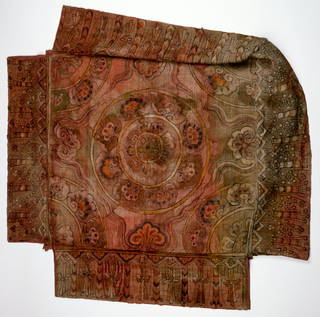
Endere was once an important military post and centre of Buddhist worship on the southern Silk Road. Coins found there indicate that the Chinese controlled the area as early as the Han Dynasty (206 BC-220 AD). During the Tang Dynasty (618-907 AD), Endere fell to the Tibetans and the city was abandoned in the ninth century AD, when the nearby Endere River changed its course. Stein excavated there in 1901 and 1906, locating remains of its great fort and a number of buildings devoted to Buddhist worship. In one shrine he found textile rags and fragments of Buddhist manuscripts deposited at the feet of stucco statuary, possibly as votive offerings. Written in Chinese, Tibetan and Sanskrit and other scripts, they suggested that the shrine had drawn worshippers from far and wide.
Ruined tower with remains of wind-eroded dwelling in the foreground, Endere, Sir Marc Aurel Stein, 1906. Photo 392/27(104), © The British Library Board (left). Same view, John Falconer, 2008. Photo 1125/16(306), © International Dunhuang Project (right)
Ruins of large building inside Endere fort, Victoria Swift, 2008. Photo 1187/29223, © International Dunhuang Project
The V&A holds on loan a number of textiles from Endere, including tanned leather, wool felts and yarns, woven silk, and braided plant fibres. The intriguing small object (below, left) is made of one length of cream felt which has been folded over and stitched around the edges with cream wool thread. It is unclear what the pad of felted wool would have been used for. Stein discovered it in the ruins of what once was a small dwelling, which he believed dated to the re-settlement after the Tang dynasty effective domination of the Tarim Basin. These fragments of red woollen braid (right) attached with stitching to felted buff wool may have been added decoration to the front opening of a felted garment.
Miran
Miran lies between Kargilik and lake Lop Nor on thesouthern Silk Road. Stein excavated an ancient fort and remains of a Buddhist sanctuary there in 1907 and uncovered spectacular Buddhist murals in its temples and stupas. These depicted winged figures with garlands; imagery which he identified with the mythology and style of Persia and Greece. The appearance of the signature "Tita" led Stein to conclude that the paintings were the work of an artist from the eastern Mediterranean. Temple sculpture, including a colossal Buddha head, was rendered in the opulent Gandharan style of northwest India. Stein called this fusion of regional styles Graeco-Buddhist and determined that the site had flourished in the first centuries of the millennium, when trade along the southern Silk Road had thrived.
View looking along base of stupa, Miran, Sir Marc Aurel Stein, 1906. Photo 392/27(118), © The British Library Board (left). Same view, Victoria Swift, 2008. Photo 1187/2(131), © International Dunhuang Project (right)
The V&A holds on loan from Miran, silk and wool fragments, and a group of lotus flowers made of cotton and silk and plaster-covered fabric fragments. These artificial flowers (below, left) were cut out flat from plain woven cotton and silk, some dyed blue and some red while others were left undyed. The flowers were cleverly made up with wooden pegs and tufts of silk thread to represent stalks and stamens. The stalks would then have been pushed through a painted cloth which perhaps covered the floor, walls or even the ceiling. The flowers may have been votive offerings of the worshippers at the shrine of Miran. The remains of a coarse cotton cloth (centre) has been covered with a very thin coat of white plaster painted dark blue. Onto the wet plaster were fixed groups and sprays of artificial leaves cut separately out of red and blue cloth and stuck together. Stein discovered these in the ruins of a shrine, square outside but circular within, which had once been surmounted by a dome and enclosed a small stupa in its centre. Spectacular murals had once decorated the walls such as winged figures and western-looking people in a 'Graeco-Buddhist' style, as coined by Stein. He described the long length of silk (right) as a girdle based on the much worn ends. He found it in the ruins of a small building with just one room and a hemispherical dome above it. It was still rolled-up. The width of the silk is about 6 centimetres wider than the standard measurement of silks made during the Han and Qin dynasties, and therefore might belong to a later date. The so-called girdle was maybe left behind by a traveller several hundred years later seeking shelter when the roof of the building was still intact.
Miran Fort
The Miran fort lies midway along southern Silk Road, at the foot of the Kunlun Mountains. When Tibetan troops occupied the area in the late eight century AD, they built the fort as part of a defensive network in and effort to control the surrounding area, which included a nearby mountain pass into Tibet, and the Qinghai route of the Silk Road into China. The fort was abandoned at the end of the 9th century, and had declined into a small farming community by the time Sir Aurel Stein visited the area.
In 1907, Stein excavated rubbish heaps at the fort and found wood slips, dating from the eight to the ninth century AD, which provided early examples of Tibetan writing. He also found fragments of wool rugs in bright colours and pieces of silk.
Ruined structure, Miran Fort, Sir Marc Aurel Stein, 1914. Photo 392/28(357), © The British Library Board
The V&A holds a large number of textiles from the Miran Fort on loan. They include patterned and plain woven silk and wool, woven and spun hemp, woven horsehair, cords and painted silk.

Sling, 8th century AD. Museum no. LOAN:STEIN.263 (M.I.0081).
Sling
Central Asia
8th century AD
Wool cord and wool felt
Length 70 cm x width 0.7 cm
Museum no. LOAN:STEIN.263 (M.I.0081)
On loan from Government of India and the Archaeological Survey of IndiaStein identified this object as a sling. It is made of closely plaited seven strands of yak outer hair which at one point is divided into two to form edge of felted wool pouch. Although the military duties at the fort were a priority, it is suggested by the finds that soldiers also farmed and herded livestock. String nets and slings indicate that they also fished and hunted.

Banded wool fragment, 8th century AD. Museum no. LOAN:STEIN.305 (M.I.0084).
Banded wool fragment
Central Asia
8th century AD
Plain weave in wool
Length 18.8 cm x width 18.7 cm
Museum no. LOAN:STEIN.305 (M.I.0084)
On loan from Government of India and the Archaeological Survey of IndiaA large number of coarse fabric fragments, mostly wool, were found at the Miran fort. The variety of texture is considerable in these fabrics, but all woven strongly and skilfully. Natural wool colours prevail such as browns, but the colour red seems to have been popular too. This is quite a fine woollen fragment, plain woven with bands of dark brown, yellow, blue, terracotta red and light brown. It is likely to have had a furnishing function originally.

Ball of yarn, 8th century AD. Museum no. LOAN:STEIN.252 (M.I.xxiv.001).
Ball of yarn
Central Asia
8th century AD
Spun wool
Diameter 6 cm
Museum no. LOAN:STEIN.252 (M.I.xxiv.001)
On loan from Government of India and the Archaeological Survey of IndiaThis ball of spun two-ply wool yarn probably once was in much stronger blue hue than now. It appears to have faded badly over time, leaving a patchy pale blue colour. The ball of yarn gives a glimpse of daily life at the Miran fort. It was perhaps used by the Tibetan soldiers and their wives for darning their clothes.

Tablet woven fragments, 8th century AD. Museum no. LOAN:STEIN.587 (M.I.0088).
Tablet woven fragments (Textiles - Room 98, Case 3)
Central Asia
8th century AD
Tablet weave in wool
Museum no. LOAN:STEIN.587 (M.I.0088)
On loan from Government of India and the Archaeological Survey of IndiaThese three fragments from a border showing a geometrical pattern are made in the tablet weave technique. The wool used has been identified as yak underwool. Although Miran was a military fort, they were also inhabited by civilians, including soldiers’ families, merchants and others. The life in these deserted forts must have been difficult. An abundance of Tibetan documents on wood and paper were found, and quite a few contain complaints about the time spent at the fort and shortages of provisions.

Tablet woven fragment, 8th century AD. Museum no. LOAN:STEIN.589 (M.I.xxvi.002).
Tablet woven fragment (Textiles - Room 98, Case 3)
Central Asia
8th century AD
Tablet weave in wool
Length 27 cm x width 6 cm
Museum no. LOAN:STEIN.589 (M.I.xxvi.002)
On loan from Government of India and the Archaeological Survey of IndiaThese three fragments come from a tablet woven border. Tablet weaving is a weaving technique where tablets or cards are used to create the sheds the wefts is passed through. The fundamental principle is to turn the tablets to lift selected sets of threads in the warp. Here at least 95 tablets have been used to weave the border which includes an animal motif, perhaps running horses, and geometrical pattern. The wool comes from yak plied with semi-fine sheel wool.
It was found at the Miran fort. When Tibetan troops occupied the area in the late 8th century AD, they built the fort to guard one of many routes through which they moved into Cental Asia.

Silk fragment with green dye, 700-800 AD. Museum no. LOAN:STEIN.550 (M.I.xii.003)
Silk fragment with green dye
China
700-800 AD
Plain weave in silk
Length 14.2 cm x Width 7.3 cm
Museum no. LOAN:STEIN.550 (M.I.xii.003)
On loan from Government of India and the Archaeological Survey of IndiaThis crumbled piece of plain woven light brown silk appears to have traces of bluish green colour on its surface. However, after examination under a microscope, in addition to blue fibres, some yellow incrustations could be seen. Small blue and black particles were also observed. The blue fibres were dyed with indigo, the yellow pigment was found to be the arsenic-containing compound pararealgar, As4S4, and the blue particles were made of lapis lazuli. The black particles were made of carbon black. Lapis lazuli is a rock, not a mineral, and can be made into jewellery, boxes and ornaments it was also ground and processed to make the pigment ultramarine for paint. The mines in northern Afghanistan have produced lapis lazuli for export for several thousands of years, but it could also be found in the mountains of the Kingdom of Khotan.

Pouch, 8th century AD. Museum no. LOAN:STEIN.648 (M.I.xxvii.001).
Pouch
China
8th century AD
Patterned weave in silk
Height 14.4 cm x width 10 cm
Museum no. LOAN:STEIN.648 (M.I.xxvii.001)
On loan from Government of India and the Archaeological Survey of IndiaA square piece of pattern woven silk has been folded over and stitched into a small triangular pouch. There are remains of sawdust inside the pouch, indicating that it might originally have been used as a perfume sachet.
It was recovered from a site called Miran fort which was held by the Tibetans during their domination of the southern Taklamakan during the 8th century AD. Finds of Chinese silk are scarce from this site, showing that trade with China declined notably through the Tibetan conquest of the Tarim Basin and the Gansu border.

Tablet woven fragment, 8th century AD. Museum no. LOAN:STEIN.588 (M.I.xxvi.001).
Tablet woven fragment (Textiles - Room 98, Case 3)
Central Asia
8th century AD
Tablet weave in wool
Length 28 cm x width 19.5 cm
Museum no. LOAN:STEIN.588 (M.I.xxvi.001)
On loan from Government of India and the Archaeological Survey of IndiaThis large fragment consists of two tablet woven borders stitched together. The top border show running animals with curling horns, while the other border has a geometrical pattern. The wool used has been identified as yak.
The yak is a long-haired bovine found throughout the Himalayan region of south Central Asia, the Tibetan Plateau as far north as Mongolia.
A gift in your will
You may not have thought of including a gift to a museum in your will, but the V&A is a charity and legacies form an important source of funding for our work. It is not just the great collectors and the wealthy who leave legacies to the V&A. Legacies of all sizes, large and small, make a real difference to what we can do and your support can help ensure that future generations enjoy the V&A as much as you have.
MoreShop online
Sir Francis Drake - Treasures of the Royal Courts Exhibition Postcard

Sir Francis Drake - Treasures of the Royal Courts Exhibition Postcard Sir Francis Drake, Marcus Gheeraerts the Younger (1561/2–1636) Oil on…
Buy nowEvent - O, those jewels! The Pride and glory of this kingdom!
Wed 26 June 2013 13:00

LUNCHTIME LECTURE: Join Richard Edgcumbe, Senior Curator, as he discusses the jewels presented in the V&A's current exhibition: Treasures of the Royal Courts: Tudors, Stuarts and the Russian Tsars.
Book online