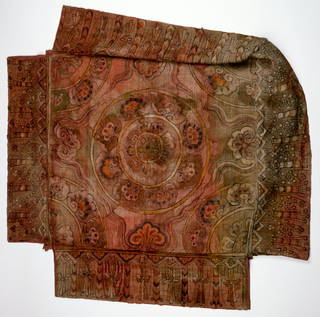
Sir Aurel Stein & the Silk Road finds - Akterek, Balawaste, Chalma-Kazan, Darabzandong, Farhad-Beg-yailaki, Kara-Yantak, Karadong, Khadalik, Khotan, Mazartagh, Mazartoghrak, Niya, Siyelik and Yotkan

Akterek
Akterek sits on the southern edge of the Taklamakan desert, near the modern city of Khotan. Stein excavated a Buddhist shrine and temple there in 1906, and found remains of elaborate reliefs and sculptures, which had once decorated the site. A wealth of stucco fragments, bearing traces of gold, linked Akterek to the gilded shrines of the Buddhist Kingdom of Khotan, which had flourished during the third and fourth centuries AD. Akterek's connection with other southern Silk Road sites was confirmed by the presence of small terracotta monkey figures, similar to those Stein had collected at Yotkan, dated to the third to sixth century AD. Stein found that the Buddha figures, lotus flowers, wreaths, and cloud scrolls he unearthed had been baked hard. He concluded that the site had ultimately been destroyed by fire.
The V&A holds on loan from Akterek fragments of a stucco palmette and a terracotta monkey. The stucco relief fragment of a five-leaved palmette with pointed leaves and incised central ribs was found in the remains of a Buddhist shrine at Akterek which lies east of the present-town of Khotan on the Silk Road branch along the southern edge. Here Stein found numerous burnt clay fragments of ears, fingers, toes and noses and other parts of the body, revealing that the walls of the passage and shrine itself must have been lined with relief images of Buddha and Bodhisattvas.
The fragment of the upper part of a terracotta figurine of a monkey was found in the west passage of a ruined Buddhist shrine at Akterek, east of the present-town of Khotan. Besides numerous fragments of Buddhist art, Stein also discovered lots of terracotta figurines, grotesque masks and monkeys, similar to the finds at Yotkan and Khotan showing. The monkey probably supported a small pottery bowl with his arms above his head as illustrated by similar objects brought back from Khotan.
Balawaste
Balawaste was located in the eastern part of the Khotan oasis, near the village of Domoko, on the southern arm of the Silk Road. Fragments of manuscripts, pottery, and plaster were found at this site but also fragments of mural paintings, probably from a Buddhist shrine. The site is dated to around 600 AD based on clothing and style of the divine beings in the paintings.
A fragment of clamp-resist dyed silk is in the V&A Stein collection. This small rectangular plain woven silk is decorated with clamp-resist dyed designs in blue-green leaving alternating floral and cruciform-shaped patterns in buff colour. Clamp-resist dyeing, known in English by the Japanese term kyokechi, uses two symmetrically carved concave blocks to clamp the folded textile and dye, and then the pattern of the convex part is obtained. The fragment was found by Stein in the remains of a roughly built dwelling in Balawaste, which he believed had been some petty administrative office dealing with both local and Chinese affairs.
Chalma-Kazan
Chalma-Kazan lies at the southern edge of the Taklamakan Desert near Yotkan, capital of the ancient Kingdom of Khotan. Here Stein found a large deposit of pottery fragments, broken glass and slag; traces of Khotan's ancient jade mining industry. He also looked for evidence of the legendary shrine of Vairocana Buddha, divine counterpart of the historical Sakyamuni Buddha. The shrine had been recorded by Xuanzang, a seventh century monk who travelled the Silk Road. Stein believed that a stupa at the site conformed to his account, but his excavations yielded no evidence, for it had been emptied by treasure hunters long ago. A Buddhist temple north of Chalma-kazan yielded painted stucco Buddha figures and floral ornaments, terracotta figures of beasts and deities, stone carvings and jewellery. The presence of many Chinese coins dating to the eight century indicated that the temple had flourished during the Tang Dynasty (618-907 AD).
A fragment of an antelope head in clay recovered from Chalma-Kazan is in the V&A collection. This stucco relief fragment is made of light-coloured clay with mud and fibre filling and reed core. Stein acquired this head together with other burnt clay figurines from a local antique dealer, who claimed that he found them at Chalma-Kazan, probably the site of a Buddhist shrine, near present-day Khotan.
Darabzandong
Darabzandong lies near the western end of the Silk Road. It was one of several oasis towns which flourished at the southern edge of the Talamakan Desert, in what was once the Kingdom of Khotan. Here Stein excavated the remains of a Buddhist temple and found artefacts bearing Sanskrit and other Indian scripts, including an Indian pothi, or religious book, and a wooden tablet. He also unearthed fragments of stucco Buddha heads and elaborate wall paintings, which were similar in style to pieces he had found at the nearby shrines of Khadalik and Dandan-oilik. He concluded that Darabzandong had been occupied at the same time, from the eight until the tenth century AD, when the surrounding land dried out and all three sites were abandoned.
The V&A holds from Darabzandong fragments of a string shoe. This is the only object in the V&A that was recovered from the site of Darabzandong. The site is located on the left bank of an earlier course of the Domoko stream and two and a half miles south from Khadalik. Here Stein discovered a number of stucco fragments from a frescoed temple wall and other sculptural remains which showed close resemblance in style to the work of the Khadalik shrines. The type of string sandal found at Darabzandong, with plaited sole and uppers of separate cords with bound-over edge has also been found at the Limes Watchtowers and Loulan.
Farhad-beg-yailaki
Farhad-beg-yailaki lies on the southern Silk Road, in what was once the Buddhist Kingdom of Khotan. Here Stein explored the remains of Buddhist shrines, which he dated from the fourth to the sixth centuries AD. Among these he found Buddha statues wearing robes with bright floral designs. At their feet were piles of fabrics offered in worship. Artefacts from the site were evidence of contacts with many cultures. Murals depicted two figures important in Indian Buddhist mythology: Hariti, protector of children, and Avalokitesvara, god of mercy and compassion, draped in cloths with Sassanian motfis. Stein also found clay seal impressions and pottery fragments bearing classical imagery, such as a winged horse and a figure of the Trojan prince Ganymede.
Digging at Farhad-beg-yailaki, Sir Marc Aurel Stein, 1906-1908. Photo 392/26(621), © The British Library Board
Excavations at the south-west wing of ruined monastic quarters, Farhad-beg-yailaki, Sir Marc Aurel Stein, 1906-1908. Photo 392/26(616). © The British Library Board
Remains of ruined temple cella and porch, Farhad-beg-yailaki, Sir Marc Aurel Stein, 1906-1908. Photo 392/26(618), © The British Library Board
Remains of ruined Buddhist shrine embedded in tamarisk-covered sand cone, Farhad-beg-yailaki, Sir Marc Aurel Stein, 1908. Photo 392/27(366), © The British Library Board
The V&A holds on loan from Farhad-beg-yailaki, fragments of woven plant fibre, silk and wool. The bundle of five fragments of different fabrics consist of plain woven cream wool, cream wool felt attached to plain woven pale red wool, plain woven dark red wool and one piece of plain woven yellow unidentified plant fibre, possibly cotton, with three blue stripes along one edge. These fragments have been secured together with the Stein number label. A piece of plain woven yellow silk is separate from the bundle and not mentioned by Stein in Serindia.
The fragment of a terracotta vessel handle in the shape of a winged horse was excavated at one of the ruins (F.II) at the site Farhadbegyailiki, situated about half a mile to the west of ruin F.I. This ruin comprised a badly eroded shrine of larger size with dwelling quarters. At Farhadbegyailiki several Buddhist shrines with dwelling quarters were discovered. This Buddhist sanctuary was part of the former Kingdom of Khotan. The stucco relief fragment of a small Buddha appliqué figurine was excavated from the temple cella of a shrine with dwelling quarters at the site of Farhad-beg-yailiki between Khotan and Keriya in Xinjiang, China.
Kara-Yantak
Kara-Yantak lies near Farhad-Beg-yailiki on the southern Silk Road. Here Stein found the remains of a Buddhist shrine, of which only the foundation beams and posts remained, along with chips of painted wood. His excavations revealed that it was similar in plan and decoration to the shrine at nearby Khadalik, which had flourished between the eighth and tenth century AD. The scanty remains included fragments of sculptures, a wooden pothi, or religious document of Indian origin, covered with a Central Asian script and clay impressions of a bodhisattva on a lotus throne. Among the most significant finds were pieces of a wall mural, showing small, seated Buddha figures in a diaper pattern. The presence of a single Tang Dynasty (618-907 AD) coin suggested that the settlement had been abandoned in the late eight century.
There are a few stucco fragments from Kara-Yantak in the V&A Stein collection. The heavily damaged fresco fragment (lower left) originally came from the foot of a stucco image base. Stein states that when the fragment was discovered the head and arm of a female figure and a small child against a white background were still visible. It was excavated from a small chapel at the remains of a Buddhist shrine at the site of Kara-Yantak, situated less than a mile and a half east of Mazartoghrak. The remains were those of a completely destroyed Buddhist shrine, which in plan and decoration must have shown the closest resemblance to the main temple of Khadalik, though probably smaller.
The other fragment (lower right) of a fresco in fine hard stucco may have belonged to the left part of a vesica or background of a large figurine. On the left is a straight border of lotus leaves, outlined in red and filled in with white paint. An elliptical panel on the right shows Buddha sitting on a lotus throne in front of a white background, outlined with red colour. It was excavated from the remains of a Buddhist shrine at the site of Kara-Yantak between Khotan and Keriya. With the exception of a few feet length of foundation beams and the fragments of posts, all pieces of wood which could be of use had been removed.
Karadong
Karadong lies south of Kucha on the northern Silk Road. On his first visit, Stein found the remains of timber dwellings atop an earthen rampart and concluded that the site had once been a frontier post. Artefacts unearthed there, including copper coins from the Eastern Han Dynasty (25-220 AD), suggested that it had flourished during this period. When Stein visited Karadong a second time, he discovered three dwellings, furniture, and household utensils, along with two irrigation canals; evidence that the site had been an oasis town, not an isolated fort.
Ruined dwelling, Karadong, Sir Marc Aurel Stein, 1906-1908. Photo 392/26(597), © The British Library Board
The V&A holds on loan from Karadong carpet fragments, silk, woven plant fibres, and spun wool, all dating from 200-300 AD. Below is one of five similar fragments of thick felt-lined woollen textiles Stein discovered in the largest ruined house at the site of Karadong. The knotted pile has been worn away in several areas but would originally have been long enough to cover the wefts in between the rows of knots. The other side shows remains of, and original layer of, felted cream and brown wool, attached to the textile with string made of hemp. Stein suggested that the fragments once may have been part of a felt-lined carpet or even a coat. The original construction and internal arrangements of the ruined houses at Karadong were practically identical with the houses of the Niya site. Also the finds of Karadong closely resemble finds of the same kind made at the Niya and Loulan site, indicating a similar culture.
Khadalik
Khadalik lies between Khotan and Keriya on the southern branch of the Silk Road. Here Stein discovered remains of a number of Buddhist shrines. Inside several temples were elaborate murals depicting Buddhist deities, large statues with traces of gilding, reliefs and painted panels. Large numbers of Buddhist texts were found among the ruins, including pothi, religious books of Indian origin, written in Sanskrit, wooden tablets and sticks covered in Tibetan writing, and fragments of documents deposited as votive offerings. Other votive gifts included numerous small pagodas and moulded Buddha figures. Strings of Tang Dynasty (618-907 AD) copper coins, left as offerings near Buddha statues, were taken by Stein as evidence that the site had been abandoned in the eight century AD.
Stupas and breach, Khadalik, Sir Marc Aurel Stein, 1914. Photo 392/29(115), © The British Library Board
Large fresco fragment, Khadalik, Sir Marc Aurel Stein, 1909. Photo 392/27(80), © The British Library Board
The V&A holds on loan from Khadalik, pieces of woven plant fibres, wool felt and twill, and plaster-covered woven fabric, which may have functioned as stucco backing. The little square of folded grass (below, left) of unknown use was recovered from the site of Khadalik, a Buddhist shrine dating from the 8th to the 10th century AD. The intriguing find might have been part of a votive gift or some sort of decoration. Perhaps folding grass was just some past-time activity. The stucco relief fragment (centre) shows a crowned gandharva enclosed by an oval flame-bordered vesica. Several almost identical relief fragments were found as they were made from the same mould. They probably served as decoration of the vesica of a colossal Buddha statue which is now lost. It was excavated in one of the Buddhist shrines at the site of Khadalik which lies between Khotan and Keriya on the southern branch of the Silk Road in Xinjiang, China. What is striking about this piece is the fact that it appears to have been burned. Does this indicate that this Buddhist shrine found its end in a fire? This wooden fragment (right) with a depitcion of Buddha was excavated from a ruined Buddhist shrine at the site of Khadalik, which lies between Khotan and Keriya on the southern branch of the Silk Road in Xinjiang, China. The fragment was probably part of a painted panel within the shrine.
Khotan
Fragments of north wall seen from the south-east, Khotan, Sir Marc Aurel Stein, 1914. Photo 392/28(391), © The British Library Board
Khotan sits near Khargalik at the western end of the southern Silk Road. The Khotan site comprises a group of oasis towns that lie in the fertile lands south of the Tarim Basin. The region is watered by two great rivers: the Karakash (Black Jade River) and the Yurungkash (White Jade River). In spring, these rivers swell with melted snow from the Kunlun Mountains and carry boulders of jade down from their glacial peaks. This has made Khotan the most important source of this precious stone since ancient times. From the Han Dynasty (206 BC-220 AD) onward, merchants from China carried their goods to Central Asia and returned with Khotanese jade. The area became the centre of agriculture and trade within the Kingdom of Khotan and a group of oasis towns sprang up around the rivers.
The Kingdom of Khotan was a centre of Buddhism on the southern Silk Road, founded by immigrants from India in the third century BC. Khotan enjoyed great prosperity, due to its exports of jade, carpets, silk and paper. The arrival of monks from Kushan, together with Persians and Chinese, produced a rich blend of artistic styles which Stein called "Serindian". During his excavations in 1900, he found Buddha statues in the sensual Indian Gandharan style, along with images of Hindu and local Khotanese deities. Coins bearing Indian and Chinese scripts were evidence of the political forces which affected this vital trade centre. During the first millennium, Khotan was ruled by a number of foreign powers, including China, Kushan and Tibet, until it was destroyed by the Mongols. Here Stein acquired many terracotta figures, coins, pottery shards and even flakes of gold from its soil; evidence of the city's former grandeur. He also located Buddhist sites recorded by the seventh century monk Xuanzang, during his travels on the Silk Road.
There are several terracotta masks and figures from Khotan in the V&A Stein collection. The terracotta appliqué mask (below, left) was purchased by Stein, together with other terracotta figures, in Khotan. Khotan was a major kingdom on the southern branch of the Silk Road and also a major centre of Buddhism. Many of these terracottas were used as appliqué ornamentation on pottery vessels. The head of a female with an elaborate hairstyle originally belonged to a figurine. There is an intact example from the Stein collection in the British Museum that shows a matronly woman cloaked in a long coat with hanging sleeves. Beside the elaborate hair styles, these terracotta female heads usually display facial tattoos. Stein purchased it around the village of Yotkan in the Borazan region of Khotan, which was identified with the ancient capital of the kingdom of Khotan. The tiny terracotta bird (right) with a large crest with incised decoration and pierced for suspension was purchased in Khotan by Sir Aurel Stein. Most of the terracottas seem to have been found on the surface and not within excavations.
Mazartagh
The fort of Mazartagh lies in the western half of Taklamakan Desert, north of Khotan. Among the ruins, Stein found huge numbers of Tibetan documents on wood and paper devoted to military and administrative matters. Many of these dated from the eight century AD, when Tibetan armies conquered the region and occupied the fort. He also found string sandals, shoes made of felt, remnants of wool clothing and nets for fishing. Similar utilitarian textiles had appeared at the Dunhuang Limes, Miran Fort and other military sites. Most of the finds came from a massive refuse heap below the fort. These rubbish deposits (containing both human and animal waste mixed with straw and various objects) measured about 57 metres in length and 21 metres wide with a depth of 1-1.5 metres in places. Stein described the rubbish heap as being rich with remains of everyday objects but that the smell still was very much pungent.
View of fort wall, Mazartagh, Sir Marc Aurel Stein, 1906-1908. Photo 392/26(715), © The British Library Board (left). Same view, John Falconer, 2008. Photo 1125/16(715), © International Dunhuang Project (right)
North bastion of ruined fort seen from outer court, Mazartagh, Sir Marc Aurel Stein, 1906-1908. Photo 392/26(721), © The British Library Board (left). Same view, Victoria Swift, 2008. Photo 1187/2(281), © International Dunhuang Project (right)
Mazartagh fort with refuse slopes, Sir Marc Aurel Stein, 1906-1908. Photo 392/26(707), © The British Library Board (left). Same view, Victoria Swift, 2008. Photo 1187/2(307), © International Dunhuang Project (right)
Ruined fort and watchtower on Mazartagh ridge, Sir Marc Aurel Stein, 1906-1908. Photo 392/26(717), © The British Library Board (left). Same view, Victoria Swift, 2008. Photo 1187/2(282), © International Dunhuang Project (right)
The V&A holds on loan several textile fragments from Mazartagh, including woven cotton, hemp string, netting, quilted wool and pieces of shoes. The upper of a felt shoe (below, left) with quilting in zig zag rows and an opening round the ankle which has been strengthened by a strip of felted semi-fine wool with a drawstring. The shoe was probably left behind by a Tibetan soldier serving at the fort of Mazartagh during the 8th century. Strong and warm shoes were needed for desert life and travel in the winter. Only the upper of the ankle shoe on the right has survived since it was last used more than 1000 years ago. It is made of felted wool stitched into a design of overlapping scales. It is likely that the missing sole was also made of wool felt but covered with leather at least at the heel and toes to make the sole more durable for wear and tear. A similar ankle shoe, but complete, is in the British Museum.
The strip (below, left) appears to be from some sort of compressed and dried vegetable fibre pulp which resembles paper. It has been painted or printed on one side with lozenge-pattern in red lines and tied with a string in the middle. It is difficult to know what it would have originally been used for, but a good guess is that it would have been something utilitarian. The length of woollen knotted cord (right) was discovered in the same rubbish heap outside the fort of Mazartagh, and may have been part of some sort of pastime or game.
Mazartoghrak
Near the shrine of Mazartoghrak in the Tarim Basin, Stein found a small plateau covered with pottery shards and an ancient rubbish mound. Within the heap were fragments of wooden tablets, sticks and paper, which he concluded were refuse from an ancient office. Most were inscribed with Indian Brahmi script, but documents in Chinese and Khotanese language also appeared. He also excavated coarse woollens and cottons along with weaving tools, such as clay loom weights and wooden combs. Stein dated the site to the period of Chinese control over the Tarim Basin, during the Tang Dynasty (618-907 AD) and he determined that it had been abandoned toward the end of the eight century AD, possibly due to desiccation of the land.
The V&A holds on loan from Mazartoghrak, fragments of woven silk and wool, tapestry and parts of a string shoe. Stein suggested that the tapestry weave fragment below had once come from a rug. The weave of the fragment has become loose after 1000 years in the sand and it is now difficult to tell the original pattern of the woollen object. The colours are still fairly strong. The ruined habitations of Mazartoghrak also revealed a quantity of documents mostly in the cursive Brahmi script, which is an ancient Indian script.
Niya
Niya includes a group of towns in the southern region of the Taklamakan Desert, at the foot of the Kunlun Mountains. Once a military post under the Kingdom of Khotan, Niya became an important oasis along the southern Silk Road. Stein excavated several groups of dwellings there and found hundreds of wedge-shaped wooden tablets, some laced together in pairs with string and affixed with clay seals. The appearance of Pallas Athena, Eros and other Greek deities on some seals showed the impact of western classical art on Khotan. The tablets were inscribed with Kharoshthi, an ancient script of northwest India. Stein identified some as Buddhist prayers and others as administrative documents and he dated them to the period of the Kushan empire, which thrived in the first three centuries AD. Among ruins of dwellings and orchards, Stein found numerous textile fragments, Roman coins, wooden furniture with elaborate carving, pottery, Chinese basketry and lacquer, and documents in Chinese script which he dated to the Han Dynasty (206 BC-220 AD).
Niya site after partial excavation, Sir Marc Aurel Stein, 1906. Photo 392/27(86), © The British Library Board
Room excavated in ancient residence, Niya, Sir Marc Aurel Stein, 1906. Photo 392/27(89), © The British Library Board
Ruin of an ancient dwelling, Sir Marc Aurel Stein, Niya, 1906-1908. Photo 392/26(191), © The British Library Board
The V&A holds on loan a large number of textiles from Niya, including leather, wool yarn, appliquéd and stitched wool felt, and braided animal hair.

Weft beater, 100-300 AD. Museum no. LOAN:STEIN.530 (N.XIII.iii.003).
Weft beater
Central Asia
100-300 AD
Wood
Length 24.2 cm x width 9 cm
Museum no. LOAN:STEIN.530 (N.XIII.iii.003)
On loan from Government of India and the Archaeological Survey of IndiaSeveral weft beaters or wooden combs have been discovered at the Niya and Mazar-toghrak sites in Khotan and neighbouring Loulan. These would have been used to beat down the weft when weaving woollen textiles such as tapestries, rugs or carpets. There was a thriving rug making industry in Khotan, as shown by the frequent mention of Khotanese rugs and carpets in contemporary documents. We also know that carpets and rugs were used in the local currency system, for example could a nice carpet pay for a camel or even a woman.

Fragment of matting, 100-300 AD. Museum no. LOAN:STEIN.191 (N.008).
Fragment of matting
Central Asia
100-300 AD
Plant fibre matting
Length 25 cm x width 18 cm
Museum no. LOAN:STEIN.191 (N.008)
On loan from Government of India and the Archaeological Survey of IndiaThis decorative matting is made from split rush plant in a zigzag pattern. It could have been used as floor covering.

Hat, 100-300 AD. Museum no. LOAN:STEIN.678 (N.XIV.004).
Hat (Textiles - Room 98, Case 3)
Central Asia
100-300 AD
Felted wool
Length 39.3 cm x width 33.5 cm
Museum no. LOAN:STEIN.678 (N.XIV.004)
On loan from Government of India and the Archaeological Survey of IndiaThis nifty little hat is made of felted yellow wool, resembling a seaman’s sou’wester hat. The crown comprises five gored pieces of felt stitched to a brim made up of two panels. Stein found it in a badly eroded structure which had been used as rubbish tip and extended over 16.15 meter by 15.24 meter.
The hat would have been a welcome protection against the biting wind in the wintry desert.
Fragment of fur, 100-300 AD. Museum no. LOAN:STEIN.182 (N.XIV.iii.002).
Fragment of fur
Central Asia
100-300 AD
Furred leather
Length 25 cm x width 10 cm
Museum no. LOAN:STEIN.182 (N.XIV.iii.002)
On loan from Government of India and the Archaeological Survey of IndiaThis strip of fur, with hair still covering one end and adhering also in a few scattered patches, might once have been part of a warming fur garment or cover. There are stitch marks along upper edge for the attachment of another strip, part of which remains and in the middle of the piece, three holes have been cut, one above the other. An analysis has shown that the skin comes from a medium-sized domestic dog.

Fragment of garment, 100-300 AD. Museum no. LOAN:STEIN.184 (N.XXIV.viii.001).
Fragment of garment
Central Asia
100-300 AD
Plain weave in wool
Length 38 cm x width 11 cm
Museum no. LOAN:STEIN.184 (N.XXIV.viii.001)
On loan from Government of India and the Archaeological Survey of IndiaThis textile fragment is of plain woven buff wool, gathered into a band of the same fabric, which has been folded over and stitched. At one end of the piece, strips of stitched plain woven red wool and a small ball of cream thread have been attached. Based on more complete finds from this area, it is possible that this is the top of a pair of trousers or a skirt.
Stein discovered this torn piece of fabric in the ruins of a large residence with several rooms and a courtyard or garden, perhaps belonging to a well-to-do person. It was found in room eight, where also a large cache of Kharosthi documents were found, most of which were deeds of sale. Kharosthi is the written Gandhari language unique to Central Asia.
Pattern woven wool, 100-300 AD. Museum no. LOAN:STEIN.631 (N.XXIV.viii.003).
Pattern woven wool (Textiles - Room 98, Case 3)
Central Asia
100-300 AD
Patterned weave in wool
Length 17 cm x height 7 cm
Museum no. LOAN:STEIN.631 (N.XXIV.viii.003)
On loan from Government of India and the Archaeological Survey of IndiaThis textile piece of polychrome pattern woven wool has a white ground with a repeating lozenge design in dark red. With this piece, there are also the remains of a small section in red yellow and blue. It was probably once used as a rug or decorative hanging. Stein found this fragment of pattern woven wool in one of the many rooms of a large residence. Most of the finds from this particular room were double wooden tablets in Kharosthi script, indicating that it had been used as an office for the well-to-do person living there. A wooden mouse-trap was also discovered in the room, so affluent people had pest-problems too.

Fragment of felt, 100-300 AD. Museum no. LOAN:STEIN.519 (N.XIV.iii.006.c).
Fragment of felt
Central Asia
100-300 AD
Felted wool, appliqué
Length 16.4 cm x width 9.8 cm
Museum no. LOAN:STEIN.519 (N.XIV.iii.006.c)
On loan from Government of India and the Archaeological Survey of IndiaThis fragment of felt is made of natural coloured wool on which is sewn a curling design in felted red wool. Felt is a non-woven cloth that is produced by matting, condensing and pressing wool fibres. While some types of felt are very soft, some are tough enough to form construction material, such as yurts of the nomads. Wool from camel, yak, sheep or goat hair could be used. Felt was a Silk Road staple and the best one was produced in Khotan.
Siyelik
Siyelik lies south of the Taklamakan Desert, near the Kunlun mountains, and was once part of the Kingdom of Khotan. Stein excavated the remains of a Buddhist temple there and found fragments of stucco sculptures and plaques. These were close in style to those of the Buddhist shrine at Aketerek, nearby, which had flourished in the third and fourth centuries. He also found what he termed "Muhammedan" coins and Sung Dynasty (960-1127 AD) cash pieces. He concluded that the temple site had flourished again in the early Islamic period, perhaps as an Islamic mazar, or shrine. A large number of bone fragments near the shrine suggested that the area had been used as burial ground at this time.
The V&A holds on loan one fragment of a red terracotta vessel from Siyelik, dated from the fourth to the fifth century AD. This fragment is of the neck of a pottery vessel, fired to terracotta red. It was recovered around the remains of some smaller Buddhist shrines at the site of Siyelik, near the present-day town of Khotan on the southern Silk Road in Xinjiang, China. Due to winds and the corroding effect of driven sand, the pottery debris Stein discovered on the surface at Siyelik may belong to widely different periods. It is a possibility that much of it dates from the early Islamic period.
Yotkan
Yar near Kum-i-shahidun, Yotkan, Sir Marc Aurel Stein, 1906-1908. Photo 392/26(825), © The British Library Board
Yotkan lies near the western end of the southern Silk Road. It was once the capital of the Kingdom of Khotan and a centre of Buddhism. Stein was the first person to excavate the site. He found fragments of pottery, engraved stones, coins bearing Chinese characters and Indian script, and animal bones; all indicating occupation for many centuries. Among the pottery finds were a large number of terracotta figures depicting monkeys, camels, human heads, flowers, monsters, birds and oxen, all dating from the third to the sixth century. Flakes of gold throughout the site were evidence of the gilded temples and monasteries which had flourished during this period.
The V&A holds on loan a large number of terracotta figures from Yotkan. This terracotta appliqué mask (below, left) is representing a lion's head was acquired at Yotkan. It is possible that the lion mask once was used as appliqué ornamentation on pottery vessels. The terracotta fragment of the head of a horse (right) might have belonged to a figurine of a horse with rider. The facial features, reins and mane are incised. It was acquired at Yotkan, the site of the former capital of the Kingdom of Khotan, ca. 10 km west of today's town of Khotan in Xinjiang, China, and a major Buddhist centre. At this site large quantities of antiquities were brought to light, unfortunately generally not from scientific excavations. The most characteristic finds are small terracottas, moulded appliques in classical style and tiny animal figurines.
This terracotta pair (below, left) portrays miniature monkeys, one male, one female. Similar monkeys with equally human-like postures (some playing instruments, masturbating or in sexual intercourse) in other collections led Stein to believe that they imitate human emotions, others believe that they may have fulfilled some amuletic purpose. Whatever their original nature and function, the monkeys are modelled in miniature with great deal of attention being paid to the depiction if their expression and poses. The terracotta figurine of a double-humped camel (right) was acquired at Yotkan. Terracottas from the region of Khotan have been well known since the end of the nineteenth century and beginning of the twentieth century when they were collected by European scholars. The nature and function of these Khotanese terracottas have puzzled scholars for decades.
Become a V&A Member
V&A Members enjoy a wealth of benefits, including free entry to exhibitions, previews, exciting events and the V&A Members’ Room. In addition, you will be supporting the vital work of the V&A.
Buy or Renew Membership OnlineShop online
Sir Francis Drake - Treasures of the Royal Courts Exhibition Postcard

Sir Francis Drake - Treasures of the Royal Courts Exhibition Postcard Sir Francis Drake, Marcus Gheeraerts the Younger (1561/2–1636) Oil on…
Buy nowEvent - O, those jewels! The Pride and glory of this kingdom!
Wed 26 June 2013 13:00

LUNCHTIME LECTURE: Join Richard Edgcumbe, Senior Curator, as he discusses the jewels presented in the V&A's current exhibition: Treasures of the Royal Courts: Tudors, Stuarts and the Russian Tsars.
Book online