Glass
Features

-

An A–Z of glass
Do you know your aventurine from your zwischengoldglas? Sharpen up your glass knowledge with our A-Z
-

How was it made? Glass engraving
Watch the beautiful, intricate and rare art of glass engraving using copper wheels
-

Dutch wine glass – a secret love token
Look closely to discover a hidden message of gay love engraved on this wine glass
-

How was it made? Glass-blowing
Step inside Elliot Walker's studio as he creates a unique glass sculpture inspired by our collections
-

Narcissus by Erwin Eisch
Erwin Eisch’s desire to 'take the straight and bend it' revolutionised European studio glass
-

Art Deco: René Jules Lalique
René Jules Lalique was an exceptional artist, astute industrialist, and a driving force of the Art Deco style
-

Antarctic Expedition by James Maskrey
James Maskrey's beautiful contemporary glassworks inspired by the ill-fated polar explorations of Captain Scott
-

How was it made? 3D scanning and printing
See how 3D scanning and printing techniques are used to reproduce an object from our collection
-
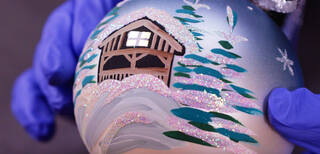
Unboxing Christmas baubles
Watch as we take a look at a selection of delicate Christmas baubles from Germany
-
 The Luck of Edenhall: history and legend of a 14th-century glass beaker
Its unique, superstition-wrapped history makes this antique drinking glass one of the museum's most intriguing objects
-

Stained glass: the Gothic Revival and beyond
How the Victorians revived the art of stained glass – laying the foundations for a modern take on decorated windows
-
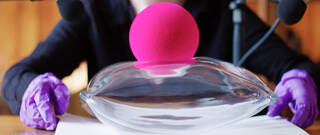 Hyperreal glass sculpture: ASMR
Can you resist reaching out and touching it?
Collection highlights
-
 Soft in Pink, glass form, designed and made by Maria Bang Espersen/The Glass Factory, 2018, SwedenV&A South Kensington
 -
 Goblet, engraved by Franz Paul Zach, Schachtenburg glassworks, 1855, Zwiesel, GermanyV&A South Kensington
 -
 Perfume sprinkler, 17th century, VeniceV&A South Kensington
 -
 Form, made by René Roubicek and Borské sklo glassworks, 1959, Nový Bor, CzechoslovakiaV&A South Kensington
 -
 Finger bowl, manufactured by Davenport & Co., 1837, Longport, Staffordshire, EnglandV&A South Kensington
 -
 Goblet, made by Jacob Verzelini at Crutched Friar's Glasshouse, engraved by Anthony De Lysle, EnglandV&A South Kensington
 -
 Drinking glass, 1590 – 1625, Germany and the NetherlandsV&A South Kensington
 -
 Water jug, manufactured by W.H.B. & J. Richardson, 1848, EnglandV&A South Kensington
 -
 Victoire, radiator mascot, designed by René Lalique, made by Lalique glassworks, about 1925, France
 -
 Mosque lamp, 1320 – 1330, EgyptV&A South Kensington
 -
 'Deep Blue and Bronze Gold Persian Set' one of eight parts, Dale Chihuly, 1999, USA. Museum no. C.108-2001. © Victoria and Albert Museum, London.
 -
 Flask, 1401 – 1336 BC, Malkata, EgyptV&A South Kensington
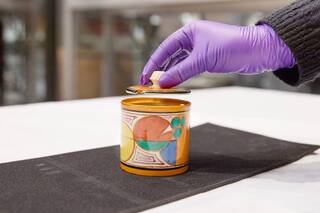


Order an Object
Get closer to the objects within our stores.
- Choose an object to view
- Decide when to view it
- Visit your object for free