The extensive collection of works in watercolour at the V&A owes much to Redgrave's ambition. But what is meant today by the term 'watercolour' is very different from what it meant in the 1850s. At that time, watercolour was considered a national art form, proudly displayed as a uniquely British art at major international exhibitions. This led to demands for a permanent collection of watercolours for the public to enjoy. Over 150 years later, the V&A's wide-ranging collection tells a fascinating story of how appreciation of works in watercolour has shifted with new generations of artists and curators, following and influencing public taste.

At its most basic the word 'watercolour' describes a medium in which dry pigment is mixed first with a binder (usually gum arabic), then with water and then applied with a brush to a support such as vellum, paper, or even ivory. When the water dries, it is the binder that sticks the pigment to the support. Depending on the balance of pigment, gum and water, the artist can achieve a variety of effects.

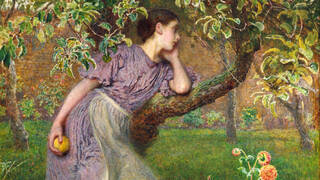
Watercolour, perhaps surprisingly, can be thick and softly opaque, as in Frederick Walker's Autumn, painted in 1865. Thick watercolour is traditionally called 'bodycolour', a word that underlines its substance. After the introduction of the manufactured pigment 'Chinese white' in 1834, the term 'bodycolour' also came to describe watercolour mixed with white (the alternative French term 'gouache' only caught on in the early 20th century). As can be seen in Walker's Autumn, adding Chinese white can soften bright watercolours, giving them a deeper velvety quality. Chinese white could also be used for white highlights, as seen in the sunlight reflecting off leaves.

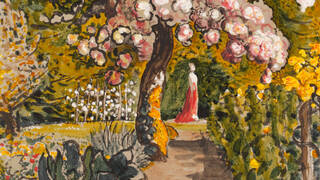
Watercolour can also be mixed using a lot of gum so it becomes shiny. This is seen in the yellow-orange lichen on the tree trunk in Samuel Palmer's In a Shoreham Garden, painted in about 1830. Palmer also painted the blossom with glossy white blobs, touched with transparent pink watercolour, some of which were so thick that they have cracked and fallen off, leaving the paper bare.
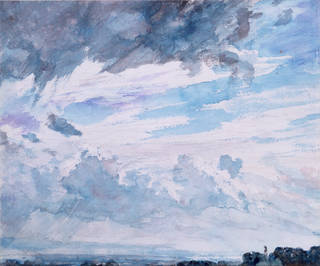
John Constable's cloud study was painted around the same time as Palmer's In a Shoreham Garden. But unlike Palmer's imaginative explosion of rich, thick colour, Constable's study is thin, transparent and sketchy. This is how watercolour is often understood today. It is also seen as good for working outdoors as it dries quickly, and for recording changing weather. Constable has scribbled on the back that he painted this sketch 'about 11 – Noon – Sepr 15 1830. Wind – W'. His purpose was to record the shifting shape and movement of the clouds. Constable first used graphite pencil to faintly outline the clouds. He then captured the dynamic quality of the weather with washes of watercolour, including the rain seen lower left. Instead of using heavy white paint, he left the paper bare to stand for the light areas of his sketch.
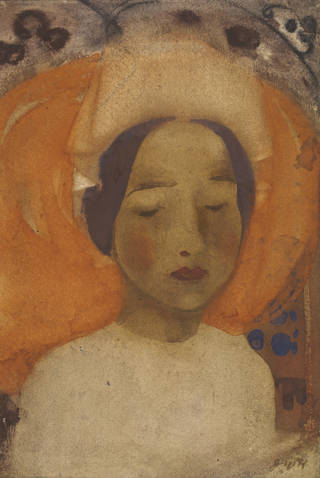
James Watterson Herald's The Saint, probably painted around 1900, is an example of 'blottesque' watercolour. This is a soft-focus method, which exploits the essential watery quality of watercolour – especially the way colours and washes can bleed into each other. In 'blottesque' watercolours, the subject matter was often less important than the beauty of the virtuoso technique.

The word 'watercolour', however, also describes a distinct art form which developed in the 18th century, particularly in Britain. This is understood as a transparent medium pioneered by such greats as JMW Turner. The art of watercolour is strongly associated with the career of Turner who was born in 1775 and died in 1851 – around the time Richard Redgrave and others were pushing for the creation of a national collection of watercolours.
Turner's landscape watercolours, such as Holy Island, painted around 1828, seem to epitomise what was championed as the 'true art' of watercolour. Turner and many of his contemporaries were committed to the medium of watercolour as a means of expression, exploring new techniques to capture the subtleties of nature such as light and atmosphere. Working with transparent watercolour, they exploited the luminosity of white paper, often leaving bare paper to stand for areas of white. Instead of using white paint for highlights, as oil painters could, they scratched out dry paint, often with the end of their brush, exposing the white paper, or removed wet paint with a dry brush or even breadcrumbs, each creating different effects of reflected light. This is possibly how Turner suggested the sea foam in Holy Island, though even with magnification it is hard to see how a skilled watercolourist created their effects.
By the time the South Kensington Museum opened in 1857, the explosion of creativity over 50 years earlier was seen as a triumphant progression from the so-called 'washed drawings' of the 18th century. The curators who formed the museum's collection of watercolours dismissed such early works as pale 'drawings' rather than paintings – mere records of actual views, meant to be hidden in a private patron's portfolio. William Pars' Killarney and Lake is a beautiful example of what was called in its day a 'stained' or 'tinted' drawing.

Pars was employed by Henry Temple, Second Viscount Palmerston, as his draughtsman on a trip to Ireland in 1771. Before photography, this was how the wealthy could record their travels. These works were not for public consumption and were probably kept together in portfolios in the Viscount's library. Such 'tinted drawings' were not the kind of watercolours that Redgrave wanted the new museum to celebrate. He wanted the Victorian public to see exhibition watercolour 'paintings' hung in gilt frames in the museum's paintings galleries. Much as they had been displayed by artists such as Turner at the Royal Academy exhibitions in London, or by John Varley at the Society of Painters in Watercolours, founded in 1804.

This society offered the first public exhibition space devoted to showing watercolours. By the 1850s this was known affectionately as the Old Watercolour Society, showing how watercolour as an art form had become established in Britain.
As can be seen in George Scharf's watercolour of the 1834 exhibition of the rival New Society of Painters in Water Colours, the watercolours shown at these societies crowded up the walls, close-hung in gilt frames.

This was how watercolours were displayed at the South Kensington Museum until the late 19th century. A photograph of the first watercolours given in 1860 by Richard Ellison, shows them densely hung in gilt frames. The swag curtains, draped above the paintings, were installed in 1864 to protect the watercolours from fading in daylight when the museum was closed to the public. Because the museum's collection was the only permanent display of watercolours at that time, it was highly influential in educating the public about what Redgrave called the 'Water-Colour Art'.
However, although Redgrave was an enthusiast of framed exhibition watercolours, he became unhappy about works by young artists which, to his eye, were not 'true' transparent watercolour.
He particularly disliked the new Chinese white, as seen in Frederick Walker's Autumn. The painting caused an outcry when exhibited at the Old Watercolour Society in 1865. But Walker was so amused by how shocked older artists and critics were, that he drew a caricature of himself squeezing Chinese white out of an enormous metal paint tube, saying "What would 'The Society' say if it could only see me?".
This controversy highlights how obscure arguments about 'true' watercolour were. Many critics were unaware that even leading watercolourists used both bodycolour and Chinese white, as well as pencil. In Holy Island for example, Turner used 'true' transparent watercolour, but first lightly sketched the composition in pencil. He also used thick white paint for some highlights, as well as in the figures' costumes, literally giving them more body compared to the watery elements of sea and sky.
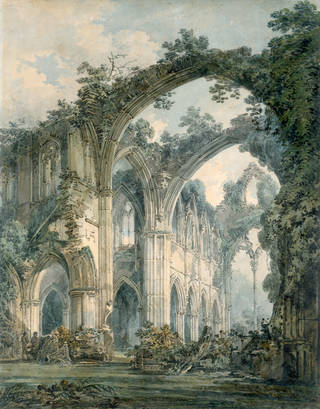
Ironically, the museum's plan to tell a story of progress in the history of watercolours in Britain meant that curators soon acquired examples of 'tinted drawings' produced before the heyday of Turner and his contemporaries. In 1871 William Smith, a Fellow of the Society of Antiquaries, invited curators to make a selection from his collection of works by artists active before the first watercolour exhibition in 1805. The 86 works chosen included an example of Turner's early work, Tintern Abbey.
In 1876 the museum published its first catalogue of the watercolour collection, recording the results of 20 years of collecting, which included the 86 early 'drawings' from William Smith. When in 1883 a question was asked in Parliament about why the government-funded museum collected watercolours, it was explained that it fulfilled two purposes: "the completion of the historical collection of British water-colour artists", and "as examples for students in the Art Training Schools", demonstrating that contemporary watercolours were still valued as a modern British art to inspire and instruct students.

But ideas about what a 'watercolour' was began to change as the 19th century came to an end. There was a growing interest in artists whose careers pre-dated the Old Watercolour Society, such as William Blake. Blake had been dismissed for most of the 19th century as an eccentric, and even in his lifetime his watercolours were little known, most having been painted for one patron, Thomas Butts.
There was also a new awareness of works previously kept by artists for their own use. These private works either came onto the market or were left to the museum by artists or their families. In 1888 John Constable's daughter Isobel gave the museum works by her father which had remained with the family since his death in 1837 – the year the young Victoria became Queen. These were private sketches, large and small, in oil, pencil, and some in watercolour, such as his little cloud study. All these could now be seen on display by the public for the first time at the museum.
This shifting taste was accelerated from 1901 when Queen Victoria's death led to an inevitable questioning of all things Victorian. The subsequent trauma of the World War from 1914 to 1918 seemed to underline this shift. In 1918, a little book on watercolour by the artist AW Rich advised students to ignore 19th century gilt-framed exhibition watercolours. Instead he recommended the V&A's room of Constable's 'studies and small works', and praised Constable's "water-colour drawings [as] the most masterly and spontaneous that exist", illustrating the modern taste for works that were personal and expressive.
By the 1920s, Samuel Palmer was one of a number of artists who were reconsidered once their private works became known. Palmer's extraordinary In a Shoreham Garden, painted around 1830 was acquired in 1926 after being displayed in the V&A's ground-breaking exhibition about the 'disciples' of William Blake. It quickly became one of Palmer's best-loved watercolours, but his son had previously kept it hidden, thinking it a youthful, embarrassing mistake.

John Sell Cotman and Francis Towne were also reconsidered once their private works became better known. Cotman's Viaduct, painted around 1806 – 7 was purchased in 1892, and Towne's Source of the Arveiron, painted around 1781 was purchased in 1921. In the 1920s these became especially admired for their formal qualities. With their simple lines, flat patterning, and blocks of colour, these watercolours were seen as similar to 20th-century modern art – and quite unlike the elaborate 19th-century exhibition watercolours once acquired by the V&A.

These works by Cotman, Towne and others could still be viewed by the public at the museum. But instead of being displayed in gilt frames in top-lit galleries, they were protected from daylight and fading in solandar boxes (book-shaped, protective storage boxes), available in the V&A's new Print Room – where visitors could view prints, drawings and watercolours on request. These works inspired young artists such as Eric Ravilious who examined watercolours in the Print Room while he was a student at the neighbouring Royal College of Art.
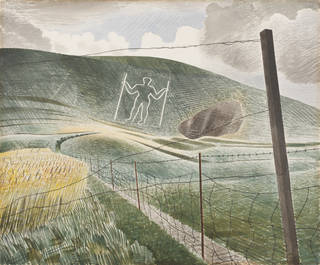
Ravilious' own watercolours were later acquired by the V&A, including Wilmington Giant (1939), bought in 1940, two years before Ravilious was lost on active service with the RAF during World War II. This striking work still appears modern today, both for its jarring and dominant foreground of barbed wire, as well as its dry, patterned brushwork. Ravilious' quirky style still appeals today, and his work is popular with both the public and collectors.
By the 20th century the V&A's collection of watercolours no longer told the story of a 'national art', as curators acquired works by artists using watercolour in all its variety. In the 1960s curators decided to build a small collection of modern foreign works, including pictures by Paul Cezanne and Emil Nolde.
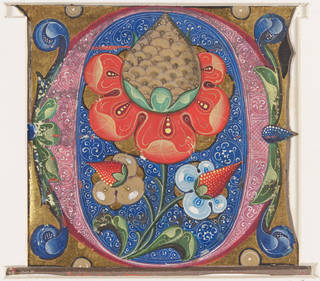
Today the collection of watercolours tells the story of a medium. It ranges from medieval illuminated manuscripts (and the related watercolour art of the portrait miniature), to works from the 20th century, and includes European 17th-century examples alongside 18th- and 19th-century British watercolours. The complexity of the controversies about transparent watercolour, opaque bodycolour, Chinese white and the 20th-century disdain for 19th-century exhibition watercolours, points to the difficulty in trying to define watercolour today as anything other than a surprisingly versatile medium.