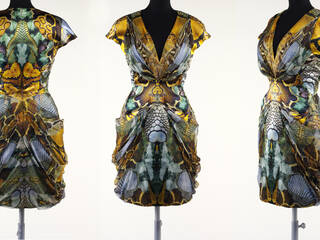
The uncomfortable truth is that because fashion is indeed 'made from nature', its current industrial practices gobble up staggering quantities of water, chemicals and fossil fuels, degrading the land and the diversity of nature's species while belching out 1.9 billion tonnes of waste per year.
As the demands on the Earth's resources by the fashion industry continue to grow, innovative research is underway to address the impact on the natural world. Ranging from synthetic biology to the use of root structures as potential fibres, these creative solutions and their early adoption by the industry indicate a willingness to change and become more sustainable in the future.
Bolt Threads
Using genetically modified (or recombinant) yeast, sugar, water and salt, Bolt Threads have developed a closed-loop process to bio-engineer a new protein fibre mimicking the structure of spider silk. It requires neither the polluting chemicals of petroleum-derived materials nor the land, water and pesticides of conventionally farmed fibres. In 2017, designer Stella McCartney teamed up with Bolt Threads to launch the first fashion collection using the new bio-engineered fabric.
Colorifix
Colorifix aims to create a low-water, pollution-free method of dyeing. Their solution relies on modifying microorganisms using Synthetic Biology such that they can produce, deposit and fix dyes to the fabric. When the cloth is placed in the dye broth, an environmentally benign dye transfer agent is added, causing the microorganisms to bind with the fabric. After the residual liquid is removed, the cloth containing the microorganisms is briefly exposed to heat, causing the cell to rupture and fix the dye onto the fabric.
Diana Scherer
Diana Scherer trains the roots of plants to grow in intricate structures, creating a 3D textile. When the roots are fully grown, she removes them from the soil and cuts off the plant stems. The pieces produced are not yet suitable to be worn, but hint at a potential, more sustainable future in which we grow our own fashion in the ground.
Pulp-It
Scientists and designers in Sweden and Britain have created a wearable 'paper'. The inexpensive 21st-century fabric has an intentionally short lifespan, and can be recycled or industrially composted. Made from unbleached wood pulp and other bio-based materials, the non-woven paper is finished using natural dyes, laser surfacing, and efficient ultrasonic construction. Energy and chemicals are reduced at every stage. With automated production, consumers could customise each garment's colour, pattern and shape. Acknowledging that disposable fashion forms part of most wardrobes, this new material offers a more sustainable approach to fast fashion.