Toys
The Museum has an extensive toy collection - toys have been, and continue to be, central to the childhood experience. In the past, most children would have had home-made toys, made from materials commonly found around the home.In ancient times, Greek and Roman children are known to have played with marbles, spinning tops and clay dolls. It was not until the nineteenth and twentieth centuries that toys were mass produced.
Alphabet Blocks
Most children have played with alphabet blocks at sometime. They are now known as a classic educational toy.
Bayko
In 1933 Charles Bird Plimpton set up the Plimpton Engineering Co Ltd especially to manufacture Bayko. This company continued to manufacture Bayko until 1959 when it was taken over by Meccano.
Blue Bird Car
This clockwork toy car is based on a real car driven by Malcolm Campbell. Campbell competed in Grand Prix racing and set nine land speed records in the 1920s and 1930s.
Buzz Lightyear
Buzz Lightyear was one of the key characters in the successful Disney film of 1995, Toy Story. He was an astronaut who landed in a boy’s bedroom and came to life. The film tells of the rivalry between the space toy Buzz and the cowboy Woody.
Clackers
Clackers were also known as Klik-Klaks, Whackers, Bangers and Knockers. They consisted of two hard plastic balls each linked to a ring with a piece of string.
Dolls
The Museum has an extraordinary and varied collection of over 8,000 dolls, ranging from the earliest, a wooden paddle doll dating from 1,300BC, to the most contemporary, a punk doll from the Bratz Boyz 2005 range.
Dolls' Houses
The Museum's dolls' house collection is the largest British collection not in private hands. The oldest house, the Nuremberg House of 1673, is one of the Museum's greatest treasures.
Hogwart's Express
Frank Hornby (1863-1936) was one of the leading names in the toy train market. Famous as the inventor of Meccano, Hornby produced his first clockwork train in 1920.
Hot Wheels
In 1968, Elliot and Ruth Handler, the co-founders of Mattel, were inspired by their grandchildren to make a range of toy cars. They took on a team to help with the design process that included Harry Bradley, from General Motors.
James Bond Aston Martin
This model car, the Aston Martin DB5, was launched by Corgi just before release of the James Bond film Thunderball in December 1965 and was a big seller.
Lego
Lego was invented by the Dane, Ole Kirk Christiansen, who started making wooden toys in 1932. By 1934 he was using the name Lego, derived from two Danish words, which mean 'play well'. In 1939, the company produced its Automatic Binding Brick, which, in 1953 was renamed the Lego Brick.
Lott's Bricks
At the beginning of the 20th century the toy industry was based predominantly in Germany. However, during the First World War imports from Germany were banned. The British government encouraged the toy industry at home to make the toys that were missed.
Magic Lantern
People have used light to make projections of shapes for hundreds of years. All that is needed is a light source, something to place in front of it and a blank wall or screen to project onto.
Masters of the Universe
The Masters of the Universe toys and comics were developed by Mattel in the early 1980s. The characters inhabited a mythical land known as Eternia, and it soon became clear that the characters had even wider appeal than expected, and an animated television series was launched in 1982.
Meccano
Meccano is one of the best known British construction toys. It was the invention of Frank Hornby (1863-1936) and has been around for over 100 years. Hornby, who was a shipping clerk with no formal engineering training, wanted his two sons to learn the basics of engineering, so he invented a construction toy which he called 'Mechanics Made Easy'.
Minibrix
Patented in 1935, Minibrix were construction kits that enabled children to build their own miniature houses. Like the later and more famous construction toy, Lego, Minibrix consisted of interlocking bricks with moulded studs on the surface.
Mr Potato Head
The invention of George Lerner, Mr Potato Head was launched by the toy company, Hasbro in 1952. The original Mr Potato Head contained only parts, such as eyes, ears, noses and mouths, and parents had to supply their children with real potatoes.
Muffin the Mule
Muffin the Mule was the first great star of children's television in Britain. He made his television debut as a puppet in October 1946 with Annette Mills.
My Little Pony
My Little Ponies were first launched by Hasbro in 1981. Every pony had a different name, examples included: Applejack, Baby Cotton Candy and Sprinkles. They quickly became one of the biggest toy crazes of the 1980s, inspiring no end of merchandise, a feature film with the voice of Danny Devito in 1986 and an animated TV series
Noah's Arks
Noah and his Ark has always been a popular biblical story for children, and toy versions of the ark have been made since the 18th century. They were particularly popular during the Victorian period when children were restricted to play with biblical toys on Sundays.
Peepshow
The Museum has two early peepshows, dating from 1721, in the collection. These could be better described as mini-theatres. Made in Austria and engraved by Englelbrecht, they are elaborate and were obviously intended to entertain high society.
Power Rangers
The animated television series Mighty Morphin Power Rangers launched in the UK in 1994 and was an immediate hit. Bandai produced a range of toys to complement the series, winning Toy of the Year in 1995 and Boys Toy of the Year in 1996.
Puppets
Puppets have been used for entertainment for centuries in countries all over the world. Travelling puppeteers were very popular in Europe in the 18th and 19th centuries.
Robosapien
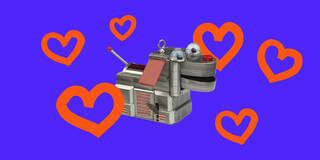
Robosapien burst onto the toy market just in time for Christmas 2004 and was crowned UK Toy of the Year that year, selling over two million in the UK alone. Robosapien is the first robot to be made using the science of applied biomorphic robotics - 'a fusion of technology and personality'.
Scalextric
Scalextric was developed in the 1950s by Fred Francis. Through his small company, Minimodels, Francis introduced a line of toy cars called Scalex in 1952. They were metal model racing cars with a unique type of clockwork motor.
Rattles
Rattles in their most basic form, as simple toys to divert babies, go back to at least the 2nd century BC. Over the years they have been made to simple designs in materials ranging from dried gourds, woven sticks and hollowed-out bones, to much more elaborate styles in glass, silver and gold.
Slinky
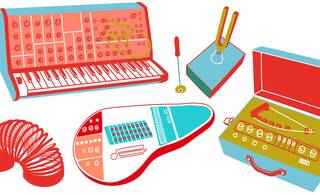
The Slinky was invented in 1943 by naval engineer Richard James. He was experimenting with tension springs for use on board ships when one of these metal coils fell to the floor and he was fascinated by its walking movement.
Soft Toys and Teddy Bears
The teddy bear is a relative newcomer, despite being possibly the most popular toy in the world. At the beginning of the 20th century, Richard Steiff wanted to make soft toys more lifelike by giving them moving joints. One of his first experiments with this technique was a bear which was shown at the Leipzig Toy Fair in Germany in March 1903.
Star Wars
Star Wars: A New Hope was released in 1977. The first film of George Lucas' trilogies was the most successful in American history and grossed over $290 million. Sequels released in 1980 and 1983 were equally successful.
Toy Horses
Toys horses, in various forms and made from many materials, have been around for several thousand years. Often they closely resembled their real counterparts and the work that they performed, and they were usually for boys.
King Charles I Rocking Horse
Made in softwood and elm, this rocking horse pre-dates the earliest example in the Museum's collection of twenty rocking horses by 200 years, and is believed to be the oldest in existence in the UK. It has been dated to 1610.
Transformers
In 1984, Transformers, with their trademark catch-phrase, 'robots in disguise', were a new and innovative toy made in Japan and marketed world-wide by the American company Hasbro.
Yo-Yo
The yo-yo is believed to have originated in ancient China. It is a small round object consisting of two equally sized discs connected by an axle. The axle has a short string wound around it.
Zoetrope
A zoetrope is a drum shaped optical toy that makes a series of drawings appear to move. The drum sits on a stand upon which it can be spun.