Ceramic Points of View: 'Big White Jug', by Alison Britton
Alison Britton, 'Big White Jug', earthenware, height 382mm, width 390mm, 1987. Museum no. C.233-1987
'Ceramics Points of View' is the result of a collaboration between The National Electronic and Video Archive of the Crafts and the V&A. A range of people were asked for their responses to the same ten objects from the V&A's 20th century ceramics collection.
On this page you can discover the six people's responses to 'Big White Jug', made in 1987 by Alison Britton OBE (born 1948). Simply choose one of the people below to see their response.
Here Alison Britton talks about her own work, and you can view the critiques by Neil Brownsword, Emmanuel Cooper, Claire Curneen, Tanya Harrod and Oliver Watson.

Alison Britton on Alison Britton
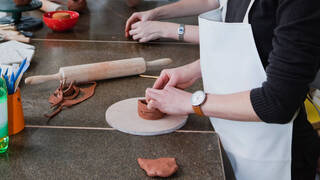
I'd roll out the buff clay, put [on] a white slip side, flip it over and do either a brown or a blue slip side. Then when it came to build I already had some marks on the clay which made suggestions about the shape that it would be. And I could have a choice of having a dark inside or a dark outside, but there'd be this strong contrast.
This is one, I think,fairly early in the group; and what I do sometimes do, when I'm not sure what the next direction's going to be, is a real patchwork one. This is many pieces, this is using up, in a way, it's make do and mend, in a way, using up lots of bits and building in a very casual way to start with, and making it difficult before I resolve it.
AB: Yes, this was the stage when I really put a lot of imagination into my titles. You'd think it would be easy to talk about your own pot, but actually it isn't.
It was from a show that meant a lot to me; 1987 was a really enthusiastic, strong moment. It was a show at Contemporary Applied Arts, which was then directed by Tatiana Morrison. It was a new body of work from a new studio. I'd been at the Railway Arch for a decade or more and moved to a butcher's shop in Stanford Hill and had about six months off scraping the meat off the ceiling and everything. So I set off to make the new work with a clearer set of rules than I normally have. I was only going to use three colours and they were very classic ceramic things. The blues were cobalt, [the white was] white slip, and red clay slip gave me a dark brown. There are a few bits of dark brown under here, but basically this is a blue and white piece.
I was going to have a strong contrast from one side of the clay to the other. I'm always painting the clay before I build, so [video clip starts] I'd roll out the buff clay, put [on] a white slip side, flip it over and do either a brown or a blue slip side. Then when it came to build I already had some marks on the clay which made suggestions about the shape that it would be. And I could have a choice of having a dark inside or a dark outside, but there'd be this strong contrast.
This is one, I think, fairly early in the group; and what I do sometimes do, when I'm not sure what the next direction's going to be, is a real patchwork one. This is many pieces, this is using up, in a way, it's make do and mend, in a way, using up lots of bits and building in a very casual way to start with, and making it difficult before I resolve it. [video clip ends]
Not placing it on the blanket would feel more stable I think.
So it's playing around with bits of clay to build something in a way that's fragmented but in the end resolved. The spout proper spout and an inverted spout, so you've got quite a yes/no choice there. The handle is just twisted coil that makes a reference to Crabstock handles, and that kind of thing. But [it has] a much softer feel; this is just purely 'slab, slab, slab,' there's no coiling. Nowadays I make things that are much softer in the end by coiling a lot in the upper section of the pot. But at this point I was just using the slab. So to thicken the edge here I actually put a bit of slab on its side to get another painting surface.
MP: When you sat down to begin this pot, did you have an idea of what it might look like or its size?
AB: Hardly at all. I think I probably thought big, and I probably didn't even think jug, necessarily. Having made tons of jugs early on in my career I then tried very hard not to make jugs for a while, and only began to relax about it again in about 1986, so not long before this. So I think I would have started off not knowing about this handle. You know, that would be a reaction to what I've got. I think I'm fond of it. I felt that it was gutsy at the time, and I'm pleased that Oliver chose it. I mean, it's the painting that pulls it together, isn't it? It's the blue lines. It could be a real worrying shambles, I think, without the dark blue that straps it together.
MP: How conscious was the blue and white?
AB: Very conscious, very back to basics to see what I could do with this convention. Messing it up, you know.
MP: Is your making [like] a need [that] you have to make?
AB: Yes.
MP: Is it something you couldn't get by without doing?
AB: Yes, although it's only part of my life now, because I'm teaching regularly. I'm also writing quite often and curating sometimes. The core of it all is this: because it's work that you don't know about, because it's a discovery and it's unpremeditated, that re-balances all the other things I have to do. It is a bit like different parts of the brain that you switch from side to side. So if I've been teaching for three days, which happens most weeks now at the Royal College, I can't immediately find that other way of operating. There has to be a little island of time where I find that other route, because they are such different ways of thinking. This is not thinking, whereas all the other work has to be more up front, more in control. So I might have half a day where I make soup or do something really domestic, [in order] to feel the vitality coming back before going into the studio.
MP: You're perceived as an example of someone who's a ceramicist or a potter, or whatever you want to be called.
AB: That's right.
MP: A potter who's articulate about their work [and] talking about their practice. Do you think your work has been received well?
AB: I think it could work both ways. I think that I have sometimes met people who, if they first come across me lecturing about somebody else, are very surprised to find that I make anything at all. There is a suspicion of people doing more than one thing, I think. It's as if you couldn't do both seriously enough. And I think having the reputation of being articulate can be really hard work sometimes, [and] that there are plenty of times when you are not articulate and where you're really struggling, and yet the expectation is that you're going to come with it again, you know. So if my hands ever seized up and I couldn't make any more, there would be real unbalancing. I don't know how well I'd be able to do the other side. That's - faintly - a prospect. I am beginning to get slightly funny hands and the last group of work I made was smaller scale to take some of the weight out of it. So I'm sure I'll find ways round it, but it would be very much clearer that the balance between the two kinds of work is the crucial thing, and that if I had to give up one of them I'd give up the writing and the teaching, if I could, and just make. Having said that, no, I don't think I want to make all day, every day; concerning yourself with other people's ideas and other people's things is really exciting and it feeds you.
MP: You said about making a lot of jugs in the early days, and there were those things with the birds on and different things in the very early days, but you're still working in the vessel tradition. Have you ever thought about not making vessels or is it just something that is simply [such a] part of what you do?
AB: There was a phase in the mid-eighties when things were much more obviously body-like, or torso-like. I did at some point perhaps cover it up completely, but it lost interest for me then. Whether it's because it's like a pot, or whether it's for some other reason, I like to look inside something, I like that hollow, in the sense of comparing this and that, a dark and a light. But I think in recent years, since I had a show in Germany in 1995 which I called 'Form and Fiction', I think I clarified [that] there is a channel for me, because a pot is such an ordinary and easily recognisable object [that] you move straight into a kind of viewability. Nobody's going to say 'What on earth is that?' - you know it's a pot. And having reached people like that, then you can do all kinds of other things; you can play around in all sorts of ways and hopefully always in slightly different ways. But [there's] something about balancing form and fiction; that form is very inchoate, if you like, it's to do with touch and being able to pick it up and have a sensation of it, and then the fiction for me is all the other stuff, all the kind of nonsense of making this shape nearly fall over but then correcting it with a painting. That's the fiction part of it, and I think it's a much more exciting pairing of words than form and function, especially for me.
Neil Brownsword on Alison Britton
NB: I think this period of work is some of my favourite of Alison Britton's, anyway. I think it's that kind of reference to the blue and white, [which] takes you back to the kind of history of the pieces of what are upstairs. But also, again, the kind of vigour in some of these pieces. And again I go back to when I was a student at Cardiff. I think there was a retrospective show on somewhere - I don't know whether it was Pennarth [but it was] somewhere near to Cardiff anyway - and there was a series of double pots, and there was one that was painted in this kind of gestural style, and it's one of my favourite pieces which she's ever done.
I just thought it was about really knowing when to start with an object. It's such a kind of skill, isn't it? It's what I say to the students: as you know they're always wanting to do something, or not enough to [do] something. It's that kind of sophistication, and I think that piece really had it for me. It was a really lovely piece. And again these references to some of these kind of gestural painters, like some of the Cornish group like Roger Hilton [and] Peter Lanyon.
[video clip starts]Again the surface makes you want to go into the piece because there's so many layers, even though, from what I gather,the pieces are determined or dictated by the surface of the objects. They're painted as a painting, and then constructed as an object. The reason I liked the piece that was on show in Wales at that point was because it hadn't got the handle. I don't think the handles are necessary in the pieces. I know there's the reference to the jug and stuff, but as the object. I think in some of the later pieces, the handles have been cut into the object, so they suggest a handle rather than being a handle. I think they are more successful. But I like the awkwardness of it as well. It is going to fall over, isn't it? And as we displayed it earlier on, I think it works better on its side, so you can see that interior and exterior more, and the base is great as well. All those runs and drips of glaze there. [video clip ends]
MP: Was she important to you as a tutor?
NB: I can remember having a conversation with Alison when I first started at the RCA, and having a conversation with her when I left, and in the meantime I think there wasn't that much discourse. But after I graduated, she did write a piece about the show in Stoke, and the new work that was evolving for that. So there was contact in that way. But again going back to the RCA, I think I just saw it as a studio for two years and then [in] London you learnt more from being in that environment and being surrounded by like-minded people, as much as what you get from the tutors. So yes, it was a good time. I don't like going back there, though, for some reason. I'm not a 'going back' person.
But I suppose looking at the brushwork here and then you look at that Staite-Murray piece, I think what Alison's doing, I might be wrong, but I'm just assuming from looking at it that she'll select from what she does, maybe on a random basis, she'll select a part of the painting and then that will be that section of the pot. So [it] may be like what I was talking about earlier on, that 90% of that slab which isn't going to be used, but there's that section where you kind of abstract, it's almost like you're looking through the lens of a camera. You zoom [in] on that particular detail and that's the bit that goes into the piece. And I think that's the manner in which she works. I might be wrong. But, yes, this is, I suppose, my favourite period of work. And just holding it it makes you want to turn it around and look at it. And again it reads on lots of different perspectives, I think ceramics is such a wonderful medium to bridge the gap between painting and sculpture, isn't it? You know you can, you know it does it brilliantly.
Emmanuel Cooper on Alison Britton
EC: 'Big White Jug', yes, and it is indeed a big, white jug. It must be, what, fifteen, sixteen, seventeen inches tall. Quite a big, white jug. And although it's called 'Big White Jug' it actually has got that slightly oriental look. The use of the blue and the white takes us straight back to Ming, takes us straight back to the Willow patterns of Staffordshire, which of course came from Ming. And it's interesting that I'm sure it's totally unconscious that there is that reference within this piece.
But again, like Elizabeth Fritsch, Alison Britton was part of the renaissance of crafts in the 1970s when it was a break away from tradition. It was actually looking at the world in which we lived, it was actually responding to the visual art world. It was being part of the visual art world. It wasn't staying in the little compartment called 'craft' which had been carved out for it. It was actually pushing out of that. And one of the strong things, I think, about Alison Britton's work is the fact that she has taken an object, a domestic object like a jug, which again if you like can be seen as a metaphor for plenty, for holding, for nourishing. [It] goes in the centre of the table, it can hold water, wine, beer, but the jug that's used in paintings to symbolise plenty, again, is a domestic icon at the same time. It's something that we use, but here she uses it as a metaphor if you like for all the jugs she's ever known, and it becomes about a jug.
But it suddenly also becomes about something else because we realise that we're dealing with a form which is actually built of different facets. And the way that it's been built up, usually she makes slabs of clay, cuts them out and here she's assembled them. So that it's got this rock-like character. It looks like it's actually hewn out of rock, and that gives it this enormous strength, this enormous sense of solidity, and when you look at it from the outside I get the feeling that it looks enormously strong, enormously heavy and enormously rooted. But then you look more carefully and you start to turn it round a bit and you see that in fact it's got a big cut away under here, and that cut away, [and] suddenly you get a tiny little base from here, and this big overhang here, which is balanced by the handle here. And what looks precise and solid is actually a little bit wobbly and not quite so certain as it might first look. And that sense of transigence, that sense of movement, that sense that things might look solid and be rooted in one place, actually might at any moment move off, is, I think, one of the great strengths of her work.
She's continued to make jugs of various sorts since she was a student at the Royal College of Art and they've become more and more sculptural. And they've got more and more sculptural over the last fifteen years since she made this jug, but I particularly like this piece. I don't like them all, I find some work better than others. And again, the more you look at [it] the more you get, because if you look, for example, at the actual decoration on it, you'll see that you've got all these white lines which are actually part of a decoration. They're not, it's not a plain white surface that you might at first imagine, so you've got this zigzag here, but it's a very quiet zigzag, but again it starts to work into the surface itself, and here you've got ... I suppose the fashionable term would be painterly surfaces. So that there is this strong understanding of form. There's this great shift of movement, of energy if you like, leaching, leering, pushing forward, but then you've got a concern with the surface.
Now you might say Alison, don't paint, don't decorate, leave it plain and see what happens, but she doesn't want to do that, that's not what the work is about. The work is about actual working with the qualities that clay can bring, that slips can bring, that the blue cobalt can bring, and adding up to a richness. Now the richness lies in the form itself, in the actual references that jugs are making and in the sense, this sense of uncertainty that we all might have in our lives, certainly at some time if not all the time.
And when you look at the top you get the jug like that and it becomes quite an exciting, but really quite angry line. [video clip starts] It zigzags about like that. And so the whole jug is actually slightly more disturbing, the more you look at it and the more you move around it, than you might first see. And just to finish, the handle, which is made by a completely different method, is twisted rather like material, it looks rather like fabric. And it's all, again, slightly difficult, it's not a smooth flowing thing, it's about anxiety, and I think that's what this jug is. It should be called 'A Jug About Anxiety' because it seems to me that that's what it's about. And at the same time it's a jug. And that is a very nice paradox. [video clip ends]
Claire Curneen on Alison Britton
CC: It's rather wobbly, isn't it? Hence the hard surface. [video clip starts] I think it's a great piece of work for all sorts of reasons, for me personally, because I started to study Ceramics in 1987, in Cork in Ireland, and there was only, I think, about eight of us in the course. It was a very, very small, young course and everybody was talking about the New Ceramics and Alison Britton and all these people doing very exciting things with the vessel and the intellectual pot, I suppose. And even though I never really worked with the vessel I was always drawn to the method of making and the construction. You know, this slabbing, the various sides so it's not just four sides or two sides. And I think it's a very curious thing because you can really respond to its ever-shifting planes. And it's always moving. [video clip ends]
I also quite like the idea where the surface and the decoration or the marks made travels onto the rim, and there's an interesting connection between the outside and the inside. And it's also quite liberating as well. It's quite exciting. It's just great to be actually this close to it. And the fact that it is very much a jug, the playing with that focus and spend[ing] probably the rest of your life working with it, which I think she still does. This is quite interesting, this handle, in that it's really quick, and it's considered because it is so quick. It's kind of twisted and put there. It seems the right thing to do.
And I think there's incredible confidence in it as well, which I think Alison Britton's work carries a lot of, her confidence in its making. It's not apologetic, anyway. I just try to think of how she actually makes it. I think she actually works flat and paints, and then constructs with that. And there seems to be that very important starting point in that the process seems very evident and very important in the construction of it. So from the very beginning of rolling a slab and then responding to the flat surface to make an abstract mark, and then what kind of decision she makes to actually construct this particular form, I find quite fascinating really. It's that responding to something quite abstract and intuitive as well. There [are] some lovely little details. In the photographs it seems much duller. There seems a lot more of a quality of surface because you actually do have raised surface here where the slip has been applied and then cut into again. So these planes [are] going on again. It's shifting all over here, [it] moves and then it shifts on the surface and it seems to be very animated. And it's architectural and it's bodily, it's very interesting.
Yes, thinking about that New Ceramics [class in] the middle of the eighties, and I think Hans Coper was their tutor, and the fact that they all came out at the same time and it was a group of five or six women... I thought that was very interesting and very exciting in that they were women. I don't think that I was hugely interested in that they were just women making art work. It's just that they happened to be women as well. But I suppose when I was studying then it was very interesting to see the profiles of women in periodicals and things like that. And even though I wasn't interested so much in the feminist element, I just found it very liberating because I thought, 'I want to be where they are.' They're doing very well, and they're independent, successful women doing their work [and] living in London. But I felt it was something that really bred in the college in that group because there was only really a very few of us on that course as well.
So there was a real opportunity for debate about this new work, this New Ceramics, and I think our tutors were very sympathetic to the argument and talking about it, [and] encouraged that quite a lot. So it did create quite a lot of discussion about the value of these constructed forms. For instance, this one as a vessel and how does it function? How do we read it? Does it matter that it's a vessel? Is it a piece of sculpture? Well, I suppose, I see it as a piece of sculpture. I think it's irrelevant that it is a vessel, even though I think [the] movement of the abstract vessel talks about it being important that it is a container. I mean, just because it has a handle and a spout doesn't really matter. That could also be something buttressing or architectural. And sculpture has insight as well.
Tanya Harrod on Alison Britton
TH: Yes, it is a big white jug. I think I must have held this before because I wrote a little ... well I didn't really write a book about Alison Britton, I encouraged her to talk to me for hours. And I did a kind of chronology of her life, but incorporating things she said and some of my thoughts, year by year. And this, what did you say the year was?
MP: 1987.
TH: 1987 I think was rather a good year for Alison, although I remember she said she thought she'd played a safe wicket using blue and white to decorate this piece, because I think there's a general feeling in the ceramics world that anything blue and white will charm people. You can't go wrong with blue and white. But no, she exhibited in a ... she had a solo show, I think, in that year from which this comes, I imagine. And seeing it here close up I suppose I'm finding it difficult to get my head round the construction of it and I'm constantly frightened it's going to fall over in a way that I don't quite remember. Perhaps if I had it pointing towards me?
MP: It's possibly largely an illusion that it looks like it's going to fall over, but ...
TH: Yes, I suppose it's an intentional illusion. I mean, this is an area of ceramics which is very different to the world of Richard Slee, for example. It's not really about ornament at all is it, this piece? [video clip starts] It's some kind of synthesis of painting and sculpture, that's what I feel about it. It is a curious way of playing with the vessel shape sculpturally, and then mark-making which makes you think of St Ives painters like, I don't know, Peter Lanyon or maybe William Scott. And there's a certain tension between those two activities, the shape and the way in which it's been decorated. [video clip ends]
Alison has written most eloquently of anyone of her generation, and her generation loosely includes figures who were taught by Hans Coper at the Royal College, like Carol McNichol and Elizabeth Fritsch. She's written most eloquently about these kinds of vessels that in some ways aren't really vessels. She calls them two-faced objects and they're at once a vessel, but vessels about vessels. Again I think this isn't [the] kind of pot you'd necessarily like to handle that much. You might want to hug it, I suppose, but it keeps you at a bit of a distance.
MP: But you need to see the whole thing, don't you, in a way that you don't necessarily with the Elizabeth Fritsch [pot]?
TH: Yes, and actually it needs to be on a plinth, which is a funny thing to say. You'd think all pots would need to be on plinths, but they don't. This is a plinth pot and I know that Alison, in fact, got a furniture designer - I think Floris Van Der Brucker, it might have been him - to design a plinth, I think it was for a beautiful blue pot that's now in a collection in Cleveland, and in seeing this I think that was a wise move. But this pot is crying out not to be sitting on this nice grey blanket but to be on a plinth so you can view it in the round. It's like a statuette in that way, you need a certain sort of statuette, a late Renaissance statuette, because you need to go round and round it.
MP: Do you like it? We haven't talked about really liking the pots, particularly.
TH: No, it's funny, I'm so used to viewing things almost through reading people's writings or talking to them or fitting them into the context of the time that I quite often forget, do I really like this pot? And shamefully I haven't always handled the pots that belong to the person whose work I think I'm trying to analyse and understand. And maybe I don't like this pot as much as another pot that was in the same exhibition which is now at Hove. I think I've got a picture of it. No ... I haven't got a picture of it. It's called 'Double White Pot' and, this may be something to do with me, it seems to stand more stably. It's a really interesting shape because it's [a] jug shape combined with a circular vessel [into] one thing. And it's got a terrific sort of sense of uplift. Sometimes I have a slight problem with the way Alison's pots sit; sometimes they can sit too solidly, [and] sometimes, as in this case, it's moving towards me rather menacingly. But they're most beautiful. They leap up, or they're conjoined in some incredibly fascinating way. So, well, obviously I like this pot, but it might not be my favourite pot.
Oliver Watson on Alison Britton
OW: Well, for me Alison is one of the key people in the British scene, and she's what I think I call a long term player, in that her importance is not something that comes with one particular batch of work or one piece or something, but it's been about the progress of her work from those early, very attractive and in a sense easy to get into jugs with animal decoration and flower decoration, to much more challenging and demanding things of this kind. I have said this in print too, I don't find her work easy, and I wish I had longer to live with pieces of it. I have got one or two pieces at home and again I have a very different relationship with those when I am able to spend longer and seeing them and looking round them. Because I think they're very demanding things and I think there's all kinds of things going on in them.
[video clip starts] One of the things I like is the issue of time that is involved in these things. For me there are all kinds of dimensions of time that are encapsulated in this pot. A simple one is actually about how it's made, that they have a kind of look as though they've been slapped together very quickly, but actually when you see her working practice it's a very meticulous, not laborious, but it's not a speedy activity. But she has flat sheets of clay that she paints and puts the clays and slips and colours on, and then those designs that she's laid out suggest the form. Then she starts building the form and then she will put more colours on over the top, and sometimes they go through several different firings to get the right balance, and I like that tension. [video clip ends]
That's the tension in time, [and] there's another tension, which is about confidence. They're very in your face things. They're not shy, retiring, tasteful things. And yet I see in them quite a lot of self-questioning, of almost tentativeness in the work. I like the fact that they're... this one is for a late piece is quite ???. It's a jug, it's got a handle on the back and jugs were a theme, but a lot of the pieces have given up that element of functionality. But they're always still pots, they've still got tops, they've still got some of their formal qualities like that. [There's a] very great deal of attention paid to the rim, taut tense rims from which the pots seem to hang.
And they're beautifully made. Throwing on the wheel is not the only way of making beautiful pots, in fact over the ages the most beautiful pots haven't been made on the wheel, but - and this again is something you can't get unless you own one or you're very lucky - these things in their weight, the way they're but together, the tautness and so on, it's got a very good ring to it. And that's for me part of their appeal. What are they about? In this broken disrupting of what you expect in terms of volume and space and form and design. And I don't always know. It takes me a long time to get through, but the thing that I do feel is that you know they are good, [a] very important pair and they've got a lot in them. Doesn't reveal itself quickly, necessarily.
MP: Who do you think are the audience for this sort of pot, and maybe the sort of things we've been looking at today?
OW: Well, for me this is purely, this is the realm of Fine Art. In some ways this shouldn't be in the V&A and maybe we're doing her a disservice by showing it here, because it's automatically aligning it with craft and history of pots and so forth. And actually for me this just operates in a way that Fine Art operates. It happens to be a pot, it happens to be made of clay, it happens to be in three dimensions, but it is a work of art. If you're interested in those issues of autonomous objects, the space they claim, what they're saying, that's something for you. And you know the sort of the fascism of certain parts of the studio pottery movement saying, 'A pot is this and it's got to be like this, and these are the values that you'll find in pots,' which is nonsense. All kinds of values can be found in pots. There is no one right answer. It's just whether things like this speak to you, engage you in a way that you find interesting, take you a little further in dealing with the world.
MP: It's difficult also to think of anywhere else in a public museum or gallery that would display this other than an applied arts/decorative arts museum.
OW: Yes, well there's a very big whole subject there about [this], there's a very powerful world of Fine Art which defends its boundaries very fiercely. But the quality that you get in here in terms of artistic expression or intellectual interest of all kinds of things is now the equal of anything you can get in a Fine Art practice. And yet, because she's a potter and comes through the Crafts Council and so forth, she doesn't have the critical acclaim, she's not reviewed in the way that she might be. She's not shown in the places she might be. And those people out there who might be interested are missing a real trick because you can buy yourself a real good bit of art for only a couple of grand and you can't buy a tenth rate painting for that amount of money.
Related content
- Neil Brownsword on Alison Britton
- Emmanuel Cooper on Alison Britton
- Emmanuel Cooper on Elizabeth Fritsch
- Neil Brownsword on Hans Coper
- Neil Brownsword on Bernard Leach
- Neil Brownsword on Michael Cardew
- Neil Brownsword on Lucie Rie
- Ceramic Points of View
- A-Z of Ceramics - D is for Delft / Delftware
- Paulette Randall - Role of the director after opening night
- About the Ceramic Points of View Project
- Ceramic Points of View: 'Cup and Saucer', by Bernard Leach
- Ceramic Points of View: 'Cup on Base', by Gillian Lowndes
- Ceramic Points of View: 'Madonna', by William Staite-Murray
- More
Become a V&A Member
V&A Members enjoy a wealth of benefits, including free entry to exhibitions, previews, exciting events and the V&A Members’ Room. In addition, you will be supporting the vital work of the V&A.
Buy or Renew Membership OnlineShop online
Jug by Max Lamb for 1882 Ltd

The V&A Shop is delighted to showcase the work of 1882 Ltd from February to May 2013, featuring a number of collaborations and one-off designs. …
Buy nowEvent - Friday Late: White Nights
Fri 31 May 2013 18:30

EVENING EVENTS: Join us for a Russian-style White Nights Festival and celebrate the summer evenings with a carnival atmosphere and an eclectic mix of contemporary music, art and performance.
More details