Lady Hawarden is an enigmatic figure – much of her life remains a mystery. Most of what we do know about Hawarden has been pieced together from her photographs. She was born Clementina Elphinstone Fleming on 1 June 1822, in Cumbernauld, near Glasgow. Her father, Admiral Charles Elphinstone Fleeming, was well-known for his part in the Venezuelan and Colombian wars of liberation (about 1811 – 25). Little is known about her Spanish mother, Catalina Paulina Alessandro, an 'exotic beauty' 26 years younger than her husband.
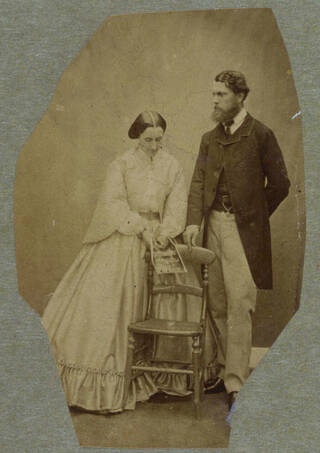
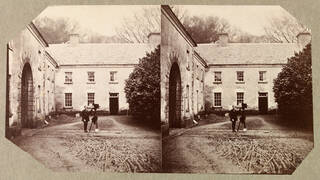
Clementina married Cornwallis Maude, 4th Viscount Hawarden, in 1845 and lived in London until 1857, when she moved with her husband to the family estate in Dundrum, Co. Tipperary, Ireland. Here, she first started to experiment with photography, taking stereoscopic landscape photographs (capturing two slightly offset photographs to create a 3D effect) around the Dundrum estate.
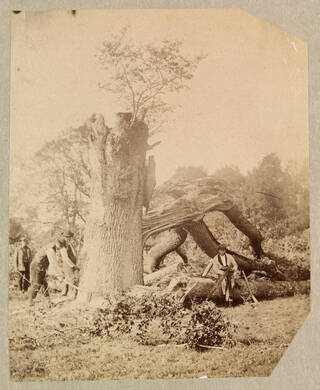
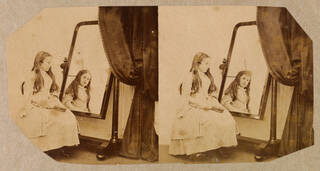
Hawarden was absorbed in motherhood, having ten children – two boys and eight girls – and yet she found time to be a prolific photographer. In 1859 the family moved back to London, where Hawarden began to photograph her daughters, first making stereoscopic photographs, before moving to large-format, stand-alone portraits.
Her work records the domestic life of an upper-class mid-Victorian woman. While male photographers at that time often set off to explore faraway places, Hawarden had to work close to home. But by creating exquisite images of her adolescent daughters, she staked out new perimeters for art photography.
Working methods
Hawarden made albumen prints from wet-collodion negatives. Introduced in 1851, wet-collodion negatives were widely used since the exposure time was relatively short. The negatives were made by coating a sheet of glass with a thin film of collodion (guncotton dissolved in ether). This was sensitised on location with silver nitrate to form light-sensitive silver salts. For maximum sensitivity, the plate had to be placed in the camera and exposed while still wet, and then developed and fixed immediately.
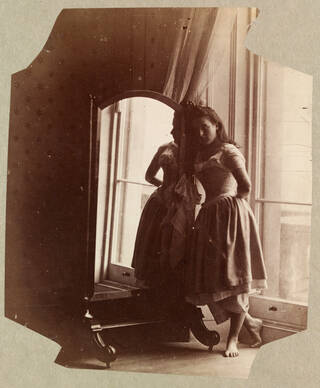
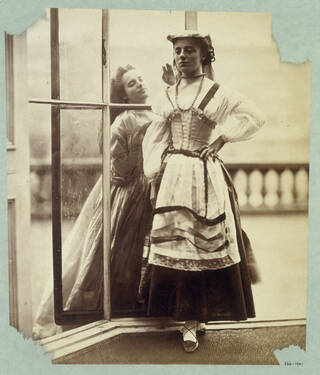
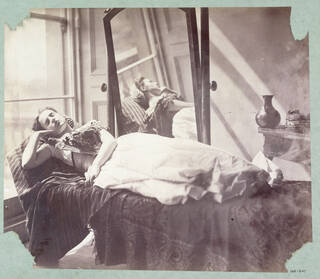
Hawarden liked to use natural light in her studio at her South Kensington home, in a way that was seen at the time as 'daring'. She placed mirrors to reflect light and used them to explore the idea of 'the double', just as other photographers (and occasionally Hawarden herself) used a stereoscopic camera to produce twin prints.
Rather than focusing on the faces of her sitters, as her contemporary Julia Margaret Cameron did, Hawarden used the surroundings in the room, as well as backdrops and fabrics, to add to the composition. The figures and dress are the main subject, framed in the room with a careful choice of props, clothing, mirrors, and posture, and often in front of the balcony. The city beyond provides a blurred background.
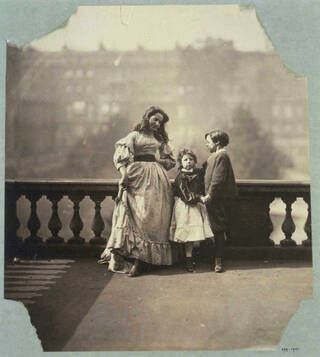
From around 1862 Hawarden concentrated on photographing her daughters in costume tableaux, a popular subject at the time. Costumes from the dressing-up box are combined with dresses at the height of fashion to produce beautiful and detailed studies that mix the contemporary with the make-believe. Much has been written about the often provocative poses of Hawarden's daughters. The Victorians were preoccupied by the idea of sexuality and adolescence, though there is no evidence that she was deliberately exploring this controversial topic.
Recognition
As a woman of Hawarden's social position it was not considered appropriate for her to sell her photographs. She did, however, exhibit her pictures with the Photographic Society of London in 1863 and 1864, under the titles 'Studies from Life' and 'Photographic Studies'. Her work was extremely well-received: she was awarded the Society's silver medal in both years, though tragically never collected them, dying from pneumonia on 19 January 1865, aged just 42. It has been suggested that her immune system had been weakened by constant contact with the photographic chemicals.
Lady Hawarden and the V&A
In 1939 the V&A held an exhibition commemorating the centenary of the invention of photography. The exhibition was visited by Hawarden's granddaughter, Lady Clementina Tottenham, who was disappointed not to find her grandmother's work on display. This prompted her to donate 775 photographs by Hawarden to the museum – about 90% of her life's work. The V&A proved a fitting home for the collection, being so close to where Hawarden lived and worked at 5 Princes Gardens, just across the road from the V&A (the site is now part of Imperial College London). The Hawarden family also knew Henry Cole, the museum's first director, and Lady Hawarden herself would have visited the museum.
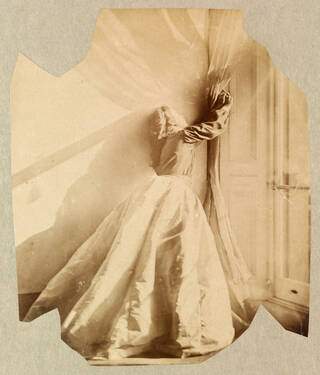
Generally, the state of a print reveals much about a photograph's material history. The corners of Hawarden's prints have been torn – the result of having once been stuck in albums (they were removed from the albums before they came to the V&A). Although there are duplicates of some photographs in the collection, the torn corners make each print unique.
The collection remained in relative obscurity until the 1970s, when the painter Graham Ovenden edited the book Clementina Lady Hawarden in 1974, raising awareness of her work. Hawarden's photographs were included in the V&A's 1984 touring exhibition, The Golden Age of British Photography, 1839 – 1900, and were exhibited at the V&A in 1999 in the display, Clementina, Lady Hawarden: Studies from Life: 1857 – 1864.
The collection can be viewed in person in our Prints and Drawings Study Room