Textiles
Features
-

Kimono
Discover the rich symbolism in traditional Japanese dress
-

Post-war textiles
Chart the progression of post-war textile design, from wartime utility to atomic-era patterns, abstract art, psychedelia and nostalgic florals
-
 Indian textiles
India's handmade textiles are embedded in every aspect of its identity
-

Althea McNish – an introduction
Discover how Althea McNish's tropical textile designs changed the character of British Modernism
-

Lucienne Day – an introduction
Of all the talented women textile designers of post-war Britain, Lucienne Day's influence is the most far-reaching
-

Àdìrẹ – 'tied and dyed' indigo textiles
Discover a hugely popular African textile tradition
-

Traditional Mexican dress
Discover the flamboyant styles of indigenous Mexican dress favoured by Frida Kahlo
-

The making of medieval embroidery
See the traditional embroidery techniques used to create masterpieces of opus anglicanum
-
 The conservation of the Bullerswood Carpet
Find out how we look after the enormous, hand-knotted Bullerswood Carpet, designed by William Morris
-

Sew your own: Mexican-style huipil
Sew your own colourful version of the traditional Mexican tunic worn by Frida Kahlo
-

Linen – the original sustainable material
Used by Ancient Egyptians as an expression of class and still popular today, linen is the original sustainable fabric. Find out how it's made
-

An A–Z of Opus Anglicanum
Do you know your cope from your chasuble, your split stitch from your satin stitch?
-

James Merry on Opus Anglicanum
Contemporary embroidery artist James Merry takes a closer look at surviving masterpieces of English medieval embroidery
-

Conservation of an Indian jama
Find out how our conservation team have repaired this intricately embellished piece
-

Golden spider silk
Discover how the world's largest pieces of spider silk cloth were made
-

Design and make a talking textile
Learn about some of Africa's 'talking textiles' and have a go at making your own!
-

In search of forgotten colours – Sachio Yoshioka and the art of natural dyeing
Step inside the dye workshop
-
 Africa fashion: cloth of a continent
Discover more about African cloth types through our collections
-

Costume conservation: My Fair Lady
From rags to riches, follow the transformation of an iconic piece of musical theatre history
-
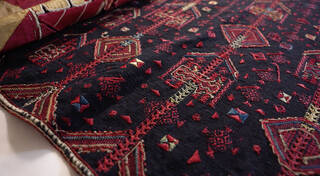 Tatreez: the ancient art of Palestinian embroidery
Discover six incredible examples of embroidered Palestinian fashion.
Collection highlights
-
 Banner, 600 – 900 AD, Dunhuang, China, pattern and plain woven silk, wood and paintV&A East Storehouse
 -
 Cravat, jumper, designed by Elsa Schiaparelli, 1927, France.V&A South Kensington
 -
 The Bullerswood Carpet, designed by William Morris and John Henry Dearle, 1889, London, EnglandV&A South Kensington
 -
 Animals by the Watering Hole, tapestry, by 'Ali Salim, 1985, EgyptV&A East Storehouse
 -
 Embroidered casket, made by Martha Edlin, 1671, EnglandV&A South Kensington
 -
 Ensemble, unknown, early 19th century, IndiaV&A East Storehouse
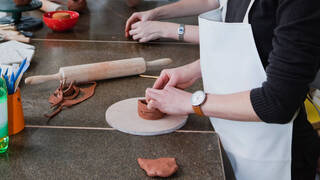


Join a V&A Academy experience
Explore our curated range of expert-led courses, workshops, and talks, all with the V&A collections at their core.
- Expert led courses
- Practical workshops
- Lectures & talks
- Professional development