Renaissance
Features

-
 Renaissance music
Music underwent an extraordinary transformation from the mid-15th to the early 17th century
-

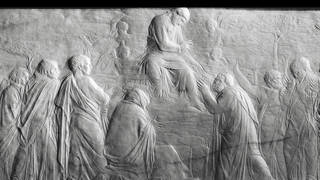
Donatello – a master at work
Discover how Donatello manipulated materials to create masterpieces of Renaissance sculpture
-

Piccolpasso's treatise on maiolica
The V&A not only holds the greatest collection of maiolica in the world, but also this unique treatise describing its manufacture.
-

Sir Paul Pindar's House
An outstanding survival of a London timber-framed house built before the Great Fire of 1666
-
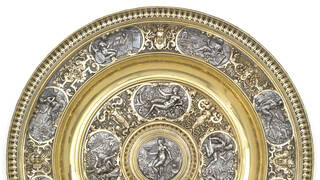 The art of the copy: the origin of the Wimbledon ladies trophy
Discover the origin of the Wimbledon Ladies Singles Championships trophy
-

The Almain Armourers’ Album
One of the Museum's great Elizabethan treasures, this book of armour designs charts some of the most spectacular armour ever made
-
 Reviving Angels: conservation in action
Find out how extensive conservation work has enlivened the appearance of the Wolsey Angels and ensured their future preservation
-
 The Great Bed of Ware
Discover the bawdy history of one of the V&A's best-known objects
-

Invisible women: uncovering gendered histories
Discover hidden female histories in our collection
-
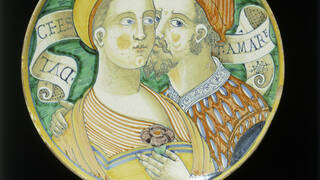 Italian Renaissance pottery – 'beautiful women' plates
'Belle donne' plates promoted an ideal of the perfect woman: beautiful, virtuous, and not infrequently, dead.
-

How was it made? Portrait miniatures
See how these tiny intricate paintings were made
-

Perugino, and his rediscovery by the Pre-Raphaelites
Find out more about Perugino, one of the most successful artists of the Italian Renaissance
-
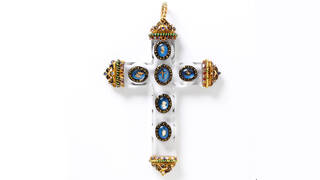 The hidden power of gemstones: meanings, myths, and magic
Revealing the hidden meanings and magical attributes of gemstones
-

Unlocking a 17th-century strongbox: ASMR
Peek into the past as we look inside a historic strongbox
-

Donatello's 'David'
Pre-dating Michelangelo's David, discover Donatello's marble and bronze sculptures of the Biblical hero
-

Donatello's Florence
Discover 15th-century Florence, Italy, home to Renaissance master Donatello, with our interactive map
-
 Shakespeare's First Folio
Discover the secrets of a 400-year-old copy of Shakespeare's collected plays
Collection highlights
-
 Notebook (Codex Forster II) by Leonardo da Vinci, 1495 – 97, Milan, Italy. Museum no. MSL/1876/Forster/141/II, f. 91r.V&A South Kensington
 -
 Pair of gauntlets, made by Lucio Piccinino, about 1585, Milan, ItalyV&A South Kensington
 -
.jpg) Portrait of a Lady known as Smeralda Bandinell, painting, painted by Sandro Botticelli, 1470 – 80, Florence, ItalyV&A South Kensington
Portrait of a Lady known as Smeralda Bandinell, painting, painted by Sandro Botticelli, 1470 – 80, Florence, ItalyV&A South Kensington -
 Hunting crossbow, about 1590, GermanyV&A South Kensington
 -
 (Detail) The Dacre Dolphin, figure, 1507 – 25, Cumbria, EnglandV&A South Kensington
 -
 Parade shield, made by Jorg Sigman, 1552, Augsburg, GermanyV&A South Kensington
 -
 Pair of gloves, made by Sheldon Tapestry Workshops, 1590 – 1610, Warwickshire, EnglandV&A South Kensington
 -
 Lantern, 1570 – 1600, Venice, ItalyV&A South Kensington
 -
.jpg) Pendant, late 16th century, EuropeV&A South Kensington
Pendant, late 16th century, EuropeV&A South Kensington -
 Mechanical globe clock, made by Georg Roll and Johannes Reinhold, 1584, Augsburg, GermanyV&A South Kensington
 -
.jpg) October; The Labours of the Months, roundel, made by Luca della Robbia, 1450 – 56, Florence, ItalyV&A South Kensington
October; The Labours of the Months, roundel, made by Luca della Robbia, 1450 – 56, Florence, ItalyV&A South Kensington -
 Samson Slaying a Philistine, figure group, sculpted by Giovanni Bologna, 1560 – 62, Florence, ItalyV&A South Kensington
Join a V&A Academy experience
Explore our curated range of expert-led courses, workshops, and talks, all with the V&A collections at their core.
- Expert led courses
- Practical workshops
- Lectures & talks
- Professional development