
Sign up to be the first to hear about National Art Library news and events:

Search the Library Catalogue
Find and request print collections available to view in our study rooms. Explore our 'Course Reserves', which provide book lists and e-resources on a range of topics, including databases, dictionaries, encyclopaedias, current V&A exhibitions and courses, NAL events and the history of the V&A. Some e-resources are only available to view when you are in our study rooms due to licensing arrangements.
You can find information on how to search the Library Catalogue and request material in our downloadable instructions.
Requesting items
Items from the National Art Library are available to view at two sites: National Art Library, South Kensington and the V&A East Storehouse.
Information about which venue the material is held and how to request it can be found in the individual search results of the Library Catalogue.
All items may only be consulted in the study rooms and cannot be borrowed.
National Art Library, South Kensington
We recommend that you request items in advance of your visit to make the most of your time in the Library. You can request up to 8 items at a time. Please note that some rare items can only be requested during your visit or are available by appointment – this is indicated in the library catalogue.
V&A East Storehouse
You can request to view library books on subjects including performance history and children’s literature at the V&A East Storehouse's Study Centre.

Visit
The Library is open on Tuesday, Wednesday and Thursday, from 10.00 to 17.00.
Christmas closure: The NAL will be closed from 17.00 Thursday 17 December 2026 until 10.00 Tuesday 5 January 2027.
Although an appointment is not necessary, you are strongly advised to order any items you wish to consult in advance of your visit via our online catalogue. Item requests must be placed by 15.15 for same day delivery. The Special Collections desk closes at 16.30.
View the location of the Library on our digital map.
Food and drink are not permitted in the Library. Any bags should be deposited at the cloakrooms. The cloakroom is free on production of your Library card. On your first visit you may wish to complete your registration at the Library to collect your card before depositing your bags. A clear plastic bag is provided to decant any items you need to use in the Library. Please see conditions of use for further information.
The Library does not have air conditioning and the reading rooms and stores can reach high temperatures. On occasion we may need to alter services or opening hours. Please check the Library catalogue and gallery closures, especially during periods of hot weather.
Visit the NAL blog for the latest updates about the Library, and sign up to the NAL newsletter.

Events
The Library hosts a number of free events for the general museum visitor.
National Art Library and Archive talks
Join V&A Library and Archive staff each Monday (except bank holidays) at 11.30 and 14.00 for a short talk on an item from our collections and the history and purpose of the Library.
Library and Archive Discovery Days
All are welcome to drop in and explore our reading rooms, meet our staff, see our collections and take a glimpse behind the scenes on one of our regular Discovery Days.
Disability access to the Library
Find out about access to and facilities for people with disabilities in the National Art Library and our other study rooms.
Group visits
If you are a group involved in researching, studying, working or participating in the arts and would like to visit the Library, you can contact us at: nalvisits@vam.ac.uk.
Group visits are offered in the following months: February – March, May – July, October – December.
Bookings require a minimum of six weeks notice.
Study rooms
In addition to the National Art Library study rooms at South Kensington and V&A East Storehouse, we have a number of other study rooms where it is possible to view over 2 million objects from the reference collections and to conduct private research.

Join
To request items to view, you will first need to join the Library by creating a user account. This can be done in advance or during your visit.
Create an account by completing our online form. Once you have set a password, you will be able to login to the library catalogue and place requests.
On your first visit to the Library you will need to show current ID (e.g. passport, bank card, national ID card, digital student identification etc.) to complete the joining process and be issued with a Library card. Please note we only accept original documents or born digital ID and do not accept photographs of identification.
Renewing your Library card
Please contact us if your membership has expired and you wish to request items in advance of your visit. We will issue your new Library card on receipt of your ID when you visit.

Enquiries and copying
Enquiries
Our staff can help you with questions about our library collections and services, as well as specific queries related to art and design.
Copying
Copying is subject to UK copyright law and permitted for private study or non-commercial research. The amount you copy must be 'fair and justifiable' and no more than a single chapter or 10% of a total work. Out-of-copyright materials may be copied not for publication.
Onsite copying
You may take photographs using hand-held devices or at the camera stand provided. Please note that flash or use of other artificial light is not permitted in order to protect our collections and avoid disrupting other readers. Please treat all material with great care and make use of the book supports and weights. Ask a member of staff if you need help or advice in handling any item.
Book scanners are available and free to use. Scans can be saved to a USB drive or directly downloaded to your mobile phone. Please bring your own USB drive for use in the study rooms.
Copying service
If you are unable to visit the library in person, please contact us to order copies online.
Please find our charges listed below.
For copyright materials we supply research quality copies (200dpi) in line with UK Copyright Law to individuals undertaking non-commercial research and private study only. Please see our Terms of use. You may be required to sign a copyright declaration statement. If you require high resolution images or images for publication, please visit V&A Images.
Please note that the supply of copies can take up to 20 working days.
Charges
Where possible scans will be provided as double page spreads. Any born digital material will be charged at a flat fee of £15.00.
Number of scans and cost:
0 – 10: £15
11 – 20: £20
21 – 50: £35
51 – 100: £50
101 – 150: £75
151 – 200: £100
201 – 250: £125
251 – 300: £150
Inter-library copying
We are part of the national inter-library loans (ILL) community, which is committed to the co-operation of libraries in sharing resources.
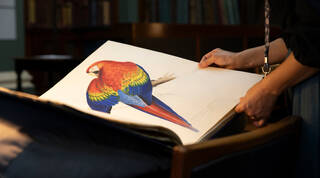
Virtual Reading Room
The National Art Library’s Virtual Reading Room (VRR) is a free service allowing you to consult items from our collection without having to visit in person.
How the VRR service works
Appointments take place via a Microsoft Teams call and are facilitated by a Library staff member, who will share your requested materials through a high-resolution camera. You can ask the staff member to turn pages and zoom in on areas of interest. If material you request is unsuitable, or has already been digitised and is available online, you will be notified by a member of staff after you have submitted your request form.
The service is free and open to all on a first come, first served basis.
What you need to know
- The service is available on Mondays and Fridays, 09.30 – 10.30 and 15.30 – 16.30, excluding bank holidays and other planned Library closures.
- Appointments should be booked at least 7 days in advance.
- Appointments are limited to 1 hour.
- You can consult up to 3 items per session.
- Large format items may exceed the reach of the overhead camera (approximately A3).
- Some materials may be unsuitable for the VRR service due to their fragility, format or copyright restrictions.
Book an appointment
Before booking an appointment, you will need to know the details of the item(s) you would like to view, including their title and pressmark. Items can be searched for using the Library Catalogue.
If you are not already a registered member of the Library, you will need to create an account in order to access the service.
Please be aware that VRR appointments are not consultations with subject experts. If you wish to speak to a subject expert at the Library, please contact us online.

Book collections
The Library holds around one million books on subjects central to the V&A collections including prints, drawings, paintings, photographs, ceramics and glass, textiles and fashion, furniture, design, metalwork and sculpture. Our rich collections range from medieval manuscripts to contemporary artists' books and armorial bindings to comics and graphic novels.

Blog
Visit our blog to keep up-to-date with the latest Library news, exciting new service developments and to discover more about our collections, displays and research projects.