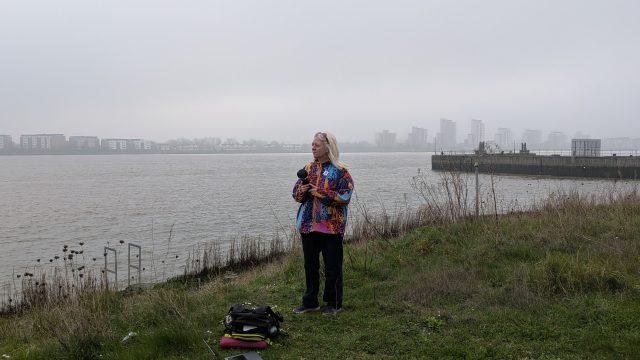
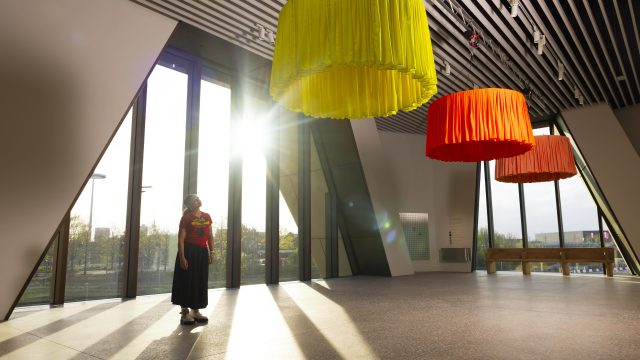
Carrie Mae Weems’s The Long Goodbye (2026), commissioned for the opening of V&A East Museum and developed over almost three years, explores migration through the often-obscured love stories intertwined within these journeys. Love is both its subject and its method: a way of restoring humanity to people whose courage and labour have shaped the modern world but whose lives are often reduced to statistics or omitted from historical accounts. Weems asks viewers to recognise the love that people carry with them when they migrate from one place to another but also the love that they leave behind, and ultimately, how these experiences continue to inform the present even if they so often remain unacknowledged.
Migration is deeply rooted in Weems’s practice and has particular resonance in east London, where it has defined the area’s past and present. Celebrating and creating space for the many communities that call east London home is central to the mission of V&A East. This commission turns Weems’s lens for the first time towards the UK and its diasporic communities, where her work has long been admired by and influential on generations of artists. Over the course of the commission’s development, Weems’s initial ideas evolved in response to debates and protests about migration that have been at the forefront of the political climate in both Britian and the United States. The Long Goodbye continues Weems’s decades-long commitment to dismantling hierarchies of power by examining how images and archives define entrenched historical narratives. The film imagines a different account of post-war Britain, one that recognises buried truths of how and why generations immigrated to the UK, that is a pertinent lesson in this political moment of how history has become warped and rewritten to serve the agendas of those in power.
‘I’m trembling. I’m trembling…tell me what’s on the other side…I remember when Britian was smashed and burned and when we became a part of the Commonwealth and when the Queen called saying that she needed us…I remember the great extraction of natural resources and wealth needed at the service of empire.’
These words spoken and sung in The Long Goodbye evoke the fear of the unknown, placing the viewer in the position of one looking across the ocean towards an uncertain future but still finding the resolve and courage to leave. She speaks on behalf of those who have immigrated voluntarily but also the terror of the millions who emigrated in chains. Her voice captures the visceral pain and fear experienced by these unnamed individuals, whose anguish has shaped our present and yet whose humanity is rarely part of the historical record.
Weems’s longstanding use of self-portraiture as an act of intervention runs throughout the film, alongside references to her own archive. By inserting her image into the historical narrative, Weems uses her voice and body to draw sharp attention to people whose experiences have been silenced or forgotten. The archive ceases to be fact and becomes something that instead we must actively question, including the assumptions that we bring to it. This is also a question of how we look, how a photograph can serve as evidence of someone’s presence while revealing little about their inner life. Weems draws attention to that gap, asking what an image preserves and what it leaves us to imagine and how we can fill in this fissure. This attention to the making of history also informed the commission’s development. In a series of workshops with the 2025 cohort of the V&A East Youth Collective, Weems shared how she frames and uses her own archive. Members of the cohort shared in response the stories from their own archives and family histories in answers to questions that Weems posed to them about what they would want someone to know about their city, their community and where they come from.
Water is central to the film as the route of migration and a connector between geographies and cultures but also a vessel of history. There are many shots that focus on the ocean and the rise and fall of its waves, evoking its rhythm and vastness as well as the lives and stories trapped within its endless depths. These passages invoke the immeasurable number of Black bodies lost in the Middle Passage of the transatlantic slave trade and their power to rise again and drown the present that was built on their lives and backs. The film suggests that the histories of migration across the Atlantic remain inseparable from the present. Weems’s imagery also invokes tidalectics, a concept developed by the Barbadian poet and historian Kamu Brathwaite that describes a way of understanding history, culture and identity through the ebb and flow of the tides as recurring movements of departure, return and transformation (in contrast to a teleological progression from past to present) and the continual presence of ancestral knowledge. The Long Goodbye offers a way to interpret the ocean as a vessel through which the humanity, memories and love of anonymous individuals are never lost but continually return to inform the present.
‘It was coming. It was coming. It was coming. We had pushed and we had pushed hard and we had made it through…It was changing. It was changing. It was changing and everybody knew it. It was changing from white and black to shades of brown. The change was coming and it was unstoppable….’
The film’s final section, framed by Weems’s laughter and a couple dancing, opens towards joy and possibility for the future because of the inevitability of change set in motion both because of and in spite of these violent histories, because of love. As Weems says in a later interview about The Long Goodbye ‘the empire has to deal with the reality of what it has created’ and how the movements of people set in motion by empire will continue to transform both Britian and the United States as well as many other major nations globally. Weems reminds us that it is this migration that underpins the world’s greatest creative centres, from London to New York and globally. Her words create a feeling of the inevitability of change and surrendering to the waves of history, trusting in that process. The film’s repeated insistence and confidence that change is already taking place and set in motion offers much-needed hope in a political climate in which progress feels elusive despite the efforts of those fighting for it. Change is going to come. Change is already occurring.
The Long Goodbye is shown at V&A East Museum alongside two films from Weems’s archive, Before the Loss of You (2005) and Okwui (2019), both also meditations on love. Before the Loss of You honours the love between Winnie and Nelson Mandela, imagining their relationship before their sacrifices to the fight against apartheid and Mandela’s 27-year imprisonment, reflecting on love, separation and the personal cost of resistance. Okwui pays homage to Okwui Enwezor, Nigerian curator, critic and poet, widely regarded as one of the most influential figures of his generation. He advanced a global perspective on art, challenging the dominance of Western narratives. Created in commemoration following his death in 2019, this film is Weems’s tribute to his life and lasting impact on how modern and contemporary art is understood and presented as is reflected today in V&A East Museum’s Why We Make Galleries.
These films seen together reveal love as a catalyst for so much of Weems’s oeuvre. Weems’s layered and multimedia practice ultimately shares stories of love and asks us to recognise it in the lives of strangers across time and place. Recovering the humanity of people marginalised in our dominant narratives changes how we live within the societies their lives helped create. Weems asks us not only to question the stories we have inherited, but to truly honour the lives, losses and loves through which our world continues to be made. Her practice has always been about making visible those who have been unseen. That, in itself, is an act of love.