Barniz de Pasto (literally ‘varnish from Pasto’) is a Latin American decorative lacquer technique which, uniquely, uses tree resin (known locally as Mopa Mopa) growing above 1600 metres in the tropical rainforest of Nariño and Putameyo. It was developed from pre-Columbian expertise during the early colonial period in the Viceroyalty of Peru and has been practised continually ever since. Today the technique is centred on the city of San Juan de Pasto in south-west Colombia, from which barniz de Pasto is named. The numbers of individuals directly involved in the production of barniz de Pasto is small: in 2023 only eight families harvested the resin which, after laborious processing, was being applied by thirty-six barnizadores (varnish masters), typically to wooden artefacts such as boxes, dishes and small carved items. In 2019 the technique was included in the Representative List of Cultural and Intangible Heritage of Colombia.[1]

In 2014 V&A curators, conservators and scientists began studying barniz de Pasto, at that time very little known in the UK, with no identified examples in any museum. The museum holds 12 historic and contemporary examples.[2]
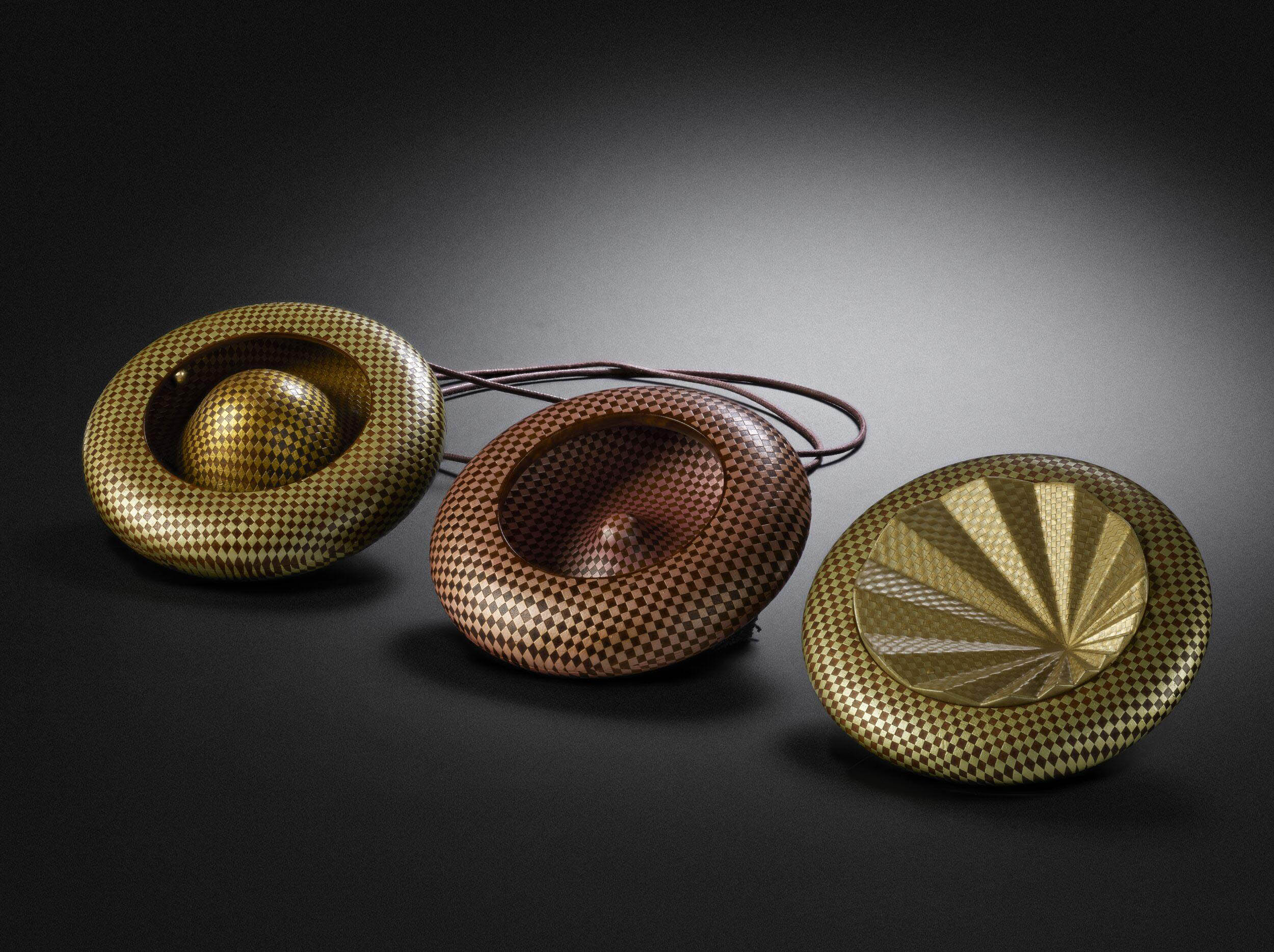
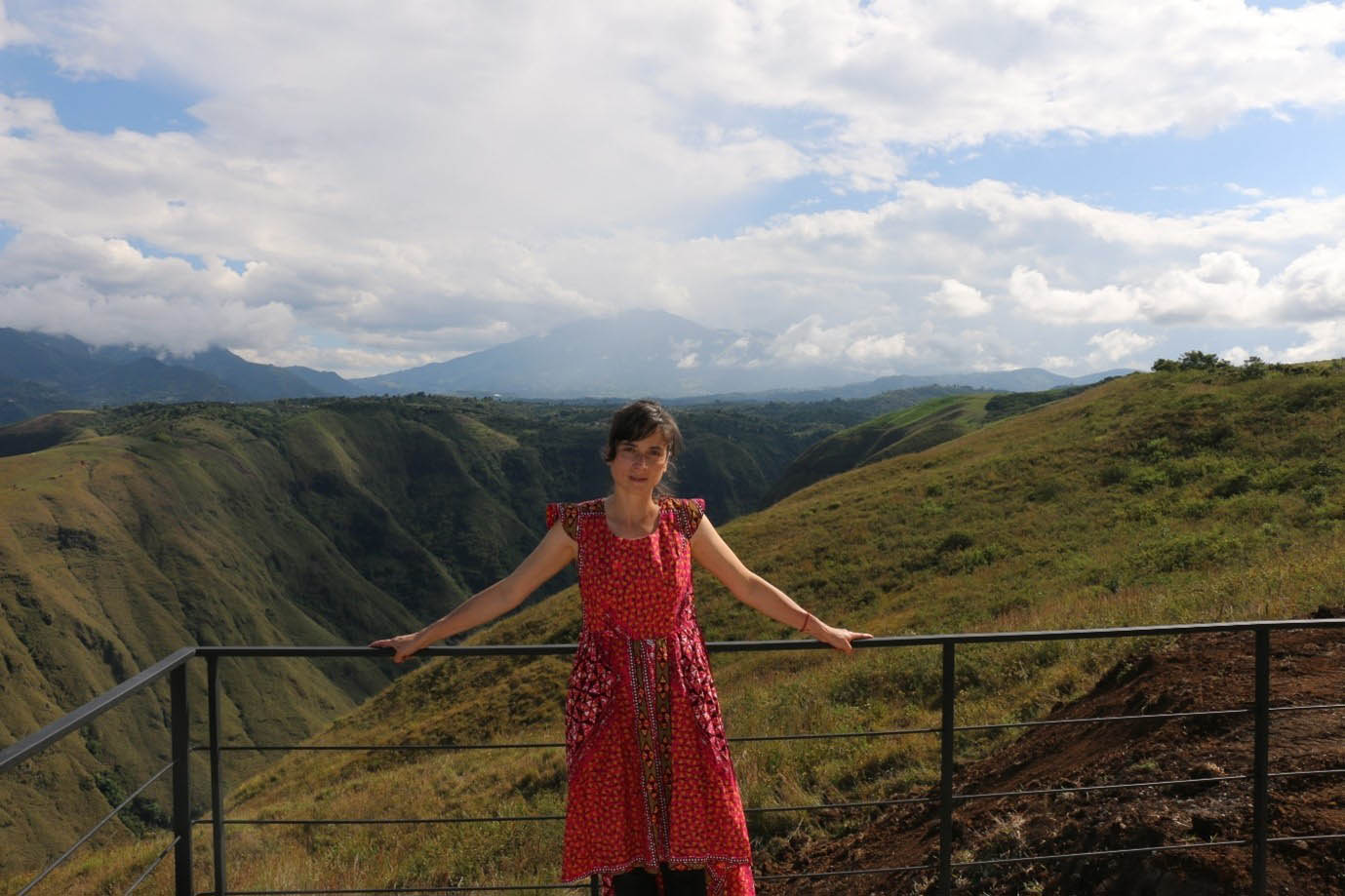
Tatiana Apráez is a jewellery designer and maker based in Bogotá, Colombia, and the co-founder and co-director of the Materia Prima jewellery school. After studies in Industrial Engineering and Art Jewellery she made an early career decision to incorporate barniz de Pasto in her own designs, and has worked with Germán Obando, a barniz master in Pasto, to apply it to materials other than wood. In 2022 Apráez won the Grand Prize of the Jewellery Design Association in Japan (Tokyo Metropolitan Museum) with a trio of Urcunina brooches, subsequently acquired by the V&A. In 2023 she spoke about her work at the museum’s Lacquer in the Americas conference, the proceedings of which were published in a special issue of the MDPI Open Access Journal Heritage: Museum and Heritage
During and after the V&A’s acquisition of her work, Tatiana corresponded with acquiring curator Nick Humphrey about her work which features alongside historic barniz at V&A East Museum.
NH: Barniz de Pasto is not well known even in Colombia. How did it come to occupy such a core part of your working practice as a designer and maker of jewellery?
TA: I am from Pasto. My parents and family are from Pasto and I spent my childhood and adolescence there. My parents didn’t have artistic backgrounds, but they always encouraged their children to be interested in what we saw around us, to love Nariño, its geography, its artisan crafts, its history. After finishing my jewellery studies at the Escola Massana in Barcelona, I returned to Colombia with many ideas, but with the certainty that I wanted to root my work and development as jeweller in my homeland, Nariño.
I started to develop a type of jewellery that could incorporate barniz de Pasto. After two years of experimentation with barniz workshops, I found maestro artesano Germán Obando, who works at a much smaller scale than what is normally seen. In 20 years, I’ve learned everything I know about Mopa Mopa from Germán, and after those two years of research I found ways to sustain what I have done for the last 18 years.
I want to offer a new perspective on barniz de Pasto within contemporary jewellery. Part of that has required new substrates for Mopa Mopa resin. We have applied it to a wide variety of materials including wood, silver, gold, steel with electrostatic paint, leather and 3D printed resin. I also wanted a more contemporary interpretation of barniz de Pasto, which took a lot of work over the years in terms of colour and graphic patterns which are fundamental to my work. With Germán, we developed a specific palette of colours for my pieces.
NH: When you were growing up in Pasto, were you aware of barniz de Pasto products and traditions; did you have examples at home?
TA: When I was little, we had a few pieces of barniz de Pasto at home. One was a set of four folding side tables with pre-Hispanic style borders around a black and white idol image, very typical of what you’d find 40 years ago. We used them when my parents would offer visitors something to eat or drink in our living room. Those four tables beside the sofa, came to life and welcomed our guests. I also remember a lidded vase, decorated with flowers, branches, and a checkered border, which was given to my father as a thank you for helping someone. It had a prominent place on the coffee table in our living room and was a special object for my brother and me. I remember its tonality with metal leaf and a layer of pink tint. These metallic colours have largely disappeared nowadays.
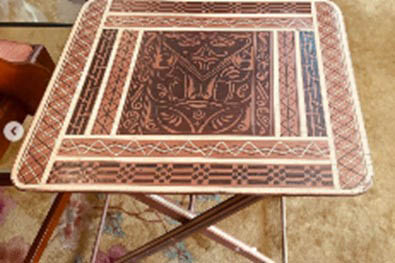
Photo: Anticuario Novecento, Bogota
NH: Who were the designers or jewellers that have influenced your own practice?
TA: I’ve learned something from each of my teachers and fellow jewellers over these 24 years, and in a field like jewellery that can be solitary, creating a community has become one of the greatest treasures. Nuria Carulla, a Colombian jeweller of Catalan descent, and a very important figure in contemporary Latin American jewelry, has been the teacher from whom I have never stopped learning and perhaps the jeweller who has most influenced my practice. She teaches both skills and a way of thinking, managing to bring out the best in her students and show them their own path. I was privileged to be guided by her teachings and, over time, to share my career and life perspectives with her.
At La Massana school in Barcelona, I studied with Ramón Puig Cuyàs, director of the Artistic Jewellery department, and with Carles Codina. From them I discovered the limitless worlds to which portable objects such as jewellery can transport you. At La Massana, the intention behind the materials used in jewelry became incredibly important to me as a jeweller. My time there also gave me my great friend and partner, the jeweller Linda Sánchez, with whom I founded the Materia Prima school in Bogotá.
NH: Given that you and German Obando work in cities that are 800 km apart – San Juan de Pasto and Bogotá – how do you organise your work together?
TA: With Mopa Mopa, I create two types of jewellery. One is a line of special pieces for exhibitions or events that allow me to explore new avenues, with significant research that constantly feeds my development as a jeweller. The other is a more commercial line presented at jewellery shows each year, which provides our workshops with financial stability and continuity. Germán and I work together on both lines. My jewellery workshop is in Bogotá. Here, each piece is conceived and created from scratch; we make the wood, metal, 3D components, and everything else that each piece requires.
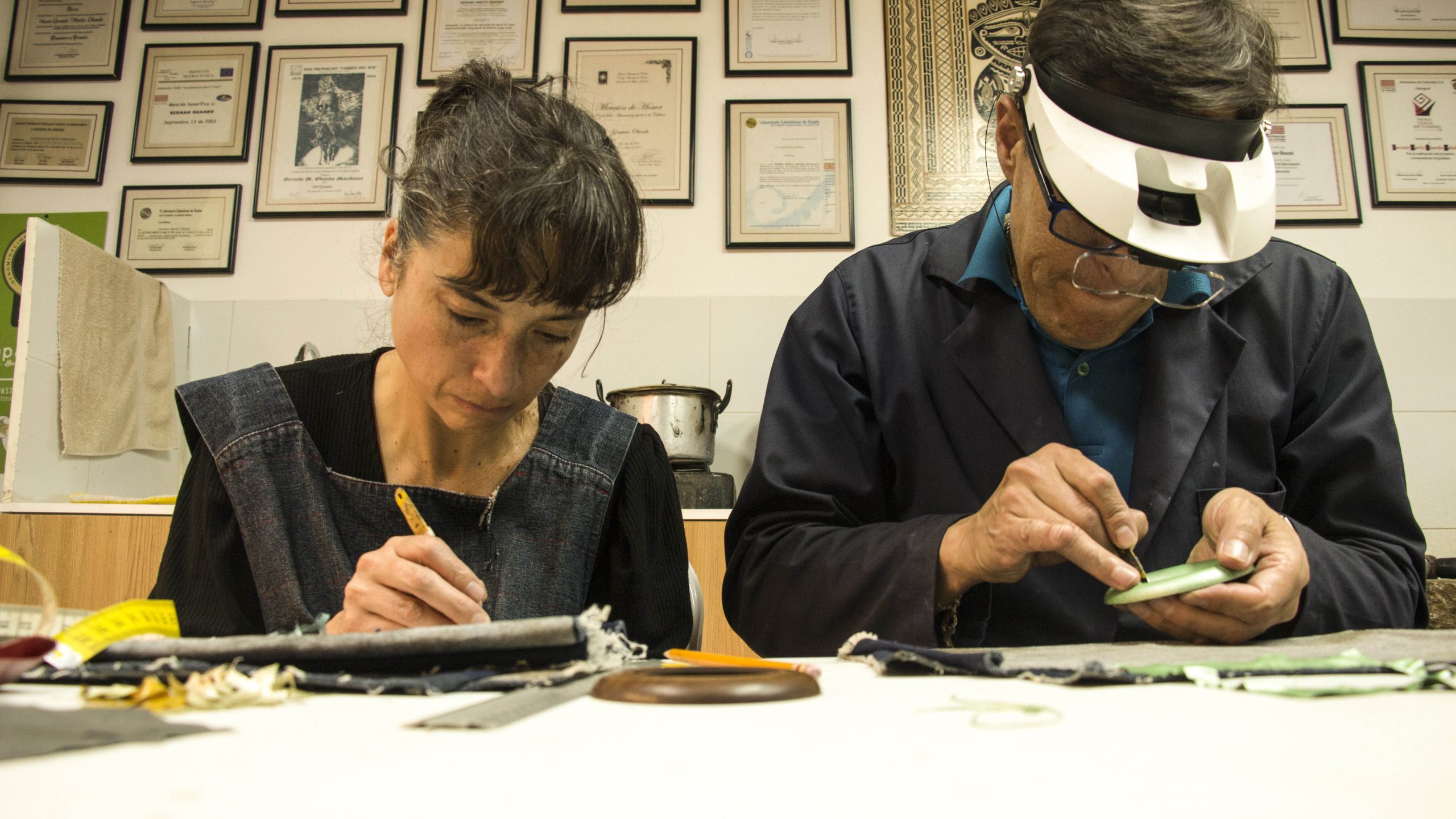
All our pieces are designed to be disassembled and reassembled. This is the biggest design challenge since some parts of each piece are sent to Pasto for the application of Pasto varnish at Germán Obando’s workshop. He decorates them according to the agreed graphic designs. After decoration the pieces return to Bogotá where they are reassembled to create the final piece. Today, it’s a streamlined process but it took time to learn how to work remotely. This is one of the greatest rewards of working together for a period of years: to feel the progress and growth of both workshops.

Obviously, making jewellery usually involves heat and metal tools whereas Mopa Mopa is worked with the fingers and bonds naturally with gentle heat so applying the resin was one of the major challenges. Every substrate has required resistance testing for the resin. Above all, the construction and decoration of each piece must avoid heat damage which would ruin the design.
I’ve also incorporated other artisanal techniques into my jewellery, such as the traditional Nariño straw work technique tamo.[3] Each technique requires research and experimentation, and a variety of problem-solving, which is very interesting to me on a personal level.
NH: Have you yourself tried to learn the art of applying barniz de Pasto?
TA: Taking this step took me a long time, not because I didn’t want to get involved in applying varnish to my pieces—I was excited to do it—but because it had to be done respectfully, and I felt that I needed Maestro Germán Obando’s permission. Four years ago, I dared to start, with Germán’s permission – it wasn’t stated formally, but it happened [laughing]. Actually I started with some pieces from the Urcunina series, after the V&A acquisitions.
Whenever I can travel to Pasto and stay there for a while, I work every day in Germán’s workshop developing ideas for new experimental and exhibition pieces. I had seen barniz applied for so many years, and as a jeweller, which has trained my fine motor skills, working with it came naturally. So it wasn’t an obstacle to be overcome so much as a defining and enriching step in my work.
NH: Before the arrival of the Spanish, coloured Mopa Mopa resin was used in the form of beads and nose rings (as well as the kero drinking cups that are perhaps better known), whereas in the colonial era barniz de Pasto came to be used on containers such as boxes and bottles. How significant is it that your work is worn on the body as an expression of identity? And is an association with pre-Columbian meanings — symbolic, cultural or religious — something that you wanted to engage with in your own practice?
TA: Twenty-four years ago, after graduating as an industrial engineer and working in that field, I decided to dedicate myself to jewellery. The change was a difficult decision in many ways, but fundamental. I was passionate about jewellery and knew that with it I could return to my homeland. On my return to Nariño, I considered various artisanal techniques, but Pasto varnish was always my first choice for several reasons: the transformation of the material, the high precision and detail that can be achieved, the colourful and graphic design aspects which offer enormous plastic possibilities. Additionally, I wanted to engage with the enormous heritage legacy that runs through the technique and its creators.

From my perspective, creating jewellery that someone chooses to wear means a great deal. I’ve always believed that what a person wears is a personal act of identity. A piece of jewellery has symbolic meaning. The way it was crafted, the materials used, the environment it evokes—these are all aspects that the wearer has considered and with which they’ve established a connection. Seeing this happen is very exciting because it preserves the essence of our work. Creating ‘local’ jewellery that someone outside of Nariño identifies with is about sharing universal values that I believe in. Perhaps that’s why my priority for jewellery hasn’t changed and why it has delayed my foray into other types of non-wearable objects.
I believe I was the first person to apply the Mopa Mopa technique to jewellery. Clemencia Plazas, who was the director of the Museo del Oro in Bogotá, is an archaeologist specializing in ancient Colombian goldsmithing. She is also passionate about Mopa Mopa. She has followed my work and says that its most original aspect is my early decision to use barniz in jewellery. Perhaps she is right; my years of working with barniz in such a disciplined way, always thinking about how to continue with it in the future, have shown me a life path to commit to, and a community to build.
NH: Barniz de Pasto was never used, as far as I’m aware, on a large scale (for items too large for one person to hold), but even so the small scale, intricacy and preciousness of jewellery seems an satisfying match with both the rarity of the Mopa Mopa resin, and the deeply tactile processes with which it is worked: barniz is created through human touch, warmth and movement so there’s something very resonant about it being used to adorn the living human body.
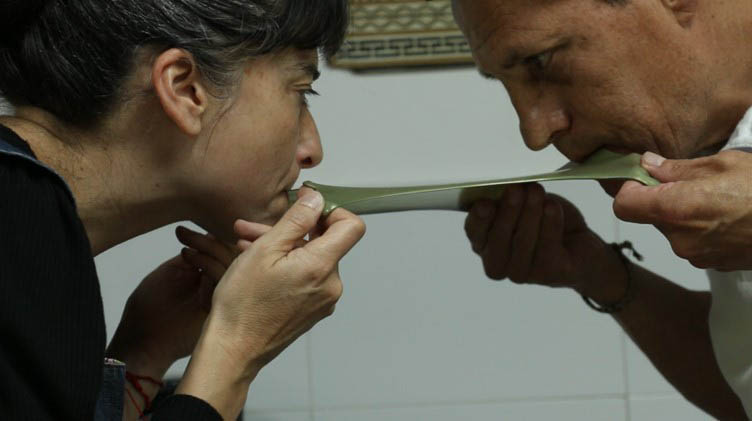
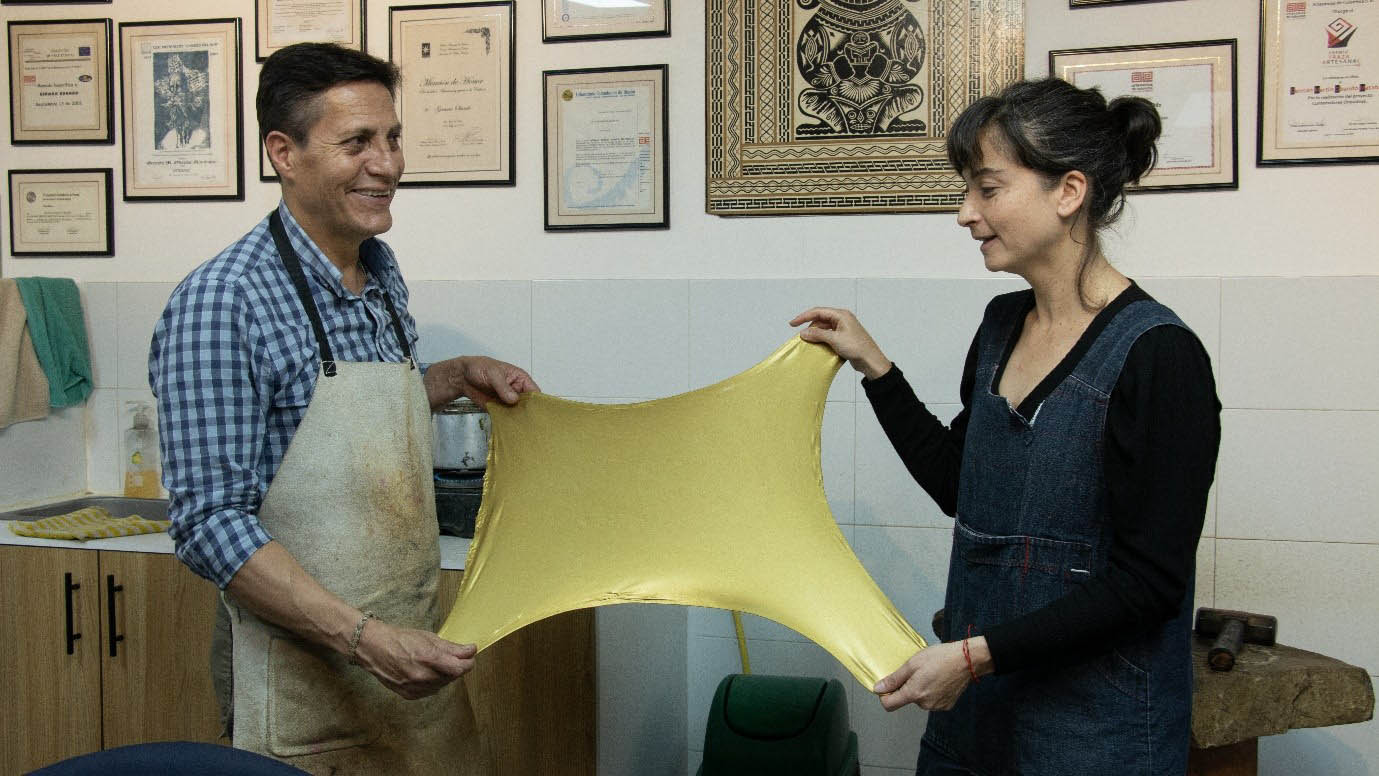
TA: I completely agree. The naturalness of the technique and its marvellous application are a perfect match for jewellery. The jeweller and the varnisher create pieces that are delicate, gentle on the skin, and warm in their materiality. To adorn the human body through what we do is beautiful. Each piece of jewellery comes to life. Barniz is a unique technique, a ‘gem’ in its own right that belongs to us, with a process that offers both traceability and the possibility of continual development –invaluable qualities for our future as human beings.


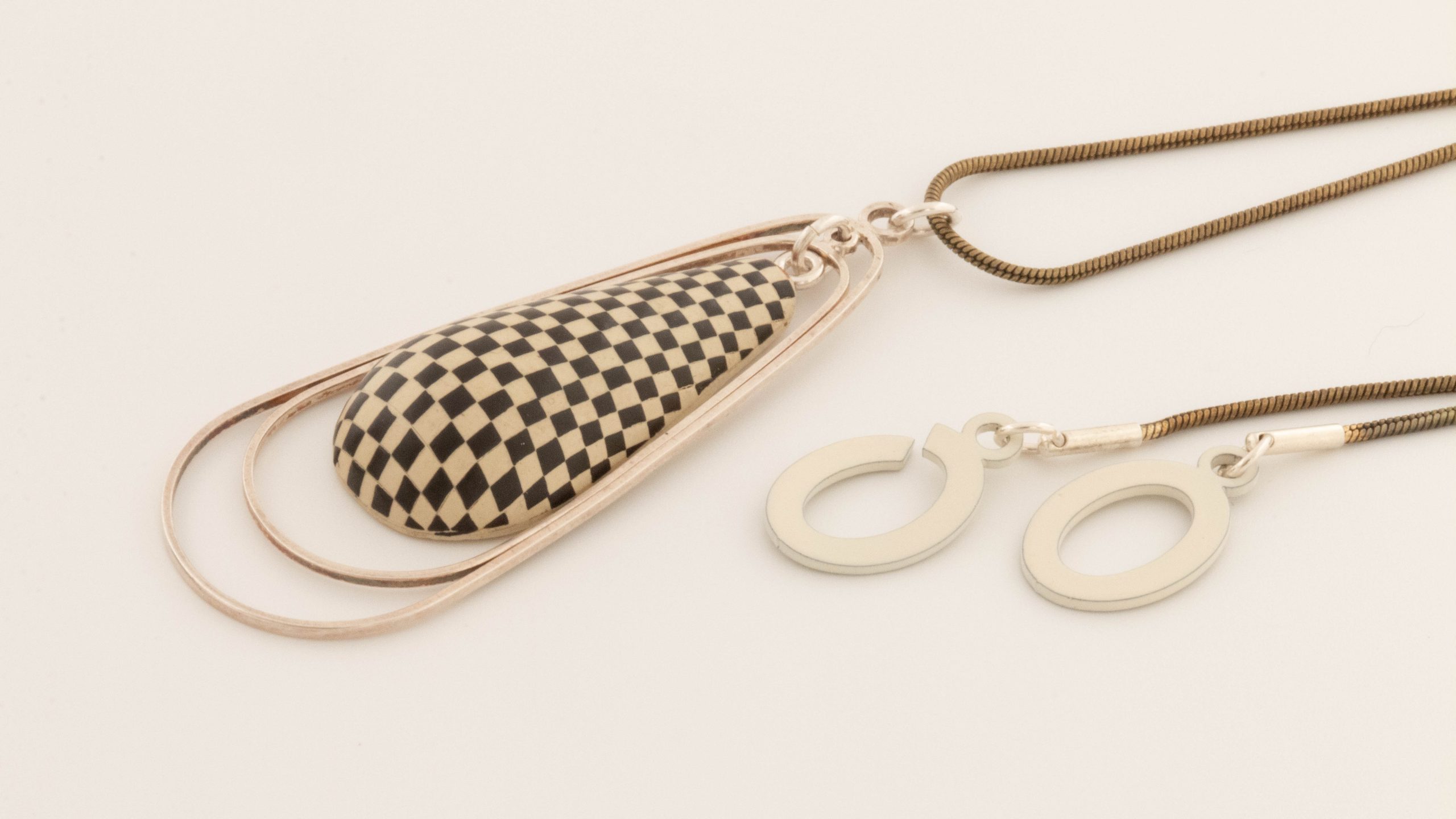
Urcunina Series: 1 (pendant), front and back views. Designed by Tatiana Apráez, with barniz de Pasto decoration by Germán Obando, San Juan de Pasto 2022. Pau D’Arco wood with barniz de Pasto, cotton cord; 92 x 22mm. V&A: W.4-2023
NH: Part of your time is spent teaching at the Materia Prima jewellery school in Bogotá. How did that come about and how do you balance the demands of design and production, with teaching? Is barniz de Pasto a particular focus there?
TA: In 2004, along with Linda Sánchez, I co-founded Materia Prima, which specializes in contemporary jewellery. We have 150 students a year seeking guidance in project development, design or various techniques, and I dedicate approximately 50% of my time to teaching. Our school doesn’t teach barniz de Pasto, primarily because the technique must be handed down and taught in the city of Pasto where the master artisans are, and our school is in Bogotá. What we do is promote each of the artisanal techniques and materials available in our country, giving our students a wide range of options to explore.
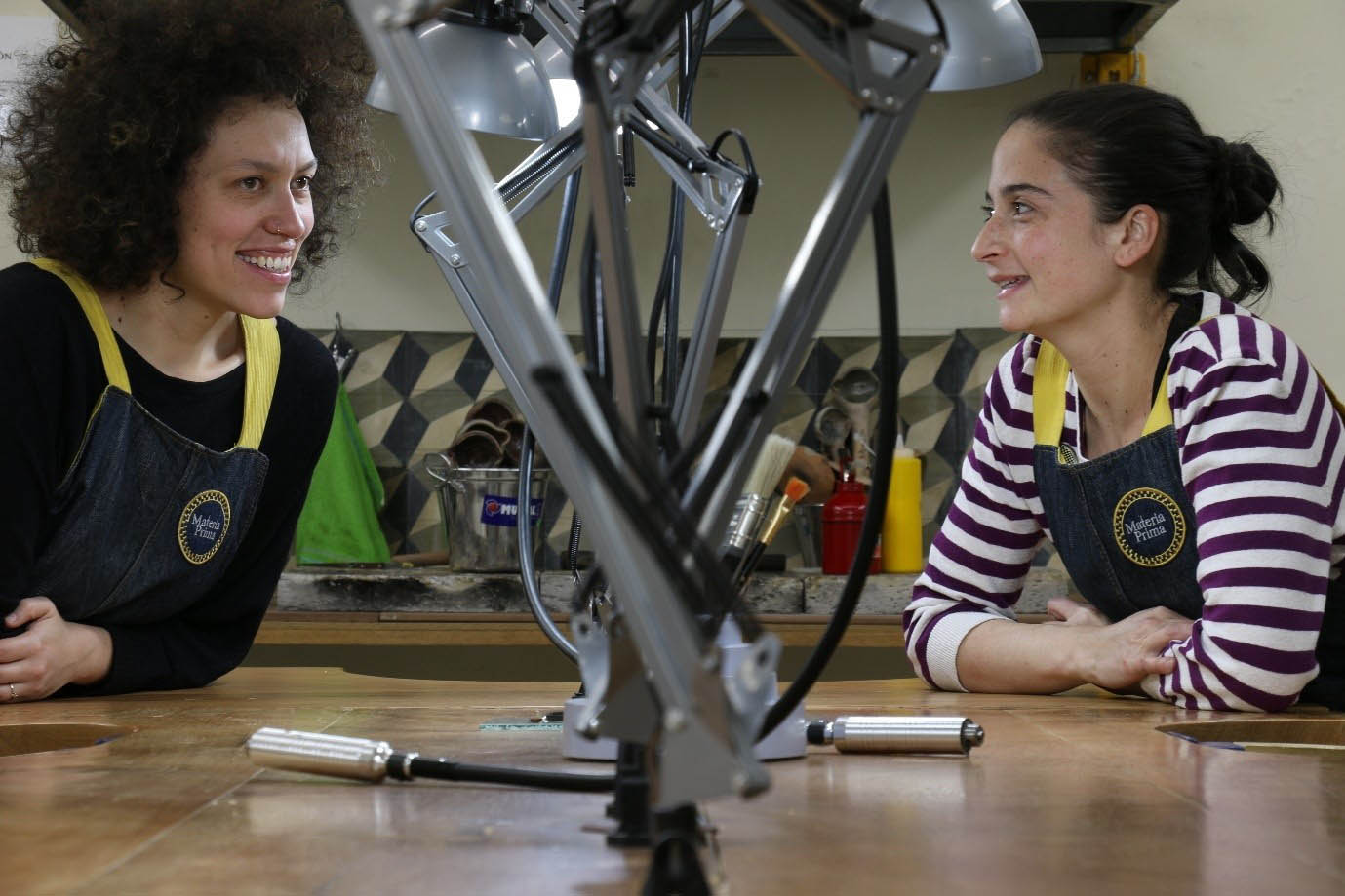
Actually, I’d like to speak about the role of community in my work more broadly. Each of my pieces emerges during a process of contemplation, challenge and desire, but it’s also a community process. The work develops through knowledge gathering at different levels: territory, heritage, the magic of transformation, the spirituality that leads to creation, appreciation of your environment and colleagues during the making process. It stems from an initial impulse driven by intimate introspection, but constant collaborative work remains fundamental. When you live in territories with as many needs as southern Colombia, your work over the years emerges from a community process. By this, I mean that a designer’s individuality isn’t enough if you don’t incorporate it into a creative process with a deeper impact, at least on the environment it touches. This is why my interests are increasingly focused on highlighting community, cultural heritage and collaborative creation by a range of people with diverse knowledge and strengths.
The work is also intended to be a creative process that can endure. In territories like Nariño, this involves generating a source of income, and emphasizing that working together creates new opportunities for our shared culture. This goal requires extensive research to consolidate traditional knowledge, sometimes combining it with new technologies or rediscovering lost knowledge. It hasn’t just been a process of doing things, it’s meant adapting to uphold our beliefs, doing everything with greater rigour and excellence, challenging ourselves to find new alternatives for artisanal techniques and traditional trades to inspire the community.
An important part of the work involves developing a methodology that connects this ancestral inheritance with the future we want as a creative community, maintaining the expertise of artisanal practice while weaving new opportunities into it. These have to be sustainable and ethical and there has to be traceability and transparency in the process. Creating objects under this framework must take responsible account of their impact on the environment, especially toward its people and its heritage.
Lately, I’ve been asking myself, why do I make jewellery? When doubts arise or my spirits waver, the answer is because I believe in community, that projects, no matter how small, can touch others and generate a collective path. The Materia Prima School matters to me as it complements these beliefs: a school involves mutual learning among all its members, building knowledge, and enacting generosity in the work.
NH: Urcunina is the local name for the Galeras volcano dominating the landscape around San Juan de Pasto, the most active volcano in Colombia, with frequent, sometimes deadly, eruptions. What led you to interpret it in your Urcunina series?
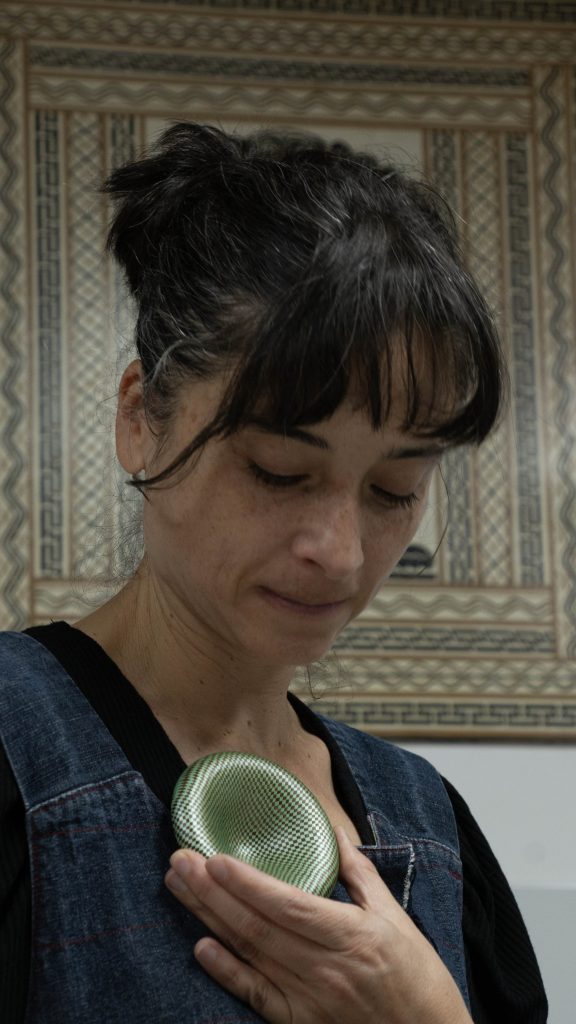
TA: In the Urcunina series I want to evoke the volcano’s contrasts, the internal forces and its beauty when calm. To me the volcano seems a powerful guardian of the city, reminding those who choose to live in its shadow to embrace life day by day. The inhabitants of Nariño have the characteristics of mountain people: sheltered, calm, discreet. Most of the year you see this calm, people don’t rush, but at new year something extraordinary happens when the Carnaval de Negros y Blancos (the carnival of Blacks and Whites) begins. There’s this colourful eruption as the heart beats wildly with music, dance, creativity and food. The place seems to be exploding in celebration for about 10 days as the sorrows, difficulties and abandonments of daily life are forgotten. Then calm returns, but with small changes that many might miss.
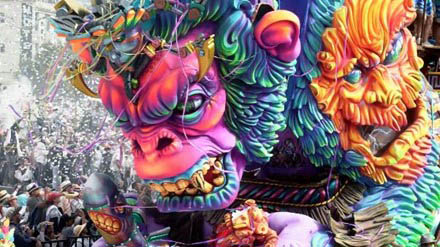
Every time I return to carnival in Nariño I’m more curious about this culture full of nuance, originality and kindness, marked by subtle cuisine and hard work. This patchwork reminds me of the colour changes in the mountains surrounding the volcano and in the volcano itself, where different crops create tapestries of colored squares.
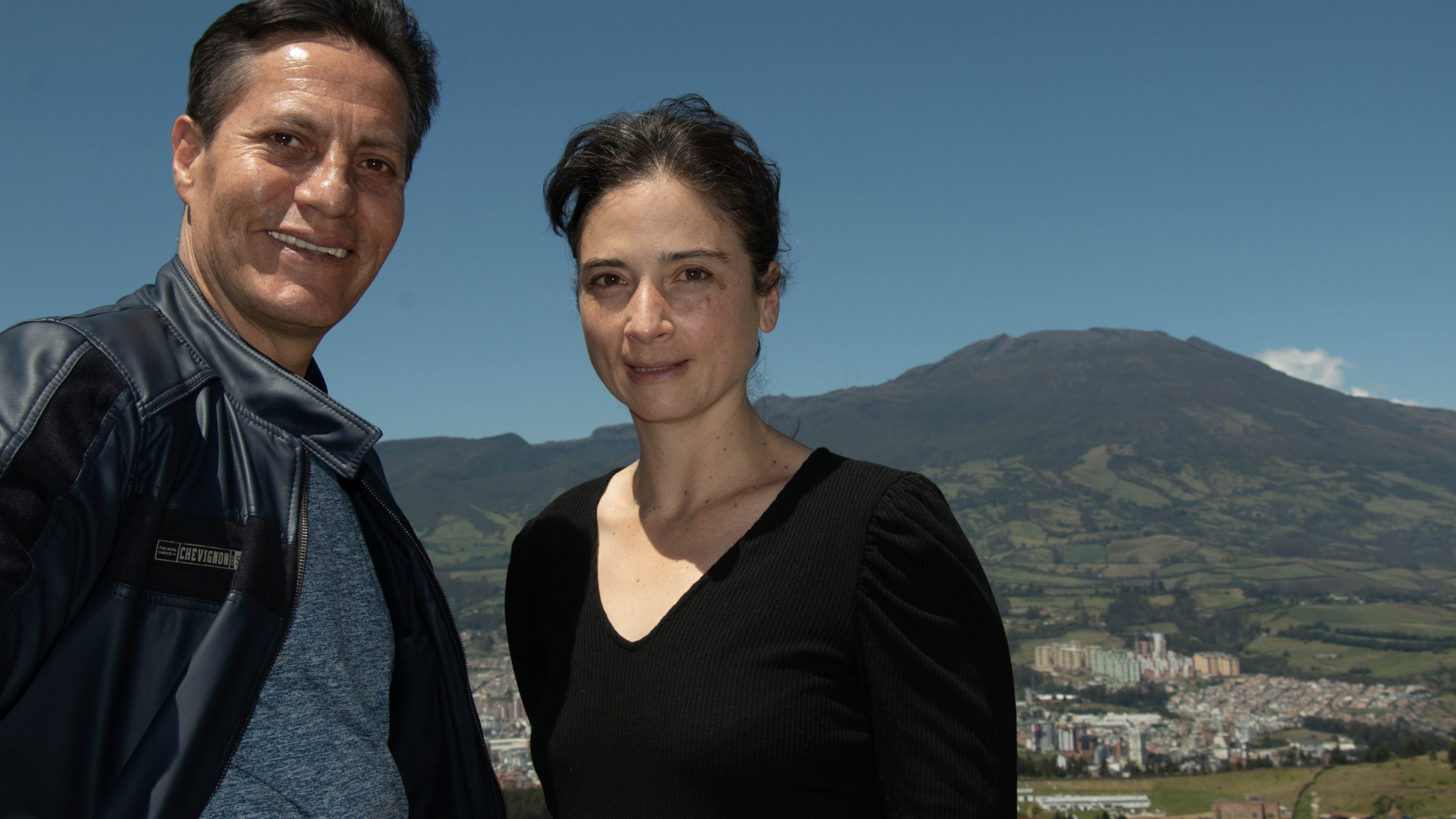
Each of my Urcunina pieces evokes that resemblance between the volcano and the inhabitants, and its subtle changes which have an intrinsic magic, colour and beauty . When I’m in Nariño someone is always commenting on the volcano’s appearance: ‘today it’s is hidden in clouds’, ‘today you can see half of it’, ‘today it’s totally clear!’ (and the smile of the speaker is obvious). The Urcunina series was fuelled by these small observations. Several years ago when I tried to address the volcano as a subject I wasn’t prepared, I couldn’t find a way, out of respect for the subject or fear of facing something so present in my life, my childhood … and the life of the Nariñenses deserves care. I believe that everything comes at the right time, and two years ago I approached the volcano again, but calmly, observing it from different locations with the love, friendship and respect that I have for it. There is a tour that we call ‘La vuelta al volcán’ (the return to the volcano), which runs through the towns and villages on its slopes, and it is wonderful how each place allows you to see it in a totally different way, not only for what is appreciated visually, but for everything that it is lived there in the inhabitants of each area that the volcano watches over.
In my series, the pieces engage in dialogue with one another, as the subject matter is dynamic, not static. It speaks not only of the volcano, but also the relationship between people born here, their region and their origins. It evokes the simplicity of life on the slopes of the volcano, a blend of human inner strength and the power of nature.
NH: The structure of the Urcunina brooches is turned wood – not such a common material in jewellery. Was woodturning a technique you’ve always been interested in? How do you create larger brooches in wood that are light enough to wear on a garment?
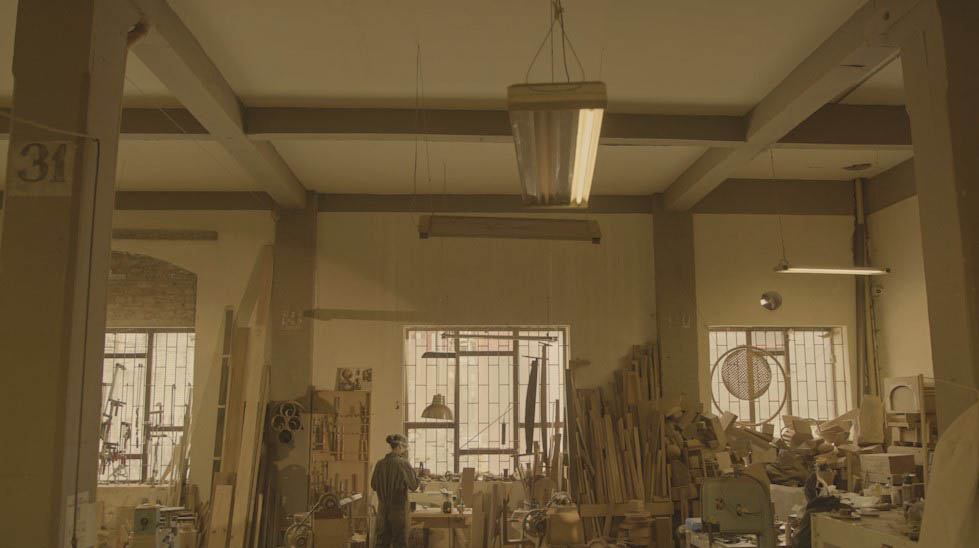
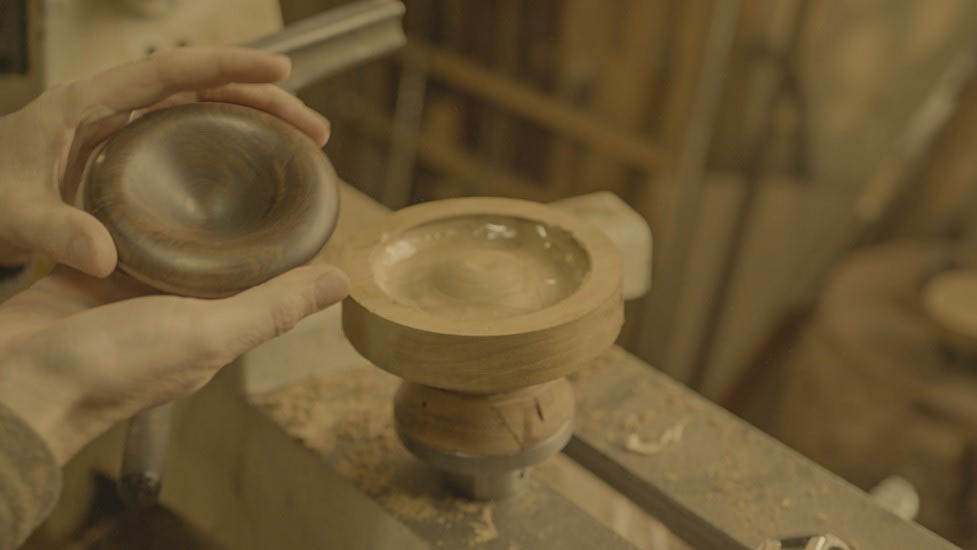
TA: For many years, I couldn’t achieve the wooden forms I wanted. I depended on what a specialized turner could produce and my pieces were therefore small, to reduce weight, and very basic in shape. Because of these limitations I experimented with other processes and materials like 3D printing and lightweight metals such as aluminum, to increase scale and modify form without creating something that would be uncomfortable to wear or unsuitable for jewellery. However, I always wanted wooden forms that evoked elastic shapes, as if the wood were being pushed from side to side. These would be on a larger scale than I was working with and as light as possible because I was already thinking about the Urcunina series. Learning woodturning in 2022 opened up a new world of movement, lightness and sensitivity for me.
For the mobile forms I desire in the Urcunina series, Pau d’Arco wood is turned to a thickness of about 2 mm. Each piece has two independently turned parts that are assembled — after decoration — to appear as a single, continuous form. The V&A’s Urcunina pieces were made in this way.
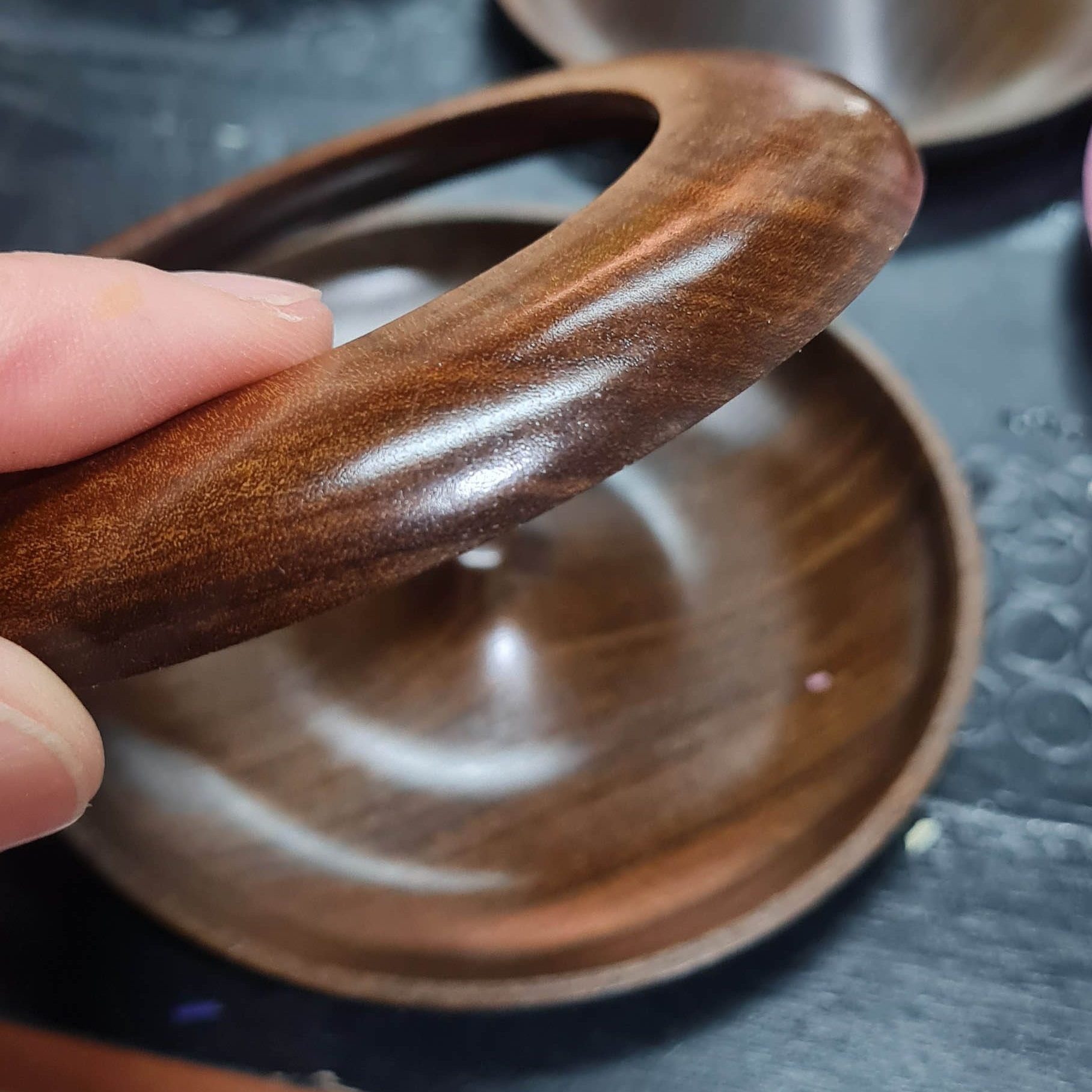
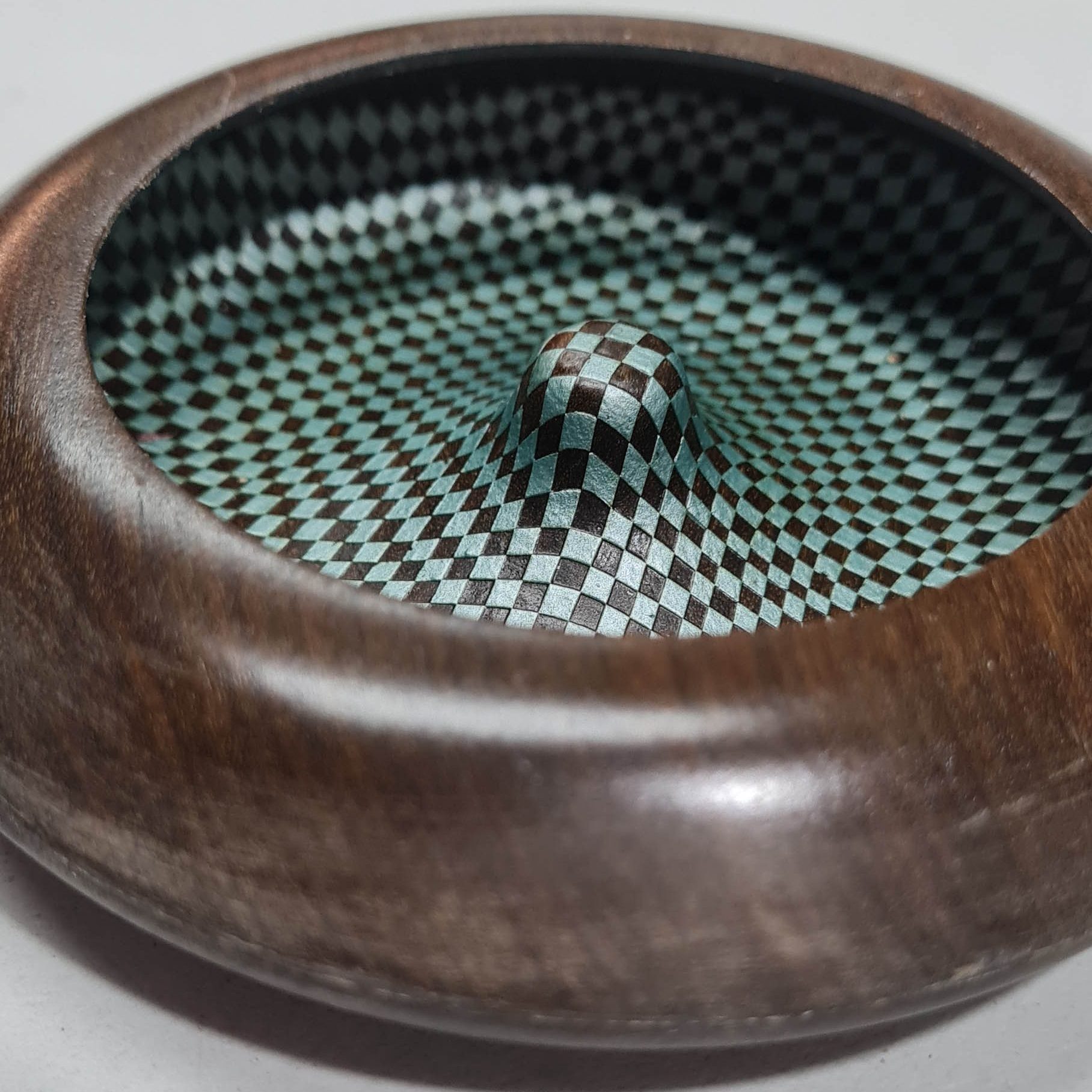
Stages during the making of a brooch from the Urcunina series. Photo: Tatiana Apráez
NH: We’re learning from dye analysis about the striking colours used in historic barniz de Pasto, and how they have faded. It must be said that they feel very different from the chemically based colours of much contemporary barniz. Were there traditional colours that you particularly wanted to recreate, or avoid?
TA: I really like traditional colours but over the years but each series has required experimentation to create new colours offering variations in softness, transparency and shine.
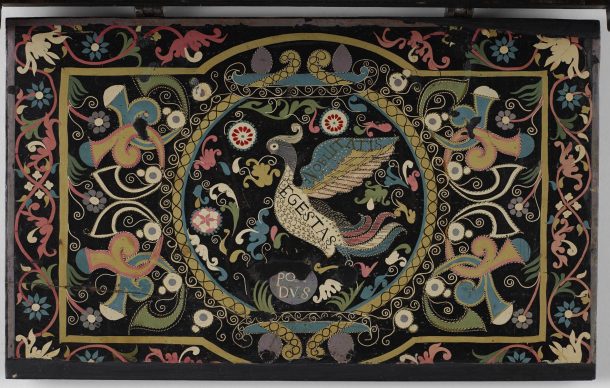
In general, artisan workshops use industrial textile pigments. For the natural colours I want, I use carbon-based blacks and reds based on achiote seeds [from the tree of that name which have a reddish-orange colour and a peppery, nutty flavour in cooking]. Other metallic tones we’ve achieved are based on food colorants. I’d like to delve deeper into achieving the traditional turquoise tones of barniz but as Mopa Mopa resin repels most natural pigments, it’s an ongoing quest to find those that are effective.
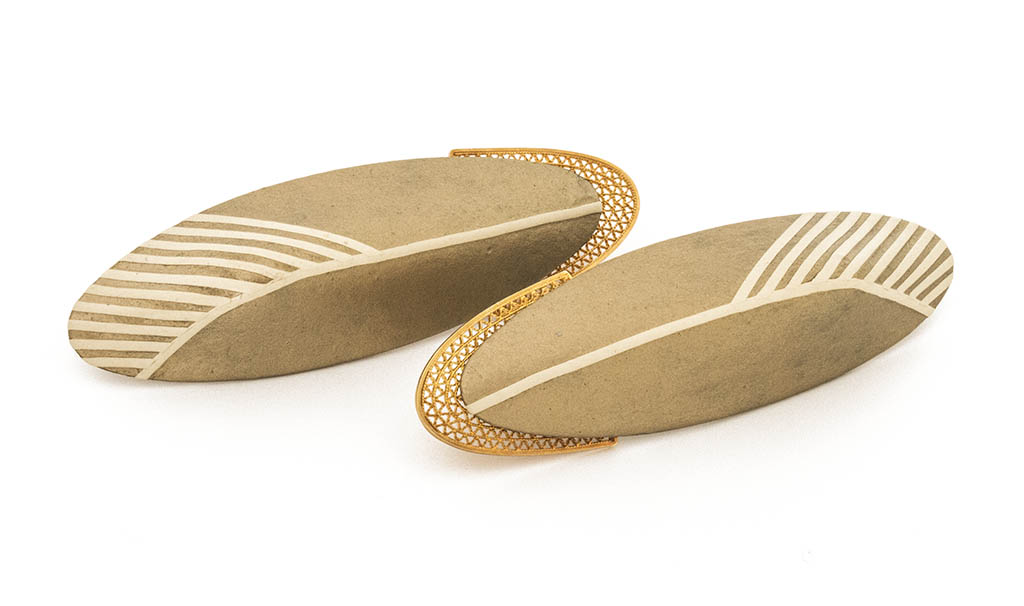
In the V&A’s Urcunina pieces, we sought a palette of metallic colors: turquoise, gold, pink, and silver. The three colors are a mixture of textile dyes to which I add a food colourant for the metallic sheen. I wanted colours to contrast with the Puy wood and to create subtle variations within the same piece, adding a colour shimmer to the graphic checkered pattern. In the pink brooch, I wanted the colour to embrace the wood without clashing, playing with the subtle relief achieved in the wood turning.
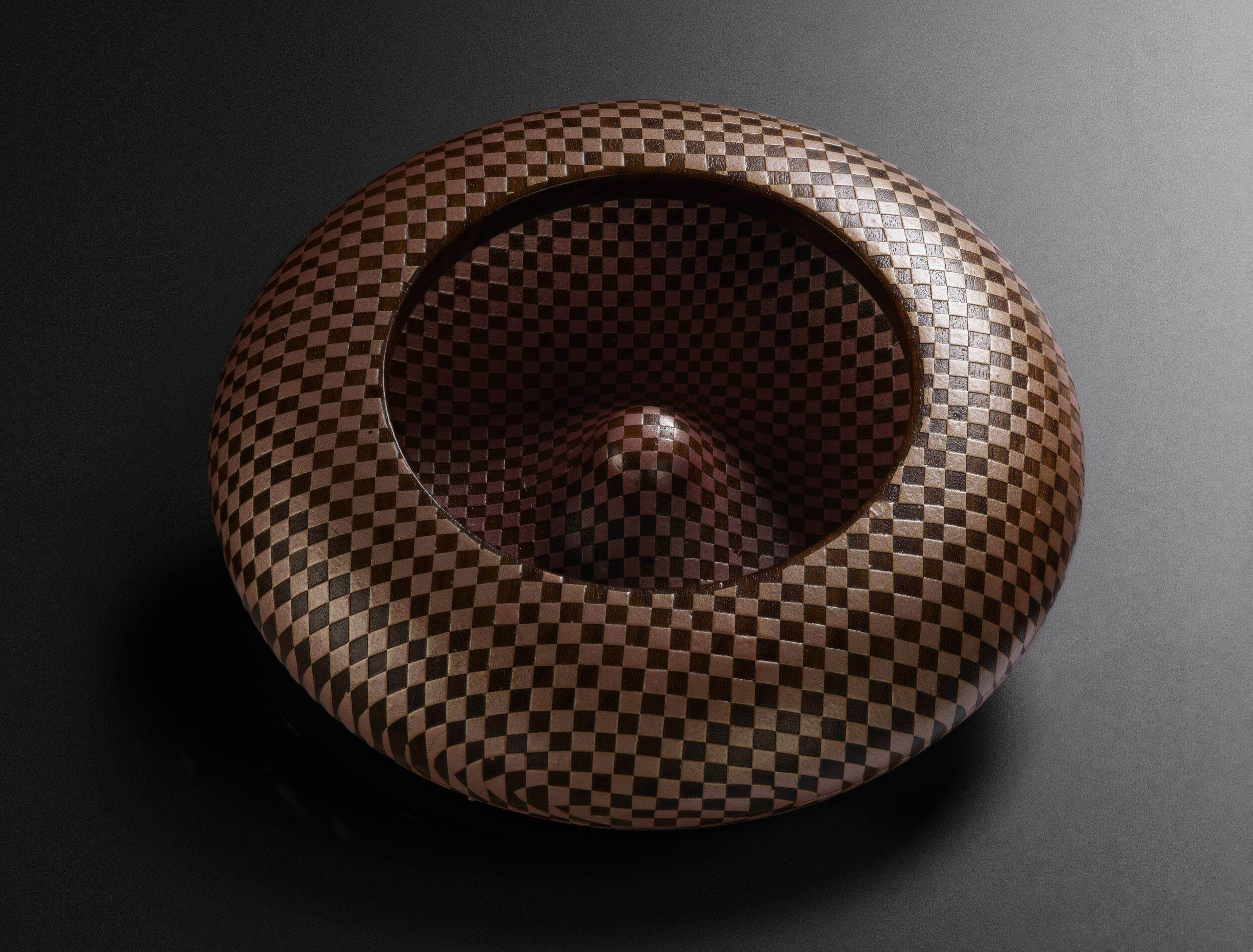
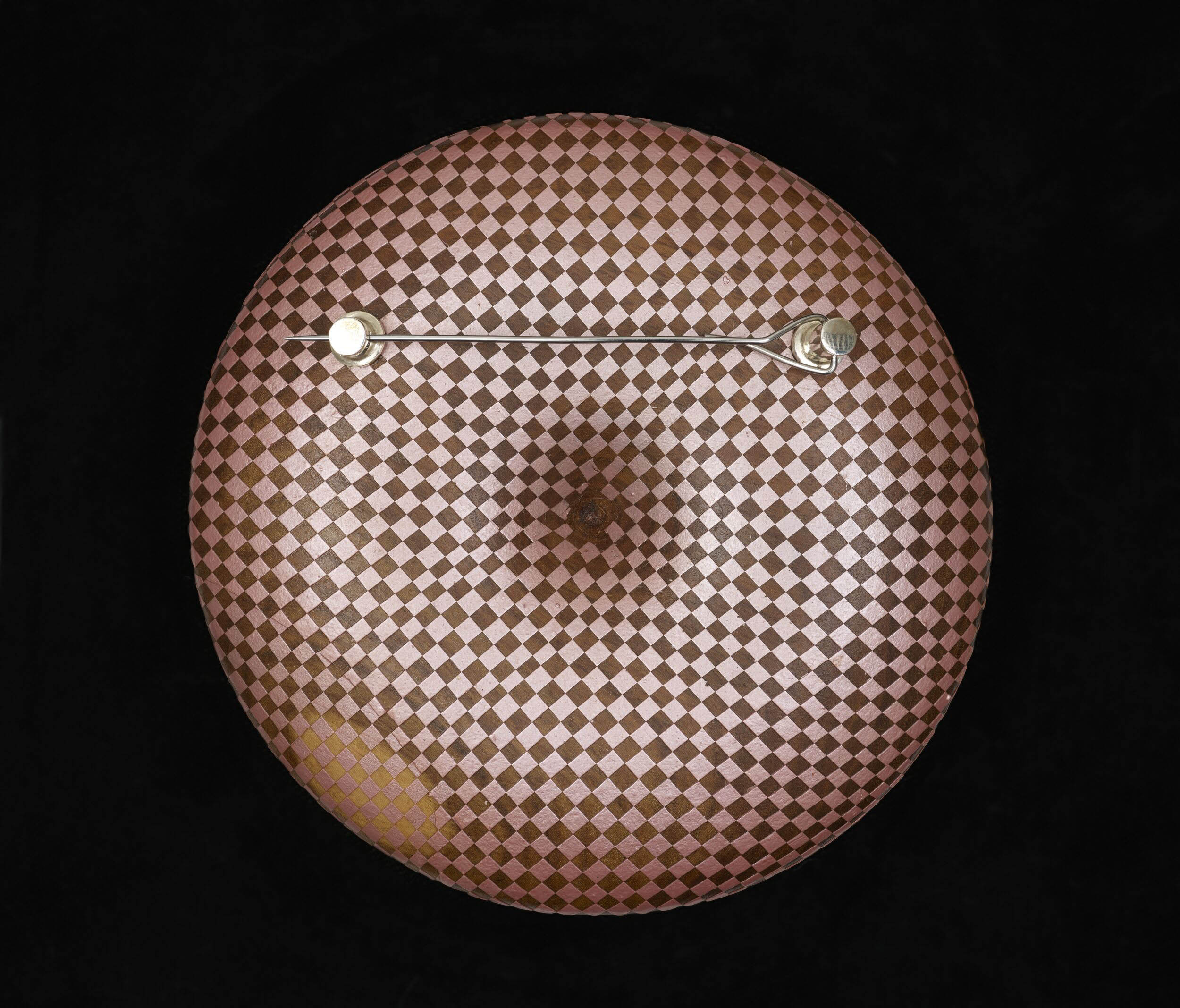
NH The surface designs on your Urcunina pieces are strikingly different from most contemporary barniz de Pasto, and indeed from your line of jewellery employing colourful plant and bird motifs. You mentioned the coloured squares of field planting near Galeras but were there other sources of inspiration for this chequerboard design?
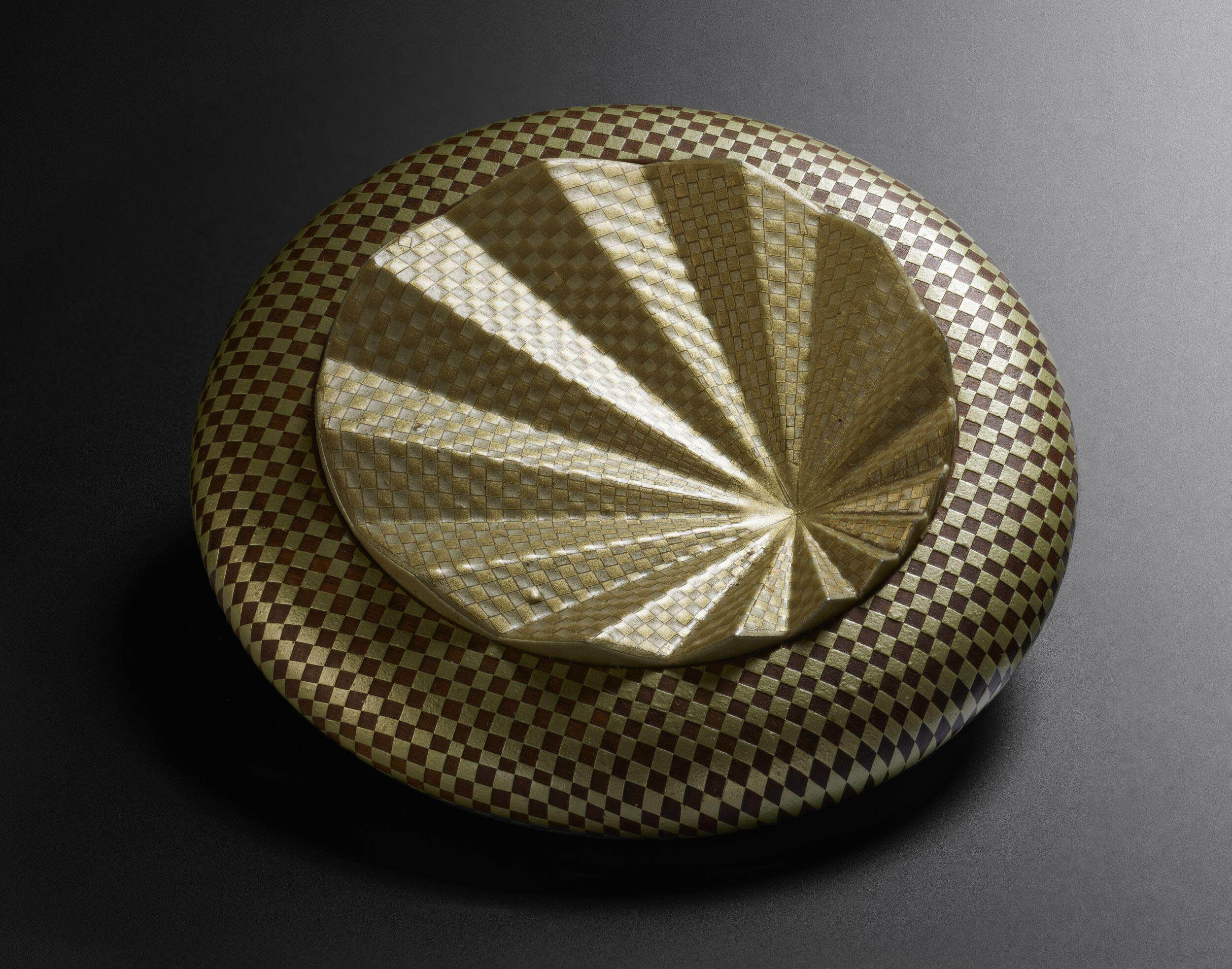
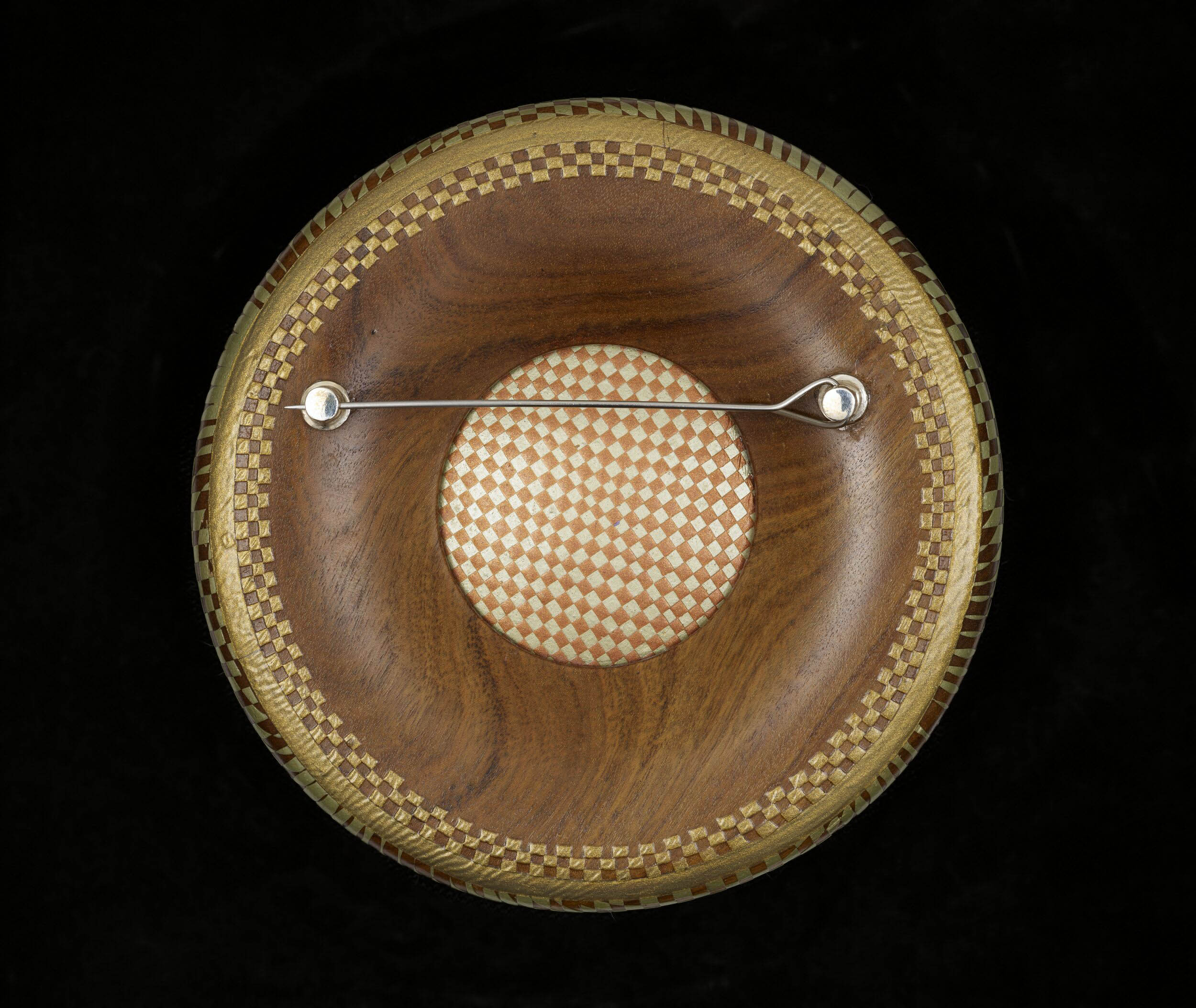
Urcunina Series: 2 (brooch), front and back views. Designed by Tatiana Apráez, with barniz de Pasto decoration by Germán Obando, San Juan de Pasto 2022. Pau D’Arco wood and 3D printed resin with barniz de Pasto, silver fittings; 92 x 17 mm. V&A: W.5-2023
TA: The Urcunina series incorporates several ideas. I’ve become fascinated by the use of positive and negative in pre-Hispanic graphics, an incredible example is the discos giratorios of Nariño (spinning discs of hammered tumbaga with depletion gilding, made around 800-1200 CE).
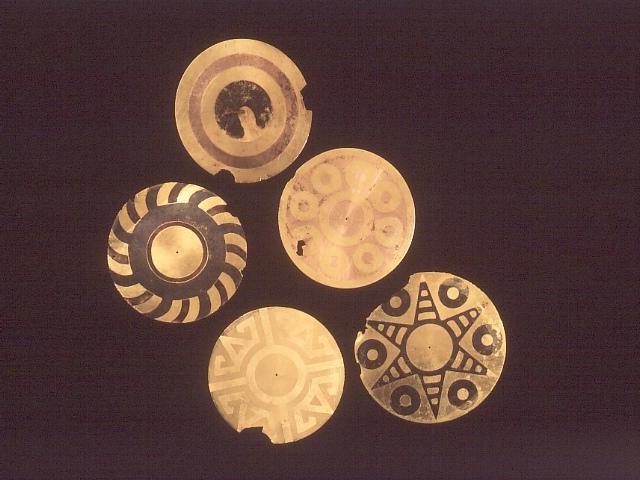
I wanted a pattern that has stood the test of time: chequered borders found in some 19th-century barniz pieces are still used in contemporary work. The repetition of the square motif allowed me to create an optical effect that enhances the wood relief and provides the intensity of plasticity I was aiming for. These pieces are reminiscent of Op Art, a movement I admired through the work of Victor Vasarely but it was something that emerged naturally. In a creative process, everything you’ve experienced through your own work opens up new paths. The optical effect, particularly evident in the Urcunina pendant, is largely a result of this exploration.
In the Urcunina series, I had a clear graphic objective: to complement the reliefs achieved in the wood that evoke the mountain. I did this by incorporating into each piece the chequerboard motif in different colours, creating the optical effects that I wanted.
In other series decorated with Mopa Mopa, I’ve used designs inspired by the traditional iconography of barniz de Pasto, such as flowers, branches, leaves and ‘momias’ — figures inspired by statues of Saint Augustine or with a zoomorphic appearance like monkeys. Sometimes I use them whole, sometimes in a more fragmented and eclectic way. These series to where they were created, inviting the viewer to connect with the place they were made, which in the tropics overflows with natural forces, exuberantly and generously as it is in the tropics. This graphic language of the natural world remains a fundamental part of barniz iconography for me.
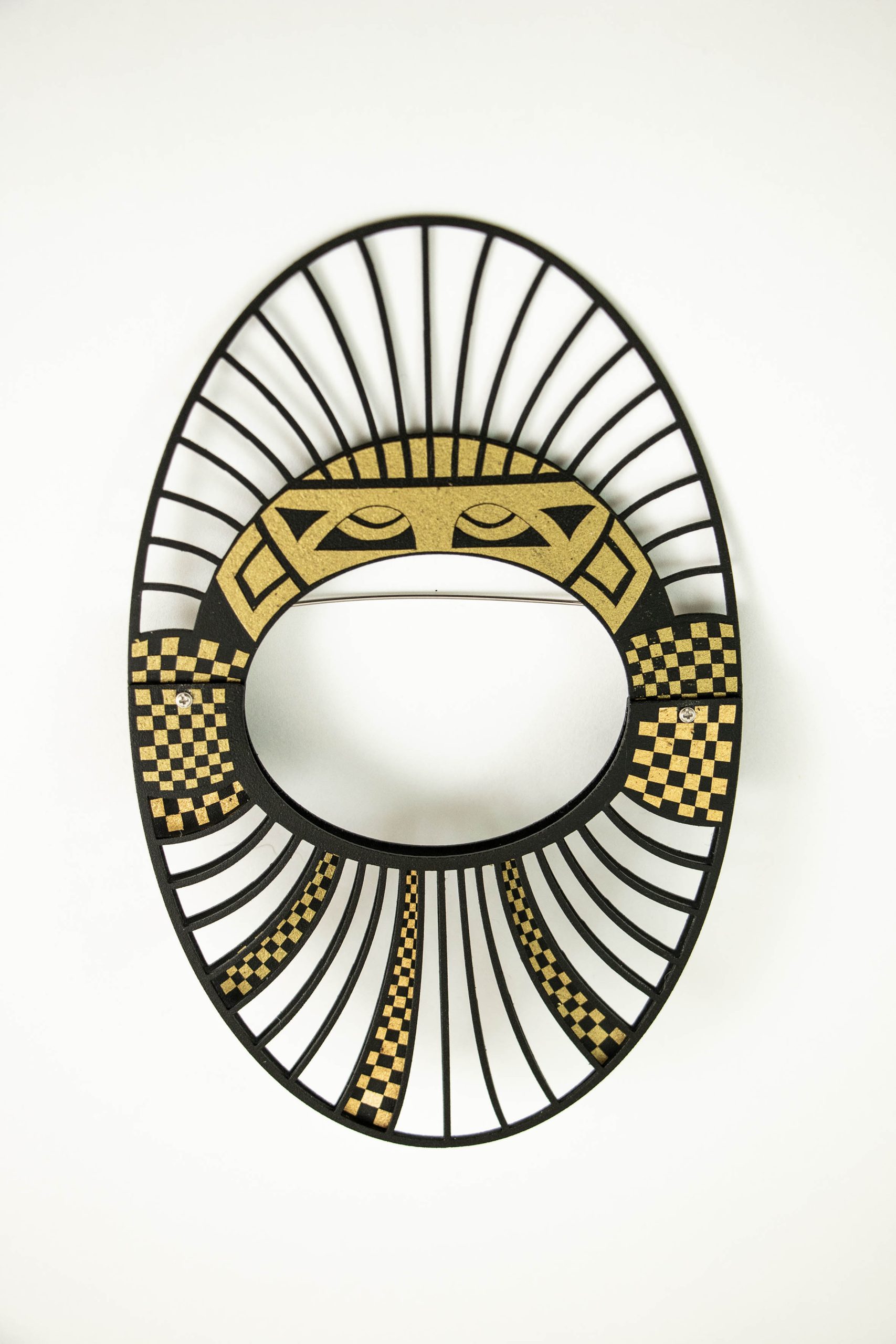
NH: I’m interested that some more recent versions of the Urcunina brooch have a chequerboard pattern on the front, with multi-coloured plant and bird motifs on the reverse. What was your thinking with that combination?

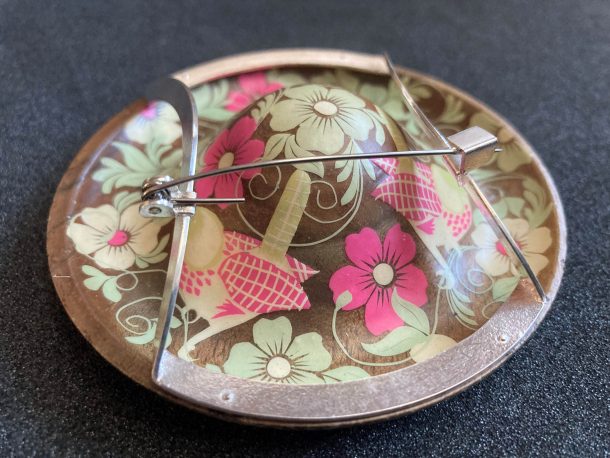
TA: In these more recent brooches I sought to respect the series’ plastic and graphic aspects while generating a surprise for the user. After experiencing the chequerboard design, someone turning it over finds a vibrant graphic design with birds and flowers – a longing for the tropics. As well as the surprise, it is that intimate ‘something’ that makes the wearer reflect on the beauty of what’s hidden, ultimately another way for me to connect with the person wearing one of my pieces. For me, there is no front and back: I want someone holding it to experience it as a whole.
In these pieces, I’m delving into natural forms that are so important in barniz de pasto. My work has always been inspired by artisanal and folk traditions, that’s why I use a variety elements from barniz but also other crafts such as basketry, ceramics and textiles.
NH: When you mention artisanal traditions, I’m reminded of Giovanni Areteaga Montes’s paper at the 2023 London conference, describing the environmental and human factors that now threaten the harvesting of Mopa-Mopa resin in remote areas.
Heritage | Special Issue : Lacquer in the Americas
https://www.mdpi.com/2571-9408/7/9/238
Barniz de Pasto developed as part of the Spanish colonial project, exploiting and developing Indigenous knowledge, products and skills to create new object types for the benefit of the colonisers. Spanish religious orders were almost certainly involved in developing barniz and landowners used official channels (such as the encomienda system) to exact tribute and labour from Indigenous populations in exchange for protecting and instructing them in the Catholic faith. Are these entangled colonial roots of barniz regarded as politically sensitive in Colombia today?
TA: I wouldn’t say that barniz de Pasto is considered controversial today in Colombia because of its history. It’s been admired as one of the most important traditional crafts and, as you say, it’s becoming more widely known (even at the V&A!), appreciated and, hopefully, protected. At the moment the issue of decolonization is not as current in Colombia as it is elsewhere. As for the history of colonization and its effects on barniz, I have never felt that it has this sensitive aspect. Of course, the Spanish took advantage of the extraordinary qualities of Mopa Mopa as an effective way to protect wooden artefacts against water, insects, etc., and they used it for goods that they prized such as small jewellery boxes. However, the varnish was already used by the Indigenous peoples in ornamental beads and as a protective surface for decorated gourds.
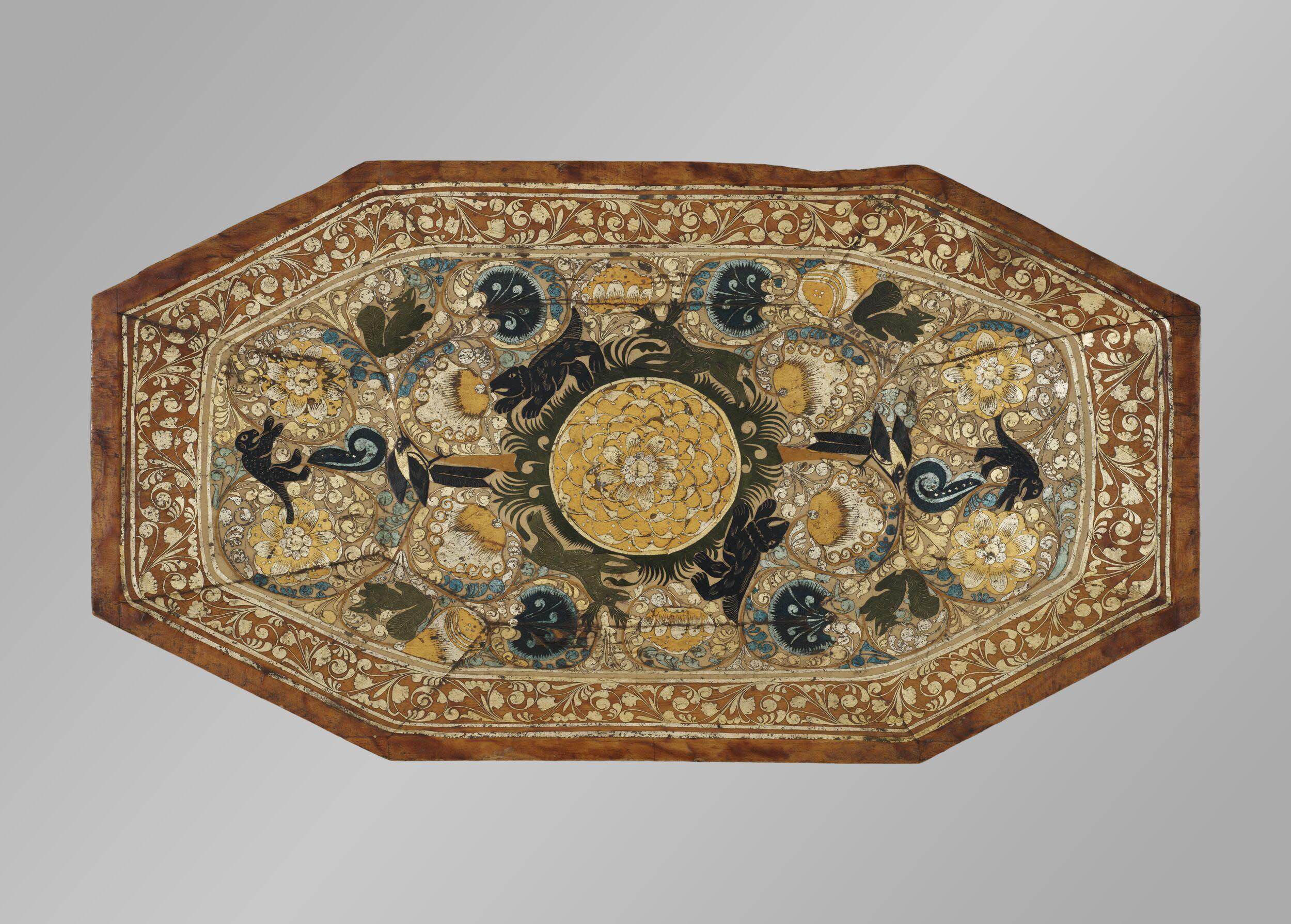
As for my work, it shares in both aspects of the historical context: I’ve incorporated elements that derive from the colonial period as well as pre-Hispanic geometrical motifs. I am part of a mestizo present, the product of a brutal colonization of which I am deeply critical, but that has not been a focus for my work with barniz. As material that was being worked before the arrival of the Spanish, I have always felt that Mopa Mopa belongs to us. Having grown up in Nariño barniz lies deep in my heart, with a sense of what this technique means for those who are part of the whole process from collection to application, and onwards to the purchaser who cherishes a piece of barniz.
Nariño and indeed Colombia have been influenced by many cultures but it’s painful now to see our regions losing rich, intangible traditions to a globalized currency. I see splendour in thousands of idiosyncratic details that are slipping away because the younger generation is unaware, and that’s why my work is increasingly directed to the preservation of a pre-Hispanic technique, and the identity of place. For artists, our Colombian reality is hard today, perhaps not helped by postponing issues of decolonising. In Nariño we have had so many years of injustice, abdication of state protection, violations of human rights; there is so much to defend and reinforce. My work has been directed along this path – more clear and determined than when I began – to preserve and renew a technique so that it and our identity can be sustained. When my work refers to symbols, customs and beliefs, landscapes and festivities, it reflects that whole complex Colombian environment and history.
NH: It seems strange that so few examples of colonial-era barniz de Pasto are on display in Colombia. Were you surprised by those seventeenth-century pieces you saw at the time of the V&A Lacquer from the Americas conference (April 2023) from the collections of the V&A, the Hispanic Society Library in New York, and the British Museum?
TA: For me, after many years working with barniz, seeing those seventeenth-century pieces at the V&A event was one of the greatest learning experiences and opportunities for reflection in my life: the range of iconography, the colours, the metallic foils, the expertise they demonstrate, was overwhelming. I had never seen such technically marvellous pieces, they opened in my mind a new chapter regarding the technique. Personally, I was deeply struck by the historic colours. That traditional knowledge to create the natural colours has been completely lost.
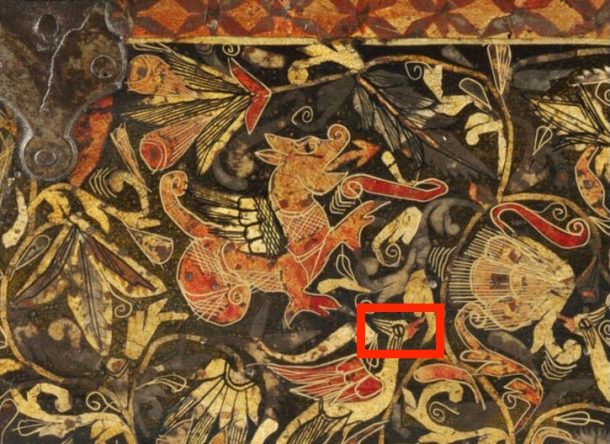
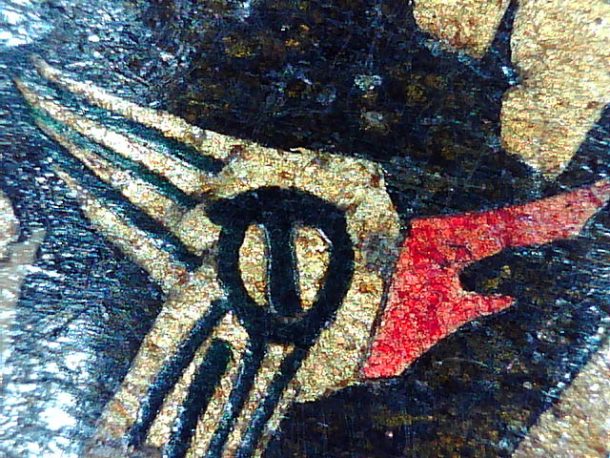
There’s a lot to consider, including the question of what happened to that level of technical expertise. I don’t mean that there aren’t very well-crafted pieces today, but I do believe that much has been forgotten. I can’t think of a contemporary piece that is technically comparable to those early pieces. I understand that the demand and pricing for barniz has completely changed, causing artisans to shift their approach toward faster, more mass-produced products. In regions like Nariño subsistence and the market are also complicated. The teaching and transmission of the craft , which must have been fundamental, also had to change, leading to changes in rigour and detailing.
NH: What difference would it make to contemporary makers if a comprehensive collection of the best barniz de Pasto from the earliest period to the present day were available to study in Colombia?
TA: Clearly it would stimulate reflection around the questions I mentioned, especially how such small scale decoration can be achieved. Grasping that level of mastery with Mopa Mopa resin could open unlimited possibilities for contemporary artists. If the evolution of the technique could be studied in a museum, we would have a living library to investigate and on which to reflect, with the possibility of rescuing and renewing those ways of working: a place for understanding the dimensions of what we hold in our hands.
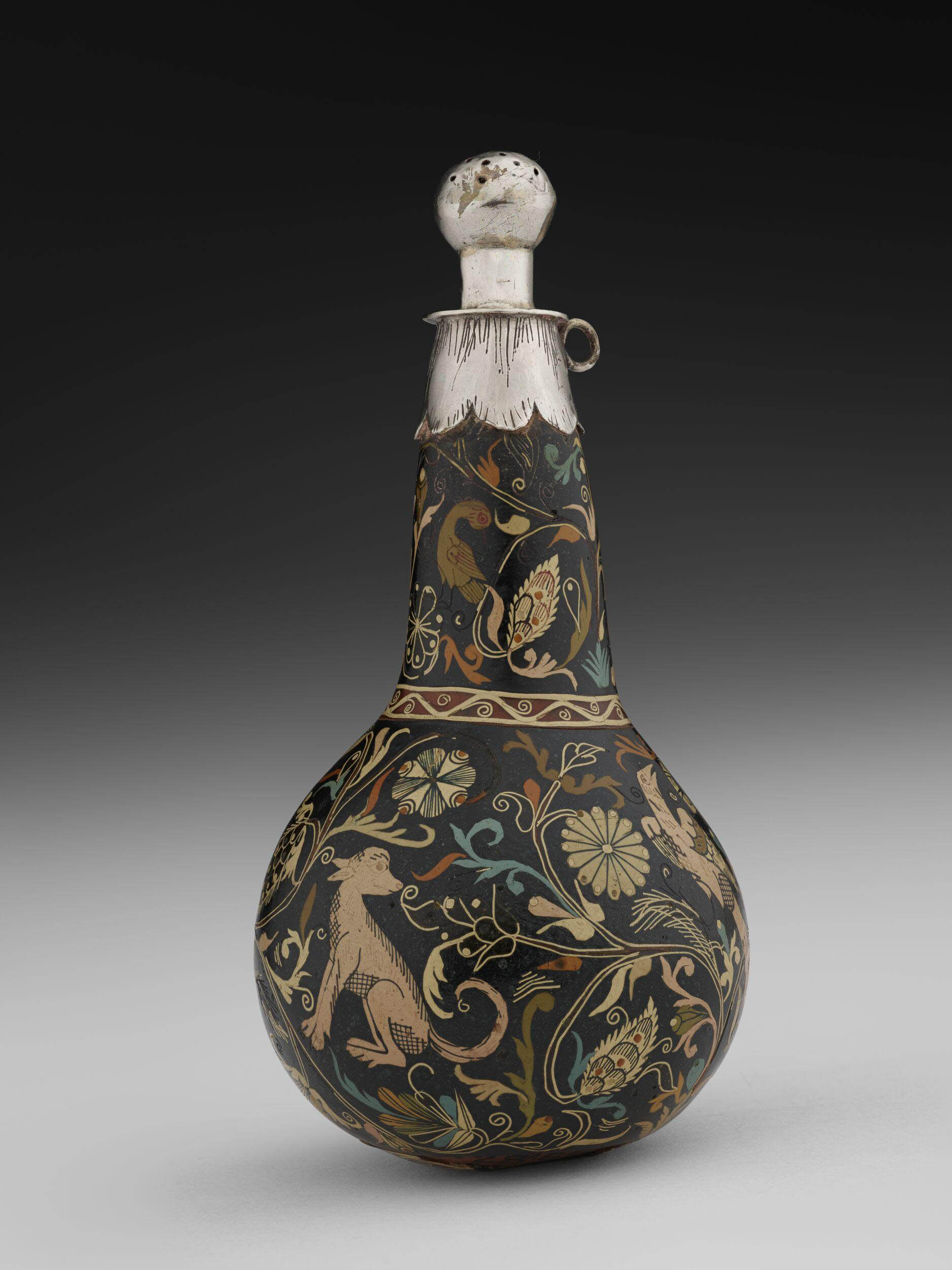
For me, seeing early pieces of barniz at the V&A – and hearing the conference papers — was a ‘before and after’ moment that intensified my commitment to what I do and where I want to direct it. I’m really interested in the research into sources of colonial period colours. And for me personally, the early iconography is a revelation: the natural scenes with animal and magical creatures, and plants worked in such detailed and marvellous ways. They’re an intense lesson for today’s makers, and studying the actual pieces would be very different from photographs, however detailed. My hope is to continue rediscovering and challenging this technique, and to enjoy the community we have created around it for as long as life allows: el trabajo continúa (the work goes on).
[1] For an introduction to the technique of barniz de Pasto see, for example, the short film by Artesanías de Colombia: https://www.youtube.com/watch?v=QuNkCszL8u4 [consulted 7/10/2025]
[2] The V&A’s collection of barniz de Pasto can be viewed online searching the collection.
[3] https://artesaniasdecolombia.com.co/PortalAC/C_sector/colombia-artesanal-enchapado-en-tamo-tecnica-con-identidad-narinense_13461# consulted 29/10/2025