Blog co-written by Robin Howie (Fieldwork Facility) and Tasnia Yasmin (V&A).
Have you ever thought about how museums help you find what you’re looking for?
Wayfinding and labelling play a big part in how visitors explore objects. That’s why sustainability is embedded throughout the design process, informing decisions at every stage.
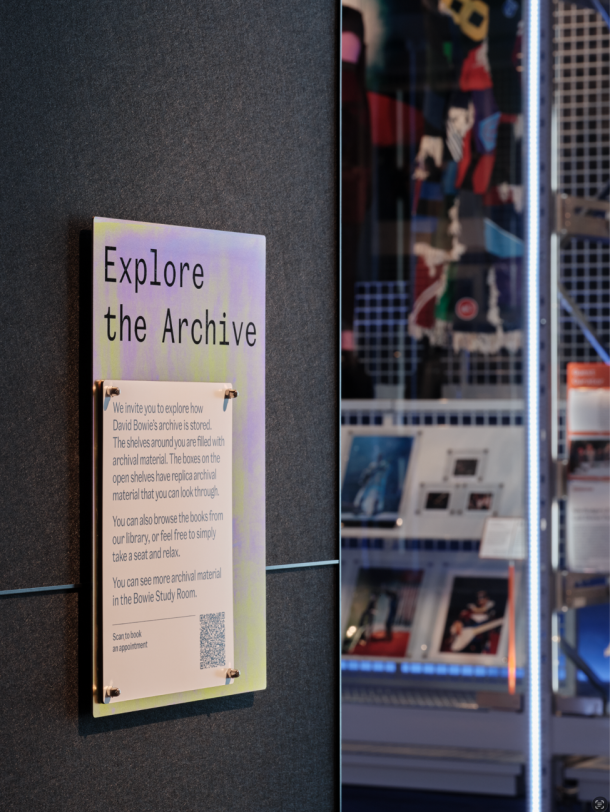
Working across V&A East Storehouse, David Bowie Centre and V&A East Museum, Hackney-based design studio Fieldwork Facility combined creative design and innovative approaches to reduce the environmental impact of wayfinding, labelling and interpretation.
“We work across frontiers in culture, climate and place, and to be honest the sustainability element of the brief absolutely amazed us… we are really used to bringing the sustainability agenda to the table, the V&A brief challenged us to dig deeper and go further”
Robin Howie, Creative Director and founder of Fieldwork Facility
Fieldwork Facility used lower-impact materials, designed to minimise waste and maximise reuse, while making sure visitors could easily find their way around the museum.
“When we think about sustainability, we need to consider the whole life of a material – where it comes from and what happens to it when we no longer need it. The aim is to keep materials in use for as long as possible, rather than throwing them away.”
Creating a kit of parts through modular design
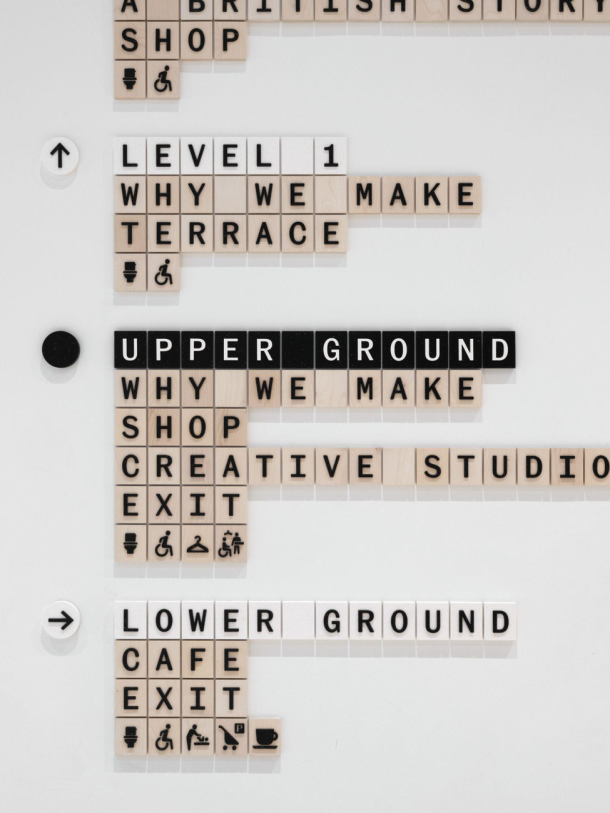
V&A East Storehouse and V&A East Museum’s wayfinding system was designed together, with each venue having its own look and feel. The modular design means each sign can be taken apart, and reused in different ways, making it easy to update and adapt wayfinding. At the end of its life, the parts can be separated into different materials for recycling.
Designing bespoke fonts for reuse
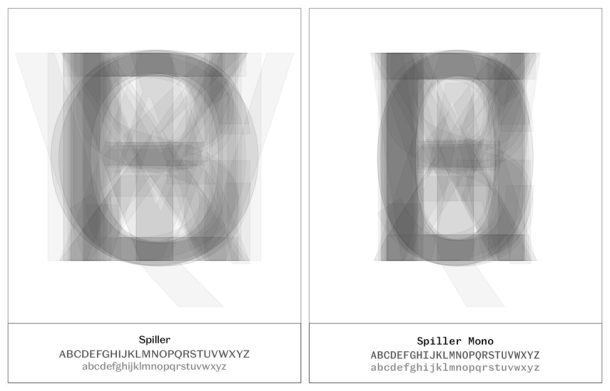
The first challenge was our font. Robin noted “the V&A has a bespoke brand typeface called Spiller, unfortunately … in its original form [it] didn’t work particularly well in a modular setting as some letterforms are very wide and some very thin”. This made it hard to read so a new font, Spiller Mono, was created with even sized letterforms.
What goes into making signs?
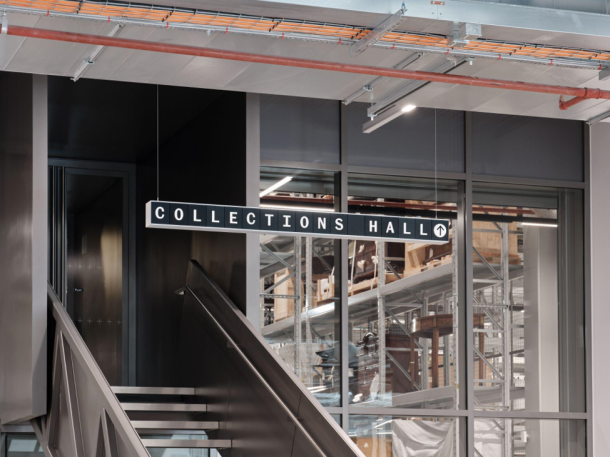
While V&A East Storehouse and V&A East Museum share the same design approach, they have their own look and feel, through different low-carbon and recycled materials.
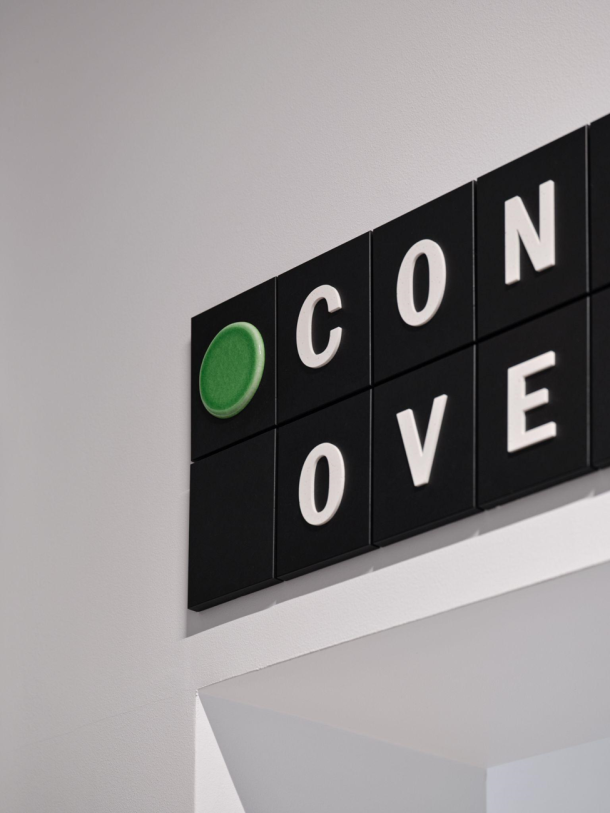
At V&A East Storehouse, the main signage is made from recycled composite paper for the black blocks and tiles, and recycled plastics for the letters. The blocks sit in aluminium cases, with a few featuring enameled lava-stone roundels. Enamelling is a process where powered glass is fused to the lava stone at high heat, creating a hard glossy finish. This process speaks to the V&A’s celebration of making.
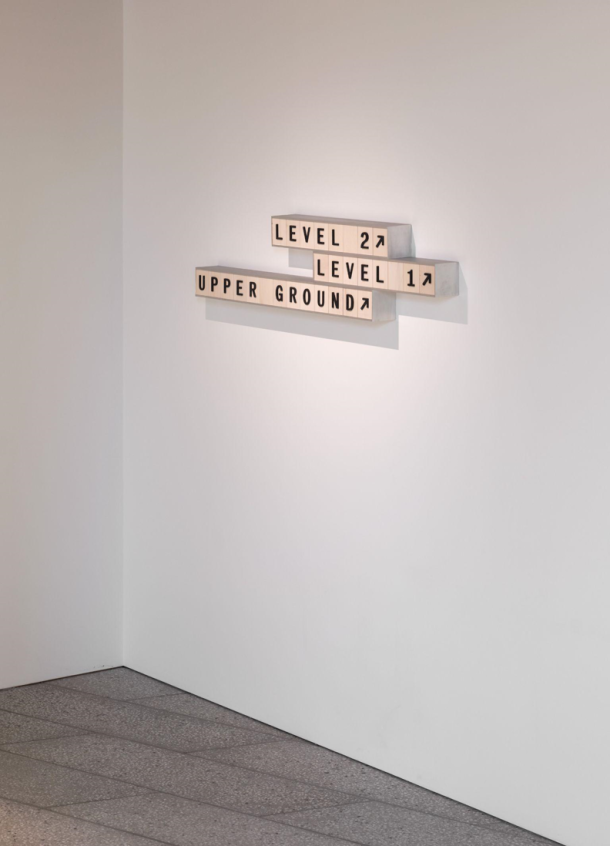
V&A East Museum has its own distinct style, combining wood with recycled plastics. Robin noted finding the right materials wasn’t a quick process. Working with Urge Collective, Fieldwork Facility looked at the carbon impact of materials early in the design. One important switch was the wood – choosing sycamore from Europe rather than bamboo from China, to reduce carbon emissions from shipping.
Designing to reduce waste
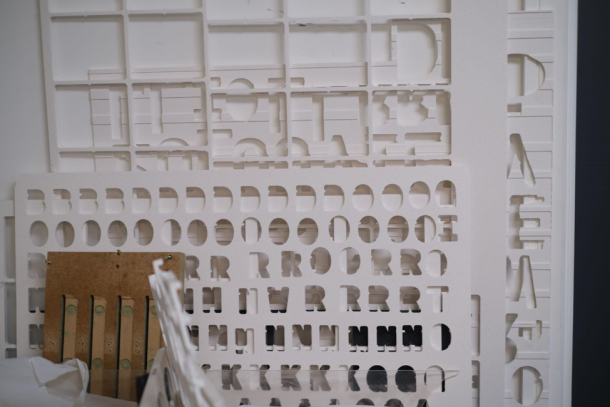
An effort was made to ensure suppliers were able to both reduce waste during production and ensure leftover material could be reused or recycled into new products. When the signs were made, all the offcuts were returned to suppliers, where they were turned into new materials instead of becoming waste.
Beyond single-use vinyl
One of the biggest sustainability challenges in museums is vinyl, particularly when used for graphics. While they are easy to print, install and remove, they cannot be reused or recycled and are made from plastic. Fieldwork Facility reduced single-use vinyl, as much as possible, across both sites by painting graphics directly onto the walls.
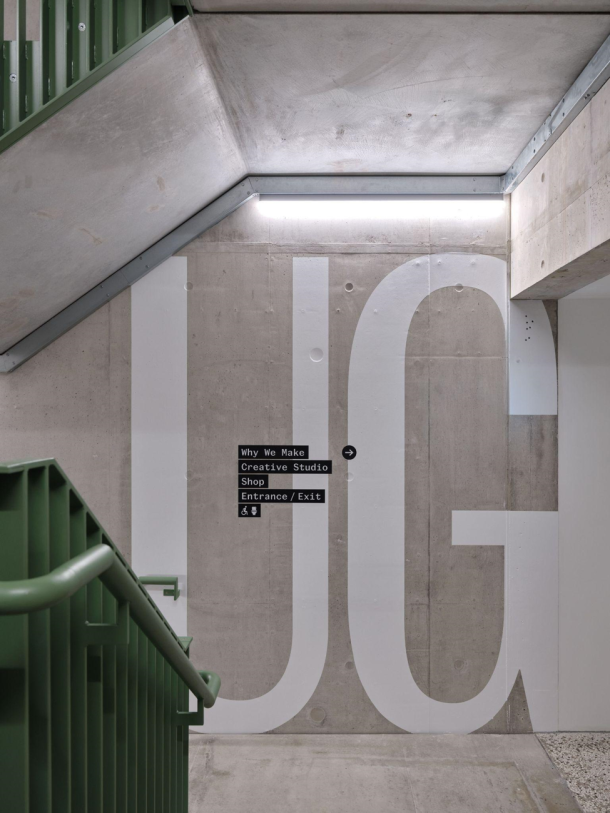
“Our perspective was that if you walk into any museum in the world you will most likely find signage and marketing materials at every corner — all typically made out of single-use plastic vinyl. Every time a new exhibition opens or a change in programme happens, the entire scheme needs to be replenished. A brand new museum deserves a brand new approach”.
Robin Howie, Creative Director of Fieldwork Facility
Designing signage for exhibitions
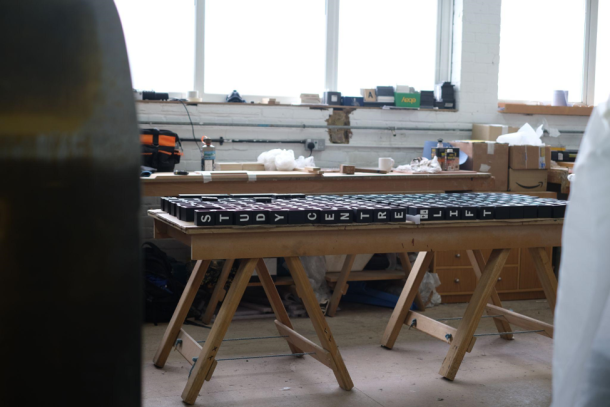
For V&A East Museum, wayfinding was designed to include temporary exhibitions. 1,240 tiles were designed and made from wood and recycled plastics, with each tile individually cut, engraved, finished and assembled by hand. This means instead of using single-use vinyl, tiles can be reused and adapted for a new exhibition.
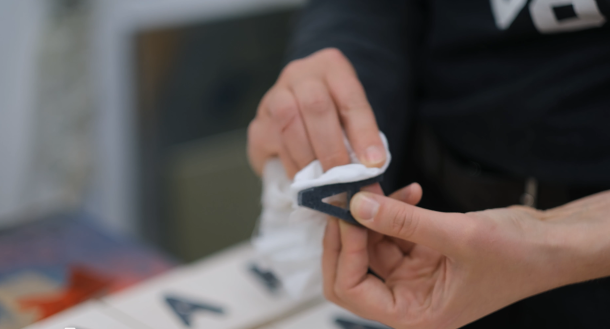
You can watch how the team made the tiles here.
To make sure there were enough temporary exhibitions tiles, Fieldwork Facility reviewed the last five years’ exhibition titles for name length. They made a bank of 1,115 spare tiles to update the Welcome Directories and Discovery signs whenever an exhibition changes.
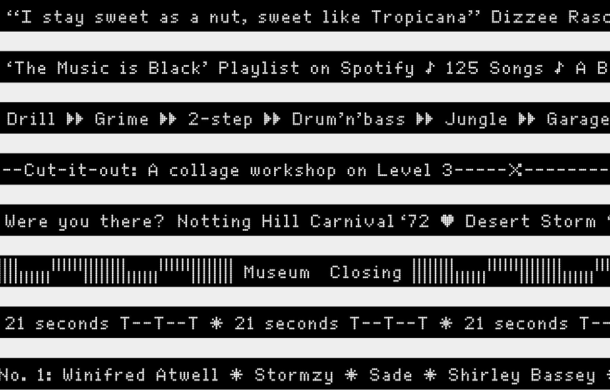
Fieldwork Facility were concerned about vinyl signs creeping back in, especially for temporary signage for events. To avoid this, LED ticker signs were made – a narrow, scrolling LED display allowing real time information that can be changed for events and temporary exhibitions.
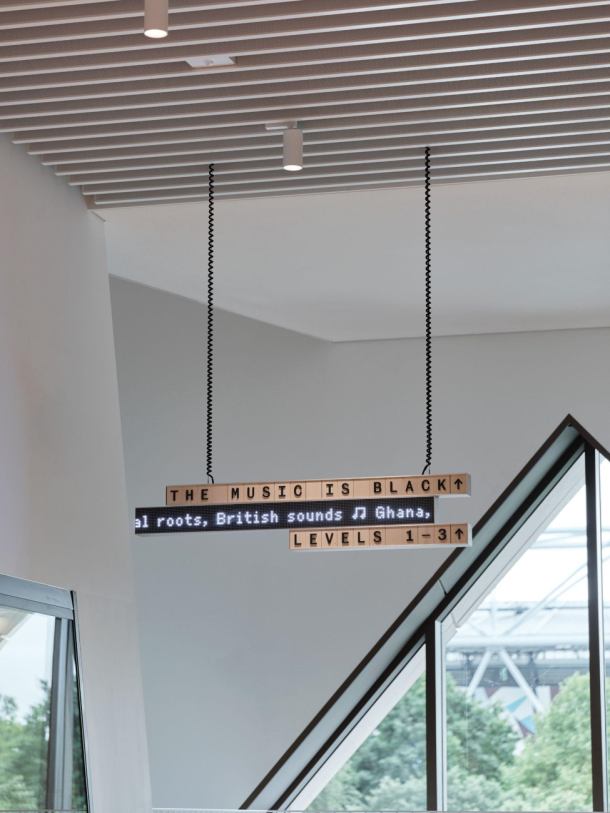
“It’s a novel approach and we are excited to see how it is utilised across future shows, we designed an additional typeface called V&A Eastbound that is unique to the LED tickers and has lots of unique glyphs [symbols] for future shows.”
Despite all the efforts, some 6m2 of vinyl still remains across the wayfinding at East Museum. This was only used for 6x6cm QR code for booking tickets.
The future of wayfinding in museums
V&A East shows how thinking about sustainability from the start of the design process can create signage that looks great and has a lower impact on the environment. Fieldwork Facility designed modular signs that can be taken apart and reused, considered where materials come from, and found ways to reduce waste during making. It encouraged creative solutions, from replacing single-use vinyl to designing an entirely new font. By considering the whole life of each material, sustainability became part of the design process rather than an afterthought.