
Just a few minutes walking from V&A East Storehouse in Hackney Wick, a rapidly changing neighbourhood where post-industrial ruins, developer cranes, and subcultural desire still coexist, playbody emerges not as a studio in the traditional sense, but as a collective gesture. Positioned deliberately at the interstice of architectural practice, radical design, and world-making, playbody reclaims their space in the contemporary art world as a mode of resistance.
Founded by a group of migrants and queer creatives, playbody centres its practice on the lived experience of non-normative identities. Through architecture that refuses to stabilise, installations that challenge boundaries, and gatherings that privilege sensorial experience, the collective asserts play as methodology.
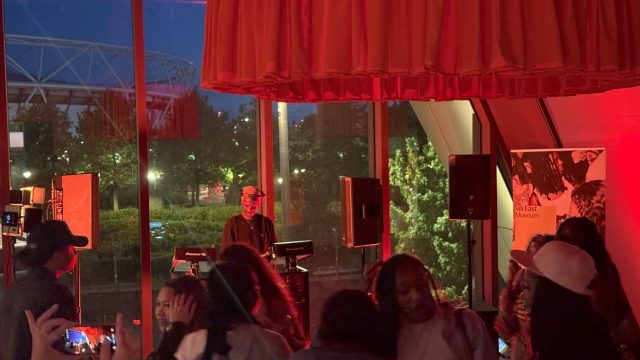
playbody’s bi-monthly events dare to imagine other ways of being, both with each other and within space. Their studio at Algha’s Plantroom functions as both exhibition and nightlife ecology, hosting collective experiments in sound, light, movement and architecture. Their club night is a testing ground for spatial affect and temporal fluidity.

For playbody, architecture does not precede the body; it follows it. This inversion is crucial. Temporary structures are designed not for permanence but for sensation. These are responsive, haptic, modular, and often unrepeatable. The club’s visual vocabulary borrows as much from scaffolding and liminal spaces as it does from high design, refusing tamed lines and binary codes in favour of futuristic, embodied experimentation. If mainstream architecture increasingly serves capital, zoning the city into spaces of control and extraction, playbody responds with soft walls, communal infrastructures, and porous thresholds. Their playground becomes a site of speculative building.

In aligning themselves with club culture (especially its queer and trans genealogies) playbody situates their practice within a long lineage of subcultural architectures serving as blueprints for spatial liberation. But where many archival approaches historicise the club, playbody rejects nostalgia and insists on its ongoing utility as a collective place-making praxis.
This approach resonates with a growing movement within architecture that have refused the sanitisation of queer expression. [i] By positioning the trans and queer experience at the forefront, playbody, along with international counterparts, is reshaping the architectural discourse to be more inclusive, dynamic, and reflective of diverse identities. What playbody adds to this trajectory is a commitment to architecture as infrastructure for survival.
playbody’s making practice is rooted in proximity, consent, and responsibility, a new architecture of relation. In an era where bodily autonomy is under siege across legislative, technological, and affective domains, playbody’s work offers a counter-model.
To build intimacy through design is a radical act. It suggests that space is not neutral, that walls remember, that thresholds speak. In doing so, playbody refuses the professional detachment of architectural modernism and embraces a politic of care. Their work insists on slowness, on negotiation, on mutuality. It dares to ask: what does a structure feel like when it is built with you and not around you?
While global discourses around queerness often risk abstraction, playbody’s commitment to the hyperlocal (from its Hackney Wick studio, and its London-based playground, to its embeddedness in community) grounds their work in specificity. In a time when queerness is both hyper-visible and violently policed, to remain in place, to hold space, becomes an act of defiance.
If architecture has long been used to divide by class, by race, and by gender, playbody offers a different spatial imaginary, one built on softness, transience, and play. And in doing so, they remind us that in the ruins of normative structures, something else is always already emerging.

Discover playbody’s work activated by their community at Archival Bodies – the first live commission at V&A East Storehouse from our contemporary programme back2back – on Saturday, 7 June 2025.
—
[i] One notable parallel can be drawn with the Nordic Pavilion at this year’s Venice Architecture Biennale, curated by Kaisa Karvinen for the Architecture & Design Museum Helsinki. The exhibition, titled Industry Muscle: Five Scores for Architecture, features Finnish artist Teo Ala-Ruona, who, along with a multidisciplinary team, reimagined architecture through the lens of trans embodiment.

Thanks a million—I’ve really enjoyed your articles and love your style; please keep up the great work!
<3
Designing Radical Intimacy: playbody looks so different and interesting.
Your details about the Designing Radical Intimacy playbody programs are informative and people need to know how they are making it a way to architectural practice and radical design.