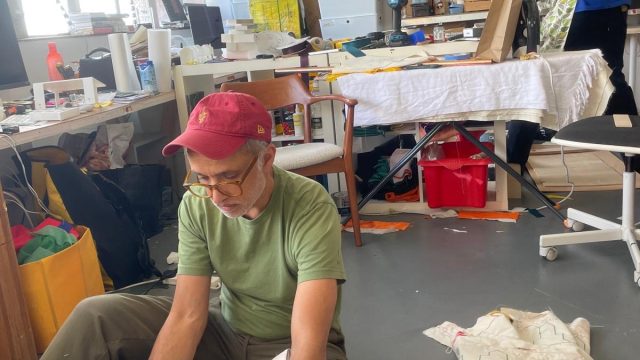
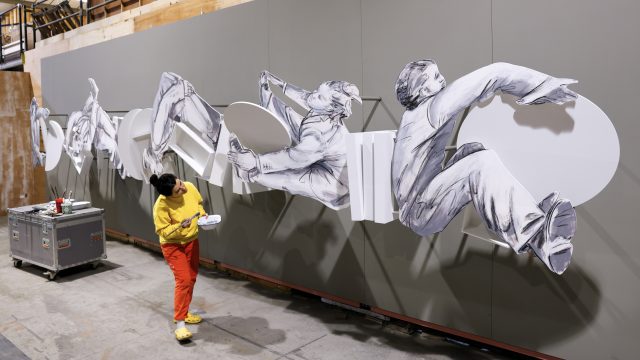
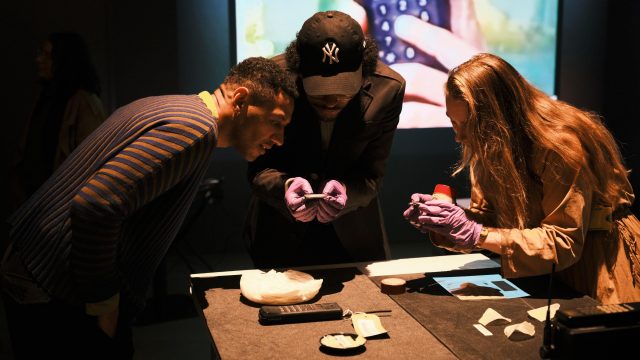
In July, V&A East celebrated its collaborations with former residents of Robin Hood Gardens and young East Londoners who helped shape the narrative of the façade of Robin Hood Gardens that now sits at V&A East Storehouse.
Focus On: Robin Hood Gardens was a day of spoken word performances, workshops, film screenings, and community meals co-curated with young East Londoners involved in the Robin Hood young people’s programme. Their films, poems, publications and objects cushion the façade with intimate reflections on home and critically examine what it means for a museum to acquire social housing today.
The event closed with a panel discussion alongside former residents, housing activists and curators. The panel was attended by Sister Christine Frost (MBE) (Director, South Poplar Limehouse Action for Secure Housing), Asma Begum (former residents and director, Active Wellbeing and Arts), Nabil Al-Kinani (built-environment specialist and writer), Nate Agbetu (facilitator of V&A East Robin Hood Young People’s Programme), Afia Yeboah (Senior Producer, V&A East) and Ben Selig (Assistant Curator, V&A East).
Here are 5 key moments from the discussion:
‘I’ve lived in Poplar long enough to have seen Canary Wharf completely disappear from ship masks to towers.’ – Sister Christine Frost

Sister Christine: ‘I look at Canary Wharf now… It’s a city within a city, and I bet that people are lonelier down there than we are on Wilcrooks estate. When I go home, there’s probably two or three rice meals waiting for me. We all look out for each other. We still have community, and community we need you.’
Sister Christine recalls a story of a community elder revisiting the Docklands area: “Where’s it gone? It’s gone,” he says after seeing an unfamiliar place – once his neighbourhood, now Canary Wharf – an area packed with skyscrapers. The London Docklands Development Corporation helped establish London Docklands as an Enterprise Zone in 1982, attracting large commercial developers free of nominal tax restrictions and responsibilities to local communities. Canary Wharf was built in 1988.
Sister Christine: ‘The stories from the older people are so, so important. I’ve lived in Poplar long enough to have seen Canary Wharf completely disappear from ship masks to towers.’
Asma: ‘Robin Hood Gardens was in the limelight, but what happened to the residents of Macrow Walk and Anderson House? They were in the same area. They were part of the same regeneration… But no one talks about them. We all lived together, we were part of the same community, but they aren’t important anymore. So, it tells us that only the building was important, not the community, not people’s lives.’
‘I didn’t want to leave the area. The community I’ve been leading for so long, they’ve started relying on me.’ – AsmaBegum

Despite enduring a 17-year regeneration process from 2007 to 2024 that worsened living conditions, Asma persevered. Initiating community walks and leading local housing action groups, Asma’s commitment became integral social infrastructure for community wellbeing and ensuring local voices were listened to.
Asma: ‘Everyone was surprised, saying ‘how come you’re not bidding [for alternative accommodation outside of Robin Hood Gardens]?’. I didn’t want to leave the area. The community I’ve been leading for so long, they’ve started relying on me. Every morning, whenever I’d start organising anything, these women, these families, they come out to participate… People with anxiety, depression, and all the other difficulties they were going through, they came out, they felt happy.’
‘There’s a power imbalance between the tenant and land ownership. The most powerful people in Britain are the landowners’ – Nabil Al-Kinani
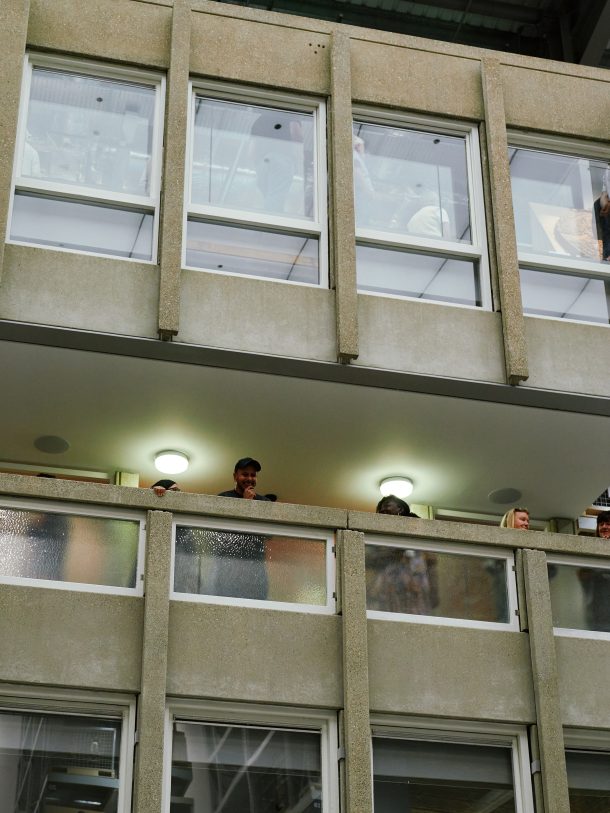
Robin Hood Gardens faced ‘managed decline’, a process by which governments and local authorities intentionally divest from the maintenance of social housing, forcing residents out as living conditions worsen.
Asma: ‘Eventually, we were convinced that regeneration was good for us because we needed new homes. The situation was getting really bad, the leaks, the flooding… these sorts of situations had become really bad. Eventually we went ahead and had to select the Housing Association who would rebuild’
In 2008, former resident Darren Paulling conducted a survey in which 130 out of 140 Robin Hood Gardens households favoured renovation, contradicting Tower Hamlet’s 2007 poll (which polled under 40% of households and excluded renovation as an option) used to justify the estate’s demolition.
Nabil: ‘We call it ‘false choice urbanism’. You are told you have two options: you must vote for regeneration… or you continue to live in squalor. The reality is, as someone who’s on the inside, I know that’s not true, and the argument for retrofitting and adaptive reuse of buildings far out ways any argument to demolish any building, especially today, when we’re also talking about climate change. The way Britain treats land ownership, there’s a power imbalance between the tenant and the land ownership. The most powerful people in Britain are the landowners.’
‘Everything happens because of the story being told.’ – Nabil Al-Kinani

Lawless). (RIGHT) Sam El-Bahja reads from her anthology ‘Naked Pen’ (Image credit: Alexis Lawless)
Nabil: ‘There is a continuous dehumanisation of the places we come from. Everything happens because of the story being told. As far as I’m concerned, our stories, as people from social housing estates around the UK, are always being told on behalf of us. By reporters, by politicians’
The term ‘sink estates’, coined by former Labour Prime Minister Tony Blair, brands social housing estates as unsalvageable – clearing the path for regeneration and gentrification.
In a 2016 article about estate regeneration, then Prime Minister David Cameron described ‘sink estates’ as ‘concrete slabs dropped from on high, brutal high-rise towers and dark alleyways that are a gift to criminal and drug dealers … decades of neglect have led to gangs, ghettos and anti-social behaviour.’
Nabil: ‘The etymology of the word ‘regeneration’ is ‘Genesis’ – to bring life into something. To regenerate is to breathe life back into something, assuming it’s dead. As far as I’m concerned, the ends have never been a place of death.’
Asma: ‘Sink estate, if you let it run down, it will run down. Unfortunately, we were part of it, we were let to run down. But as a community, we need to stand strong, and we need to speak up… Community is so important, and listening to everybody is so important. And storytelling – definitely.’
Nabil: ‘What I would like is for the young people to continue to tell their stories without their hands being held by institutions like the V&A. We don’t need our homes to be at a point of crisis to justify our stories being told. So, what I would like is for young people to flood the literature with your stories, flood the music world with your songs, flood the movie industry with your films. And you must establish the truth.’
‘How does what you make with people, as opposed to for them, become the centre of how museums function in the future?’ – Nate Agbetu

Nate Agbetu: ‘Institutions like this, despite their imperial and dark histories, are places where we can create time capsules to remember who we are as people and what that means.’
‘With moments like this where we end up disenfranchised by bigger systems that end up leaving us very traumatised with our experiences of our homes, that’s why it’s so important we think “What do museums do and what is their role in the future? What is that social practice?” And that’s why working with young people is so important to bring that intergenerational approach.
‘So, when we’re thinking about what institutions are in the future, the role should be to convene, to bring people together, to make sure that there isn’t another moment like this where people are disenfranchised when taken from their homes. And to do that with joy, and with a way to express ourselves.’
Further reading

Community initiatives and events
Active Wellbeing & Arts community walking group
SPLASH (South Poplar Limehouse Action for Secure Housing) community
Queens Market (see short film ‘Friends of the Queen’ directed by Khadija Alban)
Past the Concrete: Do Ho Suh (offsite V&A East event on 25th September at Tate Modern)
Reading materials
Robin Hood: The Arts of Occupation (V&A East young producers’ publication. View at V&A East Storehouse library now. Online access available soon)
Privatise the Mandem by Nabil Al-Kinani
Brutalism as Found: Housing, Form and Crisis at Robin Hood Gardens by Nicholas Thoburn