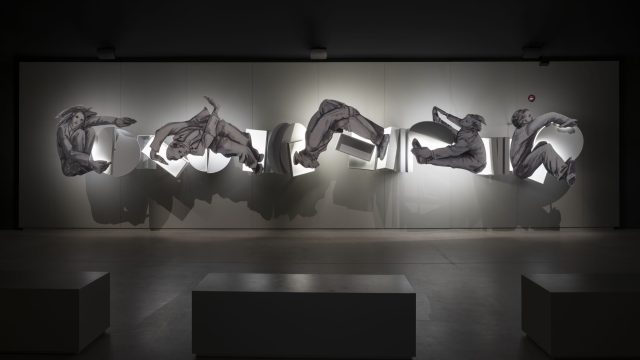
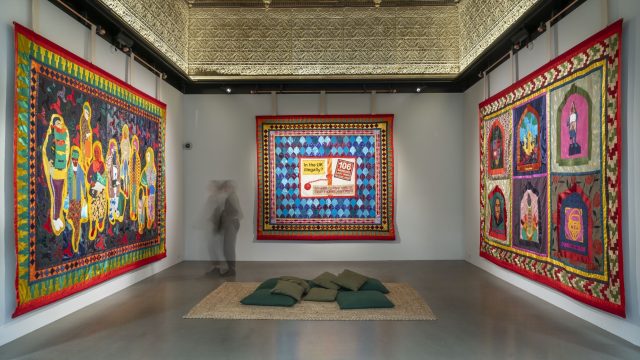
Mac Collins is a visual artist who creates allegorical objects, sculptures and installations using materials including wood, welded steel, cast aluminium and glass. Grounded in a deep understanding of materials and craftsmanship, his practice explores wider questions of identity, memory and cultural inheritance.
Mac’s relationship with V&A East Storehouse began through Hospital Rooms, an arts and mental health charity that improves mental health environments through creative programmes. During this earlier visit, participants selected and reimagined objects from the V&A collection that held particular meaning for them.
For Look What I Found, our series inviting artists to spend time researching the Storehouse collection ahead of a public show and tell, Mac returned to investigate objects that sparked new ideas, connected with personal memories or offered unexpected points of departure for his practice. He brought together masks, furniture, ceramics and sculptural objects from across the collection.

Studying the mask
During his residency, Mac developed a particular interest in masks. This began with L’Homme (1938), a carved wooden head by Jamaican-born British sculptor Ronald Moody. Masks fascinated him because they raise wider questions about anonymity, identity and authenticity within the social structures we inhabit. Across different cultural contexts, they can disguise or transform the wearer, used variously to entertain, frighten, confuse, protect or deceive.

As an artist whose own work has often moved towards abstraction, Mac was struck by the masks’ bilateral symmetry, intricate construction and figurative qualities. He examined how their makers had conveyed likeness, character and emotion while producing functional objects intended to be worn. He described this research as a possible entry point into making more figurative work.
He was equally drawn to the backs of the masks: surfaces that were not originally intended to be seen. Studying their internal contours, supports and points of contact with the face offered him another way of understanding how the objects were made and used.

Myth, fantasy and imagined forms
Mac’s interest in masks as elements of costume, play and ritual led him towards wider ideas of fantasy and mythology. Among the objects he selected was a jade vessel in the form of a mythical hybrid from China (1542&A-1882). He was fascinated by the way an imagined creature had been given a physical form.

Exploring the collection also reminded Mac of looking through his grandmother’s attic. One object, CIRC.12-1925, recalled a horse-shaped ornament she had owned. Her object was a modern, inexpensive reproduction, while the related objects at Storehouse date from the Han dynasty (206 BCE–220 CE).
The encounter revealed how similar forms can travel across centuries and cultures, appearing in both museum collections and everyday domestic spaces. It also demonstrated how personal memory can offer an immediate route into objects with much more distant histories.
Looking closely at furniture
Mac originally trained as a furniture maker, so several pieces of furniture at Storehouse captured his attention. One was an ebony cabinet made in Ceylon, now Sri Lanka (IS.18-1986). He was struck by its extensive use of ebony and the detailed carving across its surfaces, which demonstrate the skill and precision of its makers.


He was equally taken with a mahogany table made by James Lamb in Manchester in 1887 (W.9-1986). Its six flaring legs gave it an unusual, almost otherworldly appearance, which Mac described as “alien”. For him, the number of legs was not only visually distinctive but technically significant. Producing a table with multiple legs demands considerable precision, as each leg must sit evenly and provide stability, particularly on an uneven floor. Just as he had examined the unseen interiors of the masks, Mac looked closely at the backs and undersides of the furniture. These less visible areas revealed how each structure was supported, balanced and assembled.
Old objects, contemporary forms
Mac was also drawn to the experience of encountering objects made thousands of years ago and recognising in them forms, colours and construction methods that still feel current. A red earthenware object (C.261-1909) caught his eye for its combination of red and black; the black in particular echoed a colour that recurs throughout his own work, including in the ebony surfaces of the cabinet he had studied earlier.

An ancient vase from Cyprus, dating to around 1800 BCE (209-1901), also caught his attention. Despite its age, Mac found its carefully balanced and sophisticated form remarkably contemporary.
These encounters reinforced for him that historical objects do not necessarily feel remote. Their materials, proportions and methods of construction can continue to resonate with makers today, offering both practical knowledge and creative possibilities.
Through Look What I Found, Mac approached V&A East Storehouse as a space for close observation and unexpected connection. Moving between masks, mythical creatures, furniture and ceramics, he traced relationships between craftsmanship and imagination, museum objects and personal memory, and ancient forms and contemporary practice.